
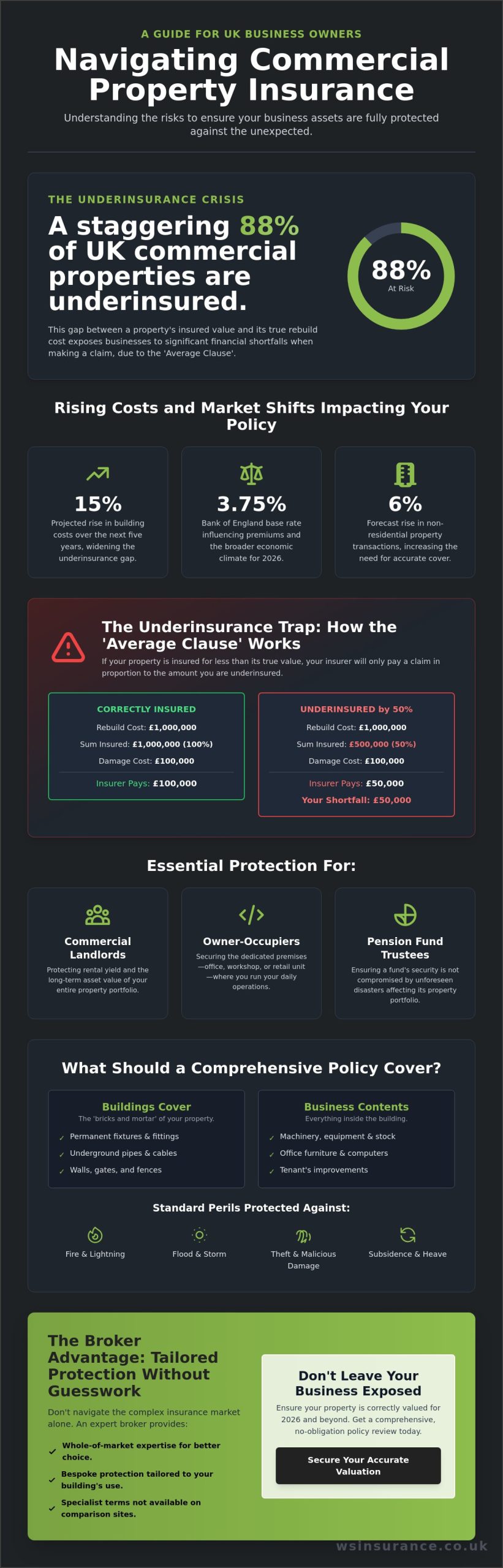
Did you know that a staggering 88% of UK commercial properties were found to be underinsured for building cover in 2025? It’s a sobering reality for business owners who assume their protection is sufficient, only to face the “average clause” during a claim. You probably feel that your current commercial property insurance is a safe bet; however, the gap between market value and actual rebuild costs is widening as construction material prices continue to climb. With building costs projected to rise by 15% over the next five years, the risk of a claim being only partially paid is higher than ever.
We’ll help you remove the anxiety from this process by providing expert insights on coverage and valuations without the guesswork. This guide explains how to secure a policy that genuinely fits your specific building use, ensuring total peace of mind that every claim will be paid in full. You’ll discover how to manage your 2026 premiums effectively, taking into account the 3.75% Bank of England base rate and shifting climate risks whilst ensuring your valuation remains accurate for the year ahead.
Key Takeaways
- Understand how to tailor your commercial property insurance to suit your specific building use, ensuring a genuine fit for both freeholders and leaseholders.
- Learn to distinguish between Buildings Cover and Business Contents protection to ensure your core peril protection is comprehensive and honest.
- Master the mechanics of the ‘Average Clause’ to safeguard your claims and ensure your property is valued with precision for the 2026 market.
- Discover how proactive risk management and enhanced physical security can lower your premiums by demonstrating property resilience to underwriters.
- Access the broker advantage through whole-of-market expertise, securing bespoke protection and specialist terms not found on standard comparison sites.
What is Commercial Property Insurance and Why is it Essential?
At its core, commercial property insurance acts as a bespoke safety net, protecting the physical assets that underpin your business operations. Unlike standard home cover, these policies are tailored to the unique risks of commercial environments, from high-footfall retail units to heavy-duty industrial warehouses. To understand the foundations, one might ask, What is property insurance? It is essentially a contract providing financial reimbursement to the owner or renter of a structure and its contents in the event of damage or theft. We focus on ensuring this protection genuinely fits your building’s specific use, removing the anxiety of one-size-fits-all products.
For UK property owners, this protection is vital. Whether you’re a freeholder holding the title or a leaseholder responsible for repairs, the financial impact of a fire or flood can be catastrophic. In 2025, the average commercial property claim exceeded £30,000 per incident. Without a robust policy, these costs fall directly on your balance sheet, potentially halting your business continuity at a time when non-residential property transactions are forecast to rise by 6% in 2026. We act as a steady hand, helping you satisfy mortgage lenders who require proof of cover to secure their investment.
Who Needs This Coverage?
Identifying who requires protection is the first step in removing the guesswork from your insurance journey. Typically, our clients fall into three categories:
- Commercial landlords: Those protecting their rental yield and the long-term asset value of their portfolio.
- Owner-occupiers: Business owners who run their daily operations from a dedicated premises, such as an office or workshop.
- Pension fund trustees: Professionals managing commercial portfolios who must ensure the fund’s security isn’t compromised by unforeseen disasters.
Is it a Legal Requirement?
Whilst commercial property insurance isn’t mandated by law like motor insurance, it’s almost always a contractual necessity. If you have a commercial mortgage, your lender will insist on comprehensive protection to secure their interest. Similarly, most lease agreements in the UK mandate that the building is insured to its full reinstatement value. Under 2026 regulations, your ‘Duty of Disclosure’ is more critical than ever. You must provide an honest, accurate representation of your property’s condition and use. We help you manage this responsibility, ensuring your policy remains valid and your peace of mind is protected at every step.
What Does a Comprehensive Policy Cover?
A robust commercial property insurance policy is more than just a list of “what ifs”; it’s a strategic shield designed to keep your business operational. Understanding the nuances of a comprehensive policy cover ensures you aren’t left with financial gaps after a major incident. We differentiate between two primary structures: “Defined Perils,” which covers only specific events like fire or lightning, and “All Risks,” which provides much broader protection by covering any damage unless it’s explicitly excluded. Most modern UK businesses prefer the “All Risks” approach to remove the anxiety of unforeseen accidents.
We take time to clarify the distinction between Buildings Cover and Business Contents protection. Buildings cover looks after the “bricks and mortar,” including permanent fixtures, fittings, and even underground pipes. Business contents protection focuses on everything inside, such as machinery, stock, and office furniture. For property owners, including Public Liability is also essential. It protects you if a third party, such as a tenant or a delivery driver, suffers an injury on your premises. We can help you review your existing policy to identify if these core elements are properly aligned with your current building use.
Standard Perils and Protections
Flood and storm damage are no longer rare events in the UK. With property insurance claims expected to reach a record £6.1 billion in 2025, ensuring your policy addresses the 2026 climate reality is vital. Theft and malicious damage cover is equally critical, protecting both your building’s exterior and any internal assets from criminal behaviour. We also prioritise structural integrity through subsidence and heave protection. These issues are often slow-moving but can result in massive repair costs that commercial property insurance is designed to absorb.
Crucial Policy Extensions
The best protection goes beyond the physical structure. We often recommend Loss of Rent cover, which protects your income stream whilst a building is uninhabitable following a claim. This is a lifeline for landlords who still have mortgage obligations to meet. Other high-frequency claim areas include glass and external signage, which are frequently damaged but often overlooked in basic policies. Finally, Property Owners Liability acts as a vital defence against legal claims, providing peace of mind that your assets are shielded from the costs of litigation and compensation awards.
Avoiding the Underinsurance Trap: Accuracy in Valuation
Underinsurance remains the most significant threat to UK businesses during the claims process. In 2025, data revealed that 88% of surveyed commercial properties were underinsured for building cover. When your commercial property insurance sum insured is too low, insurers apply the “Average Clause” to reduce your payout proportionally. This means that if you are underinsured by 25%, the insurer will only pay 75% of any claim, regardless of whether it is a partial or total loss. We work to remove this anxiety by ensuring your valuations are precise from the outset.
Consider a practical example of the Average Clause in action. If your building costs £1,000,000 to rebuild but you have only insured it for £800,000, you are 20% underinsured. If a storm causes £50,000 worth of damage, the insurer will only pay out £40,000. You are left to find the remaining £10,000 yourself. To avoid this, we recommend a professional Rebuild Cost Assessment (RCA) at least every three years. With construction material prices rising by 2% in January 2026 alone, relying on old figures is a high-risk strategy that could lead to a significant financial shortfall. Before approaching insurers, reviewing our building insurance quote checklist can help you gather the precise data needed to secure an accurate valuation.
Market Value vs. Rebuild Cost
One of the most common points of confusion in commercial property insurance is the difference between market value and rebuild cost. What you could sell your building for on the open market is irrelevant to your policy. Market value is influenced by location, land value, and local demand; insurance is only concerned with the cost of cleared site reconstruction. Your rebuild figure must include the total expense of materials, labour, and professional fees for architects and surveyors. Citing the Association of British Insurers guide on this topic can help you understand the foundational requirements for an accurate valuation.
The Role of Index-Linking
Most modern policies include index-linking, which automatically adjusts your sums insured to keep pace with inflation. Whilst this is a helpful safety net, it isn’t a substitute for a professional valuation. Index-linking often uses general construction indices that may not reflect the specific costs associated with specialist or listed buildings. If your building undergoes significant alterations or if you install new fixed machinery, you must update your broker immediately. We take the time to understand these changes, ensuring your protection remains genuine and your peace of mind is never compromised by an outdated figure.
How to Organise Your Risk Management to Lower Premiums
Lowering your commercial property insurance premiums isn’t just about shopping around; it’s about proving to underwriters that you’re a lower risk than your competitors. Insurers are currently facing record payouts, with UK property claims expected to hit £6.1 billion in 2025. Consequently, they’re increasingly rewarding proactive property owners who can demonstrate robust risk management. We help you move beyond the generic advice found on comparison sites by identifying the specific actions that move the needle on your premium.
One of the most effective ways to reduce costs is through documented maintenance. Escape of water remains a high-frequency peril in the UK. By keeping a clear log of roof inspections, gutter clearing, and pipe maintenance, you provide evidence of a well-managed asset. This documentation gives underwriters the confidence to offer more favourable terms, as they can see you’re actively preventing the most common causes of damage. It’s a simple way to remove the guesswork from your next renewal.
Physical Security and Fire Prevention
Physical security measures directly impact the ‘theft’ portion of your premium. Implementing high-quality locks, intruder alarms, and CCTV systems creates a layer of protection that insurers value. However, fire prevention is equally critical. Regular electrical testing, such as an Electrical Installation Condition Report (EICR), is now a standard requirement for many policies. We also see growing interest in smart sensors that detect leaks or temperature changes before they become catastrophic. These proactive steps don’t just lower your costs; they ensure your business stays operational and resilient.
Portfolio Management and Deductibles
For those with multiple assets, consolidating properties into a single commercial portfolio often unlocks bulk discounts. This approach allows us to negotiate as a single entity, providing more leverage with specialist underwriters who don’t always appear on direct search engines. You should also consider the trade-off between your premium and your voluntary excess. If your business is well-established with a healthy cash reserve, opting for a higher excess can significantly lower your annual costs. We’ll help you analyse your claims history to determine if this is a sensible strategy for your specific situation. If you’re ready to see how better risk management can impact your bottom line, speak to our expert brokers today for a tailored review.
The Broker Advantage: Tailored Protection Without the Guesswork
Selecting commercial property insurance shouldn’t feel like a gamble against a faceless algorithm. Whilst some online platforms promise a quote in under seven minutes, these automated systems often lack the nuance required for complex UK property risks. We position WS Insurance Brokers as your expert guide, acting as a steady hand in a fragmented market. Our whole-of-market status means we aren’t restricted to a handful of providers; instead, we access a vast network of specialist underwriters that simply don’t appear on standard comparison sites. This breadth of access ensures we find a policy that genuinely fits your business goals and removes the anxiety of being underinsured.
We believe that a policy is only as good as the support behind it when things go wrong. Our dedicated claims support acts as your personal advocate during a loss, managing the communication with insurers and loss adjusters so you can focus on your operations. This level of care is why we’ve maintained a reputation for calm reliability over our 25 years of broking expertise. We take the time to understand the intricacies of your building use, and you benefit from protection that is both honest and precise. It is a consultative partnership where our labour directly results in your ease.
Why Independence Matters
Our independence is a badge of honour that directly benefits our clients. We work for you, not the insurance company, which allows us to negotiate terms based on a genuine understanding of your specific risks. This often includes access to exclusive ‘Broker-Only’ schemes. These arrangements provide enhanced coverage and specialist wordings at no extra cost compared to direct options. By leveraging our whole-of-market reach for your commercial property insurance, we can often secure more favourable terms and lower premiums than an individual business owner could find alone.
Securing Your Quote for 2026
As we navigate the specific market conditions of 2026, preparing for your consultation is the best way to ensure a smooth process. You should have your most recent Rebuild Cost Assessment (RCA) ready, alongside the documented maintenance history and security upgrades we discussed in previous sections. Transparency is vital during the application; being honest about your building use and any past claims ensures your protection remains valid. We remove the anxiety from this process by handling the technical details on your behalf. To ensure you arrive fully prepared, our essential building insurance quote checklist for 2026 outlines every piece of information you’ll need to gather before your consultation.
Speak to a WS Insurance Brokers specialist today for a tailored commercial property review to ensure your assets are protected with the precision they deserve.
Secure Your Assets with Tailored Protection for 2026
Protecting your investment in the current economic climate requires a shift from reactive to proactive risk management. We’ve explored how professional valuations and robust security measures act as a shield against the “average clause” and rising premium costs. By moving beyond the generic coverage found on comparison sites, you can secure commercial property insurance that accounts for your specific building use and long-term business goals. This precision ensures that if the worst happens, your financial recovery is swift and certain.
As an FCA Authorised and Regulated broker with over 25 years of broking expertise, we provide the steady hand you need to navigate a fragmented market. We leverage our whole-of-market access to secure competitive rates and specialist terms without the guesswork. Our independence means we work for you, not the insurers, providing honest advice at every step of your journey. Get a bespoke commercial property insurance quote from our independent experts at WS Insurance Brokers and enjoy the confidence that comes with genuine, tailored protection. We look forward to securing your future together.
Frequently Asked Questions
What is the ‘Average Clause’ in commercial property insurance?
The ‘Average Clause’ is a condition that reduces your claim payout if the sum insured is less than the actual rebuild cost at the time of a loss. For example, if you’re 25% underinsured, the insurer will only pay 75% of any claim, even for minor damage. This clause is the primary reason why precise valuations are essential for commercial property insurance. We help you avoid this penalty by ensuring your sums insured reflect the 2026 construction market.
Does commercial property insurance cover my tenants’ belongings?
No, your policy does not cover your tenants’ stock, equipment, or personal belongings. A landlord’s policy protects the bricks, mortar, and permanent fixtures of the building itself. You should ensure your lease agreement explicitly requires tenants to maintain their own contents and liability protection. This clarity removes any ambiguity during a claim and protects your professional relationship with your occupants.
Is business interruption insurance included in my property policy?
Business interruption is typically an optional extension rather than an automatic inclusion in a standard property policy. It provides vital protection by covering lost rental income or ongoing overheads whilst your building is being repaired following a fire or flood. Given that UK property insurance claims reached record levels in 2025, adding this extension is a sensible way to ensure your cash flow remains stable during a major recovery period.
How often should I have my commercial property surveyed for insurance purposes?
We recommend a professional Rebuild Cost Assessment (RCA) every three years to maintain accuracy. With building costs projected to increase by 15% over the next five years, annual index-linking might not be enough for complex structures. Regular surveys are the most honest way to ensure your protection keeps pace with inflation and changing UK construction regulations, providing peace of mind at every step.
Can I get insurance for a commercial building that is currently unoccupied?
You can certainly insure an empty building, but you’ll need a specialist unoccupied buildings insurance policy. Standard commercial property insurance usually limits cover once a building has been vacant for more than 30 consecutive days. These specialist policies account for the increased risks of burst pipes or vandalism, providing tailored protection whilst you seek new tenants or await planning permission for a change of use.
What happens to my insurance if I change the use of my building?
Changing your building’s use significantly alters your risk profile and you must disclose it to your broker immediately. Moving from an office to a retail unit increases footfall and changes the liability risks associated with the premises. Failure to notify us of such changes could invalidate your policy, leaving you without protection in the event of a claim. We’ll help you update your cover to ensure it genuinely fits the new use.
Does the policy cover damage caused by a tenant?
Standard policies usually cover accidental damage, but malicious damage by a tenant often requires a specific policy extension. It’s a common area of confusion that we help clear up during your initial consultation. We’ll check your policy wording to ensure you have the right level of protection against tenant behaviour, removing the guesswork from your landlord responsibilities and protecting your long-term investment.
Are listed buildings more expensive to insure in the UK?
Listed buildings are generally more expensive to protect because the cost of repair is significantly higher than modern structures. Historic England requirements often mandate the use of traditional materials and specialist craftsmen, which inflates the rebuild value. We use our whole-of-market access to find underwriters who specialise in heritage assets, ensuring you get bespoke protection that respects the building’s status without unnecessary costs.