
The same accident can raise questions about both a property’s condition and the activities taking place there. That’s why property owners liability vs public liability isn’t always a straightforward choice between two similar-sounding policies. The source of the risk and the wording of each policy can both affect how a claim is considered.
If you own or manage premises, or run a business that welcomes customers, contractors or visitors, it’s understandable to wonder whether one policy is enough. The distinction matters, but the covers may overlap in some situations. A policy name alone won’t tell you exactly what’s protected.
This guide explains the main difference between property owners’ liability and public liability, using practical examples of property-related and business activity risks. It also highlights what to review in policy limits, exclusions and wording, and why describing your circumstances clearly when arranging insurance matters. WS Insurance Brokers is an independent UK intermediary with more than 15 years’ combined insurance experience. It provides personal advice and clear explanations to help you understand the differences. WS Insurance Brokers is authorised and regulated by the Financial Conduct Authority.
Key Takeaways
- Property owners liability vs public liability comes down to whether a potential claim relates to owning or managing premises, business activity, or both.
- Use the comparison and scenario tables to identify where property and operational exposures could overlap.
- Map who uses your premises, including visitors, tenants and contractors, alongside the activities your business carries out.
- Review policy wording, limits and exclusions carefully. Similar policy names don’t guarantee identical protection.
- Personal advice can help you understand how the covers relate to your circumstances and what to consider when arranging protection.
Property owners’ liability vs public liability: why the distinction matters
Similar policy names don’t automatically mean identical cover, so don’t assume one liability policy will address every type of third-party claim. When comparing property owners liability vs public liability, start by asking what may have caused the injury or damage: a feature or condition of the premises, or an activity carried out by a business. This helps focus your review, but it doesn’t determine how a claim will be handled.
Both types of cover relate to potential liability to third parties, but the circumstances behind a claim may differ. The precise scope depends on the policy wording, including its definitions, limits, conditions and exclusions. A policy title is a guide, not a substitute for checking what the cover says.
What does property owners’ liability relate to?
Property owners’ liability is cover to consider for third-party claims connected with owning or managing a property. The circumstances may involve the premises, its maintenance or how it is managed. For instance, a visitor might be injured after using a loose handrail, or falling roof material might damage someone’s belongings. These are illustrative situations, not automatic examples of insured claims. The policy terms and circumstances would matter.
What does public liability relate to?
Public liability is cover to consider for potential third-party claims connected with business activities and interactions with members of the public. For example, a visitor could be injured while attending an event, receiving a service or moving through a work area during business operations. The key question is whether the alleged cause relates to the activity, rather than simply to the fact that the incident happened on a property.
For a foundational overview of the subject, see Public Liability Explained. In practice, insurance protection depends on the specific contract, not a general description of public liability.
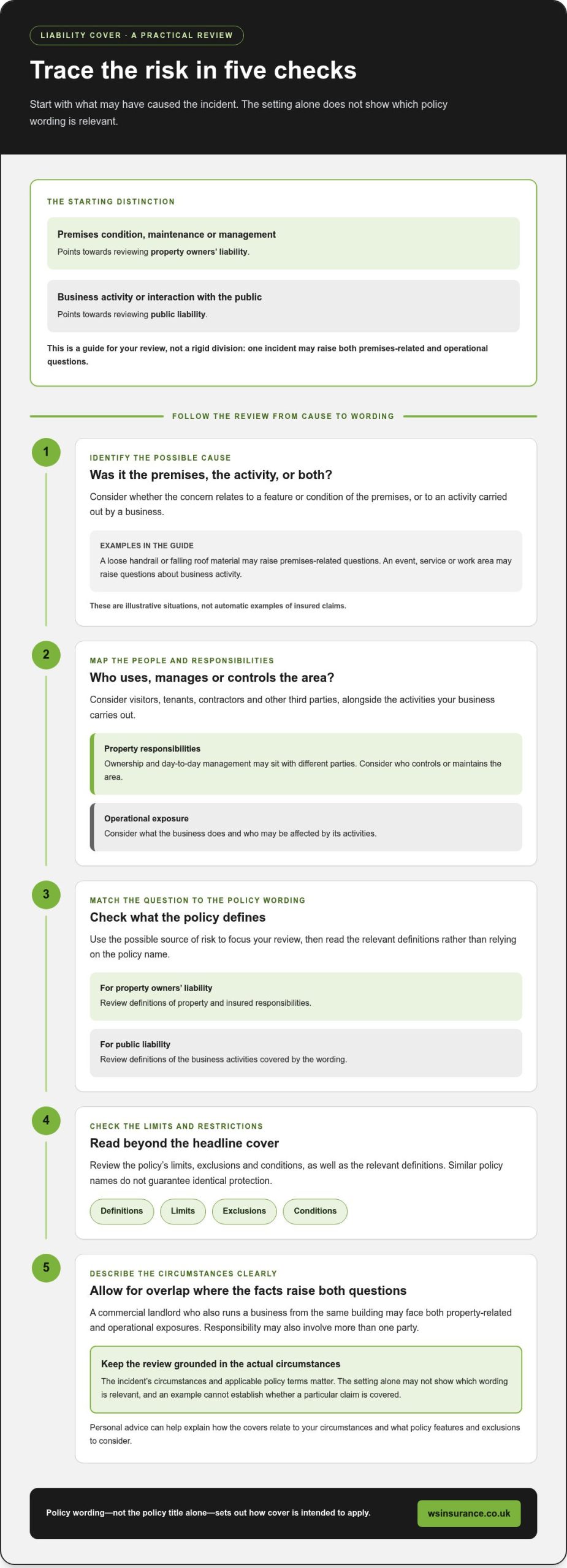
The source of the risk helps you decide which liability cover to review: premises ownership or management points towards property owners’ liability, while business operations point towards public liability. This is a starting point, not a rigid division. A commercial landlord who runs a business from the same building may face both property-related and operational exposures. A claim could also involve more than one contributing factor, so the setting alone may not show which policy wording is relevant.
Read the definitions of insured activities and property, alongside exclusions and limits, to understand how the policy is intended to apply. Consider what the policyholder owns or manages, what the business does, and who may be affected. WS Insurance Brokers provides personal advice based on clients’ circumstances, with clear information about policy features and exclusions. WS Insurance Brokers is authorised and regulated by the Financial Conduct Authority.
How property owners’ liability and public liability differ in practice
To compare property owners liability vs public liability, look beyond where the incident happened and identify what may have led to it. Was the concern the condition, maintenance or management of the premises, or did it arise from a business service, event or other activity? This distinction helps organise your policy review, but it won’t divide every claim neatly into one category.
| Point to compare | Property owners’ liability | Public liability |
|---|---|---|
| Risk source | Ownership, maintenance or management of premises | Business activities or interactions with the public |
| Relevant setting | Property an owner or manager is responsible for | Places and situations where business operations take place |
| Potential claimant | A visitor, tenant, contractor or other third party | A customer, visitor or other member of the public |
| Wording to review | Definitions of property, insured responsibilities, exclusions and limits | Definitions of business activities, exclusions and limits |
Use the table to guide your questions, not to decide whether a claim is covered. Responsibility may be disputed or involve more than one party, such as a property owner, occupier, managing agent or business operator. One event can raise both premises-related and operational questions. An illustrative scenario can help you identify what to examine, but it can’t establish whether a particular claim is covered. The incident’s circumstances and the applicable policy terms matter.
Which policy should I review for a property-related incident?
Start by considering whether the alleged cause relates to the property’s condition, maintenance or management. If someone is injured because a step is damaged, for example, the circumstances may raise a premises-related liability question. Review the policy’s insured activities and definitions, then check relevant exclusions and limits. Also consider who controls or maintains the area, as responsibility may not rest with the owner alone.
When could a business activity also create a liability exposure?
A business can create risks through what it does, not just through the physical state of its building. A defect in a doorway is different from an incident arising during a service, organised event or routine work activity, even if both happen on the same premises. For purpose-built venues such as Glasshouse Downtown, operational safety during functions must be considered alongside the physical upkeep of the premises. Note what activity was taking place, who was involved and how the incident occurred, then compare those details with the policy wording.
Where ownership and business operations sit together, review both sets of exposures rather than assuming one policy automatically deals with everything. WS Insurance Brokers arranges Commercial Property Insurance and Public Liability Insurance, and can help distinguish property-related risks from wider business activities. As an independent broker, it provides personal advice and clear information about relevant features and exclusions, with access to leading and specialist insurers. For a clearer view of how the policies may fit your situation, speak with WS Insurance Brokers. WS Insurance Brokers is authorised and regulated by the Financial Conduct Authority.
Real-world scenarios: when the two liability covers may overlap
Some incidents don’t fit neatly into a single category. A property owner might also operate a business from the premises, employ staff or organise activities for visitors. In that situation, trace the events carefully: what happened, what may have contributed, and which parties had a role in the property or activity. These examples highlight questions to consider, not conclusions about fault or insurance cover.
| Illustrative event | Possible risk source | Policy wording to examine |
|---|---|---|
| A visitor trips on a damaged step | Condition or maintenance of premises | Property owners’ liability definitions, insured responsibilities, exclusions and limits |
| A customer is injured during a service | Business activity, with the premises possibly also relevant | Public liability wording, including insured activities and exclusions |
| A visitor is injured during an event in a managed building | Event operations and the condition or management of the venue | Relevant activity and property definitions, exclusions and limits in both policies |
Location alone does not determine which policy applies. The circumstances and the wording both matter. An incident at a business premises may involve a feature of the building, the way an activity was organised, or a combination of factors. The property owner, occupier, business operator or another party may also have a role. Identifying these connections helps you review the relevant policy terms without assuming that either cover must respond.
A visitor is injured by a building defect
Imagine a visitor trips on a damaged step at a property managed by its owner. The condition of the step and who was responsible for maintaining it may make the property connection relevant. That doesn’t establish who was at fault or whether a policy covers the event. Maintenance records, reports about the defect and the applicable policy wording may help clarify the circumstances being reviewed.
A visitor is injured during business activity
Now consider a customer injured while taking part in a service or activity at a business premises. The incident may relate to how the activity was carried out, but the state or management of the surrounding premises could also be relevant. A business that owns its building may therefore need to consider both operational and property-related exposures, rather than treating them as mutually exclusive.
For either scenario, record the sequence of events and distinguish what is known from what is still being established. Then review the insured activities, property definitions, exclusions and limits in the relevant policy documents. The property owners liability vs public liability distinction can help organise that review, but only the specific circumstances and policy terms can indicate how cover may apply. WS Insurance Brokers provides personal advice based on clients’ circumstances and clear explanations of policy features and exclusions. WS Insurance Brokers is authorised and regulated by the Financial Conduct Authority.
How to assess the liability cover your property or business needs
A clear review starts with the full picture, not just the name of a policy. List what you own or manage, how each site is used and what business activities take place there. This gives you a practical basis for considering property-related and operational exposures, including situations where the two may overlap.
- Set out your role. For each property, record whether you own, occupy, let or manage it. Note where responsibilities are shared with a tenant, managing agent or another party.
- List the activities. Describe the business operations carried out at each site, such as services provided, events held or customer visits. Include activities that happen away from the premises if they form part of your business operations.
- Map the people and places. Identify areas used by visitors, tenants, contractors, staff and members of the public. Consider how people enter, move through and use each part of the premises.
- Separate possible risk sources. Flag hazards linked to the condition, maintenance or management of the property, then note risks arising from business operations. Mark any event that could involve both, rather than forcing it into one category.
- Compare your policies with the picture. Review the relevant definitions, insured activities, exclusions, limits and conditions against the circumstances you have recorded. Avoid assuming that policies from different insurers use identical wording.
Map the property and the activities taking place there
Make the review specific to each site. A commercial property may be occupied by your own business, let to tenants, or used by visitors and contractors for different reasons. Note who controls access and maintenance, as well as what activities happen in shared spaces. Separating premises-condition risks from operational risks can reveal where the two exposures might intersect.
For further context on protecting a commercial building, the commercial property insurance guide explores property protection alongside the liability questions considered here.
Review wording, limits and exclusions before deciding
Check what each policy describes as an insured event, whose actions or interests it addresses, and which business activities or properties it refers to. Read exclusions and conditions alongside the limits, since these terms can affect how the cover applies to your circumstances. The property owners liability vs public liability distinction is a useful starting point, but assess the wording against your actual risks.
If the wording or possible overlap is difficult to interpret, a broker can help relate policy features and exclusions to your property and business circumstances. WS Insurance Brokers offers personal advice and clear explanations, drawing on more than 15 years’ combined insurance experience. Discuss your property and liability cover with WS Insurance Brokers, an independent intermediary authorised and regulated by the Financial Conduct Authority.
Get clear, tailored advice on property owners’ and public liability
Property ownership and business activity can create different, sometimes connected, liability exposures. A broker-led review can help bring those risks into focus before you decide what cover to arrange. WS Insurance Brokers takes time to understand the property you own or manage, how it’s occupied and the activities your business carries out, then provides personal advice based on your circumstances.
This means the discussion can consider more than policy labels. By looking at how the premises are used and where responsibilities sit, a broker can help distinguish property-related exposures from risks arising from operations, and identify where wording may need closer attention.
What a broker-led review can help clarify
A tailored review can help you compare the risks you’ve identified with policy definitions, limits, conditions and exclusions. WS Insurance Brokers is independent and has access to a wide panel of leading and specialist insurers, helping it consider options from across the market. You’ll receive clear information about policy features, exclusions, fees and remuneration, so you can make an informed decision.
For a wider view of commercial protection, the business insurance guide provides broader context alongside your property and liability considerations.
A straightforward next step for property owners
Before a discussion, gather a simple outline of your properties, who occupies or manages them, the activities taking place and any existing cover. This gives the review a practical starting point and helps focus on questions about overlapping exposures, policy wording and how your circumstances are presented.
WS Insurance Brokers can also provide ongoing claims guidance as part of its client support. With more than 15 years’ combined insurance experience, the team offers a point of contact for understanding policy details and considering your protection as your property or business activities change.
WS Insurance Brokers is authorised and regulated by the Financial Conduct Authority. For a clear, considered discussion about your circumstances, Discuss your property and liability insurance needs.
Take the next step towards clearer protection
Your property and business can change over time. A new tenant, a different use for a building or an added service may alter the risks you need to consider, so make reviewing your cover part of keeping those details up to date. If you’re still weighing up property owners liability vs public liability, focus your next discussion on how the premises are used and what activities take place there.
WS Insurance Brokers brings more than 15 years’ combined insurance experience and independent access to a wide panel of leading and specialist insurers. The team can help you consider your circumstances and understand policy features, exclusions and remuneration. WS Insurance Brokers is authorised and regulated by the Financial Conduct Authority.
Discuss your property and liability insurance needs with WS Insurance Brokers and take a considered step towards cover that reflects your situation.
Frequently Asked Questions
Is property owners’ liability insurance a legal requirement?
Property owners’ liability insurance is not generally a legal requirement for every property owner in the UK. However, a mortgage, lease, tenancy agreement or other contract may set out insurance expectations, depending on the arrangement. Treat those separately from the question of prudent risk management: cover that isn’t legally required may still be worth considering for potential third-party claims. Review the relevant agreement and policy terms, and seek appropriate advice about your circumstances—for example, landlords or developers managing international assets often seek guidance from a commercial property lawyer sydney to ensure that contractual liability terms and lease obligations are clearly established.
Can a landlord rely on public liability insurance instead of property owners’ liability?
Not automatically. A landlord’s public liability policy may focus on risks arising from business activities, while property owners’ liability wording may address risks connected with owning or managing premises. For example, the source of a claim could relate to a shared entrance, a repair or a separate service provided at the property. Compare the insured activities and property definitions in the policy documents before deciding whether the cover addresses your circumstances.
Does property owners’ liability cover tenants’ belongings?
Property owners’ liability is not the same as insurance for a tenant’s possessions. A tenant’s furniture or personal items would generally be considered under contents insurance, subject to that policy’s terms. A separate question may arise if a tenant alleges that the owner’s actions caused damage or loss. Responsibility and policy wording would then matter. Check the relevant buildings, contents and liability policies rather than assuming one protects both the owner’s and tenant’s property.
Does property owners’ liability cover contractors working at a property?
Don’t assume it does. If a contractor is injured or their equipment is damaged, the circumstances, each party’s responsibilities and the policies involved may all be relevant. The owner’s potential liability is distinct from insurance arranged by the contractor or another party, and one policy doesn’t automatically replace the other. Before work begins, review the contract, allocation of responsibilities and applicable policy terms so you understand what arrangements relate to the project.
Is property owners’ liability usually included with landlord or buildings insurance?
It may be included in some policies, offered separately in others, or described using different wording. Buildings insurance primarily concerns the building itself, whereas liability cover addresses potential claims by third parties, subject to its terms. Don’t infer that liability protection is included from a policy’s title or from a previous arrangement. Check the current schedule and wording for the specific property, including relevant limits, exclusions and conditions.
Can a business need both property owners’ liability and public liability?
What should I do if someone makes a liability claim against me?
Notify the relevant insurer or broker promptly, following the notification requirements and timeframes in your policy. Keep a clear record of what happened, including dates, correspondence and any documents relating to the incident. Avoid admitting liability or agreeing to a settlement before receiving appropriate guidance. The policy wording sets out the claims process and required steps. A broker can help you understand the instructions and support you as you work through them.