
Did you know that in 2025, the average home insurance claim surged by 15% to £6,000, driven largely by a staggering £1.2 billion in weather-related damages? It’s a sobering figure that highlights why a generic, automated building insurance quote often falls short of providing genuine security. We understand the frustration of staring at figures that don’t seem to account for the rising cost of labour or the specific nuances of your property. You deserve to feel confident that your most significant assets are shielded by more than just a best guess.
This guide provides the clarity you need to master the complexities of property valuation and the latest 2026 regulatory shifts, including the Leasehold & Freehold Reform Act. We’ll show you how to distinguish between market value and true rebuild costs while ensuring every permanent fixture is correctly categorised. By following our definitive checklist, you’ll streamline your data gathering and secure a precise quote that meets the rigorous fair value standards now required by the FCA; this ensures your protection is as robust as the structure itself.
Key Takeaways
- Understand why calculating a building insurance quote based on your property’s market value is a fundamental error that leaves you vulnerable to the accuracy gap.
- Distinguish between contents and permanent internal fixtures to ensure every structural element is fully accounted for within your policy.
- Compare the limitations of self-service aggregators against the tailored advisory model of a specialist broker who accesses wholesale and niche markets.
- Utilise our structured checklist to organise construction dates and material specifications, ensuring your data is precise before you start the application process.
- Gain confidence by understanding how a proactive assessment of your unique risk profile eliminates doubt and secures a policy reflecting true reinstatement costs.
Navigating the Risks of an Inaccurate Building Insurance Quote
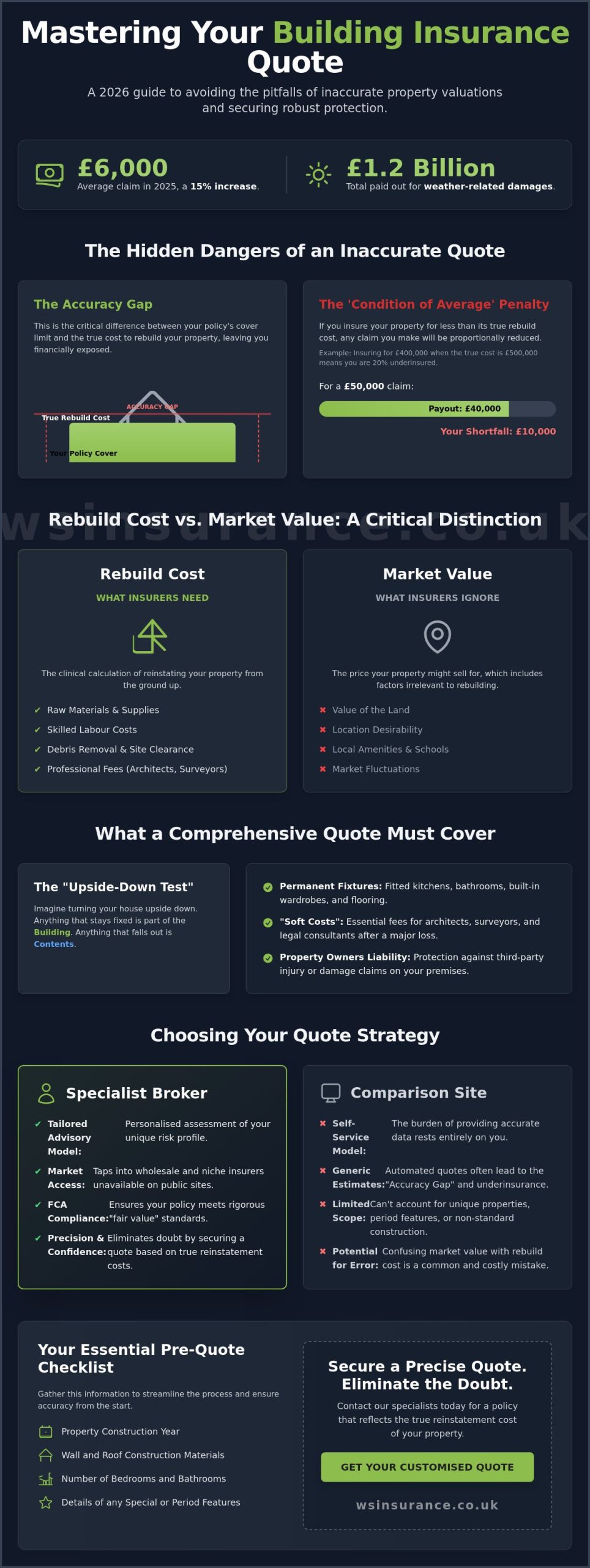
Obtaining a building insurance quote often feels like a simple checkbox exercise, yet the “Accuracy Gap” remains one of the most significant threats to property owners in 2026. This gap represents the disparity between the coverage limit on your policy and the actual cost of rebuilding your property from the ground up. Relying on an automated, generic estimate might save five minutes today, but it often leaves you exposed to catastrophic financial shortfalls. We believe in removing this uncertainty by treating every property owner as a “Trustee” of their asset, where precision isn’t just a preference; it’s a requirement for long-term security.
The Financial Conduct Authority (FCA) has sharpened its focus on the outcomes of the Consumer Duty this year. This means insurers must demonstrate fair value and transparency, yet the burden of providing accurate property data still rests with you. For mortgage holders, the stakes are even higher. Most lending agreements contain strict legal covenants requiring adequate Property insurance based on full reinstatement values. Failing to maintain this can technically trigger a breach of your mortgage terms, potentially jeopardising your financing alongside your physical assets.
The Hidden Danger of Underinsurance
The “Condition of Average” is a standard clause in UK insurance contracts that many owners overlook until it’s too late. It dictates that if a property is underinsured, the policyholder must bear a proportion of any loss. For example, if you secure a building insurance quote for a rebuild cost of £400,000, but the true cost is £500,000, you are underinsured by 20%. In the event of a partial claim, such as £50,000 worth of flood damage, the insurer may only pay out £40,000. With 2026 construction costs inflated by labour shortages and supply chain shifts, ensuring your quote reflects current material prices is vital to avoid this proportional penalty.
Rebuild Cost vs Market Value: A Critical Distinction
What a Comprehensive Building Insurance Quote Should Cover
A robust building insurance quote must account for every component of your property, extending far beyond the basic bricks and mortar. It’s a comprehensive valuation of the entire estate. While standard policies cover the main structure, a truly protective quote includes the “soft costs” that arise following a major loss. For instance, professional fees for architects, surveyors, and legal consultants are essential for navigating the planning permissions required for reconstruction. Similarly, debris removal is a significant expense; clearing a destroyed site is a complex logistical task that can cost thousands before a single foundation is poured.
We also ensure that Property Owners Liability is integrated into your quote. This protects you against claims for injury or damage sustained by third parties on your premises. While residential owners might see this as a secondary concern, it remains one of the common types of business insurance elements that provide a necessary safety net for landlords and commercial entities alike. Failing to include these layers of protection can turn a manageable claim into a significant financial burden.
Permanent Fixtures and Fittings
Distinguishing between buildings and contents is often a source of confusion. We recommend the “Upside Down Test”: imagine turning your property over; anything that remains fixed is part of the building. This includes fitted kitchens, bathrooms, flooring, and even fitted wardrobes. For those with bespoke installations or period features, a standard policy may fall short. In such cases, high net worth home insurance provides the tailored precision needed to protect high-specification finishes and unique architectural details that generic quotes often overlook.
Outbuildings and External Structures
Your building insurance quote should explicitly list all structures within your property boundaries. It isn’t just about the main house. Consider the following checklist for your valuation:
- Detached garages, carports, and garden offices.
- Sheds, greenhouses, and summerhouses.
- Boundary walls, fences, gates, and hedges.
- Hardstanding areas, including patios, driveways, and swimming pools.
You are also responsible for underground pipes, cables, and tanks that serve the property within its perimeter. If a water main bursts under your driveway, the repair costs for the pipework and the subsequent restoration of the surface should be covered. If you’re unsure whether your current policy is this thorough, WS Insurance Brokers can help you audit your requirements to ensure no structural element is left vulnerable.
Broker vs Comparison Site: Finding the Right Quote Strategy
Brokers aren’t restricted to the same consumer-facing panels as aggregators. We access wholesale and niche markets, sourcing terms from specialist underwriters who don’t appear on mainstream platforms. This is particularly vital for non-standard properties or those with unique construction materials that don’t fit into a standard algorithm’s parameters. Every insurance policy is based on a “Statement of Fact.” If a single box is ticked incorrectly on an automated form, your cover could be voided. Brokers meticulously verify these details, ensuring the insurer has a crystal-clear understanding of the risk from the outset.
There is a common misconception that working with a broker is always more expensive. This ignores the pragmatic justification of our service: we often secure better value by accurately presenting your risk profile to a wider breadth of the market. Furthermore, we provide ongoing support through mid-term adjustments and annual reviews, ensuring your building insurance quote remains accurate as your property or the economic climate evolves.
The Limitations of Automated Aggregators
One-size-fits-all forms are designed for the “average” property, but very few homes or businesses are truly average. Rushing through an online form whilst distracted can lead to significant errors in construction dates or material specifications. Perhaps most importantly, an algorithm won’t advocate for you if a claim becomes complex. In a world of automated corporations, the lack of human advocacy during a claim can leave you feeling isolated and vulnerable.
The Value of Independent Broker Expertise
We organise bespoke coverage for clients with complex portfolios, ensuring every asset is protected under a cohesive strategy. A broker acts as a protective shield, negotiating directly with underwriters to secure the best possible terms whilst maintaining absolute transparency regarding professional fees. This consultative approach prioritises your long-term security, providing a level of customisation that generic platforms simply cannot match. By choosing an expert guide, you eliminate doubt and gain the confidence that your protection is built on a foundation of integrity.
The Essential Checklist for Requesting a Building Insurance Quote
Securing an accurate building insurance quote requires a methodical approach to data gathering. You cannot rely on the “quick quote” culture if your property has unique features, a complex history, or a non-standard usage type. We’ve developed a logical sequence to ensure your information is airtight before you engage an underwriter. This preparation eliminates the risk of unintentional non-disclosure; a steady hand at this stage prevents a rejected claim later. Whether your property is residential, commercial, or a mixed-use development, the precision of your initial data determines the reliability of your eventual protection.
Usage type is a critical factor that many owners overlook. A building used for a home-based consultancy requires different considerations than one used for heavy manufacturing or retail. If your property is mixed-use, with a shop on the ground floor and flats above, you must specify this clearly. Incorrectly categorising the usage is a common reason for quote invalidity. By gathering this data upfront, you allow us to present a transparent risk profile to our panel of insurers, ensuring the premium you pay is both fair and comprehensive.
Property Details and Construction Materials
Precision in construction details is non-negotiable. If your property features a timber frame, a thatched roof, or a significant area of flat roofing (usually over 20%), you are in “non-standard” territory. Listed buildings carry even higher risks; the legal requirement to use original materials and specialised labour for repairs can significantly inflate reinstatement costs. Ensure you have the exact year of build and the primary materials used for both walls and the roof. With weather-related claims hitting £758 million for homes alone in 2025, according to industry data, the structural integrity of your building’s envelope is a primary concern for every underwriter. It is also worth noting that if you are planning any significant renovation or extension work, your standard policy may not provide adequate protection during the construction phase; contract works insurance UK is specifically designed to cover the heightened risks and shifting liabilities that arise when your property becomes an active construction site.
Security Measures and Environmental Risk Factors
Security isn’t just about safety; it’s a financial lever. Insurers typically look for five-lever mortice deadlocks that meet BS3621 standards on all external doors. If you have an alarm, specify whether it’s a bells-only system or one with a monitoring contract. Environmental factors also play a massive role. You must assess your proximity to water sources and check for any history of subsidence in the area. For high-value properties, the presence of physical barriers or safe rooms can be a deciding factor in securing favourable terms for a building insurance quote. It is also worth noting that if your property is likely to stand empty for any period, standard cover may be insufficient; specialist unoccupied buildings insurance exists precisely to address the heightened risks that arise when a structure is left unattended.
Claims History and Existing Cover
Honesty is the only policy when it comes to previous incidents. You should document all claims or notifications from the last five years, even if no payout was made. Review your current “Schedule of Insurance” to identify any existing gaps or to verify your No Claims Discount (NCD) entitlement. This transparency builds trust with the underwriter and ensures your new policy is built on solid ground. If you want to ensure your checklist is complete and your data is presented correctly, request a consultation with WS Insurance Brokers to review your specific risk profile.
Securing Your Customised Quote with WS Insurance Brokers
Securing a building insurance quote that truly reflects the intricacies of your property requires more than a digital algorithm. It demands a partnership with a professional who understands that your security is paramount. At WS Insurance Brokers, we don’t just provide a price; we deliver a clinical assessment of your risk profile to ensure every potential vulnerability is addressed. Our role is to act as a steady hand in a complex market, removing the anxiety often associated with financial protection and replacing it with the calm reliability of expert guidance.
We pride ourselves on our autonomy and lack of bias. Because we aren’t restricted to a small pool of providers, we can source terms from the entire breadth of the UK market. This access is our badge of honour, allowing us to find the precise alignment between an insurer’s appetite for risk and your specific requirements. Whether you are seeking protection for a single residence or a multi-million-pound commercial portfolio, our consultative approach ensures that transparency and integrity remain at the heart of every transaction.
Our Proactive Market Assessment
Our process begins with a proactive labour that directly results in your peace of mind. We scan the market to identify the most accurate rates, often accessing wholesale or niche providers that don’t engage with the general public. For those with High Net Worth Home Insurance needs or complex Commercial Property Insurance requirements, this bespoke attention is vital. By providing a single point of contact for all your property insurance needs, we eliminate the fragmented communication that often leads to gaps in cover. You gain a dedicated advisor who understands the full scope of your assets, ensuring your building insurance quote is as unique as the structure it protects.
Personal Advocacy and Claims Support
The true value of a broker is most visible when things go wrong. Whilst automated corporations often leave you to navigate a complex claims process alone, our relationship with you begins, rather than ends, when the policy is placed. We act as a protective shield between you and the underwriter, fighting for your interests during every stage of a claim. This advocacy is a defining signature of our service; we manage the technicalities and negotiations so you don’t have to.
Our commitment to your security extends to the seamless management of mid-term adjustments and annual renewals. As the economic landscape shifts and rebuild costs fluctuate, we ensure your protection evolves accordingly. This methodical, structured approach removes uncertainty and eliminates doubt, providing a narrative of partnership where our proactive efforts result in your total confidence. We invite you to experience a more personal, localized method of insurance placement. Contact us today to begin a consultation that prioritises your long-term security over a simple transaction.
Ensuring Your Property’s Future with Precision
Protecting your property requires a transition from the convenience of automated estimates to the clinical precision of a professional valuation. By mastering the distinction between market value and rebuild costs, you eliminate the risk of underinsurance and the proportional penalties of the “Condition of Average” clause. Our definitive checklist ensures that every structural element, from underground pipes to bespoke internal fittings, is accurately represented in your building insurance quote. This methodical preparation, combined with the advisory model of an independent broker, removes the uncertainty that generic comparison sites often leave behind.
We are authorised and regulated by the Financial Conduct Authority, offering you the security of independent access to the entire breadth of major UK insurers. Our role as your trusted advisor includes dedicated claims advocacy and support; this ensures you are never left to navigate complex market shifts alone. Request your tailored building insurance quote from our expert brokers today and gain the confidence that your most valuable assets are shielded by a policy built on transparency and integrity. We look forward to helping you secure a future defined by clarity and reliable protection.
Frequently Asked Questions
Is building insurance a legal requirement in the UK?
Building insurance isn’t a legal requirement under UK law, but it’s almost always a contractual obligation if you have a mortgage. Lenders require proof of cover from the date of exchange to protect their financial interest in the structure. For freehold owners without a mortgage, it remains a vital safety net for protecting personal wealth against catastrophic loss.
How much should I insure my property for?
You should insure your property for the full reinstatement value, which is the total cost of rebuilding the structure from scratch. This figure includes professional fees, site clearance, and raw materials. It’s distinct from market value; relying on the latter often leads to the accuracy gap discussed earlier, potentially leaving you underinsured.
What factors affect the cost of a building insurance quote?
Several variables influence the final price of a building insurance quote, including the property’s postcode, construction materials, and proximity to environmental risks like flood zones. Insurers also weigh your claims history and the level of security measures, such as BS3621 deadlocks. Accurate data on these factors ensures your premium is calculated fairly and reflects the true risk.
Does building insurance cover damage caused by tenants?
Standard residential policies typically exclude malicious or accidental damage caused by tenants. If you’re letting a property, you require specific commercial or landlord cover to protect against these risks. We can help you identify the specific extensions needed to ensure your investment remains secure regardless of occupant behaviour.
Can I get a building insurance quote for a property I haven’t bought yet?
Yes, you can and should obtain a building insurance quote during the conveyancing process. Cover must be active from the moment you exchange contracts, as this is when legal responsibility for the building transfers to you. Providing the property’s details early allows for a smooth transition on completion day and satisfies lender requirements.
What is the difference between compulsory and voluntary excess?
Compulsory excess is a fixed amount set by the insurer that you must pay toward any claim. Voluntary excess is an additional amount you choose to contribute to lower your annual premium. Whilst a higher voluntary excess reduces costs, you must ensure it’s an amount you can comfortably afford to pay out if you need to make a claim.
How often should I update my building insurance quote?
You should review your cover annually or immediately following significant structural changes. If you’ve added an extension, converted a loft, or updated a kitchen, your rebuild cost will have increased. Failing to update your details at the point of renovation can lead to underinsurance, leaving you vulnerable to the “Condition of Average” clause during a claim.
What happens if I provide incorrect information during a quote?
Providing inaccurate information can lead to your policy being voided or claims being rejected entirely. Insurers rely on the “Statement of Fact” to assess risk. If an investigation reveals non-disclosure or misinformation, you may find yourself liable for the full cost of repairs; this can jeopardise your financial stability and make it difficult to secure cover in the future.