
What if your current policy is active, but a claim about work you completed years ago still falls outside its protection? That’s why “professional indemnity retroactive date explained” matters: the date can determine how far back your cover may reach, even when a claim is made during your current policy period.
Renewing or changing insurer does not automatically mean all past work remains covered. Professional indemnity insurance is generally claims-made, so the policy in force when a claim is made may respond, subject to its terms. The retroactive date sets the earliest point from which the policy may consider your work. It differs from the inception date, which marks when the current policy begins.
This guide explains how the two dates work, what a change of insurer or a break in cover could mean, and which details to review in your schedule and endorsements. WS Insurance Brokers arranges Professional Indemnity Insurance and provides personal advice and clear information about policy features and exclusions. WS Insurance Brokers is authorised and regulated by the Financial Conduct Authority.
Key Takeaways
- Understand how a retroactive date may affect earlier professional work and how it differs from your policy’s inception date.
- Compare specified dates, unlimited retroactivity and a date set at inception, using the policy wording as well as the label.
- Review how continuous renewal, switching insurer and a break in cover may affect the dates applying to your policy.
- Compare the stated retroactive date in your schedule and endorsements with when your professional work began.
- WS Insurance Brokers provides personal advice on policy features and exclusions and is authorised and regulated by the Financial Conduct Authority.
What does a professional indemnity retroactive date mean?
A professional indemnity retroactive date sets the earliest point in time from which a policy may consider your professional work, subject to its wording. It relates to when the work was carried out, not when a claim is made.
In short: the retroactive date marks how far back the policy may consider professional services or advice; the claim date is when a client brings a claim against you. These dates answer different questions. A claim made during the current policy period may relate to work completed years earlier, but the retroactive date and other policy terms affect whether that work falls within the cover.
Professional indemnity cover commonly operates on a claims-made and reported basis: the policy in force when a claim is made and reported may respond, subject to its terms, conditions and exclusions. The general overview of professional liability insurance describes this claims-made structure. The retroactive date adds a further time boundary for the work involved. An active policy alone does not establish that every historic instruction is covered.
Which work period does the retroactive date relate to?
The date may limit how far back the policy considers professional services, advice or other work. If a matter concerns work completed before the date shown, it may fall outside the policy’s scope, even if the client makes a claim during the current period of insurance. The precise effect depends on the wording, including any relevant definition of professional services.
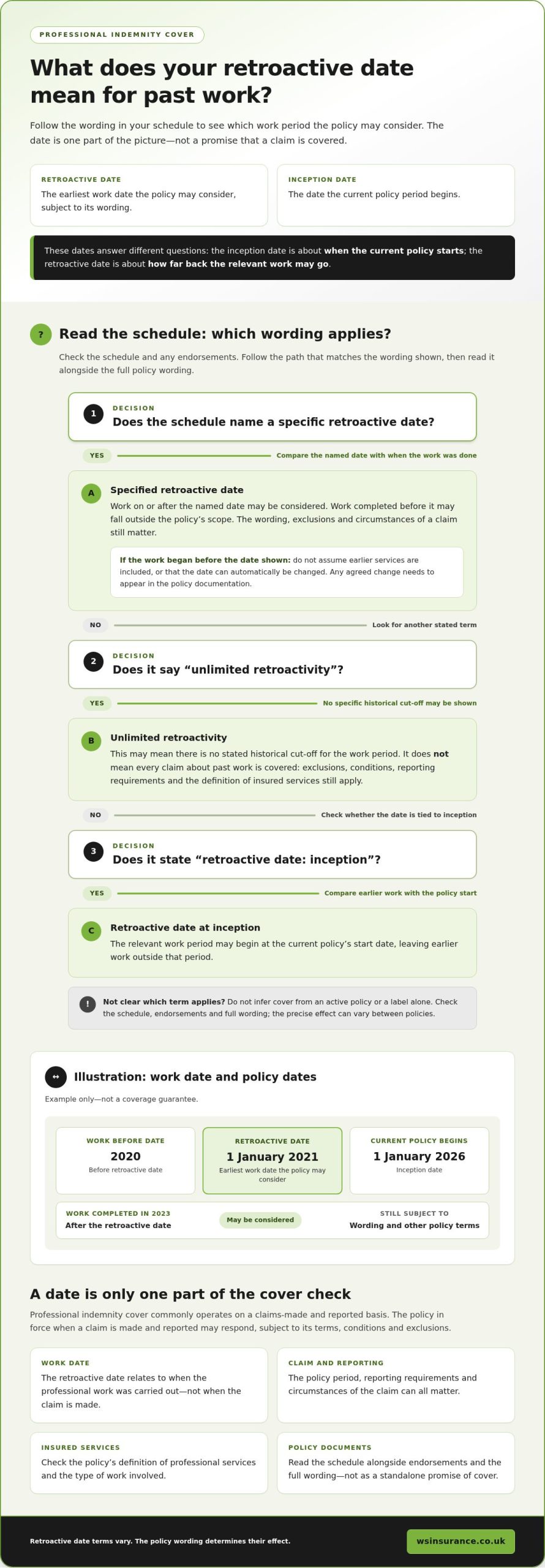
Illustration only, not a coverage guarantee: imagine a policy with a retroactive date of 1 January 2021 and a current period beginning 1 January 2026. Work completed in 2023 falls after the retroactive date, while work completed in 2020 falls before it. This comparison shows which work period may be considered; it does not confirm whether a particular claim is covered.
Exclusions, conditions and notification requirements still apply. The circumstances of a claim, the type of service involved and whether the policy’s reporting requirements have been met can all matter. Read the schedule alongside the full wording rather than treating the date as a standalone promise of cover.
Retroactive date and inception date: what is the difference?
The inception date is the start date of the current policy. The retroactive date identifies the earliest work date the policy may consider. It can be earlier than inception, so the policy may relate to work performed before the current contract began. The dates are not interchangeable. Check each separately in the schedule and any endorsements.
Illustration: Retroactive date: 1 January 2021, work from this date may be considered, subject to the wording. Inception date: 1 January 2026, the current policy period begins.
The distinction is central to having professional indemnity retroactive date explained clearly: the current policy period concerns when cover is in force, while the retroactive date concerns how far back the relevant work may go. When reviewing Professional Indemnity Insurance, WS Insurance Brokers provides personal advice and clear information about policy features and exclusions. WS Insurance Brokers is authorised and regulated by the Financial Conduct Authority.
How do retroactive date terms affect professional indemnity cover?
Policy schedules may describe the retroactive date in different ways. The label is a useful starting point, but it does not settle whether a particular claim is covered. Check which work period the policy may consider, then compare the schedule, endorsements and full wording.
Retroactivity depends on the policy’s stated date and terms, not on the label alone. These common descriptions can help you compare policies, but their precise effect can vary.
| Term | What it may mean for past work |
|---|---|
| Specified retroactive date | Work on or after a named date may be considered, subject to the policy wording. |
| Unlimited retroactivity | No specific historical cut-off may be shown, but other terms and exclusions still apply. |
| Retroactive date inception | The relevant period may begin at the current policy’s start date, leaving earlier work outside that period. |
What does a specified retroactive date mean?
A specified date sets a stated historical point from which work may be considered under the policy. For example, if a schedule gives a retroactive date of 1 January 2022, work completed in 2023 falls after that date, while work completed in 2021 falls before it. This is an illustration, not confirmation of cover: the wording, exclusions and circumstances of a claim still matter.
If your professional work began before the date shown, do not assume the policy includes all earlier services. Nor should you assume the date can automatically be changed or that an insurer will agree to a different one. Any agreed change needs to appear in the policy documentation. Check the schedule and endorsements together, then read them alongside the full wording.
What do unlimited retroactivity and retroactive date inception mean?
Unlimited retroactivity may mean there is no stated historical cut-off for the work period. It does not mean every claim about past work is covered: exclusions, conditions, reporting requirements and the policy’s definition of insured services remain relevant. Establish what the term means from the wording rather than relying on the label alone.
Retroactive date inception generally links the start of the relevant work period to the inception date, when the current policy begins. If the policy starts on 1 January 2026, work completed before then may fall outside the period considered, subject to the exact wording. This term is particularly important to review if your work history predates the current policy.
For a practical professional indemnity retroactive date explained review, compare each term with your work history, then check how the wording treats earlier services. WS Insurance Brokers arranges Professional Indemnity Insurance and provides personal advice on policy features and exclusions. You can read more about professional indemnity insurance advice. WS Insurance Brokers is authorised and regulated by the Financial Conduct Authority.
What happens to your retroactive date when you switch insurer or have a break?
Changing insurer does not automatically mean losing historic cover. The key question is whether the new policy accepts the existing retroactive date and whether its wording maintains the protection you expect. An old date on a previous schedule is useful evidence of your policy history, but it does not prove that every claim about past work will be covered.
Consider these three situations separately:
- Continuous renewal: Your policy renews without a break. Check that the renewal schedule retains the established retroactive date and that changes to the wording or endorsements do not affect how past work is treated.
- Changing insurer without a gap: A new insurer may accept an earlier date, but this needs to appear in the new policy documents. Compare the old and new schedules, not just the start and end dates.
- A break in cover: A later policy may use a new retroactive date, potentially leaving earlier work outside its stated period. Do not assume that arranging cover again restores the previous date or addresses claims arising from the gap.
Continuity, the date shown and the policy terms all need to align. A claim may concern work carried out years earlier but be made or reported after a change in cover. That makes the handover between policies more than an administrative detail.
Can a new insurer keep an earlier retroactive date?
An earlier date may be maintained when cover has been continuous and the new insurer accepts it, but this is not automatic. Give an accurate account of your policy history, including dates of cover and any interruptions, so the proposed terms can be considered against your circumstances. Then check that the accepted date appears in the new schedule or an endorsement. Whether a claim responds still depends on the insurer’s acceptance and the policy wording.
Why can a gap in professional indemnity cover matter?
The work date and the claim or notification date may fall in different policy periods. For example, a client might raise an issue about advice provided during a period without cover after you have arranged a new policy. The new policy may not automatically cover that work, particularly if its retroactive date starts after the advice was given. The precise position depends on the policy terms and circumstances.
Before the existing policy ends, compare its end date with the proposed new policy’s start date and retroactive date. Read notification requirements carefully, especially if you are already aware of circumstances that could lead to a claim. Keep schedules, endorsements and wording from each policy period, and raise any date discrepancy before the change takes effect. Clear records make it easier to explain your professional history and identify differences between the terms.
WS Insurance Brokers provides personal advice and clear information about Professional Indemnity Insurance features and exclusions. You can discuss professional indemnity cover with the team. WS Insurance Brokers is authorised and regulated by the Financial Conduct Authority.
How to check your professional indemnity retroactive date
A careful document review can show whether the date on your policy appears to fit your professional history and where further clarification may help. Do not rely on a date remembered from a previous renewal or on a brief description of the cover. Work through the documents in order and keep a record of what you find.
Where can you find the date in your policy documents?
Start with the policy schedule, then check any endorsements that amend or explain its terms. The wording may use labels such as “retroactive date”, “retroactive date inception” or “unlimited retroactivity”. Read relevant definitions alongside exclusions, conditions and claims-notification requirements. A date on its own does not establish how every claim will be treated.
- Locate the stated date. Note the retroactive date on the current schedule, or how the schedule describes retroactivity if no specific date appears.
- Check endorsements. Look for changes to the retroactive date, insured professional services or other relevant terms. Record which policy period each endorsement relates to.
- Compare it with your work history. Identify when you or your practice began providing professional services, then consider whether relevant work predates the stated date. Include earlier work carried out under a previous business or practice where relevant to your circumstances.
- Map the policy periods. Write down each policy’s inception and expiry dates, renewal dates and any changeover dates. Compare the end of one period with the start of the next, but do not treat continuous dates alone as proof that a claim is covered.
- Read the relevant terms. Check how the wording addresses claims, reporting, exclusions and conditions. If you are considering renewal or a switch, compare the proposed schedule and wording with your current documents, including any conditions attached to an earlier date.
What should you compare before renewing or changing cover?
Compare the current and proposed policy documents side by side. Check the new policy’s start date and the previous policy’s end date, then see whether the proposed schedule records the historic date you expect. Read endorsements and relevant wording for conditions or changes that could affect past work. Save schedules, endorsements, full wordings and insurer communications together, clearly labelled by policy period. This gives you a reliable record for future reviews.
In brief: identify the date, compare it with your work history, then review the policy terms. That is the core of having professional indemnity retroactive date explained in a way you can apply to your own documents. If you would like support interpreting dates, endorsements and wording, discuss your professional indemnity cover with WS Insurance Brokers. The team provides personal advice and clear information about policy features and exclusions. WS Insurance Brokers is authorised and regulated by the Financial Conduct Authority.
Getting professional indemnity advice when your retroactive date is unclear
If the date on your schedule does not appear to match your work history, or you are unsure what a term means, personal guidance can help clarify the details. An independent broker can consider your professional circumstances, policy dates and wording together, helping you understand what to resolve before renewal or a change of insurer. The aim is clarity, not an assumption that a particular date or policy will respond to every claim.
How can an independent broker help you review cover?
Your work history matters. A broker can understand the services you provide, when your practice began and how your cover has changed, then discuss options in light of those circumstances. As an independent broker, WS Insurance Brokers arranges Professional Indemnity Insurance through a wide panel of leading and specialist insurers.
WS Insurance Brokers provides personal advice and clear information about policy features and exclusions, helping you understand how the wording relates to your work. The team has more than 15 years’ combined insurance experience and offers ongoing claims guidance. For a wider view of how insurance fits into business protection, explore this business insurance guide.
What is a sensible next step if your date does not match your work history?
Gather the documents that show your professional history and cover history. A clear set of records makes it easier to discuss any mismatch and understand what the policy documents say. Include:
- Your current policy schedule and any endorsements that refer to the retroactive date.
- Previous schedules and renewal documents, especially if you have changed insurer or had a break in cover.
- A simple chronology of when your practice began, the professional services you have provided and the dates of each policy period.
Share the relevant details openly and describe any date that appears inconsistent. WS Insurance Brokers can provide personal advice on policy wording and ongoing claims guidance, helping you understand the terms without treating a historic date as proof of cover. The insurance brokers guide explains the role an intermediary can play in assessing professional risk and arranging cover.
With professional indemnity retroactive date explained in the context of your own work and documents, the next step can feel more straightforward. Discuss professional indemnity insurance with WS Insurance Brokers to talk through your circumstances and policy wording. WS Insurance Brokers is authorised and regulated by the Financial Conduct Authority.
Make your next renewal a clearer decision
If you want professional indemnity retroactive date explained in relation to your circumstances, WS Insurance Brokers can help you understand the wording and discuss Professional Indemnity Insurance options. As an independent broker, it has access to a wide panel of leading and specialist insurers. The team has more than 15 years’ combined insurance experience. WS Insurance Brokers is authorised and regulated by the Financial Conduct Authority.
Discuss your professional indemnity cover with WS Insurance Brokers and take a considered next step towards cover that reflects your professional history.
Frequently Asked Questions
Is a retroactive date the same as a professional indemnity policy inception date?
No. The inception date marks when the current policy begins, while the retroactive date relates to how far back the policy may consider professional work, subject to its wording. For example, a schedule could show a current policy starting in 2026 and a retroactive date several years earlier. Check both dates: relying on the policy start date alone will not show which earlier work may be considered.
Can a retroactive date include work completed before I first bought professional indemnity insurance?
It may, if the insurer agrees to cover work from a date before your first policy began and the accepted date appears in the documents. This is not automatic. Be ready to explain when your practice began, what services you provided and whether you had previous insurance. The phrase “professional indemnity retroactive date explained” comes down to that distinction: an earlier work date may be accepted, but the policy terms still determine its effect.
Does a retroactive date guarantee that a claim for past work will be covered?
No. The date only addresses the period of work that may be considered; it does not guarantee that a claim will be covered. The policy’s insured services, exclusions, conditions and notification requirements also matter, as do the circumstances of the claim. For example, a claim about work after the stated date could still involve an excluded service. Read the relevant wording and follow the policy’s claims-notification instructions if an issue arises.
Can an insurer change the retroactive date on a professional indemnity policy?
An insurer may agree to a different retroactive date, but do not assume it will change automatically at renewal, when switching insurer or during the policy period. Ask for any agreed change to be recorded in the schedule or a formal endorsement, then check what conditions apply. Keep the previous and updated documents together so you can see when the change took effect and which policy terms apply.
What happens if a claim relates to work completed before the retroactive date?
That work may fall outside the period the policy considers, even if the claim is made while the policy is active. Do not decide the outcome from the date alone: review the wording and notify the insurer in line with the policy’s requirements. Keep relevant contracts, advice, correspondence and project records together, as these can help explain when the work took place and what the claim concerns.
Where can I find the retroactive date on my policy documents?
Start with the policy schedule and check any endorsements attached to it. The date may appear under a different heading or be described through wording such as “retroactive date inception”, so search the documents for related terms if it is not obvious. Then read the relevant policy wording, particularly its definitions and provisions about past work. If documents appear inconsistent, note the difference and seek clarification before relying on one date.
Does unlimited retroactivity mean every claim relating to past work is covered?
No. “Unlimited retroactivity” may mean the policy has no stated historical cut-off for work, but it does not remove other limits in the contract. The claim must still meet the policy’s terms, including its definition of insured professional services, exclusions and notification conditions. Check whether endorsements qualify the phrase, and consider the circumstances of the work and claim. The wording, rather than the label alone, determines how it applies.