
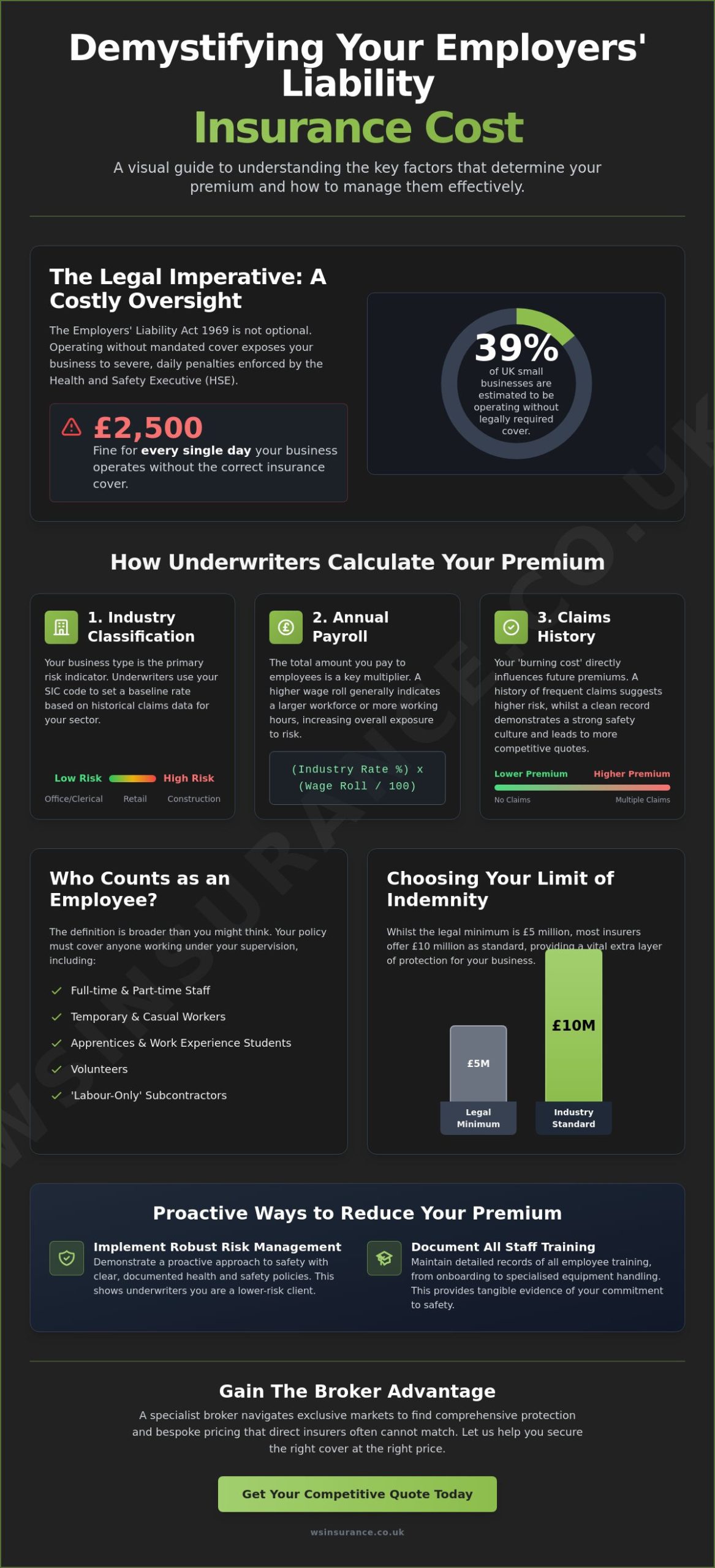
Did you know that as of January 2026, an estimated 39% of UK small businesses with fewer than ten employees are operating without legally mandated cover? It’s a startling figure, especially when you consider that the Health and Safety Executive can issue fines of up to £2,500 for every single day you remain unprotected. You likely already feel that your employers liability insurance cost should be a transparent investment in your team’s safety, yet direct insurers often leave you feeling unsettled with opaque pricing and complex terms.
We believe that securing your workforce shouldn’t be a source of anxiety. This guide is designed to remove that uncertainty by explaining the specific factors that dictate your premiums, whether you are managing subcontractors or welcoming new volunteers. You’ll discover how to secure comprehensive protection whilst managing your business overheads effectively. We will provide a clear breakdown of premium drivers and a strategy to lower your expenses without sacrificing the security of your staff, giving you total confidence that your legal obligations are met.
Key Takeaways
- Grasp the statutory obligations of the 1969 Act to avoid crippling HSE fines and ensure your duty of care is fully met across your entire workforce.
- Uncover how your specific industry classification and total annual payroll are used by underwriters to determine your unique employers liability insurance cost.
- Contrast the £5 million legal minimum against the £10 million industry standard to decide which level of indemnity provides the necessary shield for your business operations.
- Implement proactive risk management strategies and documented staff training to improve your risk profile and attract more competitive premium offers from underwriters.
- Leverage the expertise of a specialist broker to navigate exclusive markets, securing bespoke pricing and comprehensive protection that direct insurers often cannot match.
The Legal Mandate: Why Employers Liability Is a Fixed Business Cost
The requirement for employers liability insurance isn’t just a recommendation or a best practice for growing firms. It’s a foundational legal obligation. Since the introduction of the Employers’ Liability (Compulsory Insurance) Act 1969, almost every business in the UK that employs at least one person must hold a minimum level of cover. This statutory mandate ensures that if a member of your team suffers an injury or develops an illness resulting from their work, the necessary financial resources are available to provide compensation and cover legal fees. It acts as a vital safety net for both the individual and the business owner.
This obligation stems from your inherent “Duty of Care.” As an employer, you’re responsible for the health and safety of everyone under your supervision, regardless of their contract type. Failing to maintain this cover doesn’t just leave you vulnerable to civil claims; it invites severe regulatory intervention. The Health and Safety Executive (HSE) enforces these rules with clinical precision. You can be fined up to £2,500 for every single day you operate without the correct insurance. Additionally, you’re legally required to display your certificate of insurance so employees can access it easily. Failure to do so, or refusing to make it available to an inspector, can result in a £1,000 fine. When you calculate your employers liability insurance cost, it’s helpful to view it as a protective shield against these potentially business-ending penalties.
Who Counts as an Employee for Insurance Purposes?
The legal definition of an “employee” is broader than many business owners realise. It isn’t limited to those on permanent, full-time contracts. For insurance purposes, your team includes part-time and casual staff, alongside apprentices and students on work experience. Even volunteers are often classified as employees in the eyes of an underwriter. A common area of confusion involves subcontractors. If you hire “labour-only” subcontractors who work under your direction and use your tools, they’re typically treated as employees. Conversely, “bona-fide” subcontractors who manage their own risk and provide their own materials may not impact your premium, provided you verify they have their own cover in place. Recruitment agencies placing workers across multiple client sites face particularly complex liability exposures, which is why understanding professional indemnity insurance for recruitment agencies is an important consideration alongside your employers liability obligations.
Exemptions and the “Family Business” Rule
Specific instances exist where the law allows for exemptions, primarily for family-run firms that only employ close relatives. However, this exemption disappears the moment you hire a single person from outside the family circle. It’s also a common misconception that limited companies with a single employee who is also the director are always exempt. If that director owns less than 50% of the share capital, cover is usually mandatory. Even if you technically qualify for an exemption, operating without a policy is a significant risk. A single workplace accident can lead to legal costs that far exceed the annual employers liability insurance cost, making a policy a prudent choice for your long-term security.
Key Variables: How Underwriters Calculate Your Insurance Premium
Underwriters determine your premium by assessing the probability of a claim occurring within your specific business environment. They don’t rely on guesswork. Instead, they utilise historical data and actuarial tables to quantify risk. While official government guidance sets the legal framework for compliance, insurance providers look closely at your Standard Industrial Classification (SIC) code to establish a baseline for your employers liability insurance cost. A consultancy firm with clerical staff presents a vastly different risk profile compared to a scaffolding business. While office-based roles are viewed as lower risk, manual roles involving physical labour attract higher premiums due to the increased frequency and severity of workplace accidents.
Your “burning cost” or claims history acts as a significant lever in these calculations. If your business has a history of frequent incidents, underwriters view this as a pattern of risk rather than a series of isolated events. This almost inevitably leads to higher premiums. Conversely, a clean record demonstrates a robust safety culture, which we use to negotiate more favourable terms on your behalf. If you’re looking for bespoke employers liability insurance, demonstrating a consistent commitment to safety is your strongest asset. Underwriters also evaluate your physical work environment. They distinguish between controlled office settings and high-risk site work where variables are harder to manage.
Industry Risk Categories and Their Cost Impact
The specific activities your team performs are critical to the final quote. Clerical and retail sectors occupy the lower end of the risk spectrum. However, if your operations involve “working at height,” handling hazardous chemicals, or operating heavy machinery, you’ll face premium loadings. In the building sector, the complexity of your projects often means that your construction site insurance requirements will closely overlap with your EL assessment. Underwriters look for precision in how these high-risk tasks are managed to ensure your protection remains comprehensive without becoming prohibitively expensive.
The Correlation Between Payroll and Premium
Most insurers calculate the employers liability insurance cost using a “rate per mille” model. This means you’re charged a specific amount for every £1,000 of your total annual payroll. This method is preferred over simple headcounts because payroll accurately reflects the scale of your operations and the total man-hours exposed to potential risk. When calculating this figure, you must include bonuses, overtime, and dividends paid in lieu of salary. We recommend providing accurate payroll forecasts at the start of your policy year. This proactive approach prevents unexpected mid-term adjustments if your staff numbers grow faster than anticipated.
Evaluating Cover Limits: Determining if £5 Million Is Sufficient
While the law mandates a minimum of £5 million in cover, most reputable insurers provide £10 million as a standard baseline. This isn’t an arbitrary increase. It reflects the escalating financial reality of personal injury settlements and legal fees in 2026. A single complex claim involving long-term care or severe disability can quickly erode a £5 million limit. By understanding the various factors that determine insurance cost, you can see why higher indemnity limits are a prudent investment rather than an unnecessary expense. Your employers liability insurance cost is intrinsically linked to the level of risk you are transferring to the insurer. This protection works alongside other business insurance pillars to ensure your firm remains resilient against unforeseen liabilities. With business liability claims resulting in an average payout of £7.6 million daily across the UK, the adequacy of your limit is a critical consideration for your long-term security.
When the Legal Minimum Isn’t Enough
There are several scenarios where the statutory £5 million limit may prove insufficient. If your business operates in a high-density environment, a single event like a fire or a structural failure could result in multiple claimants. In such cases, the limit applies to the total incident rather than each individual person. Additionally, many corporate clients and local authorities now demand a minimum of £10 million in cover as a contractual prerequisite. Without this higher limit, you may find yourself excluded from lucrative tendering opportunities. We often see firms with over 600,000 non-fatal workplace injuries occurring annually in the UK, making a robust limit essential for any growing enterprise.
The Cost Difference Between £5m and £10m Limits
You might expect that doubling your level of cover would double your premium, but this is rarely the case. The premium increase for moving from £5 million to £10 million is often surprisingly marginal. This occurs because underwriters view the likelihood of a claim exceeding £5 million as significantly lower than the risk of smaller, more frequent incidents. This concept of “diminishing risk” allows you to secure double the protection for a fraction of the initial cost. The standard £10 million limit serves as an essential safety buffer for modern SMEs, offering peace of mind that far outweighs the slight premium adjustment. Securing this extra layer of security effectively removes the anxiety of a catastrophic claim outstripping your financial resources.
Proactive Cost Control: Reducing Premiums Through Risk Management
Underwriters don’t just look at what you do; they look at how you do it. A robust Health & Safety (H&S) policy isn’t just a compliance document; it’s a financial asset that directly influences your employers liability insurance cost. When we present your risk to the market, a well-structured H&S framework acts as a signal of quality. It tells insurers that your organisation is proactive, reducing their perceived risk and increasing their appetite to offer competitive terms. This creates a narrative of partnership where your investment in safety leads directly to lower overheads and enhanced peace of mind.
Documented training is another powerful lever for cost reduction. Every induction, toolbox talk, and refresher course should be recorded with clinical precision. These records provide the evidence brokers need to justify premium discounts during negotiations. If you can prove that every team member has been thoroughly trained in your specific operational hazards, you remove the element of doubt that often leads to higher quotes. It’s about demonstrating that safety is woven into the fabric of your daily operations rather than being an afterthought.
A proactive safety culture is also evidenced through “near-miss” reporting. Rather than hiding minor incidents, recording them shows that your business learns and adapts. This transparency builds trust with insurers, as it proves you’re actively working to prevent the next major claim before it occurs. You can also achieve significant efficiencies by bundling your protection. Combining EL with public liability insurance often unlocks package savings that separate policies cannot match. For a tailored assessment of your risk profile, contact our expert advisory team today.
Risk Assessments as a Financial Strategy
Regular, professional risk assessments are more than just a box-ticking exercise. They’re the cornerstone of your “Statement of Fact,” the document that forms the basis of your insurance contract. Being transparent about your hazards and the steps you’ve taken to mitigate them ensures your cover remains valid. Industry-specific accreditations or ISO certifications further improve your risk profile, acting as a badge of honour that proves your commitment to international safety standards. These certifications often act as a shield, protecting your business from the premium spikes that hit less diligent competitors.
The Impact of Voluntary Excesses
Choosing a higher voluntary excess is a direct way to reduce your annual premium. By agreeing to pay a larger portion of any initial claim, you signal to the underwriter that you have “skin in the game.” However, you must avoid the false economy of setting an excess that your business cannot comfortably afford during a crisis. This logic mirrors the strategies found in our guide on how much is public liability insurance, where balancing immediate savings against long-term stability is key to effective budgeting. A steady hand in managing these variables ensures your employers liability insurance cost remains predictable and sustainable.
The Broker Advantage: Navigating the 2026 Insurance Market for Value
Securing the right protection requires more than a simple search engine query. An independent broker acts as your expert guide, providing access to exclusive “Broker-Only” markets and specialist schemes that remain invisible on standard comparison sites. This autonomy allows us to search the entire breadth of the market, ensuring your employers liability insurance cost is a true reflection of your business’s unique risk profile rather than a generic industry average. We don’t just collect quotes; we proactively “sell” your risk to a panel of underwriters, highlighting your safety credentials and risk management protocols to secure bespoke pricing and comprehensive terms. For businesses in the staffing sector, this expertise extends to sourcing specialist covers such as professional indemnity insurance for recruitment agencies, where the regulatory landscape is shifting significantly in 2026.
Our role extends far beyond the initial transaction. As your business evolves throughout the year, your payroll will inevitably fluctuate, requiring precise mid-term adjustments to keep your cover accurate and compliant. We manage these complexities on your behalf, acting as a shield between you and the administrative burden of the insurance market. Should the worst happen, our claims advocacy ensures you aren’t left to face the process alone. Having a seasoned professional on your side doesn’t just provide emotional support; it significantly reduces the long-term impact on your premiums by ensuring claims are handled fairly and efficiently, protecting your future insurability.
Market Breadth vs. Direct Limitations
Tailored Security for Peace of Mind
True value in insurance is only revealed at the point of a claim. Selecting a policy based solely on the lowest premium is a risk that can lead to significant anxiety if the cover proves inadequate when it’s needed most. We focus on removing uncertainty, providing a sense of security that allows you to concentrate on growing your business. Our commitment to your long-term protection means we prioritise the quality of the indemnity over the immediate transaction. If you’re ready to ensure your workforce is protected by a policy that matches your ambitions, we invite you to consult with WS Insurance Brokers for a tailored premium review today.
Securing Your Business Legacy through Strategic Protection
Protecting your workforce is a non-negotiable pillar of business leadership. By understanding how your industry risk and payroll figures influence your employers liability insurance cost, you transition from reactive spending to strategic budgeting. You now have the tools to evaluate indemnity limits and implement the safety protocols that underwriters value most. This clarity removes the anxiety of potential HSE fines; it ensures your team remains secure under a robust legal shield.
As an expert guide in a complex market, we’re here to provide the transparency and integrity your business deserves. We are authorised and regulated by the FCA, offering you access to a wide panel of leading UK insurers and dedicated claims support. This consultative approach ensures you don’t have to face the selection process alone. Request a bespoke employers liability quote from our expert brokers today to receive transparent advice tailored to your specific needs. We’re ready to help you build a safer, more resilient future for your organisation.
Frequently Asked Questions
Is employers liability insurance a legal requirement for all UK businesses?
Yes, it is a statutory requirement for almost every business that employs at least one person. The 1969 Act mandates this cover to ensure that workers are financially protected if they suffer an injury or illness resulting from their work. Whilst there are limited exemptions for some family-run firms, failing to hold a valid policy for your staff leaves you open to severe prosecution and daily fines.
How much does employers liability insurance cost on average for a small business?
Your employers liability insurance cost is primarily dictated by your specific industry sector and your total annual payroll. Underwriters apply a rate based on every £1,000 of wages paid, which means a high-risk construction firm will naturally pay more than a clerical office. We focus on presenting your unique safety credentials to insurers so that your premium reflects your actual risk rather than a generic industry benchmark.
Will my premium increase if I hire temporary staff or students?
Yes, hiring additional personnel usually impacts your premium because it increases your total payroll and the number of individuals exposed to risk. Students on work experience and temporary staff are legally classified as employees for insurance purposes. We recommend notifying your broker of these changes immediately to ensure your protection remains valid and your business budgeting stays accurate throughout the policy year.
Can I be fined if I do not have employers liability insurance?
Yes, the financial penalties for non-compliance are severe and strictly enforced by the Health and Safety Executive. You can be fined up to £2,500 for every single day you operate without the required cover. Additionally, you can face a £1,000 fine for failing to display your insurance certificate or refusing to show it to an inspector during a routine visit to your premises.
Does employers liability insurance cover me if I am a sole trader?
You don’t legally require this insurance if you’re a sole trader with no employees. However, the mandate applies the moment you hire a trainee, an apprentice, or even a casual worker for a short-term project. It’s a common pitfall for growing businesses to overlook this requirement during their very first hire, which can lead to significant legal vulnerability and potential financial ruin if an accident occurs.
What is the difference between employers liability and public liability costs?
Employers liability is a legal requirement based on your payroll, whilst public liability is a voluntary cover typically based on your annual turnover. EL protects your staff, whereas public liability covers claims from third parties like clients or visitors. Bundling these covers together often results in a more efficient total employers liability insurance cost through package discounts that aren’t available on standalone policies.
How can I lower my employers liability insurance premium?
Implementing a robust health and safety policy and maintaining detailed training records are the most effective ways to lower your premium. Underwriters reward businesses that demonstrate a proactive safety culture with more favourable rates and increased appetite. You might also consider accepting a higher voluntary excess, provided your business can comfortably manage the initial cost of a claim without compromising your cash flow.
Does the cost of insurance change depending on my business location?
Yes, geographical location can influence your premium based on regional claims data and local risk factors. Insurers often adjust their rates depending on whether your operations are based in a high-density urban centre or a lower-risk rural area. Our access to the entire breadth of the market ensures we find the specific provider with the most favourable appetite for your business location and trade type.