
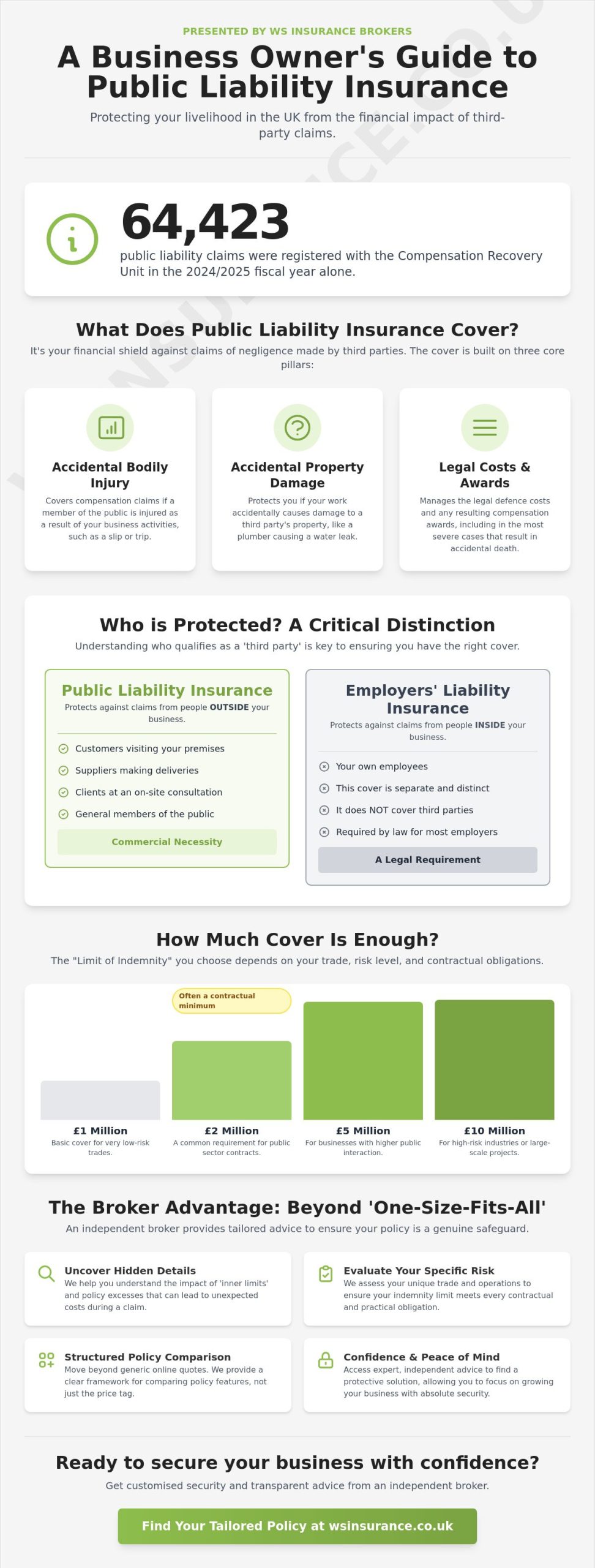
Did you know that 64,423 public liability claims were registered with the Compensation Recovery Unit in the 2024/2025 fiscal year? You likely recognise that protecting your livelihood is paramount, yet the dense jargon surrounding public liability insurance often feels more like a barrier than a bridge. It’s exhausting to face ‘one-size-fits-all’ online quotes that ignore your unique risks, especially when you’re unsure if a £2 million limit is a genuine safeguard or merely a box-ticking exercise for a specific contract.
This guide removes that uncertainty by showing you how to shield your business from the heavy financial impact of third-party claims without overpaying for unnecessary extras. Customised security. Transparent advice. Peace of mind. We’ll examine your specific risk exposure, provide a clear framework for comparing policy features; and ensure you have the confidence to choose a limit of indemnity that truly stands between you and a major claim. By distilling complex regulatory shifts into actionable advice, we provide the clarity you need to move forward with absolute security.
Key Takeaways
- Learn to distinguish between physical damage and financial loss so you don’t leave your business exposed by a misunderstanding of cover types.
- Evaluate your specific risk exposure against standard UK limits to ensure your chosen public liability insurance meets every contractual obligation.
- Uncover the impact of hidden ‘inner limits’ and policy excesses to prevent unexpected financial strain when it’s time to make a claim.
- Use a structured comparison framework to move beyond ‘one-size-fits-all’ quotes and secure a policy that’s tailored to your unique trade.
- Access the expertise of an independent broker to clear away market complexities and find a protective solution with absolute confidence.
The Foundation of Business Security: What is Public Liability Insurance?
Every business, regardless of its size or sector, operates within a web of human interaction. Whether you’re a consultant visiting a client’s office or a retailer welcoming shoppers into a physical store, you hold a fundamental “duty of care” to those around you. Public liability is the legal concept that holds your business accountable if this duty is breached. In simple terms, securing public liability insurance is the most proactive step you can take to ensure a single accident doesn’t lead to a catastrophic financial loss.
Who is a ‘Third Party’ in the Eyes of an Insurer?
Clarity is essential when defining who is actually protected under your policy. A ‘third party’ encompasses almost anyone who isn’t directly employed by your business. This includes your loyal customers, the suppliers delivering goods to your warehouse, and even random passers-by who might be affected by your operations. If a visiting consultant trips over a loose cable in your office, or a delivery driver is struck by a falling sign outside your premises, they are considered third parties. It’s vital to remember that whilst public liability insurance covers these external individuals, it does not cover your own staff. For anyone on your payroll, you’ll need Employers Liability Insurance, which is a strict legal requirement for any business with one or more employees.
Common Scenarios: When Public Liability Responds
The triggers for a claim are often mundane but the costs are anything but. The classic “slip and trip” incident remains the most frequent scenario; such as a customer sliding on a wet floor that wasn’t clearly marked with a warning sign. However, the cover is equally vital for tradespeople working on-site. If you’re a plumber and an accidental leak causes thousands of pounds in water damage to a client’s hardwood flooring, your policy is designed to respond. In the context of a 2026 UK legal claim, negligence is defined as a failure to exercise the level of care that a reasonable person would have exercised under the same circumstances, resulting in foreseeable harm or loss to another party.
Decoding the Differences: Public Liability vs. Other Key Covers
Identifying the right protection for your business often feels like a balancing act between comprehensive security and fiscal responsibility. Whilst public liability insurance serves as a robust shield against physical accidents, it is only one component of a resilient commercial portfolio. Confusion often arises because the boundaries between different types of cover can appear blurred to the untrained eye. According to the Association of British Insurers, selecting the correct arrangement of policies is essential to ensure that a claim in one area of your operations doesn’t leave you financially exposed in another.
The core distinction lies in the nature of the loss being claimed. Public liability focuses on physical outcomes; specifically bodily injury or tangible property damage. In contrast, other policies address financial losses stemming from errors in judgement or professional advice. Holding a public liability policy does not automatically grant you protection against these financial risks, nor does it satisfy specific legal mandates that apply to businesses with staff. Creating a robust defence requires a methodical approach to identifying these gaps before they are tested by a real-world incident. For a broader understanding of how all these covers fit together, our comprehensive guide to UK business insurance provides a complete framework for building a resilient commercial portfolio.
Public Liability vs. Employers’ Liability
The legal landscape in the UK makes a sharp distinction between the public and your workforce. Whilst public liability is technically optional for many, Employers’ Liability Insurance is a strict legal requirement under the Employers’ Liability (Compulsory Insurance) Act for almost any business with one or more employees. If you fail to hold a valid policy with a minimum cover of £5 million, the Health and Safety Executive (HSE) can impose fines of up to £2,500 for every single day you are uninsured. This cover specifically protects your staff; including full-time employees, part-time workers, and even some volunteers; if they suffer an injury or illness as a direct result of their work for you.
Public Liability vs. Professional Indemnity
Drawing a clear line between physical actions and professional advice is vital for long-term security. Consider a plumber: if they accidentally burst a pipe and flood a client’s kitchen, their public liability insurance responds to the property damage. However, if that same plumber provides a faulty central heating design that leads to a massive overspend on energy bills without any physical damage occurring, they would need Professional Indemnity Insurance to cover the resulting financial loss. This distinction is equally critical for recruitment agencies. They often require a blend of covers to protect against the physical actions of candidates on-site and the professional advice provided during the placement process. If you are unsure which combination best suits your trade, we can help you organise a tailored insurance review to eliminate any doubt.
Assessing Your Risk Exposure: How Much Cover is Enough?
Determining the appropriate “Limit of Indemnity” is often the most critical decision you’ll make when arranging your public liability insurance. In the UK, policies are typically structured around four standard tiers: £1 million, £2 million, £5 million, and £10 million. While the lower end might seem sufficient for a small office-based consultancy, it’s vital to adopt a “catastrophic claim” mindset. A single fire caused by a faulty laptop charger in a shared building could result in property damage and business interruption claims that far exceed a £1 million limit. This Small Business Administration guide to business insurance highlights how liability coverage serves as a fundamental shield against such unpredictable and potentially ruinous events.
Precision in selection is key. We move beyond ‘one-size-fits-all’ estimates by helping you evaluate the environment in which you operate. High-risk sites, such as construction zones or industrial facilities, require significantly higher limits than standard office spaces due to the potential severity of an incident. By conducting a thorough risk assessment, you can ensure your chosen limit is a genuine safeguard rather than a mere formality. This methodical approach removes the anxiety of being under-insured when you need protection the most.
Contractual Obligations and Tenders
Your choice of cover is often dictated by external forces rather than internal preference. Local authorities, government bodies, and large corporations frequently demand a minimum of £5 million or £10 million before they’ll consider your tender. These entities require a high level of security to protect their own interests. It’s also wise to check your lease agreement; landlords often stipulate specific liability requirements to protect the building’s fabric. As your business grows and you win larger contracts, you can easily scale your limit to match these new obligations. This flexibility allows your protection to evolve alongside your commercial success.
The Hidden Risks of High-Footfall Locations
The environment in which you operate significantly shifts your risk profile. High-footfall locations, such as retail centres or busy high streets, naturally increase the statistical likelihood of an incident occurring. If your premises are located within a listed building or near a heritage site, the cost of repairing property damage can be exponentially higher due to specialist materials and conservation requirements. In these instances, your public liability insurance needs to be carefully calibrated to account for both the volume of public interaction and the physical value of the surroundings. For a truly comprehensive approach to protecting your physical assets, you should also consider how this cover integrates with your Commercial Property Insurance to ensure no gaps remain in your defence.
The True Cost of a Claim: Why Cheap Policies Often Fail
Selecting a policy based on the lowest monthly premium is a gamble that rarely pays off when a crisis hits. Whilst it’s tempting to view public liability insurance as a commodity, the reality is that ‘off-the-shelf’ digital quotes often hide restrictive terms that can leave you financially stranded. Many entry-level policies contain subtle ‘Inner Limits’ on specialist equipment or specific claim types. These caps restrict the maximum payout for certain incidents to a fraction of your headline indemnity figure, potentially leaving you to cover a significant shortfall from your own reserves.
You must also scrutinise the policy excess. A low premium frequently masks a high compulsory excess; sometimes requiring you to pay the first £1,000 or £2,500 of any claim out of pocket. For a small business, this immediate cash-flow impact can be just as damaging as the incident itself. It’s equally vital to ensure your policy includes robust legal expenses cover alongside the indemnity limit. Whilst the indemnity handles the compensation awarded to the third party, legal expenses cover the costs of your own defence. Without this, you might find yourself funding an expensive legal battle to prove you weren’t negligent; even if the claim against you is eventually dropped.
The technical wording of your policy also dictates when you are protected. Most public liability policies are written on a ‘claims-occurring’ basis, meaning they cover incidents that happen whilst the policy is active. However, if you accidentally secure a ‘claims-made’ policy, you could be left exposed for incidents that occurred in the past but are only being reported now. This technical distinction is where a professional review becomes invaluable; ensuring your safety net has no hidden holes.
Exclusions You Must Look Out For
Standard online policies often include broad exclusions that render the cover useless for specific activities. Common examples include strict ‘Work at Height’ limits or ‘Use of Heat’ clauses that require unrealistic safety protocols to be met before a claim is valid. For those in trades or construction, exclusions regarding pollution or asbestos are frequent pitfalls that can invalidate your protection entirely. We take the time to identify these traps; ensuring your policy is calibrated to the actual work you perform rather than a generic industry template.
The Claims Process: Support vs. Automation
The first 48 hours after a third-party injury occurs are critical for gathering evidence and managing the narrative. A budget insurer will often direct you to an automated portal or an impersonal call centre, leaving you to navigate complex legal paperwork alone. In contrast, an independent broker acts as your diligent advocate and protective shield. We provide a steady hand during a disputed claim; managing the communication with the insurer and ensuring your business is treated fairly throughout the process. If you want to move beyond automated quotes and secure a policy built on integrity, request a comprehensive insurance review from our seasoned advisors.
The Broker Advantage: Navigating the UK Market with WS Insurance Brokers
Your business is dynamic, and your protection must keep pace. WS Insurance Brokers organises bespoke public liability insurance that’s designed to evolve alongside your commercial ambitions. Whether you’re winning larger contracts or expanding your physical footprint, we ensure your limit of indemnity remains sufficient to meet every new challenge. Having a dedicated expert to handle mid-term adjustments removes the administrative burden from your shoulders. If your circumstances change; you don’t need to navigate an impersonal phone tree or wait for a generic response. You simply contact your trusted advisor; who will update your protection with precision, speed, and integrity.
Removing Uncertainty from the Selection Process
Our methodical approach to risk assessment identifies potential gaps in your defence before they become financial liabilities. We pride ourselves on transparency; translating complex regulatory jargon into clear, actionable protection that you can actually understand. In an era of shifting compliance and economic flux, WS Insurance Brokers provides a steady hand that guides your business through market volatility with calm reliability. We eliminate the doubt that often accompanies insurance renewals; replacing it with the confidence that comes from professional tenure and a lack of bias. This consultative process ensures that every detail of your exposure is addressed with clinical precision.
Securing Your Long-Term Business Future
Our commitment to your security extends far beyond the initial placement of your policy. We provide ongoing support and proactive risk management advice to help you maintain a resilient commercial profile as you scale. With regional expertise rooted in our London, Bristol, and Exeter offices, we combine localised accessibility with a national reach to serve clients across the UK. We remain fiercely loyal to your interests; acting as a protective shield in a complex financial landscape. Contact our expert team today for a transparent review of your liability cover.
Building a Resilient Future with Absolute Confidence
We have explored the vital importance of distinguishing between physical damage and professional advice; alongside the necessity of aligning your indemnity limits with both contractual obligations and genuine risk exposure. By moving beyond generic online quotes and identifying hidden exclusions, you ensure your business remains shielded from the financial impact of unforeseen incidents. Selecting the right public liability insurance isn’t just a box-ticking exercise; it’s a strategic commitment to your long-term security.
As an FCA authorised and regulated firm, we provide independent ‘whole of market’ access to ensure your protection is never limited by a single insurer’s restricted options. Our team offers dedicated claims advocacy and support, acting as your expert guide through every market complexity. Request a bespoke public liability insurance quote from our expert brokers to remove any remaining uncertainty from your selection process. Your hard work deserves a safety net built with precision and integrity, and we’re here to ensure you move forward with total peace of mind.
Frequently Asked Questions
Is public liability insurance a legal requirement for UK businesses?
Public liability insurance is not a general legal requirement for most UK businesses, although it is often a contractual necessity for securing projects with government bodies or large corporations. The only exception where it is legally mandated is for horse riding establishments. Whilst not required by law, failing to hold cover can prevent you from winning tenders or accessing specific trade associations. It remains a fundamental pillar of professional risk management.
How much does public liability insurance cost on average in 2026?
The cost of your policy is determined by several specific factors; including your annual turnover, the nature of your trade, and your level of interaction with the public. High-risk industries like construction typically see different premium structures than office-based consultancies due to the increased likelihood of an incident. We recommend understanding how much public liability insurance costs for your specific trade to ensure your premium reflects your actual risk profile rather than a generic industry average that might not fit your needs.
Can I get public liability insurance for a one-off event?
You can certainly arrange protection for a specific one-off event if you don’t require an annual policy. This is particularly useful for organisers of festivals, exhibitions, or pop-up shops who need temporary security against third-party claims. It provides the same essential accidental injury and property damage cover as a standard policy but is limited to the duration of your specific event. This ensures you only pay for the protection you actually need.
Does public liability insurance cover my own tools and equipment?
A standard public liability policy does not cover your own tools, stock, or business equipment. Its primary purpose is to protect you against claims made by third parties for injury or damage to their property. If you need to protect your own assets, you should consider adding specific covers such as Commercial Property Insurance or specialist tools cover to your portfolio. This ensures your livelihood is protected from both external liabilities and internal losses.
What is the difference between ‘Limit of Indemnity’ and ‘Aggregate Limit’?
The ‘Limit of Indemnity’ is the maximum amount your insurer will pay for a single claim, whilst the ‘Aggregate Limit’ is the total amount they will pay across all claims during the policy year. For example, if you have a £5 million limit of indemnity “any one claim,” each incident is covered up to that amount. Understanding these definitions is vital to ensure your business isn’t left exposed after multiple smaller incidents occur within the same period.
Does public liability cover me if I am working at a client’s home?
Your protection follows your business activities wherever they occur, including work carried out at a client’s private residence. If you accidentally damage a customer’s property or cause an injury whilst working in their home, your public liability insurance is designed to respond. It’s essential to ensure your broker is aware of the specific environments you work in so your policy is accurately calibrated to those locations and the risks associated with them.
How do I prove I have public liability insurance to a potential client?
You can prove your cover by providing a potential client with your ‘Certificate of Insurance,’ which outlines your indemnity limits and the policy expiry date. Most clients or main contractors will request this document before allowing you on-site or signing a contract. We provide digital copies of these documents promptly; ensuring you have the evidence needed to demonstrate your professional standing and secure new business opportunities without any unnecessary administrative delay.
What happens if I don’t have public liability insurance and a claim is made?
If a claim is made against you without a valid policy in place, your business is directly responsible for all legal defence costs and any resulting compensation awards. These expenses can easily reach tens of thousands of pounds; potentially leading to insolvency for smaller firms. Without public liability insurance, you also lose the benefit of professional claims advocacy, leaving you to navigate complex legal proceedings and negotiations entirely on your own during a crisis. To understand how public liability fits within the full spectrum of protection your enterprise requires, explore our 2026 comprehensive guide to UK business insurance for a complete overview of your commercial protection options.