
What if the insurance payout you’re counting on to save your business is based on a definition of ‘Gross Profit’ that doesn’t actually match your accounting books? It’s a common source of anxiety for business owners who worry that an indemnity period might be too short or that a complex claims process will stall their recovery. You deserve absolute clarity on what is actually being protected, rather than just hoping for the best when the unexpected occurs.
Partnering with specialist business interruption insurance brokers uk provides the clinical precision needed to bridge this gap, transforming a complex financial product into a reliable safety net. You’ll discover how a dedicated advisor navigates the intricacies of the 2026 market, including the FCA’s Consumer Duty, to ensure your cash flow remains uninterrupted whilst you recover. This article explains how expert advocacy secures a policy reflecting your actual recovery timeline, ensuring you aren’t left vulnerable by outdated wording or insufficient coverage periods.
Key Takeaways
- Understand the critical distinction between property damage and the resulting financial shortfall to ensure your cash flow remains resilient following an incident.
- Avoid the common ’12-month trap’ by learning how to accurately define an indemnity period that covers your entire recovery journey rather than just the initial rebuild.
- Gain access to the whole of the market through business interruption insurance brokers uk, securing bespoke policy wording that standard comparison sites cannot provide.
- Establish long-term security by choosing an independent, FCA-authorised advisor who prioritises your interests and removes uncertainty from the claims process.
What is Business Interruption Insurance and Why Does it Matter?
Business interruption insurance is the protective mechanism that bridges the gap between a physical disaster and your business’s return to normality. Whilst standard commercial property insurance covers the “bricks and mortar”, it doesn’t address the lost revenue or ongoing bills that continue to mount while your doors are closed. It’s essentially a survival strategy designed to restore your financial position to exactly where it would’ve been had the loss never occurred. Without this cover, the physical repair of your building might be a hollow victory if you’ve lost your customer base in the meantime.
Most policies operate under what is known as the ‘Material Damage Proviso’. This technical requirement ensures that the physical damage causing the disruption is actually covered by a property policy before the business interruption claim can proceed. It’s a logical safeguard; the insurer needs to know that the funds are available to repair the damage, as this is the primary catalyst for getting your business trading again. Working with business interruption insurance brokers uk ensures this alignment is handled with precision, preventing a situation where a claim is rejected due to a lack of underlying property cover.
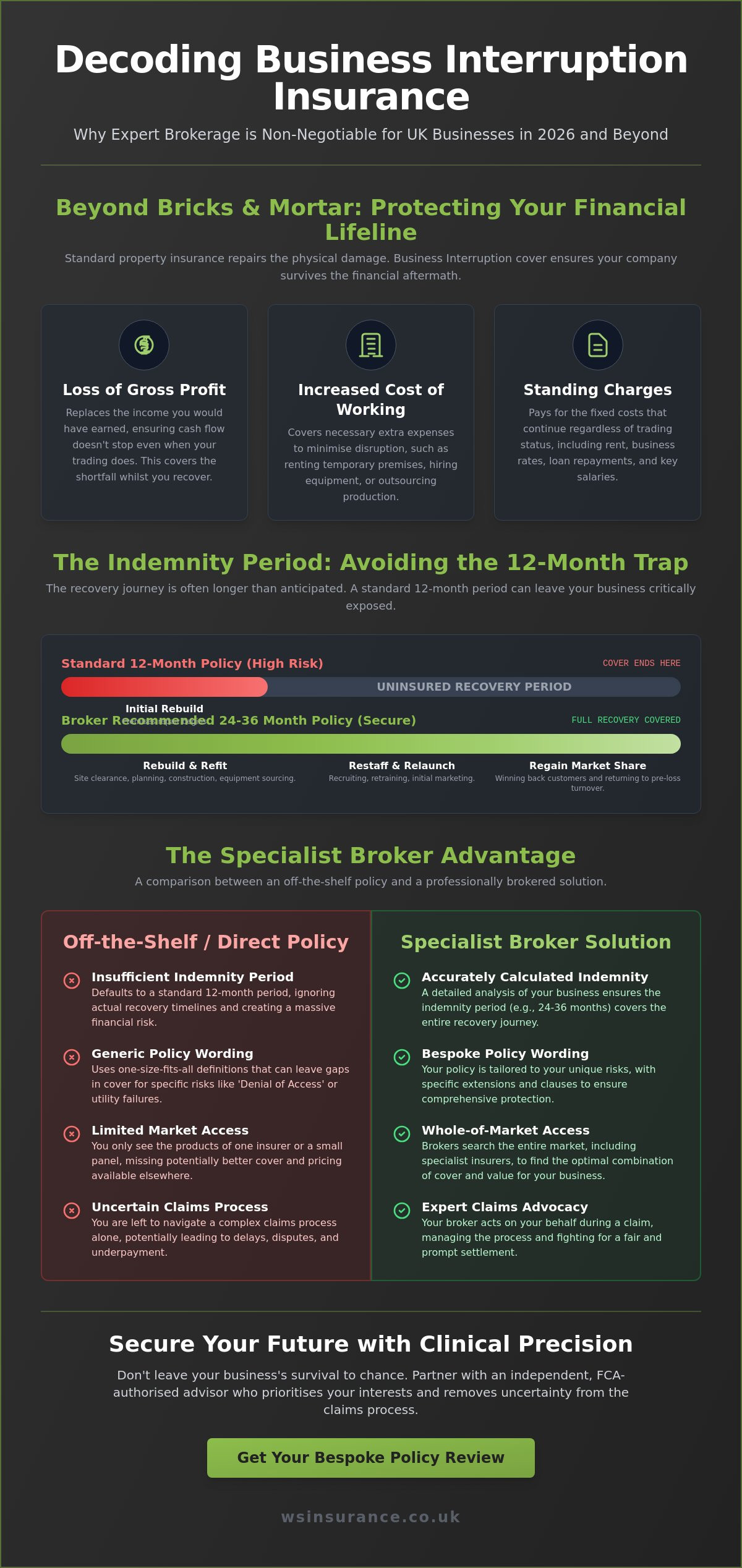
A comprehensive policy typically focuses on three key financial pillars:
- Loss of Gross Profit: This replaces the actual income lost during the downtime, adjusted for variable expenses.
- Increased Cost of Working (ICW): This covers the extra costs you incur to minimise the loss of turnover, such as renting temporary office space or outsourcing production.
- Standing Charges: These are the fixed costs, like rent, business rates, and loan repayments, that you must continue to pay regardless of your trading status.
Beyond Property Damage: The Financial Impact
Common Triggers for a Business Interruption Claim
Fire, flood, and storm damage remain the most frequent catalysts for claims. However, modern risks require more than basic cover. Specialist business interruption insurance brokers uk often recommend extensions like ‘Denial of Access’, which protects you if the emergency services cordon off your street, or ‘Utilities’ cover for prolonged power outages. Relying on off-the-shelf solutions often leaves these gaps wide open. Bespoke wording provides a shield against the specific complexities of your industry, ensuring that you aren’t caught out by a narrow definition of what constitutes a ‘loss’.
The Indemnity Period: Avoiding the 12-Month Trap
The indemnity period represents the maximum duration your insurer will compensate you for lost revenue or increased costs. It’s often the most misunderstood element of these policies. Many SMEs fall into the trap of selecting a standard 12-month period, assuming a year is plenty of time to get back on their feet. In reality, the 2026 landscape presents hurdles that make this timeframe highly optimistic. Between clearing a damaged site, navigating local planning permission, and dealing with extended lead times for specialist equipment, a year can vanish before you’ve even laid a new foundation. Expert business interruption insurance brokers uk typically suggest that a 24 or 36-month period is the only way to guarantee your cash flow remains secure until you reach your former trading levels.
The Financial Conduct Authority (FCA) has consistently highlighted the importance of clarity in policy wording, particularly regarding how long a business is protected. This regulatory focus ensures that brokers must act as a shield, helping you avoid periods that are too short for a full recovery. If your cover stops at the one-year mark but your factory isn’t operational, you’re left to fund the remaining recovery yourself, which can lead to permanent closure.
Calculating the Right Duration for Your Business
You must look beyond the physical rebuild when assessing your needs. Consider the time required to recruit and retrain staff if they’ve moved on during the closure. If your business relies on a specific ‘centre’ or location, finding a comparable alternative in a tight commercial property market can take months. Seasonal businesses face even greater risks; missing a peak trading window can mean your recovery takes an extra twelve months just to reach the next cycle. We help you map these variables to find a duration that offers true security.
Gross Profit vs. Revenue: Getting the Sums Right
Misinterpreting the definition of ‘Gross Profit’ is a leading cause of claim disputes. An accountant’s definition usually subtracts all variable costs, but an insurance policy definition is often much narrower, only allowing for specific ‘uninsured working expenses’ like raw materials. If you declare a figure based on your tax returns, you might be significantly underinsured. This triggers the ‘Average’ clause, where the insurer only pays a fraction of your actual loss. Opting for a ‘Declaration Linked’ policy provides an uplift on your sum insured, offering a vital safety net if your business grows faster than expected. Seeking specialist business interruption insurance guidance ensures these calculations are precise, removing the fear of a reduced payout.
Why Use Business Interruption Insurance Brokers in the UK?
Selecting the right protection requires more than a simple price comparison; it demands a deep understanding of how your specific revenue streams operate. Unlike automated comparison sites that rely on restricted panels, business interruption insurance brokers uk provide access to the ‘whole of market’. This autonomy allows them to source bespoke wording and niche providers that aren’t available to the general public. Forbes explains business interruption coverage as a vital tool for managing the financial consequences of a disaster, yet the effectiveness of that tool depends entirely on how well the policy is aligned with your unique risks.
Expert risk assessment is the cornerstone of a broker’s value. They act as a steady hand, identifying hidden vulnerabilities in your supply chain that you might have overlooked. For example, a broker might highlight your reliance on a single specialist supplier or a specific utility hub. They also serve as an essential guide through the industry’s complex jargon. Many business owners struggle to distinguish between ‘Increased Cost of Working’ (ICW) and ‘Additional Increased Cost of Working’ (AICW). A broker ensures you understand that ICW is specifically for costs that reduce your loss of turnover, whilst AICW offers broader flexibility to keep your business operational even if the expenditure doesn’t result in an immediate pound-for-pound saving.
Bespoke Wording vs. Off-the-Shelf Policies
A standard business insurance policy often contains generic clauses that may not reflect the operational reality of sectors like recruitment, technology, or construction. Off-the-shelf products frequently carry ‘silent’ exclusions or narrow definitions of ‘denial of access’ that can lead to a claim being declined. An independent broker uses their industry standing to challenge these restrictive terms, negotiating with underwriters to secure tailored clauses. This proactive labour results in a policy that acts as a precise shield, ensuring your specific recovery needs are met without compromise.
The Claims Process: Your Professional Advocate
The true strength of business interruption insurance brokers uk is most visible during a claim. When a disaster strikes, the process of proving a financial loss is incredibly demanding and requires meticulous documentation. Your broker acts as a professional advocate, standing between you and the insurer’s loss adjuster to ensure your interests are protected. They focus on securing interim payments to maintain your business’s cash flow, preventing a temporary closure from becoming a permanent failure. This expert representation removes the anxiety from the process, providing the peace of mind you need to focus on your team and your customers.
Choosing Your Broker: What to Look For
Selecting a partner to protect your revenue is a decision that requires careful scrutiny. You aren’t just buying a policy; you’re appointing a shield between your business and financial ruin. The best business interruption insurance brokers uk act as expert guides, prioritising your long-term security over a quick transaction. Independence is the first trait to verify. An unbiased broker is fiercely loyal to you rather than the insurer, utilising their autonomy to scour the breadth of the market for the most protective terms. This lack of bias ensures that the advice you receive is focused purely on your recovery needs, removing the pressure found in sales-driven environments.
Regulatory standing provides the foundation for this trust. Always verify that a firm is authorised and regulated by the Financial Conduct Authority (FCA). This authorisation is more than a legal requirement; it’s a badge of professional integrity that ensures the broker adheres to strict standards of conduct and client protection. Alongside this, look for a proven tenure in commercial risk. A broker with extensive industry experience has likely handled diverse claims and understands the nuances of various sectors, from manufacturing to retail. Transparency regarding fee structures and commission models is equally vital. A professional advisor will always be upfront about how they are remunerated, eliminating doubt and fostering a relationship built on honesty. For company directors and senior managers, this same principle of comprehensive protection extends beyond business interruption to encompass personal liability, making it equally important to consider directors and officers insurance UK as part of a complete commercial risk strategy.
National Reach with a Personal Touch
Your broker should offer the best of both worlds: the clout to negotiate with major UK insurers like Allianz and AXA, and the accessibility of a local partner. This “Trusted Advisor” approach is a world away from the impersonal nature of automated call centres. When you have a complex commercial property insurance portfolio, you need an expert who understands how your buildings and your income protection must work in tandem. This integrated view ensures there are no gaps in your safety net during a crisis, providing a steady hand when you need it most.
Questions to Ask Your Potential Insurance Partner
Before committing, it’s prudent to conduct a brief consultation with these specific questions to gauge their suitability:
- How do you calculate the suggested sum insured for my specific sector? This tests their technical knowledge of the ‘Gross Profit’ definitions discussed earlier in this guide.
- Can you provide examples of how you’ve handled BI claims in the past? Experience in the trenches is the ultimate proof of a broker’s value as an advocate.
- What level of ongoing support do you provide throughout the policy year? You need a partner who is available for mid-term adjustments, not just at the point of renewal.
If you’re ready to secure your business’s future with an advisor who puts your interests first, speak with our independent brokers for a comprehensive review of your requirements.
Secure Your Future with WS Insurance Brokers
At WS Insurance Brokers, our core philosophy is built on the removal of uncertainty and the elimination of doubt for every client we serve. We understand that your revenue isn’t just a number on a balance sheet; it’s the lifeblood of your organisation and the foundation of your future growth. As independent business interruption insurance brokers uk, we act as a protective shield between your business and the complexities of the global insurance market. Our methodical, consultative approach ensures that we don’t just provide a policy, but rather construct a survival strategy that prioritises your long-term security over a simple transaction.
Our autonomy remains our greatest badge of honour. By maintaining access to the entire breadth of the UK insurance market, we source bespoke wording and competitive rates that restricted competitors simply cannot reach. This whole-of-market access allows us to secure comprehensive protection that aligns perfectly with your operational reality. When a crisis occurs, our dedicated claims support team becomes your professional advocate. We stand by your side to manage the intricate documentation and negotiate with loss adjusters, ensuring your cash flow remains resilient whilst you focus on the practicalities of recovery.
The WS Insurance Difference: Clarity and Precision
We believe that transparency is the only way to build lasting trust, especially in a landscape governed by the FCA’s Consumer Duty. Our advisors take the time to assess your specific risk profile, identifying hidden vulnerabilities that standard off-the-shelf products often ignore. We strip away the complex jargon that often surrounds financial services, replacing it with clear, benefit-driven advice that you can actually use. This focus on precision and clinical detail is why businesses across the UK rely on us as their expert guide. We treat your security as our own, providing a steady hand in a market that can often feel impersonal and automated.
Getting Started: Your Professional Consultation
The journey to total peace of mind begins with a thorough, professional review of your current arrangements. We help you move past the confusion of ‘Gross Profit’ definitions and the dangers of insufficient indemnity periods that we explored earlier. Our team works alongside you to calculate accurate sums insured that reflect your actual recovery timeline, not just a generic industry estimate. If you’re looking for a partnership based on integrity and expert advocacy, reach out to us today. We’re ready to provide the personal, localised communication you need to ensure your revenue remains secure, no matter what the future holds.
Protecting Your Revenue in an Uncertain Future
Securing the long-term resilience of your business requires a shift from viewing insurance as a commodity to seeing it as a survival strategy. By accurately defining your financial vulnerabilities and extending indemnity periods beyond the standard 12-month trap, you ensure your recovery isn’t cut short by technicalities. Specialist business interruption insurance brokers uk provide the clinical precision needed to align your policy with your actual trading patterns, acting as a shield against the complexities of the 2026 market.
Since 2012, our team has provided independent and unbiased advice, acting as a steady hand for clients across the country. As an FCA Authorised and Regulated firm with access to major UK insurers, we focus on removing uncertainty and eliminating doubt at every stage of the process. Your revenue is the lifeblood of your company; it deserves the protection of an expert guide who prioritises your security. Secure your business’s future with a bespoke consultation from WS Insurance Brokers and gain the clarity you need to move forward with confidence. We’re here to help you build a more resilient tomorrow.
Frequently Asked Questions
Is business interruption insurance a legal requirement in the UK?
Business interruption insurance is not a legal requirement for UK companies, unlike Employers Liability insurance. While the law doesn’t mandate it, most commercial lenders and landlords require proof of cover as a condition of your lease or loan agreement. It acts as a vital survival tool that provides the liquidity needed to pay staff and fixed costs even when your trading is temporarily impossible.
How long should my business interruption indemnity period be?
Your indemnity period should reflect the total time required for your revenue to return to pre-loss levels, not just the time needed for physical repairs. While a 12-month period is often the standard offering, many UK SMEs find that 24 or 36 months is necessary to account for planning permission delays and specialist equipment lead times. A steady hand from your broker helps you calculate a duration that eliminates the risk of cover ending prematurely.
What is the difference between Gross Profit and Increased Cost of Working?
Gross Profit cover replaces the actual income lost following a disaster, whereas Increased Cost of Working (ICW) pays for the additional expenses incurred to maintain turnover. For example, ICW might fund the rental of temporary premises or the outsourcing of production to avoid losing key clients to competitors. Understanding this distinction is crucial for ensuring your policy protects both your bottom line and your ongoing operational capacity during a recovery.
Can I buy business interruption insurance as a standalone policy?
It is rare to find business interruption insurance as a standalone product because most policies require a ‘Material Damage Proviso’ to be met. This means that a physical loss, such as fire or flood, must be covered by a property policy before the interruption claim can be triggered. Most business interruption insurance brokers uk will arrange this cover as part of a comprehensive commercial package to ensure all triggers are correctly aligned.
Does business interruption insurance cover pandemics or cyber attacks?
Most modern policies now include explicit exclusions for pandemics following the landmark legal cases of recent years. Similarly, while some traditional policies offer limited extensions, a dedicated Cyber & Data Breach Insurance policy is typically required to protect against revenue loss caused by digital attacks. We help you review your policy wording to identify exactly what is included, ensuring you aren’t left vulnerable to these specific modern risks.
How much does business interruption insurance typically cost?
The cost of your cover is determined by several factors, including your annual turnover, your industry’s risk profile, and the length of your chosen indemnity period. Premiums are also influenced by the specific extensions you require, such as ‘Denial of Access’ or ‘Utilities’ cover. Because every business is unique, we focus on sourcing a bespoke solution that offers fair value and clinical precision rather than providing a generic price.
What happens if I have underinsured my business’s gross profit?
If you underinsure your gross profit, the ‘Condition of Average’ will likely be applied to your claim, resulting in a significantly reduced payout. This means if you only insure 50% of the true value, the insurer may only pay 50% of your loss, regardless of the claim’s size. Specialist business interruption insurance brokers uk work to prevent this outcome by ensuring your sums insured are calculated with absolute accuracy and transparency.
How do I make a claim on my business interruption insurance?
You should contact your broker as soon as an incident occurs to begin the claims process. Your advisor will act as your professional advocate, helping you organise the complex financial documentation required to prove your loss of income. They focus on securing interim payments from the insurer to maintain your cash flow, acting as a shield between you and the loss adjuster whilst you concentrate on rebuilding your business.