
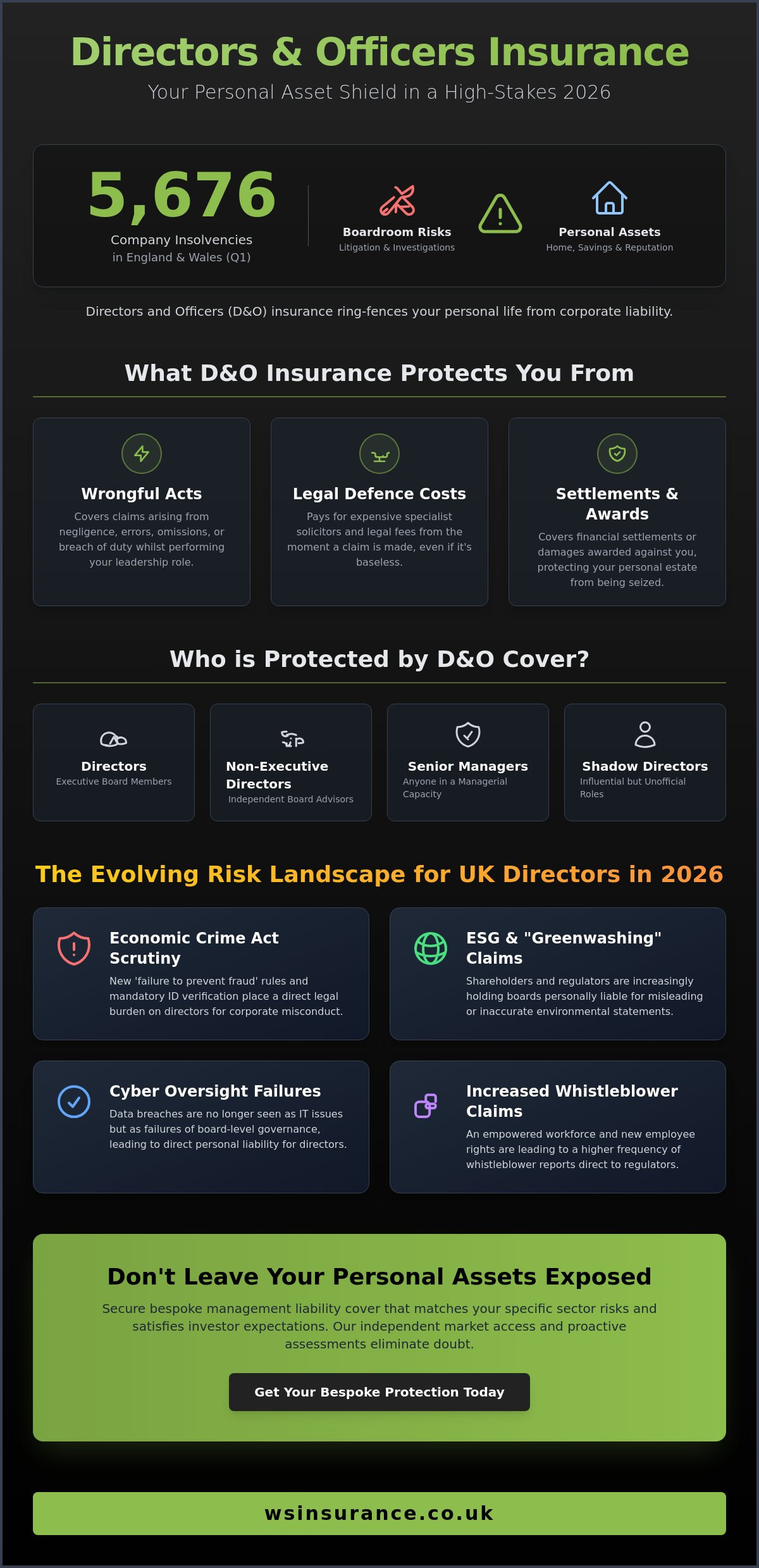
Your family home, your life savings, and your professional reputation shouldn’t be the collateral for a single corporate decision. In 2026, the boundary between company liability and personal accountability has never been thinner, especially with 5,676 company insolvencies recorded in England and Wales in the first quarter alone. Securing robust directors and officers insurance UK isn’t just a corporate formality; it’s the vital shield that ring-fences your private life from the boardroom’s legal storms.
It’s understandable if you’re feeling the pressure of the Economic Crime and Corporate Transparency Act or the expanded employee rights that arrived this April. We’ve analysed these complex regulatory shifts to provide you with a clear, protective roadmap. You’ll learn how to safeguard your personal assets against litigation, understand why the 3.75% base rate is shifting the claims landscape, and find a precise framework for choosing your indemnity limits. This guide removes the uncertainty from management liability, giving you the security to lead with absolute confidence.
Key Takeaways
- Understand how management liability products ring-fence your personal assets from corporate legal actions amidst 2026’s heightened regulatory scrutiny.
- Identify the crucial differences between “advice” and “management” risks to ensure your board is fully protected against individual litigation.
- Learn to distinguish directors and officers insurance UK from other essential pillars like Public Liability to ensure there are no gaps in your professional defence.
- Master the framework for determining precise indemnity limits that satisfy both your specific sector risks and venture capital expectations.
- Discover how independent market access and proactive risk assessments eliminate doubt when securing bespoke cover for your leadership team.
What is Directors and Officers Insurance (D&O)?
Directors and officers insurance UK is a specialised management liability policy designed to shield the personal assets of those leading a business. Whilst many professionals assume that the “limited” status of a UK company provides a total safety net, this protection rarely extends to the individuals making the decisions. If a director is accused of a “wrongful act,” they face personal liability that can lead to financial ruin. D&O cover acts as a vital financial buffer, paying for expensive legal defence costs and any resulting settlements. For a broader overview of the policy’s history and typical claim types, Wikipedia’s guide to D&O insurance provides an excellent starting point for understanding these complex protections.
This insurance is fundamentally different from other commercial lines because it focuses on the person, not just the entity. When you’re facing a legal challenge, the costs of hiring specialist solicitors can quickly exceed a company’s available cash flow. Without this cover, you might be forced to fund your own defence using personal savings or home equity. D&O insurance removes this anxiety, ensuring that your livelihood remains ring-fenced from the risks inherent in corporate leadership.
The Legal Basis: Why Directors are Personally At Risk
The Companies Act 2006 remains the bedrock of director accountability in the UK. It outlines seven statutory duties, including the requirement to promote the success of the company and to exercise reasonable care, skill, and diligence. A “wrongful act” isn’t limited to deliberate fraud; it often includes simple negligence, errors, or omissions. Shareholders, creditors, or regulators like the Financial Conduct Authority (FCA) can bring claims against you for these failings. Since your liability as a director is potentially unlimited, these claims can target your personal estate directly. Our role is to act as a protective shield, managing the complexities of these legal requirements so you can focus on your board’s objectives.
Who Qualifies as an “Officer” in a UK Business?
A common misconception is that this cover only applies to those with “Director” in their job title. Modern directors and officers insurance UK policies are much broader. They often include a “Managerial Capacity” clause that extends protection to senior managers and supervisors who make high-level decisions. This is crucial because UK law can hold anyone acting in a leadership role accountable for the company’s conduct. Coverage also typically protects:
- Non-executive directors: Who carry the same legal weight as executive members.
- Shadow directors: Individuals whose instructions the board is accustomed to following.
- Senior employees: Those involved in regulatory oversight or compliance roles.
By identifying every person in your organisation who carries managerial risk, we eliminate the doubt that often plagues standard insurance packages. We ensure that your entire leadership structure is fortified against individual litigation, providing a steady hand in an increasingly complex market.
The Evolving Risk Landscape for UK Directors in 2026
The landscape of corporate leadership has shifted significantly as we move through mid-2026. Directors now face a convergence of environmental accountability, technological risk, and an increasingly vigilant regulatory environment. One of the most prominent shifts involves the Economic Crime and Corporate Transparency Act. Since the implementation of mandatory identity verification in November 2025 and the “failure to prevent fraud” offence that came into force in September 2025, the legal burden on individuals has reached a peak. High-quality directors and officers insurance UK is no longer just about court settlements; it’s about managing the exhaustive costs of being under the microscope.
ESG reporting has also moved from voluntary disclosure to a primary source of litigation. We are seeing a rise in “greenwashing” claims where shareholders hold boards personally responsible for misleading environmental statements. Similarly, “Cyber Oversight” has become a 2026 focal point. Regulators no longer view data breaches as mere IT failures but as a failure of board-level governance. If you haven’t demonstrated proactive security leadership, you could be held personally liable for the fallout of a breach. Cultural shifts have also led to an increased frequency of whistleblower claims, with employees feeling more empowered to report perceived corporate failings directly to regulators. Understanding how to systematically approach the full spectrum of business risks to insure against — from AI-driven liabilities to complex supply chain failures — is an essential first step for any board seeking to close coverage gaps before they become costly.
Regulatory Scrutiny and Investigation Costs
The financial impact of a regulatory probe often begins long before a fine is even considered. Defence costs for investigations by bodies like the Health and Safety Executive (HSE) can be staggering. The HSE has sharpened its focus on senior accountability, meaning directors are frequently the primary targets of inquiry. According to the Association of British Insurers guide, D&O policies are essential because they often trigger at this early investigation stage. This early intervention is critical for protecting your reputation and your personal finances before a formal suit is even filed.
Employment Practice Violations
The Employment Rights Act 2025 has fundamentally altered the relationship between directors and their workforce. With the abolition of the Statutory Sick Pay waiting period and the introduction of day-one rights for paternity leave as of April 2026, the room for administrative error has grown. We are seeing a surge in allegations of discrimination brought directly against individual managers. Whilst many businesses rely on standalone Employment Practices Liability (EPL) cover, modern directors and officers insurance UK often includes “Entity Cover” to provide a seamless shield for the company itself. If you are concerned about how these legislative shifts affect your board, speaking with an independent advisor can help clarify your current level of protection.
Differentiating D&O from Other Commercial Liability Covers
A robust suite of business insurance is the foundation of any resilient company, yet many directors mistakenly believe that general liability policies offer personal protection. Public Liability insurance, for instance, focuses on physical injury or property damage caused to third parties. Whilst essential for operational safety, it does nothing to shield a director’s private bank account from a claim regarding financial mismanagement. Similarly, Employers Liability is a legal requirement to cover staff illness or injury, but it won’t prevent a liquidator from pursuing a director’s personal assets if they’ve breached their fiduciary duties. Directors and officers insurance UK exists specifically to fill these gaps, acting as a personal safety net that other commercial covers simply aren’t designed to provide.
Understanding how these policies sit alongside each other is vital for eliminating doubt. We often see boards that are well-insured against external accidents but completely exposed to internal governance failures. By layering your protection correctly, you ensure that the company’s balance sheet and your individual livelihood are both fortified against different types of legal storms.
D&O vs. Professional Indemnity
The distinction between Professional Indemnity (PI) and D&O often causes confusion, but the difference lies in the nature of the “wrongful act.” PI insurance covers the professional services or advice you provide to clients. If a recruitment agency provides a candidate with falsified qualifications, the resulting client loss falls under PI. However, if that same agency’s board fails to monitor the company’s cash flow, leading to a loss for shareholders, directors and officers insurance UK would be the relevant cover. Professional Indemnity addresses the breach of a professional duty owed to a client, whereas D&O addresses the breach of a fiduciary duty owed to the company and its stakeholders. Recruiters and consultants often need both because their risks are split between the quality of their work and the governance of their business entity.
The Relationship with Landlord and Property Risks
Directors of property management companies or Right to Manage (RTM) organisations face a unique set of exposures. Whilst you might already understand what does landlord insurance cover uk, those policies typically protect the physical building and the landlord’s liability as a property owner. They don’t protect the individuals making the decisions about service charges, maintenance contracts, or health and safety compliance. If leaseholders allege that an RTM director has mismanaged the sinking fund or failed to adequately maintain the premises, that director can be held personally accountable. In these scenarios, D&O cover provides the steady hand needed to navigate disputes without risking your own home or savings.
Determining the Correct Indemnity Limits for Your Board
Selecting the right indemnity limit for directors and officers insurance UK requires a methodical approach that balances your firm’s turnover with its specific risk profile. There is no one-size-fits-all figure. A small private company might find a £1 million limit sufficient, whilst a firm with complex supply chains or international operations may require significantly more. If your organisation is seeking venture capital or external funding, you’ll often find that investors mandate specific, higher limits as a condition of their support. These requirements are designed to protect their investment from being drained by legal defence costs before the business can scale.
The structure of your policy also dictates your level of security. Policies are typically written on an “Aggregate” basis, meaning the limit is the total amount available for all claims within a single year. In contrast, an “Any One Claim” structure provides the full limit for every individual notification. For boards facing multiple potential threats, the latter offers superior peace of mind. We also prioritise the inclusion of “Run-off Cover.” This ensures that retired directors remain protected against claims relating to their past decisions for several years after they’ve left the board, effectively ring-fencing their retirement savings from delayed litigation.
Factors That Influence D&O Premiums
Insurers look for stability and transparency when calculating your premium. A clean balance sheet and a consistent history of financial health suggest a lower risk of insolvency-related claims. Conversely, if your business has significant jurisdictional reach, particularly in the United States, you can expect higher costs due to the litigious nature of the American legal system. We work to present your risk in the best possible light, using our access to the entire market to secure favourable terms that reflect your proactive management style and eliminate unnecessary doubt.
The Danger of Underinsurance
Opting for the cheapest available limit is often a false economy. Legal inflation in the UK is rising, and a single complex regulatory investigation or shareholder dispute can exhaust a £1 million limit surprisingly quickly once specialist solicitor fees are tallied. This is why we advocate for a wider view of financial resilience. Working with business interruption insurance brokers uk can help you understand how different risks overlap, ensuring your board isn’t left exposed when a crisis hits. Underestimating your potential liability doesn’t just threaten the company; it places your personal assets at the centre of the storm.
If you’re unsure whether your current limits are fit for purpose, contact our expert team today for a comprehensive review of your management liability requirements.
Securing Bespoke Management Liability with WS Insurance Brokers
Choosing the right directors and officers insurance UK shouldn’t be a source of anxiety for your board. At WS Insurance Brokers, we position ourselves as a steady hand, acting as a shield between your personal assets and the complexities of the 2026 legal environment. Our approach is fundamentally consultative; we prioritise your long-term security over the immediate transaction. By conducting a proactive risk assessment, we eliminate the doubt that often accompanies standard insurance renewals, ensuring your leadership team can operate with absolute clarity and confidence.
The Independent Broker Advantage
Unlike direct insurers who are restricted to their own limited products, our independence is a badge of honour. We have access to the entire breadth of the UK market, allowing us to source bespoke wordings that “off-the-shelf” policies simply cannot match. This autonomy ensures that we’re fiercely loyal to you, not the service provider. We look for restrictive exclusions that could leave you exposed during a crisis and negotiate terms that reflect your specific boardroom dynamics. Transparency is at the heart of our service, from our clear fee structures to the way we manage your policy year-round. This diligent approach acts as a protective layer between your board and the complexities of the broader insurance market.
Having a dedicated claims advocate is perhaps the most significant benefit of our partnership. If a notification occurs, you aren’t left to face an automated corporate system or a generic call centre alone. We act as your seasoned professional representative, managing the dialogue with insurers and legal teams to ensure your defence is robustly funded from the outset. This level of personal accessibility contrasts with the impersonal nature of large, automated corporations and provides the calm reliability you need when your professional reputation is on the line.
Next Steps: Protecting Your Professional Legacy
Securing your future begins with a methodical review of your current exposures. We encourage a holistic look at your entire insurance stack, from your management liability to your commercial property insurance, to ensure no gaps exist in your defence. Our process is logical and structured, beginning with an identification of your unique risks and concluding with a tailored protective outcome that ring-fences your private life from corporate legal storms.
Your professional legacy is too valuable to leave to chance. Contact WS Insurance Brokers for a confidential D&O review to begin the journey toward total boardroom security and the elimination of management liability uncertainty.
Fortifying Your Board for the Future
The corporate landscape of 2026 demands more than just strategic vision; it requires a robust defensive framework that separates your personal livelihood from boardroom risks. We’ve explored how the Economic Crime and Corporate Transparency Act and shifting employment laws have heightened individual accountability. By establishing clear indemnity limits and understanding the critical boundary between professional advice and management duty, you can lead with absolute certainty. Protecting your home and savings shouldn’t be an afterthought whilst you navigate the complexities of modern UK regulation.
Securing the right directors and officers insurance UK isn’t a task you should face alone. As an independent partner, WS Insurance Brokers provides access to the entire UK market to ensure your cover is bespoke and comprehensive. We’re Authorised and Regulated by the Financial Conduct Authority, offering the steady hand of a dedicated claims advocate to protect your professional legacy. Our role is to act as a shield, removing the anxiety from the selection process so you can focus on the growth and success of your organisation.
Don’t leave your personal assets to chance in an increasingly litigious environment. Request a Bespoke D&O Insurance Consultation today to eliminate doubt and ensure your future remains secure. We’re ready to guide you toward a tailored solution that provides lasting peace of mind.
Frequently Asked Questions
Is Directors and Officers insurance a legal requirement in the UK?
D&O insurance isn’t a legal requirement in the UK, unlike Employers Liability which is mandated by law. However, it’s often a contractual necessity for securing venture capital funding or attracting experienced board members. Operating without this cover leaves your personal assets exposed to regulatory investigations and shareholder claims that the company’s limited status won’t block.
Does D&O insurance cover criminal acts or deliberate fraud?
Policies don’t provide a final settlement for proven criminal acts or deliberate fraud. They do, however, fund legal defence costs until a final adjudication or admission of guilt is reached. This ensures you have access to expert legal representation during the investigation and trial phases, providing a steady hand when your reputation is under intense scrutiny.
Who typically pays the premium for a D&O policy?
The company almost always pays the premium for a D&O policy. Since the cover protects the individuals acting on behalf of the business, it’s considered a legitimate business expense. This removes the financial burden from individual directors whilst ensuring the entire board is fortified against potential litigation from creditors or regulators.
What is the difference between D&O and Management Liability insurance?
Management Liability is an umbrella term for a suite of covers, whilst directors and officers insurance UK is a specific, primary component of that package. A comprehensive Management Liability policy typically includes D&O, Employment Practices Liability, and Corporate Legal Liability. This integrated structure ensures that both individual leaders and the business entity itself are shielded from diverse legal threats.
Can a director be sued even after they have left the company?
How much does Directors and Officers insurance cost for a UK SME?
The cost for directors and officers insurance UK varies significantly based on your turnover, industry sector, and financial stability. Insurers assess your specific risk profile, including factors like jurisdictional reach and past claim history, to calculate a fair premium. We recommend a bespoke review to ensure your board isn’t overpaying for generic cover that might contain restrictive exclusions.
Does D&O insurance protect my personal home and savings?
The primary purpose of this insurance is to ring-fence your personal home, savings, and other private assets from business-related legal actions. If you’re pursued personally for a perceived corporate failing, the policy pays for the legal costs and any resulting settlements. This prevents a professional dispute from escalating into a personal financial catastrophe that could lead to bankruptcy.
What is “Side A” cover in a D&O policy?
Side A cover provides direct protection for directors when the company is legally or financially unable to indemnify them. This typically triggers during insolvency or when the law prevents the firm from paying a director’s legal expenses. It acts as the final line of defence for your individual assets, ensuring that you aren’t left exposed if the corporate safety net fails.