
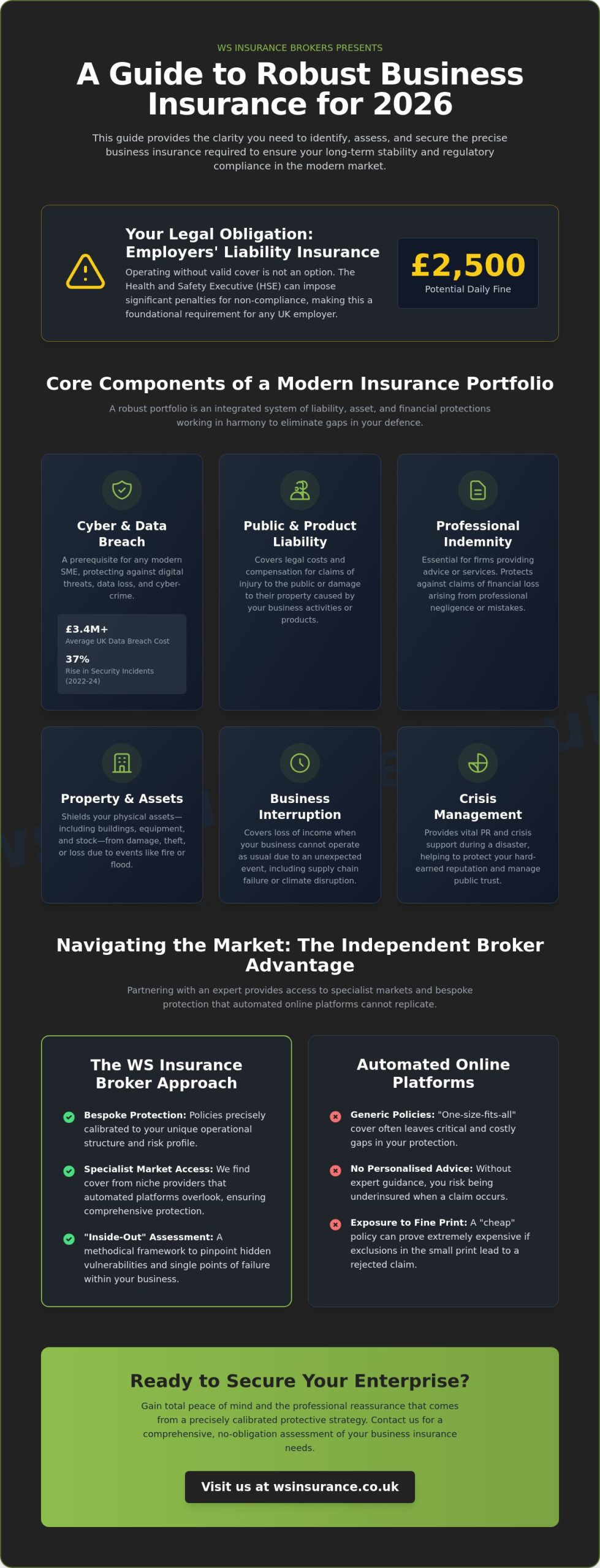
Did you know that the Health and Safety Executive can fine your firm up to £2,500 for every single day you operate without valid Employers’ Liability cover? It’s a sobering figure that highlights why getting your protection right isn’t just about safety; it’s a fundamental legal necessity for any UK employer.
It’s completely natural to feel a sense of anxiety when faced with rising premiums and the complex jargon of modern policies. You’ve worked hard to build your enterprise, and the thought of a claim being rejected due to overlooked fine print is a heavy burden to carry. We understand that you need more than just a policy; you need a steady hand to guide you through the noise of the current market.
This guide provides the clarity you need to identify, assess, and secure the precise business insurance required to ensure your long-term stability and regulatory compliance. Our methodical approach strips away the confusion, replacing uncertainty with a bespoke risk-management strategy tailored to your specific sector.
We will explore your mandatory legal obligations, examine the sharp rise in 2026 cyber risks, and provide a structured framework for choosing cover that acts as a genuine shield for your assets. By the end, you’ll have a clear path toward total peace of mind and the confidence that your livelihood is secure.
Key Takeaways
- Identify the critical differences between mandatory legal requirements and contractual obligations to ensure your firm remains compliant and competitive in the 2026 market.
- Discover the “Inside-Out” assessment method to pinpoint hidden vulnerabilities and single points of failure within your unique operational structure.
- Understand how to adapt your business insurance portfolio to address emerging risks, including digital threats and environmental shifts that traditional policies often overlook.
- Explore why partnering with an independent broker provides access to specialist markets and bespoke protection that automated online platforms cannot replicate.
- Gain a methodical framework for securing your assets and livelihood, providing the professional reassurance that comes from a precisely calibrated protective strategy.
What is Business Insurance and Why is it Essential in 2026?
At its core, business insurance is a suite of protective policies designed to shield your enterprise from financial ruin. Whether you’re facing a complex liability claim or significant property damage, these products act as a steady hand, ensuring a single incident doesn’t lead to total insolvency. The market is strictly regulated by the Financial Conduct Authority (FCA), which ensures transparency and fairness across the industry. This regulatory oversight means you can trust that your provider is held to high standards of integrity, prioritising your security over their own bottom line.
As we move through 2026, the risk landscape has evolved. Traditional cover must now account for rapid digital shifts and increasing environmental volatility. With the UK insurance industry paying out over £23 billion in commercial claims in 2023 alone, the scale of potential loss is undeniable. Modern policies have adapted to include protection against supply chain failures and climate-related disruptions, reflecting a world where risks are more interconnected than ever before. Understanding the Core Components of Commercial Insurance helps you build a foundation that addresses these contemporary challenges with clinical precision.
Think of your coverage as a safety net rather than a mere administrative burden. It provides the confidence directors need to take calculated risks and pursue growth. When you know your assets are secure, you’re free to innovate and expand without the constant anxiety of “what if.” It’s the difference between a business that survives and one that truly thrives in a competitive market.
Beyond the Policy: Insurance as a Business Asset
Robust coverage does more than just pay out; it enhances your professional credibility. Many high-value contracts in the UK now require proof of specific indemnity levels before you’re even allowed to tender. Choosing a “cheap” policy often proves more expensive during the claims process if the fine print leaves you exposed. A comprehensive business insurance programme signals to partners that you’re a diligent, well-managed firm worth doing business with.
Protecting Your People and Your Reputation
Your business relies on the people behind it. Protecting employees and the public from harm is a moral and legal duty that shouldn’t be overlooked. Beyond the human element, certain policies provide vital crisis management and PR support during a disaster. This proactive assistance acts as a shield for your hard-earned reputation, helping you manage the narrative and maintain public trust. By avoiding the “one claim” failure scenario, you ensure your legacy remains intact for years to come.
The Core Components of a Robust Commercial Insurance Portfolio
A robust business insurance portfolio isn’t just a collection of random policies; it’s a carefully calibrated shield designed to eliminate gaps in your protection. Think of it as a methodical layers-of-defence strategy. Instead of viewing each cover as an isolated expense, you should see them as an integrated system where liability, asset, and financial protections work in harmony. This holistic approach ensures that a single event, such as a flood or a professional error, doesn’t trigger a domino effect that collapses your entire operation.
In 2026, the definition of “robust” has shifted to include protection against digital threats. With a 37% increase in data security incidents reported to the ICO between 2022 and 2024, Cyber and Data Breach insurance is now a prerequisite for any modern SME. The average cost of a data breach in the UK has climbed past £3.4 million, making digital security a matter of survival rather than just IT compliance. Whilst you focus on your day-to-day operations, your insurance should act as a silent partner, managing these high-stakes risks in the background.
Before diving into specific covers, it’s vital to distinguish between what you choose to have and what you must have. Understanding mandatory business insurance in the UK is the first step in building your framework. Once legal compliance is met, you can then move on to bespoke covers that address your specific industry vulnerabilities.
Property and Asset Security
Securing your physical foundations starts with Commercial Property insurance. This protects the “bricks and mortar” of your premises against fire, theft, or weather damage. However, the building is only part of the story. Stock and Contents cover ensures your inventory and essential equipment are protected whether they’re on-site or in transit. Perhaps most critically, Business Interruption insurance acts as a financial lifeline; it replaces lost income and covers ongoing costs when an insured event prevents you from trading.
Specialist Liability Covers
Liability protection is about shielding your personal and professional future. Professional Indemnity is essential if your business provides advice or designs, as it covers the costs of defending against claims of negligence. For those in leadership roles, Directors and Officers (D&O) insurance is a vital tool to protect personal assets from management liability claims. Finally, Public Liability remains the fundamental safety net for any business interacting with clients or the general public. If you’re unsure how these specialist covers should overlap for your trade, it’s wise to speak with a trusted advisor who can audit your current risk profile.
Legal Obligations vs. Discretionary Protection: What is Mandatory?
Distinguishing between what you choose to have and what the law demands is a critical step in building your protective framework. In the UK, the regulatory environment is designed to ensure that businesses remain accountable to their staff and the public. Whilst many forms of business insurance are optional, skipping the mandatory covers isn’t just a risk; it’s a legal violation that can lead to severe financial penalties and criminal prosecution. Understanding these boundaries allows you to prioritise your spending with clinical precision, ensuring you’re never left exposed to avoidable legal action.
Beyond the strict letter of the law, you must also consider regulatory and contractual obligations. Even if a policy isn’t mandated by a specific Act of Parliament, it may be required by your professional body or a high-value client before you can begin work. This creates a landscape where “mandatory” often extends beyond government legislation into the realm of professional survival and market access.
The Employers Liability (Compulsory Insurance) Act
If your business employs even one person, Employers Liability Insurance is almost certainly a legal requirement. This legislation is designed to ensure that funds are available should a member of staff suffer an injury or illness as a result of their work. The definition of an “employee” is broader than many directors realise; it often includes volunteers, casual labourers, and even students on work experience. Under the Act, you must maintain a minimum of £5 million in cover. However, the industry standard is typically £10 million to provide a more robust safety net against complex, long-term claims. The Health and Safety Executive (HSE) enforces this strictly. They can fine your business up to £2,500 for every single day you operate without valid cover. To ensure you’re budgeting accurately for this essential protection, our detailed breakdown of employers liability insurance cost explains the specific factors that drive your premium in 2026.
Industry-Specific Mandatory Covers
For certain professions, the “choice” to insure is removed by regulatory bodies. Solicitors regulated by the SRA typically require a minimum of £2 million to £3 million in Professional Indemnity cover, whilst ICAEW accountants must maintain at least £2 million. These requirements act as a badge of integrity, reassuring clients that your professional advice is backed by financial security. Similarly, in the construction and trades sector, local authorities and government bodies often mandate Public Liability tiers of £5 million or £10 million as a contractual prerequisite for any project. For firms operating in this space, understanding the full scope of construction site insurance is essential to meeting these strict lender and contractual mandates. Checking your specific trade body guidelines is a non-negotiable step in your risk assessment. Failing to meet these standards doesn’t just risk a fine; it can result in the immediate loss of your licence to practice or the termination of essential contracts.
Finally, remember that any vehicle used for business purposes on public roads must have valid commercial motor insurance. Relying on a standard private policy for business errands is a common mistake that can lead to rejected claims and points on your licence. For a comprehensive understanding of how to correctly classify your vehicles and avoid costly policy errors, our guide to commercial vehicle insurance UK covers the latest 2026 regulatory requirements in full. By addressing these legal and professional requirements first, you create a secure foundation upon which you can build a more comprehensive, discretionary protection strategy.
Assessing Your Risk Profile: How to Determine Your Coverage Needs
Determining the right level of protection requires an “Inside-Out” approach. Instead of scanning policy documents to see what fits, you must first audit your internal operations with clinical precision. This methodical self-reflection ensures that your business insurance is built around your actual vulnerabilities rather than a generic industry template. By identifying the unique moving parts of your enterprise, you can eliminate the anxiety that comes from guesswork and replace it with a calibrated strategy for security.
A critical step in this process is identifying “Single Points of Failure.” These are the specific elements of your business that, if compromised, would bring operations to a standstill. It could be a specialised piece of machinery with a six-month lead time for replacement, or a single software platform that holds all your client data. Understanding these dependencies allows you to prioritise coverage where the impact of a loss would be most catastrophic. A policy that was adequate in 2024 may no longer suffice in 2026; your business has likely evolved, and the external costs of labour and materials have certainly risen.
Conducting a Thorough Risk Assessment
A professional risk assessment should be structured and logical, covering three primary pillars:
- Physical Hazards: Evaluate your premises for fire risks, flood potential, and security vulnerabilities. Don’t forget to consider the impact of extreme weather events, which are becoming more frequent in the UK.
- Liability Risks: Review the frequency and nature of your interactions with the public. High-footfall businesses face different challenges than those operating primarily through digital consultations.
Valuation Accuracy and Avoiding Under-Insurance
Many UK directors fall into the “Average Clause” trap without realising it. If you under-insure your assets, insurers can proportionally reduce your claim payout. For example, if you insure a building for 75% of its true rebuild cost, the insurer may only pay 75% of any subsequent claim, even for minor damage. This makes accurate valuation a non-negotiable part of your strategy. You must factor in 2026 reconstruction costs, which include higher prices for specialised materials and skilled trade labour.
Ensuring your sums insured reflect current market realities is the only way to guarantee a full recovery after a disaster. For more detailed advice on calculating these figures, you can refer to our Commercial Property Insurance Guide. Taking the time to get these numbers right today prevents a financial shortfall tomorrow. If you’re ready to move beyond generic quotes and secure a policy that reflects your true value, we invite you to request a comprehensive risk audit from WS Insurance Brokers.
Navigating the Market: Why an Independent Broker Offers Superior Security
In a landscape where automated comparison sites treat business insurance as a mere commodity, the value of human expertise has never been more significant. Whilst an algorithm might offer a quick price, it lacks the clinical precision required to understand the nuances of your specific operation. An independent broker acts as your expert guide, navigating the entire breadth of the market to uncover specialist “broker-only” underwriters that remain hidden from the general public. This autonomy ensures our loyalty remains firmly with you, rather than any single service provider, allowing for a truly unbiased selection process.
The transition from an off-the-shelf policy to a bespoke programme is where real security is found. Beyond simply placing cover, a broker provides essential claims advocacy, acting as your professional negotiator when it matters most. Having a seasoned hand to manage the complexities of a claim transforms a potentially devastating event into a structured, manageable recovery. This partnership ensures that your interests are protected with the same diligence you applied to building your enterprise in the first place.
Removing Uncertainty from the Selection Process
We work to organise your various requirements into a cohesive, cost-effective portfolio that eliminates doubt. Instead of juggling multiple renewal dates and disparate points of contact, we consolidate your protection into a logical structure. This methodical approach ensures no gaps exist between different policy types, providing the professional reassurance that every angle is covered. By simplifying the administrative burden, we allow you to focus on your operations whilst we handle the market complexities with integrity and transparency.
Your Partner in Long-Term Growth
A static policy is a risk in itself as your business scales or pivots. We provide ongoing support through mid-term adjustments, ensuring your cover remains accurately calibrated to your current risk profile. This dedicated, UK-based guidance acts as a shield against the unexpected, providing the calm reliability you need to pursue your ambitions with confidence. If you’re ready to move beyond generic solutions and secure a strategy built for 2026 and beyond, we invite you to experience the difference of a tailored consultation with WS Insurance Brokers and protect the future of your livelihood today.
Securing Your Professional Future in 2026
We’ve explored how a methodical approach to risk assessment removes the uncertainty of under-insurance. By prioritising mandatory legal covers and layering them with bespoke protections like cyber and professional indemnity, you create a resilient foundation for growth. Your business insurance should never be a source of anxiety; it should be a strategic asset that empowers you to take calculated risks with confidence.
As an FCA Authorised and Regulated firm, we offer the calm reliability of a trusted advisor. Our independence ensures we can access major UK insurers to find the precise fit for your specific needs, providing dedicated claims support and advocacy when you need it most. We act as a shield between your enterprise and the complexities of the broader market, ensuring your long-term security is never in doubt.
Take the first step toward total clarity today. Secure your business with a bespoke insurance review from our expert brokers and move forward with the professional reassurance you deserve. Your hard work has built this business; let’s ensure it stays protected for years to come.
Frequently Asked Questions
Is business insurance a legal requirement for sole traders in the UK?
Business insurance is not a general legal requirement for sole traders who work alone; however, Employers’ Liability remains mandatory if you hire any staff, including casual labourers or volunteers. Even without employees, you may find that clients or professional bodies require specific levels of Public Liability or Professional Indemnity cover as a contractual condition. Operating without these protections leaves your personal assets vulnerable to claims that could arise from your professional activities.
How much does business insurance typically cost for a small business in 2026?
The cost of your premium depends on several variables, including your industry sector, annual turnover, and the specific risks associated with your operations. In 2026, we’ve seen prices influenced by the rising costs of repairs and the increased frequency of digital threats. To ensure you receive a fair price that reflects your actual risk profile, it’s best to consult with a broker who can access a broad range of underwriters rather than relying on generic estimates.
What is the difference between Public Liability and Professional Indemnity?
Public Liability protects your business against claims for third-party injuries or property damage, such as a client tripping in your office. Professional Indemnity focuses on the professional advice or services you provide, shielding you if a client suffers a financial loss due to a mistake or negligence in your work. Whilst the former covers physical accidents, the latter acts as a safety net for your intellectual output and professional integrity.
Can I change my business insurance policy mid-year if my circumstances change?
You can certainly update your policy at any time through a process known as a mid-term adjustment. Whether you’ve purchased new equipment, moved premises, or scaled your workforce, it’s vital to inform your broker immediately to ensure your protection remains accurate. Keeping your cover aligned with your current operations eliminates the risk of a claim being rejected due to outdated information.
Does business insurance cover me for losses related to cyber-attacks?
Standard commercial policies typically exclude digital risks, meaning you require a dedicated Cyber and Data Breach policy for comprehensive protection. This specialist cover manages the fallout from data theft, ransomware, and system failures, providing the financial and technical support needed to recover. Given that cyber incidents reported to the ICO have risen significantly in recent years, this is no longer an optional extra for modern SMEs.
What happens if I under-insure my business assets?
Under-insuring your assets triggers the “Average Clause” during a claim, which allows insurers to proportionally reduce your payout based on the level of under-valuation. If you insure your stock for only half its true replacement value, the insurer may only pay 50% of any claim, regardless of the total loss. This methodical reduction can leave your business with a significant financial shortfall at the most critical time.
How do I make a claim on my commercial insurance policy?
You should contact your insurance broker immediately after an incident occurs to begin the claims process. Your broker acts as a dedicated advocate, helping you gather necessary evidence and negotiating with the insurer on your behalf to ensure a fair settlement. Acting quickly and providing thorough documentation, such as photos and records, helps to remove uncertainty and speeds up the restoration of your business operations.
Why should I use an insurance broker instead of a comparison website?
An independent broker provides bespoke guidance and access to specialist “broker-only” markets that automated comparison sites simply cannot reach. Whilst a website treats your security as a commodity, a broker acts as a trusted advisor, identifying hidden gaps in your cover and providing human advocacy during a claim. This partnership ensures your business insurance is a calibrated strategy for long-term stability rather than a one-size-fits-all product.