
Could a single misunderstanding of “carriage of goods” versus “haulage” leave your business assets completely unprotected? Many UK business owners find themselves caught between rising premium costs and the fear that a simple administrative error might invalidate their entire policy. It’s a stressful position to be in when your livelihood depends on staying mobile. Finding the right commercial vehicle insurance UK isn’t about choosing the cheapest quote on a screen; it’s about building a bespoke financial shield that stands up to scrutiny.
Reliable cover. Total compliance. Financial peace of mind. We understand that you need to protect your tools and vehicles without overpaying for unnecessary extras. This guide provides the expert insights you need to secure your fleet and maintain full legal standing throughout 2026. We’ll clarify the latest regulatory shifts, including the new smart tachograph requirements for vehicles over 2.5 tonnes and the significant tax reclassifications for double-cab pick-ups. You’ll learn how to navigate the complexities of usage classes and secure a personalised level of protection that understands the specific demands of your trade.
Key Takeaways
- Confirm your adherence to the Road Traffic Act 1988 to guarantee your business motor operations remain within the law and fully compliant.
- Analyse how 2026’s advanced driver assistance systems (ADAS) affect your premiums and the potential financial impact of repairing specialist components.
- Distinguish between ‘Agreed Value’ and ‘Market Value’ to ensure your high-value assets and permanent modifications are never under-insured.
- Master the nuances of usage classes to secure commercial vehicle insurance UK that accurately reflects your daily business activities and prevents policy invalidation.
- Leverage the expertise of an independent broker to access bespoke schemes and eliminate the ‘fine print’ risks common with standard providers.
The UK Commercial Vehicle Insurance Landscape: Legalities and Logic
Commercial vehicle insurance is a professional contract that mitigates third-party liabilities and protects business-critical assets. Under the Road Traffic Act 1988, every vehicle operating on British roads must carry a valid insurance policy. For a business owner, this isn’t a mere administrative hurdle; it’s a non-negotiable legal obligation. Whether you operate a single van or a sprawling fleet, the law requires specific cover that reflects the professional nature of your journeys. Finding the right commercial vehicle insurance UK involves more than just comparing premiums; it requires a deep understanding of how your vehicles support your bottom line.
Relying on a standard private motor policy for business tasks is a risk that rarely pays off. If you use a vehicle to visit clients, transport stock, or carry professional tools, a personal policy will likely be invalidated during a claim. By 2026, the market has shifted, and insurance is now viewed as a strategic business continuity tool rather than a simple “grudge purchase.” It acts as a steady hand, ensuring that an unexpected incident on the road doesn’t lead to a permanent halt in your operations. We position ourselves as your expert guide, helping you move beyond basic compliance toward true financial security.
TPO, TPFT, or Comprehensive: Choosing Your Shield
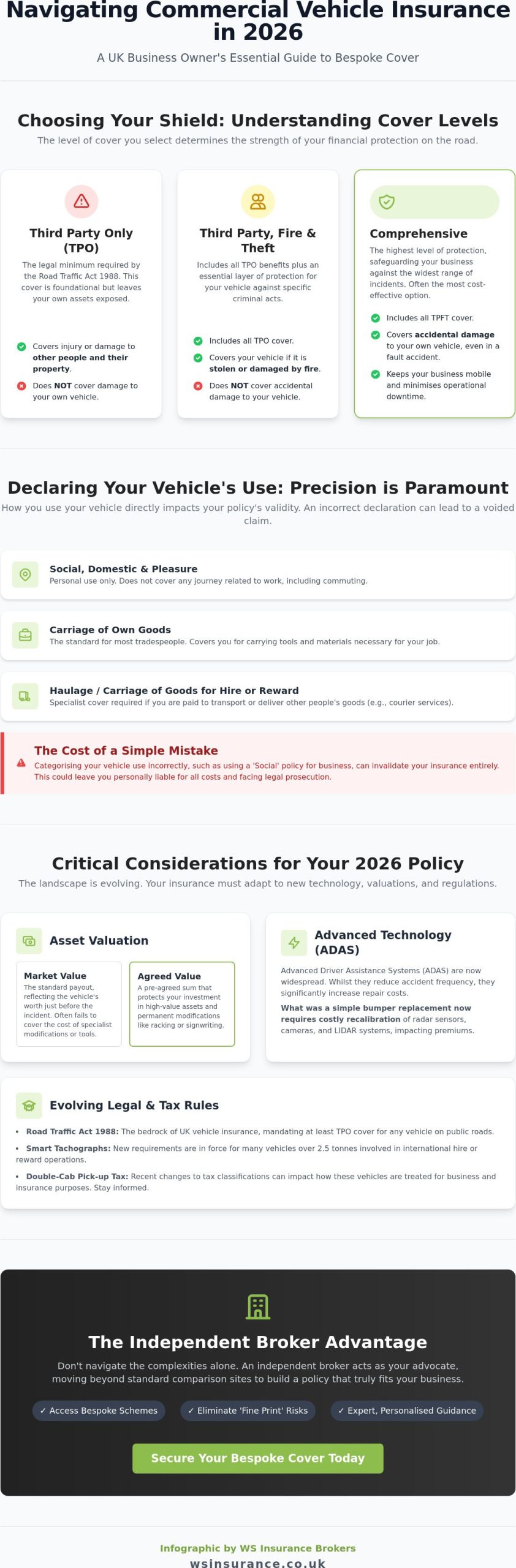
Your choice of cover level determines the strength of your protective barrier. Third Party Only (TPO) remains the legal minimum under the UK Vehicle Insurance Legal Framework, providing compensation for others but leaving your own assets vulnerable. Third Party, Fire and Theft (TPFT) introduces a layer of security against arson or criminal activity, which is vital for tradespeople who store equipment in their vehicles. However, Comprehensive cover is frequently the most cost-effective option for modern enterprises. It removes uncertainty by covering accidental damage to your own vehicles, ensuring your team stays mobile even after a fault accident.
The True Cost of Being Under-Insured
Precision is essential when declaring your vehicle usage. Incorrectly categorising “carriage of own goods” as “social use” can lead to unpaid claims and potential legal prosecution. Beyond the immediate risk of an accident, Continuous Insurance Enforcement (CIE) ensures that any vehicle not declared SORN is monitored for valid cover. If you’re involved in an incident with an uninsured driver, the Motor Insurers’ Bureau (MIB) provides a safety net, but having your own robust commercial vehicle insurance UK is the only way to guarantee your business isn’t left out of pocket whilst waiting for a settlement. We act as a shield, ensuring your declarations are accurate from the very start.
Decoding Protection in 2026: Modern Risks and Integrated Tech
Modern commercial vehicles have evolved into sophisticated hubs of technology. By 2026, the widespread integration of Advanced Driver Assistance Systems (ADAS) and semi-autonomous features has fundamentally altered how underwriters calculate risk. While these systems are designed to reduce human error, they also introduce a new tier of financial exposure. A minor front-end collision that once required a simple bumper replacement now involves recalibrating delicate radar sensors and LIDAR arrays. These rising repair costs for specialist components mean that your commercial vehicle insurance UK must be precisely calibrated to reflect the true replacement value of your technology.
Security standards have also shifted to combat the rise of “relay” or keyless theft. Underwriters in 2026 frequently require specific physical or digital security protocols before offering comprehensive terms. Your policy needs to be a living document that evolves alongside your fleet’s software updates. If a manufacturer releases a security patch that you fail to install, you might find your cover compromised. Compliance with the Road Traffic Act 1988 is the legal baseline, but staying ahead of digital vulnerabilities is what ensures long-term business resilience. We recommend reviewing your tech-stack regularly to ensure your commercial vehicle insurance UK remains fully effective.
Cyber-Security and Digital Vehicle Risks
The threat of vehicle hacking is no longer a theoretical concern reserved for large logistics firms. Smaller businesses are increasingly targeted through digital vulnerabilities in fleet management software. Data protection has become a core component of motor risk, as a breach could expose sensitive client delivery information or proprietary route data. Telematics play a vital role here; they act as a digital witness that provides objective data to resolve complex claims and prove driver behaviour. This level of transparency helps eliminate doubt during the claims process and can lead to more favourable premium rates for diligent operators.
Essential Commercial Add-ons
Standard policies often leave gaps that can disrupt your daily trade. We suggest considering specific enhancements to create a more robust shield for your business assets:
- Motor Legal Protection: This provides a professional advocate to recover uninsured losses, such as loss of earnings, whilst your vehicle is off the road following a non-fault accident.
- Tools in Transit: This protects the expensive equipment, professional racking, and trade materials that allow you to earn a living, which are often excluded from standard motor policies.
- Misfuelling and Windscreen Cover: These small additions prevent minor human errors or road debris from turning into significant business delays and unexpected out-of-pocket expenses.
Specialist Solutions: From Prestige Assets to Commercial Fleets
Standard “off-the-shelf” policies often fail to provide the precision required for high-value or performance business vehicles. When your professional image relies on a luxury saloon or a high-performance SUV, a generic commercial vehicle insurance UK policy might only offer “Market Value” for a total loss. This typically calculates a payout based on a depreciated figure, potentially leaving you with a significant financial shortfall. We advocate for “Agreed Value” cover, where the replacement sum is fixed at the start of the policy. This eliminates doubt and ensures that your business can replace a unique asset without dipping into vital capital reserves. For those managing luxury business cars, our prestige car insurance guide provides a detailed roadmap for protecting these high-tier assets.
Efficiency is a strategic advantage in a competitive market. Consolidating multiple vehicles under a single renewal date simplifies your administration and removes the anxiety of tracking various expiry periods. Every vehicle used for professional purposes must comply with the Road Traffic Act 1988, but managing these requirements through a single point of contact provides a steady hand for your business operations. This structural logic allows you to focus on growth whilst we handle the complexities of your commercial vehicle insurance UK portfolio.
Managing Prestige and Performance Risks
Specialist underwriting for prestige business vehicles often involves specific safeguards that standard providers overlook. These may include requirements for restricted annual mileage or the mandatory use of manufacturer-approved repairers to preserve the vehicle’s warranty and resale value. For high-net-worth business owners, a dedicated account manager acts as a protective shield, ensuring that your high-value assets receive the thorough attention they deserve. We often find that clients with luxury vehicle requirements also benefit from high net worth home insurance to ensure their entire asset portfolio is managed with consistent professional integrity.
The Efficiency of Commercial Fleet Insurance
Scaling your business requires insurance that can grow alongside you. Commercial fleet insurance typically becomes a viable option for businesses operating three or more vehicles, offering bulk-buy cost efficiencies that are often unavailable on individual policies. An “Any Driver” policy structure is a pragmatic choice for busy teams; it removes the uncertainty of assigning specific staff to specific vans and allows for seamless operational flexibility. If your business involves haulage or delivery, integrating Goods in Transit cover is essential. This protects the cargo you carry for your clients, ensuring that a road incident doesn’t lead to a costly breach of contract or damaged professional reputation. Operators running larger heavy goods vehicles should also explore dedicated HGV fleet insurance UK solutions, which are specifically structured to address the unique risks and regulatory demands of the haulage sector.
Risk Assessment Framework: Optimising Your Business Cover
Optimising your business motor protection requires a methodical approach to risk. It isn’t enough to simply accept a renewal figure; you must ensure your policy reflects the current reality of your operations. Accurate vehicle valuation is the first step in this framework. This must include permanent modifications, such as professional racking or heavy-duty refrigeration units, which are often overlooked. If these aren’t declared, you might find yourself under-insured during a total loss claim. We work to eliminate this doubt by helping you calculate a precise figure that covers the vehicle and its integrated business assets.
The second pillar of optimisation involves your drivers and security. Underwriters scrutinise driver history, and the presence of “young” or “convicted” drivers will naturally influence your premium. Balancing this risk with robust overnight security and tracking requirements can help satisfy underwriter conditions and lower costs. Many commercial vehicle insurance UK providers now mandate specific Thatcham-approved trackers for high-value vans or HGVs. By proactively addressing these security concerns, you position your business as a lower risk, which leads to more favourable terms and long-term security.
Usage Classes: Carriage of Goods vs Haulage
Selecting the correct usage class is vital for maintaining a valid policy. “Carriage of Own Goods” is the standard choice for tradespeople transporting their own tools and materials. If you’re a courier or delivery driver, you require “Hire and Reward” cover. This is distinct from business travel insurance UK, which focuses on the individual rather than the vehicle’s cargo. Finally, “Haulage” is reserved for those transporting third-party goods over long distances, and businesses in this sector should review our comprehensive guide to HGV fleet insurance UK for haulage operators to ensure their cover is correctly structured. Getting this wrong is a common cause of policy invalidation, so it’s essential to be transparent about your daily activities from the outset.
The Excess Debate: Voluntary vs Compulsory
Your choice of excess is a pragmatic lever for managing annual costs. Increasing your voluntary excess can reduce your premium, but it also increases your financial exposure during a claim. You must ensure that the total combined excess remains affordable for your business. If a total loss occurs, can your cash flow sustain the out-of-pocket deduction? Some businesses opt for specialist “Excess Protection” policies as a secondary shield. This allows you to benefit from lower primary premiums whilst capping your actual loss in the event of an accident. We can help you optimise your commercial vehicle insurance UK by finding the right balance between premium savings and financial risk.
The Independent Broker Advantage: Eliminating Uncertainty
Direct platforms often force complex business needs into restrictive, automated templates. An independent broker provides a vital alternative, granting you access to “broker-only” markets that remain invisible to the general public. This access isn’t just about finding a lower price; it’s about securing commercial vehicle insurance UK that actually fits the unique architecture of your trade. By acting as your trusted advisor, we eliminate the doubt that often accompanies “off-the-shelf” policies, ensuring that “fine print” surprises don’t arise during the stress of a claim. Our role extends beyond the initial selection, providing dedicated claims advocacy that acts as a steady hand to organise the recovery process on your behalf. This methodical approach to risk is a core component of a wider business insurance strategy designed to protect your corporate legacy.
Bespoke Curation for Complex Professional Lives
We specialise in organising multi-asset policies that bridge the gap between your professional and personal life. Moving away from the impersonal nature of automated call centres, we provide a dedicated account manager who understands your history and your ambitions. This personal relationship ensures your cover evolves proactively as your business grows or your fleet expands. We don’t just sell a product; we provide a consultative service that prioritises your long-term security over a single transaction. To understand how professional insurance brokers navigate complex risk placement on your behalf, our complete 2026 guide outlines the full scope of this expertise. This proactive policy management means your commercial vehicle insurance UK is always aligned with your current operational reality.
Securing Your Business Future
Our commitment to transparency and integrity means we assess the entire breadth of the market to secure competitive rates without compromising on quality. We don’t settle for restricted panels; we look for the highest level of protection that matches your specific risk profile. By removing the anxiety from the selection process, we allow you to focus on running your business with the confidence that your assets are shielded by professional curation. We act as a protective barrier between your livelihood and the complexities of the broader market, ensuring that every journey is backed by robust financial security. Experience a professional consultation that removes the anxiety of insurance selection and secures your business future today.
Secure Your Professional Fleet for the Road Ahead
Protecting your business assets in 2026 requires more than a simple comparison of premiums. It demands a strategic understanding of how modern technology, accurate usage classes, and legislative changes impact your liability. By moving away from automated platforms and embracing bespoke curation, you eliminate the uncertainty that often leads to policy invalidation. Securing the right commercial vehicle insurance UK ensures that your trade remains resilient against both physical road accidents and emerging digital threats.
As an independent broker authorised and regulated by the Financial Conduct Authority, we provide unbiased access to the entire UK insurance market. We offer dedicated UK-based claims support and advocacy, acting as a steady hand to guide you through complex settlements. Request a bespoke commercial vehicle insurance consultation from WS Insurance Brokers to ensure your protection is as diligent and thorough as your business operations. Your professional legacy deserves a shield built on transparency and integrity; we look forward to helping you secure it.
Frequently Asked Questions
What is the difference between personal and commercial vehicle insurance?
Personal insurance is designed for social, domestic, and pleasure activities, whilst commercial insurance is a professional contract for vehicles used for business purposes. If you use your vehicle to transport stock, visit clients, or carry out trade activities, a personal policy won’t provide the necessary protection. Commercial cover is specifically curated to mitigate the higher risks associated with professional driving and protects your business-critical assets.
Do I need commercial vehicle insurance if I only use my van for commuting?
Yes, you typically require a specific class of cover if you use your van to travel between your home and a permanent place of work. Standard “Social, Domestic and Pleasure” policies often exclude commuting for commercial vehicles. To ensure your policy remains valid, you must declare your commute to your insurer. This prevents “fine print” surprises and ensures you’re fully compliant with the Road Traffic Act during your daily journeys.
What is ‘Hire and Reward’ cover and who needs it?
‘Hire and Reward’ is a mandatory usage class for anyone transporting third-party goods or passengers in exchange for payment. This is the essential level of commercial vehicle insurance UK for couriers, delivery drivers, and hauliers. Without this specific endorsement, any claim made whilst you’re being paid to transport items will likely be rejected, leaving your business facing significant out-of-pocket expenses and legal risks.
Can I insure multiple business vehicles under a single fleet policy?
You can certainly consolidate three or more vehicles into a single commercial fleet policy to simplify your administration. This approach aligns all your renewal dates and often introduces “Any Driver” flexibility, which removes the anxiety of managing individual driver assignments. Fleet structures provide a pragmatic way to manage risk and often yield cost efficiencies that individual policies simply can’t match for growing businesses.
Does commercial vehicle insurance cover the tools and goods inside my van?
How can I reduce my commercial vehicle insurance premium in 2026?
Improving your risk profile through Thatcham-approved security and telematics is the most effective way to lower your commercial vehicle insurance UK costs in 2026. You might also consider increasing your voluntary excess, provided your cash flow can sustain the higher cost during a claim. We act as your expert guide to assess the entire market, ensuring you secure competitive rates without compromising the quality of your shield.
What happens if an employee has an accident in a company-insured vehicle?
The company’s commercial policy will handle the third-party liability and vehicle damage, provided the employee was authorised to drive under the policy terms. It’s vital to ensure that all drivers meet the underwriter’s criteria regarding age and conviction history before they get behind the wheel. We provide dedicated claims advocacy to manage this process on your behalf, acting as a steady hand whilst you focus on your operations.
Is my commercial vehicle covered for business use outside of the United Kingdom?
Most UK policies provide the minimum legal cover required for EU travel as standard, but comprehensive protection often requires a specific extension. If your business involves international transport or for-hire cabotage, you must notify your broker to ensure your cover remains robust across borders. We help you navigate these complexities, ensuring your vehicles remain fully protected whilst operating in international markets or across the continent.