
Did you know that an estimated 400,000 UK landlords are currently operating without any specialised insurance? In a year defined by the Renters’ Rights Act 2026 and the abolition of Section 21 evictions, leaving your investment to chance isn’t just risky; it’s potentially devastating. If you’re asking what does landlord insurance cover uk, you’re likely seeking a shield against the increasing complexities of the modern rental market.
It’s natural to feel a sense of anxiety regarding new pet rights or the transition to periodic tenancies. You might worry that a standard policy won’t shield you from the financial fallout of a long eviction process or accidental tenant damage. We understand that the distinction between mortgage requirements and comprehensive security often feels blurred, leaving many property owners vulnerable to hidden exclusions during a claim.
This guide provides the clarity you need to move forward with confidence. You’ll discover the critical differences between core buildings cover and specialist options like rent guarantee and legal expenses. We’ll show you how to tailor your policy to your specific property type, ensuring you avoid the pitfalls of underinsurance whilst keeping your portfolio secure for the long term.
Key Takeaways
- Identify the fundamental difference between standard home insurance and a specialist landlord policy to ensure your property remains legally and financially protected.
- Discover exactly what does landlord insurance cover uk, from the physical structure of your building to the complex legal liabilities associated with modern tenancies.
- Learn how to navigate the Renters’ Rights Act 2026 by integrating rent guarantee and legal expenses cover into your risk management strategy.
- Understand the crucial distinction between insurable sudden events and general property aging to avoid the frustration of rejected claims.
- Recognise the security of a bespoke policy that matches your specific property type and tenant profile, providing a precision-engineered safety net for your investment.
The Core Components: Buildings and Liability Protection
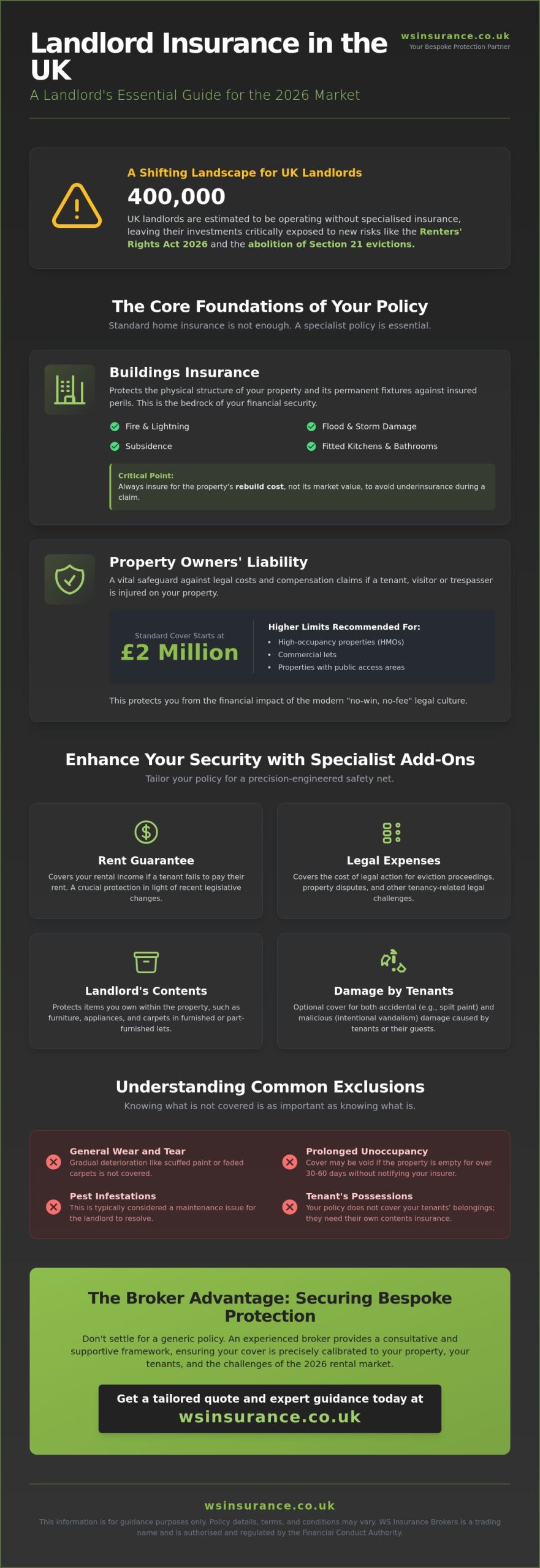
Landlord insurance isn’t just a box-ticking exercise for your mortgage lender. It is a specialised protective layer designed to address the unique risks of letting property. When you ask what does landlord insurance cover uk, the answer starts with the physical bricks and mortar and extends to the legal safety of everyone who enters your premises. WS Insurance ensures these core elements are precisely calibrated to your specific property type and usage, removing the uncertainty often found in generic policies.
Standard home insurance policies usually exclude properties that are let to tenants, leaving you exposed to significant financial loss. A dedicated landlord policy acts as a steady hand, providing a consultative and supportive framework for your investment. It treats your property as a business asset, protecting not just the structure but also your long-term financial security. By prioritising your ease and confidence, we help you build a resilient portfolio that can withstand the complexities of the 2026 rental market.
Buildings Insurance for Buy-to-Let Properties
The foundation of any policy is buildings cover. This protects your investment against “insured perils” such as fire, flood, subsidence, and lightning strikes. Crucially, it includes permanent fixtures and fittings; think fitted kitchens and bathroom suites that you’d leave behind if you sold the property. We recognise that your property is a significant capital investment that requires thorough protection.
In 2026, the most common mistake is confusing market value with rebuild costs. Your insurance must reflect the actual cost of labour and materials to reconstruct the building from the ground up. We place a heavy emphasis on index-linking to protect against inflation, ensuring your commercial property insurance remains accurate year after year. This proactive labour on our part results in a policy that actually performs when you need it most, preventing the sting of underinsurance during a major claim.
Property Owners Liability: A Vital Safeguard
Property Owners Liability is perhaps the most underrated component of a policy. It defends you against legal costs and compensation if a tenant, visitor, or even a trespasser is injured on your premises. Standard limits often start at £2 million. However, for a commercial let or a high-occupancy HMO, we frequently recommend higher limits to provide a more robust shield against litigation.
This cover eliminates the anxiety associated with the modern “no-win, no-fee” legal culture. By using precise liability wording, we act as a protector, ensuring you aren’t left exposed to predatory claims. While many focus on physical damage, protecting your financial position against litigation is equally vital. This often works in tandem with Rent insurance concepts, where the goal is to maintain your cash flow and assets despite unforeseen legal or physical disruptions. We believe in providing a comprehensive safety net that addresses every angle of risk.
Enhancing Security with Specialist Policy Add-ons
A solid foundation of buildings and liability insurance is essential, but it doesn’t account for every variable in a landlord’s journey. To truly eliminate doubt, you must consider the specific pressures of the 2026 rental market. When exploring what landlord insurance covers and doesn’t, it’s clear that the most resilient portfolios rely on tailored add-ons. These extensions act as a custom-fitted shield, protecting your cash flow and assets from the unpredictable behaviour of both nature and people. Understanding what does landlord insurance cover uk requires looking beyond the basic policy document to these vital layers of protection.
Whilst core cover is vital, specialist add-ons provide a more comprehensive safety net that reflects your unique risk profile. If you provide furnished or part-furnished accommodation, contents insurance becomes a necessity rather than an option. It protects your furniture, appliances, and carpets from damage, ensuring you aren’t left with a significant replacement bill at the end of a tenancy. By matching the provider’s effort with your specific outcome, we help you build a policy that feels like a partnership rather than a mere transaction.
Safeguarding Income: Loss of Rent and Tenant Default
There is often confusion between loss of rent and tenant default, yet they serve very different purposes. Loss of rent cover triggers if an insurable event, such as a significant flood, makes your property uninhabitable. It compensates for the income you lose whilst the property is being repaired. Conversely, tenant default insurance provides a safety net if a tenant remains in the property but stops paying their rent.
With the abolition of Section 21 evictions in May 2026, the process of regaining possession has become more complex and potentially longer. This legislative shift makes income protection more than just an optional extra; it is a strategic necessity for maintaining cash flow. Much like how business interruption insurance brokers uk help commercial clients protect their revenue streams during unexpected disruptions, specialist landlord advisors ensure your rental income remains secure even during a dispute. WS Insurance helps you assess which income protection model fits your risk appetite, ensuring your financial commitments remain secure even during a dispute. To ensure your specific property type is fully protected, you can speak with our expert advisors for a comprehensive review of your needs.
Accidental and Malicious Damage Cover
Your property is your investment, and seeing it damaged is a primary source of anxiety. Accidental damage cover is designed for those one-off mishaps, such as a tenant spilling red wine on an expensive carpet or a bathroom leak caused by a simple mistake. It provides the peace of mind that minor accidents won’t result in major out-of-pocket expenses.
Malicious damage is a different category altogether. It protects you against deliberate harm caused by tenants or their guests. This is particularly relevant given the increased rights for tenants with pets introduced by the Renters’ Rights Act 2026. While most tenancies are trouble-free, having this protection acts as a steady hand, ensuring you aren’t left footing the bill for significant structural harm or vandalism. Distinguishing between minor wear and tear and significant damage is crucial for successful claims, and we provide the clarity needed to navigate these situations with confidence.
Navigating Legal Realities and Complex Scenarios
Understanding the legal landscape is as critical as protecting the physical structure of your property. Whilst the UK government does not legally mandate landlord insurance, your contractual obligations often tell a different story. For many, the question of what does landlord insurance cover uk is answered by their mortgage agreement. Lenders view uninsured rental properties as high-risk assets; failing to secure the correct cover could put you in breach of your loan terms. Our role is to act as your expert guide, ensuring your policy aligns with both lender requirements and the latest Financial Conduct Authority standards.
Risk management also requires a nuanced approach to tenant types and property uses. A student let carries a different risk profile compared to a long-term professional tenancy or a holiday rental. By tailoring your policy to these specific scenarios, you eliminate the doubt that often plagues generic insurance products. It’s about creating a narrative of partnership where your proactive choice of cover directly results in long-term ease and confidence. This methodical approach ensures your specific property type is protected, regardless of how the market shifts.
Is Landlord Insurance Mandatory in the UK?
Technically, you aren’t breaking the law by operating without cover. However, you are almost certainly breaking your mortgage contract. Standard residential home insurance is designed for owner-occupiers; it is typically void if the property is let to third parties. This leaves you personally liable for every risk, from fire damage to tenant injury. For a deeper look at these requirements, this comprehensive guide to landlord insurance outlines why specialist cover is the only viable path for serious investors. WS Insurance provides the robust documentation your lender needs, allowing for seamless policy validation and removing the anxiety of administrative hurdles.
Managing Coverage During Unoccupied Periods
The “unoccupied period” trap is a common point of failure in standard policies. Most insurers restrict or withdraw cover if a property remains empty for more than 30 or 60 consecutive days. This creates a dangerous gap during extensive renovations or whilst you’re searching for new tenants amongst a shifting market. We see this as a critical area where a steady hand is required to maintain your security.
To keep your protection intact during void months, you might need “unoccupied property insurance” or a specific policy extension. We advise taking proactive steps to safeguard your claim, such as:
- Implementing a documented schedule of weekly or fortnightly property inspections.
- Ensuring all waste is removed and mail is cleared to prevent the property looking abandoned.
- Maintaining a minimum temperature or draining water systems during winter to prevent burst pipes.
By following these methodical steps, you ensure that your claim remains valid even when your property is between tenancies. This level of diligence acts as a shield, protecting your investment from the complexities of the broader market and ensuring you’re never left vulnerable to the unexpected.
Understanding Exclusions: What Is Typically Not Covered?
Clarity is the ultimate antidote to the anxiety felt during a claim. Many property owners mistakenly view their policy as a comprehensive maintenance fund, yet when asking what does landlord insurance cover uk, it’s vital to recognise that insurance is designed for sudden, unforeseen events. It’s not a substitute for a robust property maintenance schedule. WS Insurance acts as your dedicated advocate, ensuring you understand these boundaries before an incident occurs, which eliminates the doubt that often surrounds complex policy wordings.
Insurance policies are built on the principle of “fortuity.” They protect you against the unexpected, such as fire or theft, rather than the inevitable passage of time. We believe in transparency and integrity, which is why we prioritise helping you distinguish between insurable damage and your ongoing responsibilities as a landlord. By taking a proactive approach to property care, you ensure that your protective safety net remains intact when you truly need it.
General Wear and Tear vs. Insured Perils
Standard policies typically exclude damage that occurs gradually. This includes peeling paint, the natural thinning of carpets in high-traffic areas, or roof tiles that eventually slip because of rusted nails. These are considered “wear and tear” and fall under the landlord’s ongoing duty to maintain the property in a good state of repair.
Regular inspections are a powerful tool for maintaining policy validity. By documenting the condition of your property at frequent intervals, you can clearly differentiate between the slow aging of a building and sudden accidental damage. This methodical evidence-gathering acts as a shield during the claims process, providing the precision required to secure a successful outcome. If you are unsure how your current policy handles these distinctions, you can request a comprehensive policy review from our expert team today.
Maintenance Responsibilities and Equipment Breakdown
Maintaining your legal compliance is also a cornerstone of insurance validity. You must keep up-to-date gas safety certificates and electrical inspections to ensure your cover remains active. If a fire occurs and it’s discovered that you neglected these statutory checks, your insurer may have grounds to reduce or even reject your claim. We recommend a structured approach to compliance:
- Organise annual gas safety checks with a registered engineer.
- Conduct Five-yearly Electrical Installation Condition Reports (EICR).
- Address minor leaks or damp spots immediately before they evolve into structural issues.
By following these steps, you demonstrate a commitment to property safety that mirrors our own dedication to your security. This partnership ensures that your investment is protected not just by a document, but by a consistent strategy of risk management.
The Broker Advantage: Securing Bespoke Protection
In a market where digital algorithms often prioritise speed over security, the broker advantage remains your most significant asset. Automated comparison sites treat insurance as a commodity; yet, the question of what does landlord insurance cover uk deserves a more nuanced answer than a generic search result can provide. By choosing an independent broker, you gain access to the entire breadth of the UK insurance market. This allows us to source competitive, tailored rates that restricted competitors simply cannot match.
We position ourselves as your expert guide, moving beyond the clinical precision of financial products to offer a warm, client-centric approach. This narrative of partnership ensures that our proactive labour results directly in your ease and confidence. We remove the uncertainty of “off-the-shelf” policies, replacing it with a safety-oriented strategy that prioritises your long-term security over an immediate transaction. Our autonomy and lack of bias mean we’re fiercely loyal to you, acting as a shield between your investment and the complexities of the broader market.
Bespoke Placement for High-Value Portfolios
For landlords with prestige rentals or extensive investments, standard cover often falls short. We specialise in high net worth home insurance and bespoke property placement, ensuring every asset is valued with absolute transparency and integrity. Consolidating multiple properties into a single portfolio policy streamlines your administration whilst allowing us to tailor limits and excesses to match your specific financial risk profile. This level of customisation provides the precision required for complex assets, ensuring your specific property type is protected against every eventuality.
Continuous Support and Claims Advocacy
Our commitment to your security doesn’t end when the policy is signed. We provide a steady hand through continuous support, processing mid-term adjustments as your rental circumstances or tenant types change amongst the 2026 legislative shifts. If you need to make a claim, we act as your professional advocate. We ensure the process is settled fairly and promptly without the stress of dealing with impersonal corporations. This dedicated support eliminates doubt, providing a clear path to personal contact and ensuring your investment remains protected at every stage of the journey. By choosing a consultative atmosphere over high-pressure sales, we ensure your peace of mind remains the priority.
Securing Your Rental Legacy for 2026 and Beyond
The 2026 rental landscape demands more than a generic policy. It requires a precision-engineered strategy that accounts for the Renters’ Rights Act and the evolving expectations of modern tenants. By understanding exactly what does landlord insurance cover uk, you’ve taken the first step toward removing the uncertainty that often clouds property investment. You now recognise that true security lies in the balance between core buildings protection and the vital add-ons that shield your cash flow from legal disputes or tenant default.
As an organisation authorised and regulated by the Financial Conduct Authority, we act as a steady hand in this complex market. Our independent access to the entire breadth of major UK insurers ensures you receive a bespoke rate without bias. We don’t just place your cover; we provide dedicated claims support and advocacy to act as your shield when it matters most. We invite you to request a bespoke landlord insurance review from our expert brokers today. Let’s work together to ensure your portfolio remains a source of confidence and security for years to come.
Frequently Asked Questions
Do I need landlord insurance if I am renting to a family member?
You still require a specialist policy even when letting to family members. Standard home insurance is designed for owner-occupiers and usually becomes invalid if you aren’t living in the property yourself. Specialist cover ensures you remain protected against buildings damage and liability claims, providing a steady hand regardless of your personal relationship with the tenant. It removes the uncertainty that could arise if a claim is rejected on a residential policy.
Does landlord insurance cover the boiler if it breaks down?
Standard policies generally exclude boiler repairs as they are classified as property maintenance rather than an insurable event. If you want protection against mechanical failure, you should consider a “Home Emergency” add-on. This removes the anxiety of sudden repair bills and ensures your tenants aren’t left without heating or hot water during the winter months. We believe in providing a comprehensive safety net that addresses these common maintenance headaches.
Can I use standard home insurance for my buy-to-let property?
No, you cannot use a standard residential policy for a buy-to-let investment. Doing so would likely void your cover, leaving you entirely unprotected in the event of a claim. When asking what does landlord insurance cover uk, the primary answer is that it provides the specific legal and financial safeguards that standard home insurance excludes by default. Using the correct policy acts as a shield between you and significant financial loss.
Is accidental damage included as standard in landlord policies?
Accidental damage is rarely included as a standard feature and is typically an optional add-on. We recommend this extension to protect against one-off mishaps like a tenant damaging a kitchen worktop or spilling wine on a carpet. It acts as a custom-fitted layer of security, ensuring minor accidents don’t result in significant out-of-pocket expenses for you. This proactive choice directly results in greater ease and confidence throughout the tenancy.
What happens to my insurance if my rental property is empty?
Most insurers restrict or even withdraw cover if a property remains unoccupied for more than 30 or 60 consecutive days. If your property is empty between tenancies, you must inform your broker to arrange unoccupied property insurance. This ensures your protection remains intact whilst you search for new tenants or carry out necessary renovations. Taking this methodical step prevents the elimination of your safety net during void periods.
Does landlord insurance cover my tenants belongings?
Landlord insurance does not cover the personal possessions of your tenants. It only protects items that you own, such as white goods or furniture provided as part of a furnished tenancy. You should encourage your tenants to take out their own contents insurance to ensure their belongings are protected against theft or damage. This clarity helps manage expectations and ensures everyone involved in the rental agreement understands their specific responsibilities.
How much does landlord insurance cost on average in the UK?
The cost of what does landlord insurance cover uk depends on factors like location, property age, and rebuild value. Market data shows that premiums have risen by approximately 17% year-on-year for single-property policies as of 2026. We provide a consultative approach to help you balance comprehensive protection with a competitive rate. By accessing the entire breadth of the market, we find the most efficient way to secure your investment without compromising on quality.
Do I need employers liability insurance for my rental property?
You only need Employers Liability insurance if you employ staff to help manage or maintain your property. This includes cleaners, gardeners, or any maintenance workers who are not independent contractors. If you do have employees, this cover is a legal requirement in the UK and provides essential security against injury claims made by your staff. We act as a seasoned professional to help you determine if your specific management structure requires this mandatory protection. Landlords who manage their properties through a limited company structure should also be aware that directors and officers insurance UK can provide a vital layer of personal protection against claims arising from management decisions made on behalf of that company.