
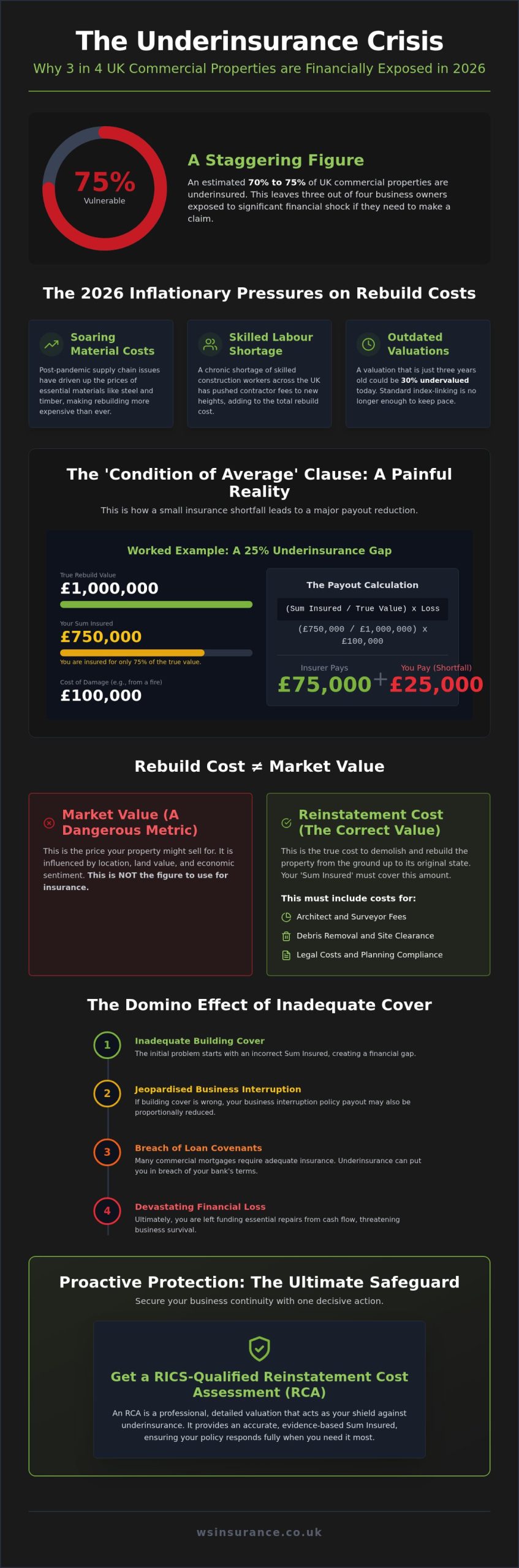
Did you know that between 70% and 75% of UK commercial properties are estimated to be underinsured in 2026? It is a staggering figure that leaves three out of four business owners vulnerable to a financial shock they likely haven’t prepared for. When rebuild costs outpace policy limits, the consequences of underinsuring commercial property become painfully clear the moment you file a claim. Most owners assume a small shortfall won’t matter for a partial loss. Unfortunately, the reality of the ‘Condition of Average’ clause means your payout could be slashed proportionally, regardless of the size of the damage.
We recognise that managing insurance often feels like a burden when you are focused on daily operations. It is difficult to balance rising construction costs against the need for competitive premiums whilst trying to decipher complex industry jargon. This article will help you discover the hidden financial and legal traps of underinsurance and learn how to protect your business assets from devastating claim reductions. We will provide total clarity on the ‘Average Clause’ formula; we will also outline a strategy to avoid underinsurance whilst maintaining your business continuity and security.
Key Takeaways
- Grasp why 2026 market volatility and rising material costs have rendered traditional valuation methods obsolete for your business assets.
- Learn how the ‘Condition of Average’ clause operates to ensure you aren’t blindsided by the financial consequences of underinsuring commercial property during a claim.
- Distinguish between market value and true reinstatement costs; this includes often-overlooked expenses like professional fees and debris removal.
- Identify the ‘domino effect’ where inadequate building cover can jeopardise your business interruption protection and breach bank loan covenants.
- Discover how a RICS-qualified Reinstatement Cost Assessment acts as a shield against uncertainty and secures your long-term business continuity.
Defining the Crisis: Underinsurance in the 2026 UK Property Market
The UK commercial property market is grappling with an unprecedented gap between insurance cover and actual replacement costs. This crisis has reached record levels in 2026 because the pace of construction inflation has consistently outstripped standard policy adjustments. When a claim is filed, insurers apply the Condition of Average to determine the final payout. Most owners find themselves in this position unintentionally, often because they haven’t reviewed their valuations since the economic climate shifted. Others might make a deliberate choice to lower premiums to manage overheads, but this short-term saving pales in comparison to the long-term consequences of underinsuring commercial property.
Post-pandemic supply chain shifts have fundamentally altered the price of essential materials like steel and timber. Simultaneously, a chronic shortage of skilled labour across the UK has pushed contractor fees to new heights. These aren’t just temporary spikes; they represent a structural change in how buildings are valued for insurance purposes. This shift means that historical data is no longer a reliable guide for risk. Materials that were once readily available now carry premium price tags whilst also involving extended lead times, effectively shrinking the safety net of an older policy.
The 2026 Inflationary Pressure on Rebuild Costs
Contractors face higher energy and transport overheads, which they must pass on to clients. If your policy valuation is three years old, it’s likely 30% undervalued today. Relying on standard index-linking is a gamble in this climate. These automatic uplifts rarely account for the strict requirements of the Building Safety Act or specific site access issues that inflate modern construction budgets.
Why ‘Market Value’ is a Dangerous Metric
Property owners often confuse market value with replacement costs. Market value is driven by economic sentiment and location; these figures don’t help when you need to buy bricks and mortar. Your policy relies on the ‘Sum Insured’ as the absolute ceiling of cover. Sum Insured is the total cost to rebuild from the ground up, including professional fees. To avoid the consequences of underinsuring commercial property, you must ensure this figure includes:
- Architect and surveyor fees
- Debris removal and site clearance
- Legal costs for planning compliance
- Temporary shoring or protection of the site
The ‘Condition of Average’: How Underinsurance Slashes Claim Payouts
Understanding the technicalities of your policy is the first step in avoiding the severe consequences of underinsuring commercial property. The Condition of Average is perhaps the most misunderstood element of a commercial contract. It isn’t just a technicality; it’s a fundamental principle of UK insurance law designed to ensure premiums are proportionate to the risk being carried. If you declare a building’s value at 80% of its true rebuild cost, you’re effectively telling the insurer you’ll handle the remaining 20% of the risk yourself. This means the insurer only pays out 80% of any claim you make, regardless of the size.
Many owners mistakenly believe this penalty only applies when a building is completely destroyed, but the consequences of being underinsured apply to every single incident, from a minor leak to a small kitchen fire. Insurers apply this proportional penalty to ensure that those who pay for full cover aren’t subsidising those who have deliberately or accidentally undervalued their assets. It’s a method of maintaining equity across the entire pool of policyholders; it ensures that the premium paid matches the true potential liability.
The Average Clause Formula Explained
To understand how this functions, consider the standard formula: (Sum Insured / True Rebuild Value) x Amount of Loss = Payout. Imagine a property with a true rebuild value of £1,000,000, but it is only insured for £750,000. If that building suffers a fire causing £100,000 worth of damage, the calculation would be: (£750,000 / £1,000,000) x £100,000. The resulting payout is £75,000, leaving the business owner with a £25,000 shortfall to fund from their own cash reserves. This illustrates how the consequences of underinsuring commercial property manifest even in routine claims, often leaving businesses unable to complete essential repairs.
Case Study: The Impact of a 25% Valuation Gap
A 25% gap might seem like a minor administrative error, but it changes your legal status to that of a ‘co-insurer’. In a recent scenario, a manufacturing firm was unable to replace vital machinery after a partial roof collapse because the building payout was reduced by a third. They couldn’t bridge the funding gap, which led to a permanent cessation of trade. This highlights why accurate commercial property insurance is about more than just compliance; it’s about survival. The psychological toll on owners who realise they’ve lost their business over a valuation oversight is immense. If you are unsure whether your current limits are sufficient, our team can help you audit your existing cover to remove any lingering doubt.
Rebuild Cost vs. Market Value: A Critical Comparison
Many property owners mistakenly rely on their latest valuation for sale or purchase when setting insurance limits. This confusion is a primary driver of the consequences of underinsuring commercial property. Market value represents what a willing buyer might pay in the current economic climate; it accounts for location, demand, and the land the building sits on. In contrast, the rebuild cost, also known as the reinstatement value, is purely about the physical labour and materials required to replace the structure from scratch. Because land doesn’t burn down or blow away, it is excluded from insurance valuations, but the costs to replace what stands upon it are often much higher than owners anticipate.
Anatomy of a Rebuild Cost Assessment
A precise assessment goes beyond the price of bricks and mortar. You must account for demolition and clearing costs, which frequently reach six figures for complex commercial sites. Professional fees for architects, surveyors, and planning consultants typically add another 10% to 15% to the total budget. Additionally, any rebuild in 2026 must comply with the latest public authority requirements. This includes stringent Net Zero targets and updated fire safety standards mandated by the Building Safety Act, both of which significantly inflate the final bill compared to the building’s original construction costs.
The Comparison Table: Rebuild vs. Market
Understanding these differences is vital for your long-term security. Using the wrong figure can lead to a significant shortfall during a claim, triggering the proportional penalties discussed earlier.
| Feature | Market Value | Rebuild Cost (Sum Insured) |
|---|---|---|
| Primary Purpose | Buying, selling, or securing a mortgage. | Replacing the physical structure. |
| Influencing Factors | Location, land value, and local demand. | Material costs, labour, and regulations. |
| Insurance Relevance | None; it doesn’t reflect actual repair costs. | The absolute ceiling of your policy cover. |
Regional economic nuances create specific risks for the unwary. In some parts of the UK, a building’s market value might be lower than its actual rebuild cost. If you insure based on that lower market figure, you trigger the consequences of underinsuring commercial property immediately upon filing a claim. Conversely, in high-demand commercial hubs, the market value often exceeds the rebuild cost due to the premium placed on the land. Insuring for the market value in these instances leads to ‘over-insuring’, where you pay unnecessarily high premiums for cover that exceeds the actual reinstatement cost. Our role as your expert guide is to help you navigate these complexities, ensuring your valuation is precise and your assets are truly protected.
Beyond the Building: Secondary Consequences for the Business
The impact of a claim shortfall ripples through the entire corporate structure, affecting far more than just the physical walls. One of the most immediate consequences of underinsuring commercial property is the ‘domino effect’ it has on Business Interruption cover. If you cannot afford to start repairs because of a significant funding gap, the clock on your indemnity period continues to tick whilst you search for capital. This delay often results in the business running out of operational support before the doors can reopen, turning a manageable incident into a terminal failure.
Financial institutions also take a dim view of inadequate protection. Most commercial mortgages include strict covenants requiring the property to be insured for its full reinstatement value at all times. A shortfall discovered during a claim can trigger a technical default; this may lead to a recall of the loan or a significant downgrade in your credit rating. Future insurability also becomes a hurdle. Other providers may view a history of underinsurance as a sign of poor risk management, which often leads to higher premiums or a total refusal of cover amongst the leading UK insurers.
Directors’ Personal Liability and Fiduciary Duty
Directors have a clear legal obligation to protect company assets and ensure the business remains a going concern. If a massive shortfall occurs because a valuation was neglected, shareholders or stakeholders may pursue claims for ‘negligent management’. This shifts the focus from a property loss to a professional liability issue. Ensuring your sums insured are accurate is a critical part of your legal business risks to insure against. Without this diligence, you risk personal exposure and potential Directors & Officers claims that could have been easily avoided with a professional assessment.
Breach of Lease and Tenant Disputes
Proactive Protection: How to Ensure Your Sums Insured Are Accurate
Protecting your business assets requires a shift from passive renewal to proactive assessment. The consequences of underinsuring commercial property are severe, but they are entirely preventable with the right professional support. Relying on outdated figures or generic index-linking in a 2026 market is a gamble that few businesses can afford to take. Instead, establishing a robust valuation cycle ensures your cover remains aligned with real-world rebuild costs, providing a steady hand in an unstable economy. By taking these steps now, you eliminate the risk of a reduced payout later.
A Reinstatement Cost Assessment (RCA) conducted by a RICS-qualified surveyor is the gold standard for accuracy. Whilst some owners opt for cheaper ‘desktop’ valuations, these often miss site-specific complexities that drive up costs. We recommend a full professional valuation every three to five years. You should also trigger a re-valuation immediately following any significant renovations, extensions, or changes in the building’s use. This diligence ensures that your policy’s ‘Sum Insured’ is a precise reflection of your actual risk.
You should also consider the ‘Day One Reinstatement’ clause. This provides a percentage buffer, often between 15% and 50%, on top of the declared value to account for inflation during the policy year. It acts as a safety net. It ensures that even if material prices spike unexpectedly between your last valuation and the date of a loss, your payout remains sufficient to cover the full rebuild. This clause is a vital tool for maintaining business continuity in a volatile construction market.
The RICS Valuation Process
A professional surveyor examines much more than just the floor plan. They evaluate construction types, the presence of hazardous materials like asbestos, and site access limitations that could hinder heavy machinery during a rebuild. A full site survey provides the granular detail needed to satisfy an insurer’s scrutiny. This level of precision removes the guesswork and provides a documented audit trail that can be vital during a claim dispute. It transforms your insurance from a mere commodity into a bespoke protective outcome.
The Broker’s Role in Removing Uncertainty
WS Insurance Brokers act as your shield against market complexity. We don’t just facilitate a transaction; we guide you through the intricacies of policy wording to eliminate doubt. Our team reviews index-linking percentages to ensure they match the 2026 reality of construction inflation rather than relying on historical averages. We take the proactive labour out of the process, allowing you to focus on your core business with confidence. This partnership ensures that you avoid the devastating consequences of underinsuring commercial property by maintaining a sum insured that reflects the true cost of reinstatement.
Contact WS Insurance Brokers today for a comprehensive property insurance review
Securing Your Assets Against Market Volatility
Protecting your business in 2026 requires a shift from passive renewals to diligent risk management. We have explored how the ‘Condition of Average’ can turn a minor incident into a terminal financial blow and why market valuations are a dangerous metric for insurance. Avoiding the consequences of underinsuring commercial property requires more than a simple annual uplift; it demands a precise understanding of modern construction costs and regulatory requirements. By prioritising a RICS-qualified assessment and leveraging professional buffers like ‘Day One’ clauses, you can eliminate the doubt that often surrounds a claim. Security is a proactive choice.
As an independent and FCA regulated broker, WS Insurance Brokers acts as a shield between your organisation and market complexity. We provide access to the entire UK insurance market and offer expert claims advocacy to ensure you are never left fighting a loss alone. Our consultative approach focuses on your long-term security, moving beyond transactions to build a partnership of trust. Secure your business future with a professional insurance review from WS Insurance Brokers today. You deserve the clarity to grow with confidence.
Frequently Asked Questions
What is the ‘Condition of Average’ in commercial insurance?
The Condition of Average is a standard clause in most UK commercial policies that penalises underinsurance by reducing claim payouts proportionally. If your property’s true rebuild cost is £1 million but you only insure it for £500,000, your insurer will only pay 50% of any claim. This applies to partial losses as well as total destructions. It ensures the premium paid accurately reflects the risk the insurer is carrying.
Can I use my mortgage valuation for building insurance?
You shouldn’t rely on a mortgage valuation for insurance purposes because it usually focuses on market value or lending security. Market value includes land price and location demand, which aren’t relevant to rebuilding costs. Insurance valuations must cover the physical labour, materials, and professional fees required to reinstate the structure from scratch. Using a mortgage figure is a common way to trigger the consequences of underinsuring commercial property.
How often should I have a professional Reinstatement Cost Assessment (RCA)?
We recommend a full RICS-qualified Reinstatement Cost Assessment every three to five years. In a volatile market like 2026, construction inflation can quickly outpace standard index-linking. You should also commission a new RCA immediately after any significant structural renovations, extensions, or changes in the building’s usage. Regular assessments provide a documented audit trail that removes uncertainty and satisfies insurer scrutiny during a claim process.
Will my claim be rejected entirely if I am underinsured?
Your claim is unlikely to be rejected entirely solely due to underinsurance; instead, it will be reduced proportionally under the Condition of Average. However, if the level of underinsurance is so significant that it constitutes a deliberate or reckless breach of the duty of fair presentation, the insurer may have the right to void the policy. In most cases, you’ll simply face a funding gap that you must cover from your own reserves.
What is a ‘Day One Reinstatement’ clause and does it prevent underinsurance?
A Day One Reinstatement clause allows you to declare a base value on the first day of the policy and adds an inflation buffer, typically between 15% and 50%. This protects you against rising material and labour costs during the policy year. Whilst it provides a vital safety net, it doesn’t prevent the consequences of underinsuring commercial property if your initial base valuation was inaccurate or outdated at the start.
Does underinsurance affect my Business Interruption cover?
Yes, underinsurance often has a devastating domino effect on Business Interruption cover. If a claim payout is reduced, you might lack the funds to start rebuilding promptly. These delays can cause you to exceed your Business Interruption indemnity period, meaning your financial support stops before your business is back on its feet. Inadequate building cover can effectively render your business interruption protection insufficient for a full recovery.
Are professional fees included in my building’s sum insured?
Professional fees aren’t automatically included unless you specifically factor them into your sum insured. You must account for architects, surveyors, and legal consultants, which typically add 10% to 15% to the total rebuild cost. You also need to include the costs for debris removal and site clearance. Failing to include these ancillary expenses is a frequent cause of underinsurance that leaves owners with significant out of pocket costs.
Can I be personally liable as a Director for underinsurance?
You can potentially face personal liability if failing to secure adequate cover is viewed as a breach of your fiduciary duties. Directors are responsible for protecting company assets and ensuring business continuity. If a massive claim shortfall leads to insolvency or significant shareholder loss, you could face legal action for negligent management. This is why accurate valuations are a critical component of a Director’s risk management strategy.