
What if the insurance policy designed to protect your firm is actually the primary barrier to your growth? For many in the trade, scaffolding insurance feels less like a safety net and more like an escalating tax on ambition, especially when insurers impose restrictive height limits or demand exorbitant premiums for high-hazard work. You know that cutting corners isn’t an option when lives and livelihoods are on the line; yet, finding a broker who truly understands the difference between a domestic tower and a complex industrial rig remains a constant struggle.
In this 2026 guide, we promise to show you how to secure robust, tailored protection that matches your operational reality whilst ensuring full regulatory compliance. We’ve meticulously analysed the current market to bring you clarity on everything from Employers’ Liability statutory minimums to the nuances of Professional Indemnity for temporary works. You’ll discover how expert advocacy can transform the claims process from a business threat into a manageable hurdle, providing you with the transparency and security your business deserves.
Key Takeaways
- Understand the specific risk factors that categorise scaffolding as a high-hazard trade and how these influence your annual premiums.
- Identify the legal requirements for Employers’ Liability and the necessary limits for Public Liability to satisfy major commercial contracts.
- Learn how to navigate height limits and common policy exclusions that could otherwise result in rejected claims and financial loss.
- Discover how robust risk management and professional memberships can help you secure more competitive rates for your scaffolding insurance.
- Gain insights into how independent advocacy and bespoke policy placement can remove the uncertainty of high-risk protection.
What is Scaffolding Insurance and Why is it Classified as High-Hazard?
Scaffolding insurance isn’t a single, monolithic product. It’s a specialised suite of liability covers designed to address the extreme risks inherent in working at height and the use of heavy, temporary structures. To understand the necessity of this protection, one must first consider what is scaffolding in a modern context: a complex assembly of tubes, boards, and couplers that must support significant weight whilst remaining stable under variable weather conditions. This complexity is why insurers view your trade through a different lens than standard construction work.
The “high-hazard” classification isn’t just a label; it’s a reflection of the potential severity of a claim. While a minor error by a decorator might lead to a stained carpet, a minor error by a scaffolder can result in a catastrophic structural failure or a fatal fall. This status directly impacts both your premiums and the availability of cover. Many insurers simply won’t touch the risk, leaving those that do to apply strict criteria. Relying on a generic, off-the-shelf policy is a significant gamble. Bespoke wording is essential to ensure that your specific activities, from high-rise commercial builds to domestic extensions, are actually covered by the fine print.
The Unique Risk Profile of the Scaffolding Sector
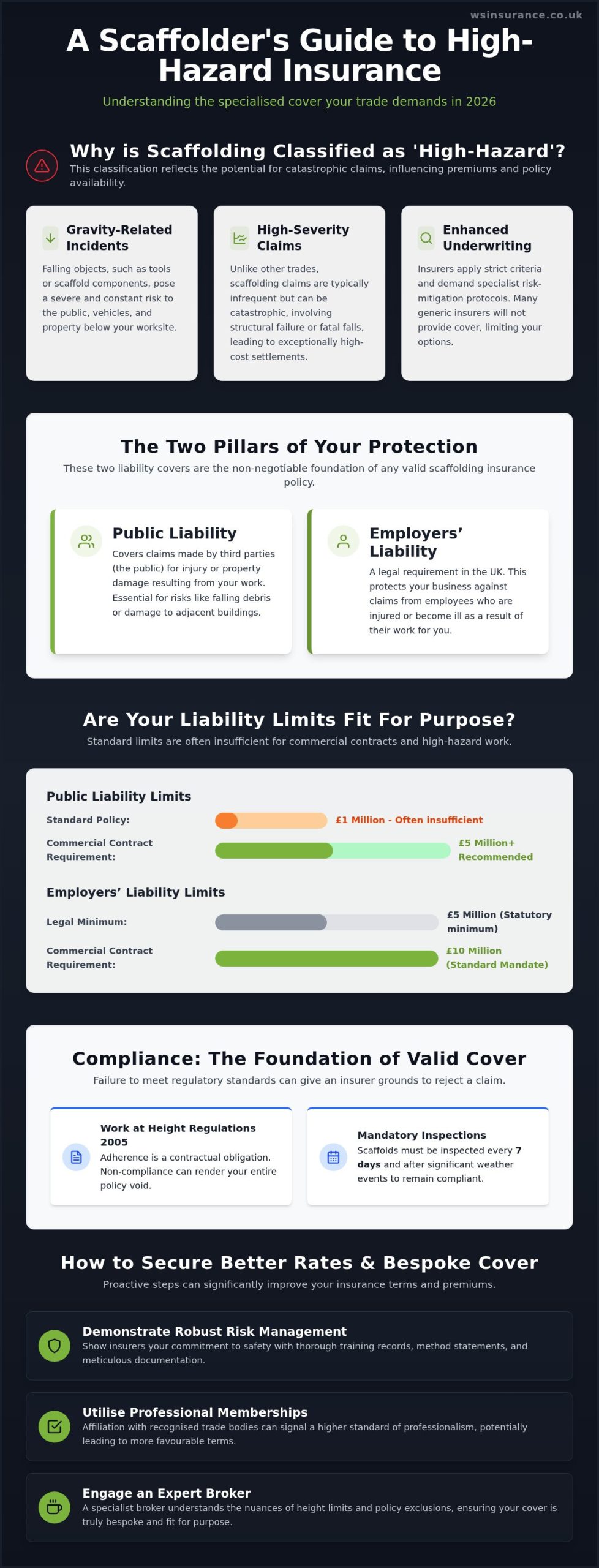
The primary concern for underwriters centres on “gravity-related” incidents. Falling objects, such as tools or scaffold components, pose a severe risk to the public and property below. Unlike low-level trades where claims are often frequent but low-value, scaffolding claims are typically infrequent but high-severity. In the 2026 UK insurance market, high-hazard status is defined as any operational activity where the potential for catastrophic injury or third-party property damage necessitates enhanced underwriting scrutiny and specialist risk-mitigation protocols. This reality demands a policy that prioritises structural integrity and robust safety barriers over simple price considerations.
Regulatory Requirements for UK Scaffolders
Compliance with Health and Safety Executive (HSE) standards is the bedrock of your insurance validity. Regulations like the Work at Height Regulations 2005 aren’t just safety guidelines; they are contractual obligations in the eyes of your insurer. If an investigation reveals that a scaffold wasn’t inspected every seven days or after a significant weather event, your insurer may have grounds to void your protection entirely.
Public contracts and major commercial projects now strictly mandate specific liability limits. It’s common to see requirements for at least £10 million in Employers’ Liability and £5 million in Public Liability. Without a policy that explicitly meets these thresholds and adheres to HSE standards, your firm remains legally and financially exposed, potentially barred from the very contracts you need to grow.
Essential Cover: Public Liability and Employers Liability for Scaffolders
Scaffolding insurance is built on two non-negotiable pillars: Public Liability and Employers Liability. These covers act as the primary shield for your business, yet they are often the most misunderstood elements of a policy. In a sector where a single loose coupler can lead to a catastrophic event, having the right limits isn’t just about compliance; it’s about survival. Relying on a standard £1 million limit is a significant risk in 2026. Given the rising costs of litigation and property repairs, such a low ceiling can be breached by a single incident involving a falling tube on a busy high street or damage to a high-value commercial facade.
Public Liability: More Than Just “Slip and Trip”
Public Liability (PL) is your first line of defence. It protects against claims from third parties for injury or property damage caused during the erection, use, or dismantling of a structure. While many trades consider PL a “slip and trip” cover, for scaffolders, it’s far more significant. It must account for the risk of falling objects striking pedestrians or passing traffic, as well as structural damage to the buildings you’re working on. Following UK scaffolding regulations is a prerequisite for any valid claim. For those seeking a wider perspective on how these covers integrate into a broader risk strategy, our Business Insurance UK guide provides essential context.
Employers Liability and Your Duty of Care
Employers Liability (EL) is a legal requirement if you employ staff. This includes labour-only sub-contractors (LOSC), who are treated as employees under the Employers’ Liability (Compulsory Insurance) Act 1969. While the statutory minimum is £5 million, the industry standard for scaffolding is £10 million per occurrence. Major contractors and local authorities rarely accept anything less due to the high-risk nature of working at height.
You must also understand vicarious liability when using bone-fide sub-contractors. Even if they carry their own insurance, you could still be held responsible for their actions on site if they’re working under your direction. Working at height inherently increases the severity of EL claims; a fall from even a few metres can be life-altering. Ensuring your policy limits match the reality of your site risks is vital for long-term stability. If you’re unsure if your current cover meets these modern standards, a professional liability review can offer the clarity you need. We focus on removing the anxiety of the selection process by placing your risk with insurers who understand the scaffolding sector’s specific demands.
Navigating Height Limits and Critical Policy Exclusions
The most dangerous part of a scaffolding insurance policy isn’t the premium; it’s the fine print. For many firms, the “Height Limit” clause represents a binary trigger that can render a policy useless in an instant. If your schedule of insurance specifies a 15-metre limit and an incident occurs on a structure measured at 16 metres, the insurer may have grounds to reject the claim entirely. This lack of flexibility is a significant pain point for growing businesses that occasionally take on larger projects without updating their cover. Full disclosure of your typical project scope is the only way to remove this uncertainty.
Beyond height, certain activities and materials are frequently excluded from standard policies. Heat work, such as using blowtorches for roofing repairs on a scaffold, or the handling of asbestos, typically requires specialist endorsements. Similarly, working in “prohibited locations” like airports, railways, or chemical plants often falls outside the remit of a generic policy. Ensuring your protection remains valid whilst working on specialised structures requires a broker who understands scaffolding industry standards and can negotiate the removal of these restrictive barriers on your behalf.
Understanding Height and Depth Restrictions
Standard policies often come with pre-set height limits, typically ranging from 10 to 25 metres. However, specialist firms often require unlimited height options to remain competitive for high-rise contracts. It’s vital to know how your insurer measures height; most define it from the lowest ground point to the highest working platform or the top of the structure itself. If a project exceeds your current limits mid-term, don’t wait for the renewal. A proactive broker can often arrange a temporary extension or a permanent limit increase to ensure continuous security.
Specialist Locations and High-Risk Sites
Insuring work on listed buildings or heritage sites adds a layer of complexity due to the high reinstatement costs of historical materials. Industrial environments, such as power stations or marine docks, present unique hazards that require precise underwriting. For a deeper understanding of how site-specific risks influence your broader business protection, our Commercial Property Insurance guide offers valuable insights. We act as a shield between your business and these complexities, ensuring that even the most demanding environments are accounted for in your policy wording. By eliminating doubt through thorough risk placement, you can focus on the technical execution of the build with absolute confidence.
How to Reduce Scaffolding Insurance Premiums Through Risk Management
Securing competitive scaffolding insurance doesn’t happen by accident. In the eyes of an underwriter, your business is a collection of data points, and the most influential of these is your safety record. Firms that demonstrate a “Safety First” culture aren’t just protecting their workers; they’re actively lowering their risk profile. When you can prove that your site protocols exceed the bare minimum, you move from being a “standard” high-risk prospect to a preferred client. This shift is the most effective way to combat the rising costs of protection in 2026.
Professional memberships and accredited training are your strongest negotiating tools. Holding a membership with the National Access & Scaffolding Confederation (NASC) acts as a badge of honour, signaling to insurers that you adhere to the highest industry standards. Similarly, ensuring all staff hold valid Construction Industry Scaffolders Record Scheme (CISRS) cards provides concrete evidence of competence. Underwriters view these qualifications as proof of reduced liability, often resulting in more favourable rates than those offered to unaccredited competitors. Safety pays, both on the rig and in the boardroom.
Documentation and Evidence of Best Practice
Rigorous record-keeping is the backbone of any premium-reduction strategy. Maintaining detailed inspection logs, signed method statements, and site-specific risk assessments creates a paper trail of diligence that is invaluable during a renewal or a claim. In 2026, the adoption of digital risk assessment tools has become a benchmark for excellence, allowing for real-time reporting and immediate rectification of hazards. Proactive risk management acts as a robust shield for your business, deflecting the financial impact of preventable incidents before they reach your bottom line.
Choosing the Right Deductibles and Limits
Finding the sweet spot between your policy excess and your annual premium is a delicate balancing act. Increasing your voluntary deductible can lead to significant upfront savings, but it requires a clear understanding of your cash flow. You must ensure your firm can comfortably absorb the cost of minor claims without threatening business continuity. Cheap insurance often costs more in the long run if the policy is riddled with high excesses and restrictive clauses that trigger when you’re most vulnerable. For a deeper look at how to weigh these factors, our Identifying Business Risks guide provides a strategic framework for UK trades.
Our role as your advisor is to help you present your business in the best possible light to the entire UK market. We don’t just sell policies; we help you build a narrative of reliability that insurers want to back. To discover how your safety record can translate into tangible savings, request a bespoke scaffolding insurance review today. We’ll work alongside you to remove the uncertainty from your renewals and ensure your cover matches your operational reality.
Securing Bespoke Protection with WS Insurance Brokers
Finding the right scaffolding insurance is only half the battle. The true value of a policy is revealed during a complex claim or a difficult renewal. As an independent, FCA-regulated broker, we don’t just sell products; we provide a steady hand in a complex market. Our autonomy allows us to search the entire breadth of the UK market to find the precise fit for your high-hazard risks. This independence ensures our loyalty remains firmly with you, the client, rather than any single insurer. We act as a shield between your business and the complexities of the broader market, ensuring your protection is never compromised by generic wording.
Our commitment to transparency means we strip away the hidden jargon to provide clear, actionable advice. We understand that scaffolding is a demanding trade that requires precision, and we mirror that precision in our risk placement. By focusing on your long-term security over immediate transactions, we build a narrative of partnership where our proactive labour results in your ease and confidence. You deserve a broker who understands that your insurance is an operational license, not just a necessary cost.
The “Trusted Advisor” Model
We believe in a consultative approach that prioritises your business continuity. This means you’ll have a named contact who understands the specific pressures of the scaffolding sector, from height restrictions to the nuances of vicarious liability. We provide a supportive atmosphere that removes the anxiety from the selection process, offering expressions of security at every stage. For a deeper understanding of how this professional risk placement works, our Specialist Insurance Brokers guide explains our methodology in detail.
Your Next Steps to Comprehensive Cover
Securing a tailored policy begins with a thorough risk assessment. To prepare for your consultation, ensure you have your current policy documents, safety certifications (such as CISRS or NASC memberships), and a clear breakdown of your typical project heights and locations. Our methodical process moves from establishing your underlying philosophy to granular policy placement, ensuring every exclusion is addressed. This diligent approach eliminates doubt and ensures your policy limits actually match your operational reality. To begin removing the uncertainty from your business protection, speak to a specialist at WS Insurance Brokers today. We are ready to provide the expert guidance and dedicated advocacy your scaffolding firm requires.
Build Your Scaffolding Business on Solid Ground
Your protection should be a foundation for growth, not a source of constant anxiety. We’ve explored how high-hazard trades require more than just off-the-shelf policies, focusing instead on bespoke wording that accounts for height limits and specialist site risks. By implementing robust risk management whilst seeking independent advocacy, you can navigate the 2026 market with absolute confidence. Our status as an FCA authorised and regulated broker ensures that you receive transparent, unbiased advice at every stage.
Choosing a partner who prioritises your long-term security over a quick transaction is vital for your firm’s stability. With independent access to a wide panel of major UK insurers and deep specialist construction sector expertise, we act as a shield between you and market complexities. It’s time to remove the uncertainty from your renewals and ensure your policy matches your operational reality. Request a tailored scaffolding insurance consultation from WS Insurance Brokers today. We’re here to provide the steady hand you need to reach new heights safely.
Frequently Asked Questions
Is scaffolding insurance a legal requirement in the UK?
Employers’ Liability is a legal requirement under the Employers’ Liability (Compulsory Insurance) Act 1969 if you have any staff. The statutory minimum for this cover is £5 million. While Public Liability isn’t a legal requirement by statute, local authorities and main contractors will mandate it for permits and project access. Most industry bodies, such as the NASC, also make specific liability limits a condition of membership to ensure professional standards are maintained.
How much does scaffolding insurance cost on average?
The cost of scaffolding insurance varies significantly based on your firm’s turnover, height limits, and claims history. Because scaffolding is classified as a high-hazard trade, underwriters assess each risk individually rather than using a flat rate. Factors such as the use of sub-contractors and the geographical location of your projects also influence the final premium. We recommend a bespoke consultation to determine a precise figure that reflects your specific operational reality and safety protocols.
Does my policy cover me for work on high-rise buildings?
Cover for high-rise work depends entirely on the height limits specified in your schedule of insurance. Standard policies often include a cap, such as 15 metres, which could leave you exposed on taller structures. If your business regularly undertakes high-rise projects, you must ensure your policy includes an unlimited height endorsement. Disclosing your maximum working heights during the application process is vital to prevent insurers from rejecting claims due to a breach of policy conditions.
What happens if I use sub-contractors on a project?
Your insurance obligations change depending on whether you use labour-only or bona-fide sub-contractors. Labour-only sub-contractors are usually treated as employees, meaning they must be covered under your Employers’ Liability policy. Bona-fide sub-contractors should carry their own insurance, but you still face vicarious liability if their actions lead to a claim against your firm. It’s essential to verify their documents and ensure your policy is worded to account for these complex working relationships and legal duties.
Can I get cover for scaffolding equipment theft or damage?
Yes, you can secure protection for your tubes, boards, and specialised plant through specific equipment or contract works cover. Scaffolding equipment is highly susceptible to theft and accidental damage whilst on site or in transit. A robust policy can be tailored to include these assets, covering the cost of replacement or repair. This ensures that a single incident of site theft doesn’t cause a significant financial setback or delay your project timelines and contractual obligations.
What is the difference between Public Liability and Employers Liability for scaffolders?
Public Liability protects your business against claims made by third parties for injury or property damage caused by your operations. Employers’ Liability, however, covers claims made by your own staff or labour-only sub-contractors for injuries sustained whilst working for you. In the scaffolding sector, both are critical because the risk of a falling object hitting a pedestrian is just as serious as the risk of a staff member falling from height during erection or dismantling.
Are there specific height limits in a standard scaffolding policy?
Most standard scaffolding insurance policies include specific height restrictions, typically ranging from 10 to 15 metres. These limits are a primary cause of rejected claims if a firm accidentally exceeds them. If your work involves taller commercial buildings or industrial rigs, you require a policy with extended or unlimited height endorsements. We prioritise checking these clauses during our risk assessment to ensure your protection matches the physical reality of the structures you build every day.
How does my safety record affect my insurance premiums?
Underwriters use your safety record as a direct indicator of future risk, meaning a clean history often leads to lower premiums. Implementing a safety first culture and maintaining rigorous training records shows insurers that you are a lower liability. Conversely, a history of frequent minor claims or safety breaches signals a higher risk profile, which usually results in increased costs. Proactive risk management acts as a shield, protecting your bottom line from escalating insurance expenses.