
Private medical insurance can help with eligible private treatment, but it won’t replace income you lose while you’re unable to work. If you’re searching for “private medical insurance for self-employed person”, the practical questions are what treatment the policy covers, how you access it and how you’d manage financially if illness stopped you earning.
When you work for yourself, you may not have an employer health scheme or sick-pay arrangement to fall back on. Before choosing a policy, compare its benefits, exclusions and potential out-of-pocket costs with your needs. Private medical insurance is designed to cover eligible treatment, while income protection is intended to provide an income if illness or injury prevents you from working. They address different risks.
This UK guide explains what medical cover may include, where its limits can lie and how to compare policy terms with your work and household circumstances. It also explains how an independent broker can assess your needs and source suitable cover from a panel of UK insurers.
Key Takeaways
- Assess private medical insurance for self-employed person cover against the treatment routes and arrangements that matter to your work and household.
- Compare inpatient, outpatient and diagnostic benefits, then check how exclusions, limits and out-of-pocket costs affect the cover in practice.
- Separate healthcare costs from lost earnings when weighing medical insurance and income protection. Each addresses a different risk.
- Review your treatment preferences, dependants and whether individual or joint cover better fits your circumstances.
- A broker can help clarify your priorities and source tailored cover from a panel of UK insurers.
Why private medical insurance can matter when you are self-employed
Working for yourself can make illness feel like two problems at once: arranging care and managing the impact of time away from work. Private medical insurance may help with eligible private healthcare, subject to the policy’s terms, but it doesn’t replace earnings you lose if you can’t work. Keep this distinction in mind when considering private medical insurance for self-employed person cover.
Private medical insurance helps meet the cost of eligible private medical treatment, while income protection is designed to provide an income if illness or injury prevents you from working. They address different risks, so one shouldn’t be mistaken for a substitute for the other.
What private medical insurance may help with
Depending on the policy, cover may contribute towards eligible private consultations, diagnostic tests or treatment. The policy documents explain the benefits and how to access them. For a general overview of how this type of cover works, see Private Medical Insurance.
Limits and processes matter as much as headline benefits. A policy may require a referral or insurer authorisation, and may restrict which services or costs are covered. These conditions determine whether a particular appointment, test or course of treatment falls within the cover. Read the terms rather than assuming a private appointment or recommended treatment will automatically be paid for.
Why working for yourself changes the decision
Your income may depend closely on your ability to work, but each self-employed person’s financial arrangements are different. Consider separately whether you want more choice over treatment routes and how you would manage financially if you couldn’t work. Medical insurance relates to eligible healthcare costs or access as defined by the policy. It doesn’t itself provide replacement earnings.
Private medical insurance is optional. NHS care remains available, and choosing insurance doesn’t mean giving up access to NHS services. The decision is whether private cover fits your preferences, circumstances and budget, not whether one route is right for everyone.
Separate the questions before comparing policies: what eligible healthcare would you want cover to help with, and what financial resources would you rely on if illness kept you from working? The first can guide your assessment of medical cover. The second points to income protection, which is designed around lost earnings rather than treatment costs. Keeping the two clear helps you judge each policy on its own purpose.
Once you know which concern matters most, look beyond the policy name to its terms, limits and access requirements. That gives you a more grounded basis for deciding whether medical cover could support the way you work, without expecting it to address every consequence of ill health.
What self-employed private medical insurance may cover, and what it may exclude
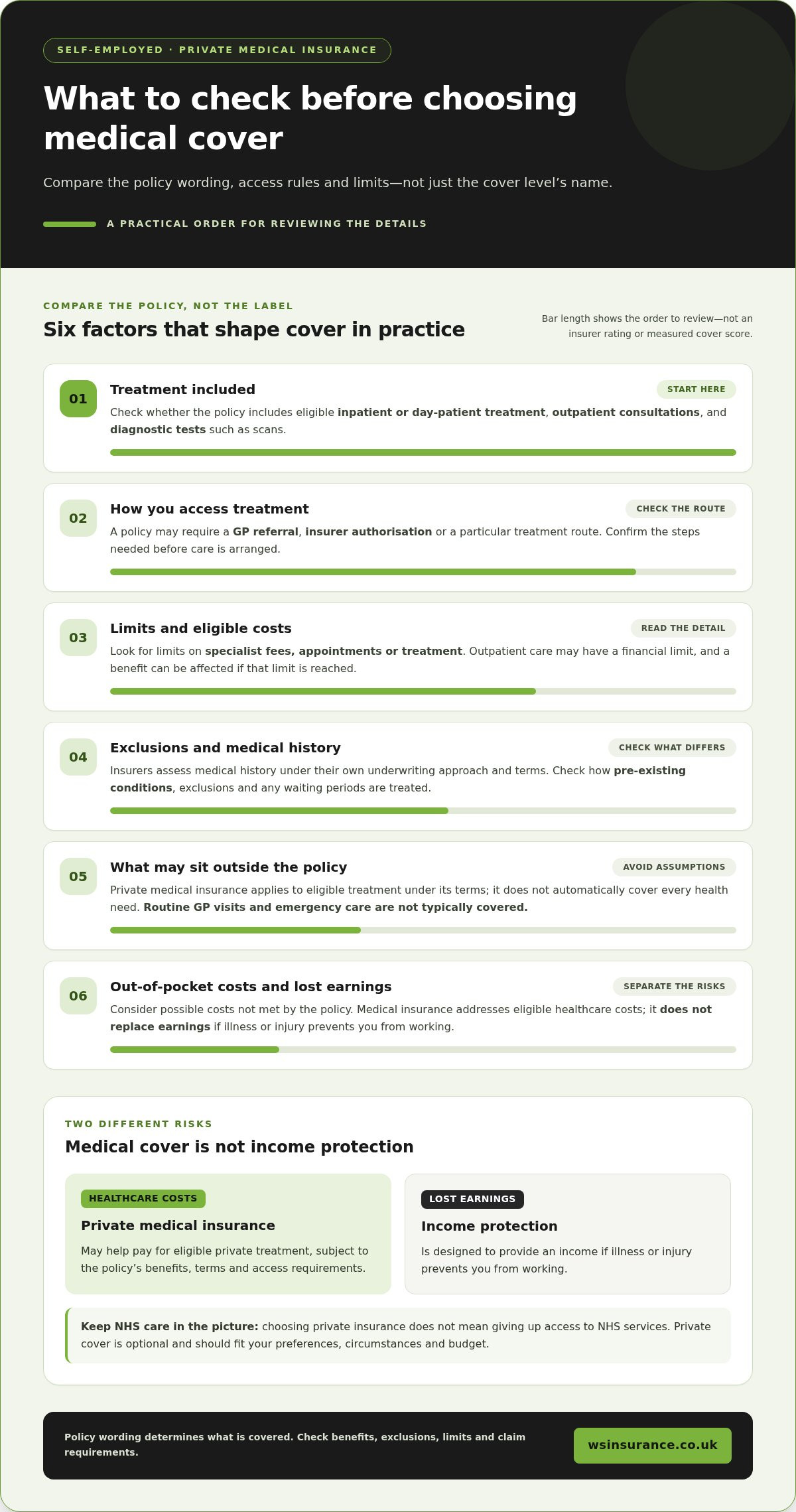
Private medical insurance can help with the cost of eligible private healthcare, but there isn’t one standard package. The treatment covered, how you access it and how much the insurer may pay depend on the policy. Policy wording, not a broad label such as “comprehensive”, determines what cover you have.
Benefits may include the following, subject to the insurer’s terms:
- Inpatient or day-patient treatment: eligible care that involves a hospital stay or treatment without an overnight stay.
- Outpatient care: consultations with specialists and other eligible appointments outside hospital admission, sometimes subject to a financial limit.
- Diagnostics: tests such as scans or other investigations, where covered and accessed through the policy’s referral and authorisation process.
These examples don’t mean every listed service will be covered by every policy. An insurer may require a GP referral, prior authorisation or a particular treatment route. A policy may also set limits on eligible fees, appointments or treatment. Check how these provisions work together: a benefit can look useful in a summary but offer less practical value if a limit is reached or a required step isn’t followed.
How cover levels and policy options can differ
Policies can differ in whether they cover inpatient treatment, outpatient consultations or both, and in the limits applied to specialist fees and diagnostics. Optional choices also vary by policy. Compare the detail, not just the cover level’s name.
Private medical insurance is distinct from NHS services and routine healthcare. Private cover applies only to eligible treatment under the policy; it doesn’t automatically pay for every appointment or health need. Routine GP visits and emergency care are not typically covered by private medical insurance, so don’t assume these are included. Consider which NHS services you would continue to use and which eligible private treatment you want the policy to address.
Exclusions, pre-existing conditions and underwriting
Insurers assess medical history according to their underwriting approach and policy terms. A pre-existing condition may be treated differently between policies, so don’t assume it will be covered or excluded in the same way by every insurer. Before choosing, read the exclusions, any waiting periods, referral rules and claim requirements. These details can determine whether the cover suits your circumstances.
When comparing private medical insurance for self-employed person policies, consider what each insurer will cover against the treatment routes and arrangements you value. WS Insurance Brokers can help you understand policy differences and source suitable cover from a panel of UK insurers. Discuss tailored private medical insurance with the team.
Private medical insurance vs income protection: which risk does each address?
These policies address different financial pressures. Private medical insurance relates to eligible private healthcare costs or access, as the policy defines them. Income protection is designed to provide a regular income if illness or injury leaves you unable to work, subject to the policy’s qualifying conditions. Private medical insurance does not automatically pay a replacement income.
That distinction matters if you work for yourself. A policy that may help with eligible treatment won’t, by itself, cover business overheads or household bills while you’re unable to earn. An income-replacement benefit isn’t medical treatment cover either. Consider each risk separately rather than expecting one policy to do both jobs.
What each type of cover is designed to do
This table summarises the general difference. Exact benefits, definitions and claim requirements depend on the relevant policy wording.
| Private medical insurance | Income protection |
|---|---|
| Purpose: Helps with eligible private healthcare costs or access, as defined by the policy. | Purpose: Provides income support if you can’t work because of illness or injury and meet the policy conditions. |
| Potential trigger: Eligible treatment that falls within the cover and follows any required referral or authorisation process. | Potential trigger: Incapacity that meets the policy’s definition, subject to its claim conditions. |
| Typical benefit form: Cover towards eligible treatment costs, within the policy’s limits and terms. | Typical benefit form: Regular income payments, if a claim is accepted under the policy. |
| Important limitations: Exclusions, limits, underwriting terms and access requirements can affect what is covered. | Important limitations: Definitions of incapacity, claim conditions and payment terms vary between policies. |
For example, if you need a consultation or diagnostic test, medical insurance may respond only if that care is eligible and you follow the policy’s process. If illness prevents you from doing your work, income protection addresses the separate question of income support, subject to its own terms. Neither outcome is automatic: policy wording determines eligibility and the conditions for a claim.
When a self-employed person might consider both
Map two exposures: the cost or access arrangements for private treatment, and the effect on your income if you can’t work. Review savings, other benefits and financial commitments, including regular household costs and business outgoings. This won’t decide the answer for you, but it can show which gaps matter most and what you already have in place.
Broader planning can help you consider these personal concerns alongside risks facing your work. WS Insurance Brokers’ guide to identifying business risks to insure against offers a wider risk-planning perspective. If you’re researching “private medical insurance for self-employed person” cover, keep the healthcare and income questions distinct as you compare your options.
How to assess private medical insurance as a self-employed person
A useful comparison starts with your circumstances, not a list of headline benefits. Use this review process to identify what matters, compare equivalent cover and spot terms that could affect how you use a policy. Premiums depend on individual factors, so compare the cover and conditions rather than assuming that two similar-looking policies offer the same protection.
Build a shortlist around your circumstances
Consider your work pattern, household needs, treatment preferences and any existing cover. Decide whether you need cover for yourself alone or want to include a partner or dependants. Personal medical history can affect underwriting and the terms available, so provide accurate information and review any exclusions or special terms.
- 1. Identify your priorities. Note the treatment settings and services you’d value, alongside practical preferences for arranging eligible care. Separate must-haves from features you’d consider optional.
- 2. Map your household needs. Decide who needs cover and whether individual or joint arrangements suit your circumstances. Consider dependants and how their needs may differ from yours.
- 3. Take stock of existing cover. Review any health insurance or other relevant benefits already available to you. This helps you focus on gaps rather than features that may duplicate cover.
- 4. Consider underwriting information. Medical history may influence how an insurer assesses an application and the terms it offers. Read the resulting terms carefully, particularly where an exclusion or limitation affects a priority you identified.
- 5. Compare premiums in context. Premiums depend on individual factors and the cover selected. Compare them alongside policy limits, excesses and exclusions, rather than treating the premium alone as a measure of value.
Compare policy wording, not just headline features
Once you have a shortlist, check how each policy’s wording applies to the treatment and access arrangements you care about. Comparing equivalent cover levels makes the differences clearer, but limits, exclusions and authorisation requirements can still vary. A broker can help explain these differences and its role, as outlined in this guide to insurance brokers.
- 6. Check eligibility and exclusions. Look at what treatment qualifies, how pre-existing conditions are treated and whether exclusions affect likely use.
- 7. Understand limits and excesses. Check any caps on benefits and what you may have to contribute towards eligible claims. Consider whether those terms still suit your priorities.
- 8. Review the process and renewal terms. Note referral, authorisation and claim requirements, then read how renewal is handled. These conditions can affect how the policy works over time.
For a tailored comparison, discuss your private medical insurance needs with WS Insurance Brokers. As an independent broker, the team can assess your priorities and source suitable cover from a panel of UK insurers.
Arrange self-employed private medical insurance with clear, tailored guidance
Choosing cover needn’t mean working through policy language alone. A broker-led discussion can start with the healthcare arrangements you value, who needs protection and the terms you want to understand. This keeps the comparison practical: the aim is to identify cover that fits your circumstances, not to assume one policy suits every self-employed person.
What to have ready for a cover discussion
You don’t need to have every decision made in advance. A few notes can make the conversation more useful and clarify what you want a policy to do.
- Your priorities: note the types of eligible treatment or access arrangements that matter to you, and separate essential preferences from optional features.
- Household requirements: consider whether cover is for you alone or whether you want to discuss including a partner or dependants.
- Existing arrangements: list any current health cover or relevant benefits, so these can be considered alongside potential new cover.
- Medical history: provide accurate information when requested. The insurer uses its underwriting approach to assess an application and determine the terms it may offer.
Having this information ready can keep the conversation centred on your needs. It doesn’t determine the outcome: eligibility, exclusions, benefits and final terms depend on the insurer’s assessment and the policy documents. Review those documents so you understand what is covered and any conditions that apply before making a decision.
What support to expect from WS Insurance Brokers
WS Insurance Brokers is an independent insurance brokerage. The team can discuss your priorities, assess relevant circumstances and source tailored private medical insurance from a panel of UK insurers. The insurer, rather than the broker, underwrites the policy and sets its terms. A broker can help explain differences between options so you can consider the policy wording as well as the headline benefits.
Support can continue after placement. Policy administration can help you manage your cover, while claims advocacy can help you navigate the claims process and understand the steps involved. This support doesn’t guarantee that a claim will be accepted or paid: the insurer assesses claims against the policy terms.
To explore your requirements, discuss private medical insurance with WS Insurance Brokers. Outline what matters to you and consider suitable options. A clear conversation is a sensible first step towards assessing whether private medical insurance for self-employed person cover fits your needs.
Take a confident next step towards suitable cover
Decide what a suitable outcome would look like for you. Think about the treatment arrangements you value, who you want covered and which policy conditions you need to understand before proceeding. This can make a conversation about private medical insurance for self-employed person cover more focused, without committing you to a particular option.
WS Insurance Brokers is an independent UK insurance brokerage, authorised and regulated by the Financial Conduct Authority. The team can assess your requirements and source tailored cover from a panel of UK insurers. Support can continue through policy administration and claims advocacy, helping you manage paperwork and navigate the claims process. The insurer determines claims in line with the policy terms.
To explore your options with guidance shaped around your circumstances, discuss private medical insurance with WS Insurance Brokers. A conversation can help you move forward with greater clarity about the cover and terms that suit your needs.
Frequently Asked Questions
Can I get private medical insurance if I have a pre-existing condition?
Possibly, but how a pre-existing condition is treated depends on the insurer’s underwriting approach and the policy terms. It may be excluded, covered subject to specific terms, or assessed in another way. Answer medical-history questions accurately and read any exclusions before accepting cover. If you searched for “private medical insurance for self-employed person”, remember that eligibility and terms are assessed individually, so another person’s experience won’t establish what your policy will cover.
Is private medical insurance tax deductible for a self-employed person in the UK?
For a sole trader or freelancer, private medical insurance is generally a personal expense and isn’t tax-deductible. The position can differ if a limited company pays for a director’s or employee’s policy: the company may typically claim the premium as a business expense for Corporation Tax, while the individual may owe income tax on the Benefit-in-Kind and the company may owe Class 1A National Insurance. Tax treatment depends on circumstances, so seek appropriate tax guidance.
Does private medical insurance replace NHS care?
No. Private medical insurance doesn’t replace NHS care or remove your ability to use NHS services. It provides cover for eligible private healthcare according to the policy, so you can retain NHS care as part of your healthcare arrangements. For example, you might use the NHS for one health need and consider private treatment for another, depending on clinical advice, your preferences and the cover available under your policy.
Can a self-employed person include a partner or children on a policy?
Some policies allow a partner or children to be included, subject to the insurer’s eligibility rules, underwriting and policy terms. Check whether the policy covers each person on the same basis, as benefits, exclusions or costs may differ between members. If a child or partner has a medical history that affects their terms, review those details separately rather than assuming the main policyholder’s cover applies equally to everyone.
How soon can I use private medical insurance after taking it out?
You can use cover only in line with its start date, terms and any applicable waiting periods or authorisation requirements. Don’t assume that taking out a policy means treatment can begin immediately or that a condition already being investigated will be covered. Before arranging private treatment, follow the insurer’s claims process and check that the proposed consultation or treatment is eligible. The policy documents explain the relevant requirements.
Can I cancel private medical insurance if my circumstances change?
You may be able to cancel, but the process and any notice requirements depend on your policy. Check the cancellation terms and how ending cover affects any pending claims or treatment arrangements. If your household or work circumstances change, reviewing the policy before cancelling can help you understand whether an adjustment is possible. Make sure you know when cover would end and what that means for future eligible treatment.