
What if the sudden loss of your most influential leader didn’t just leave a hole in your strategy, but also triggered a complex tax scenario that threatened your firm’s solvency? For many UK business owners, the fear of losing a founder is compounded by a deep uncertainty regarding how HMRC treats the financial safety nets meant to protect them. You likely recognise that your people are your most valuable asset, yet the technicalities of the “wholly and exclusively” test often make the selection process feel more like a gamble than a plan.
We’re here to provide the clarity you need to move forward with confidence. In this 2026 strategy guide, you’ll discover how to navigate key person insurance tax implications uk whilst ensuring your business remains resilient. We’ll demystify the current HMRC Business Income Manual standards and the long-standing Anderson Rules that govern premium deductibility. By the end of this article, you’ll have a clear framework for identifying key personnel and a professional strategy for structuring your cover to be as tax-efficient as possible. This approach allows you to focus on your commercial goals without the weight of unnecessary financial doubt.
Key Takeaways
- Understand how key person cover functions as a critical liquidity buffer to protect your firm’s cash flow and debt obligations during a leadership crisis.
- Learn how to conduct a vulnerability audit to identify the “rainmakers” and essential staff whose absence would impact operations in as little as 48 hours.
- Explore standard valuation methods, such as multiples of profit or salary, to ensure your level of protection accurately reflects an individual’s commercial worth.
- Navigate the complex key person insurance tax implications uk by applying the Anderson Rules to ensure premiums remain tax-deductible for the business.
- Discover the advantages of using an independent broker to access the entire UK market and secure bespoke terms that align with your specific risk profile.
Key Person Insurance: Why it’s Vital for UK Businesses
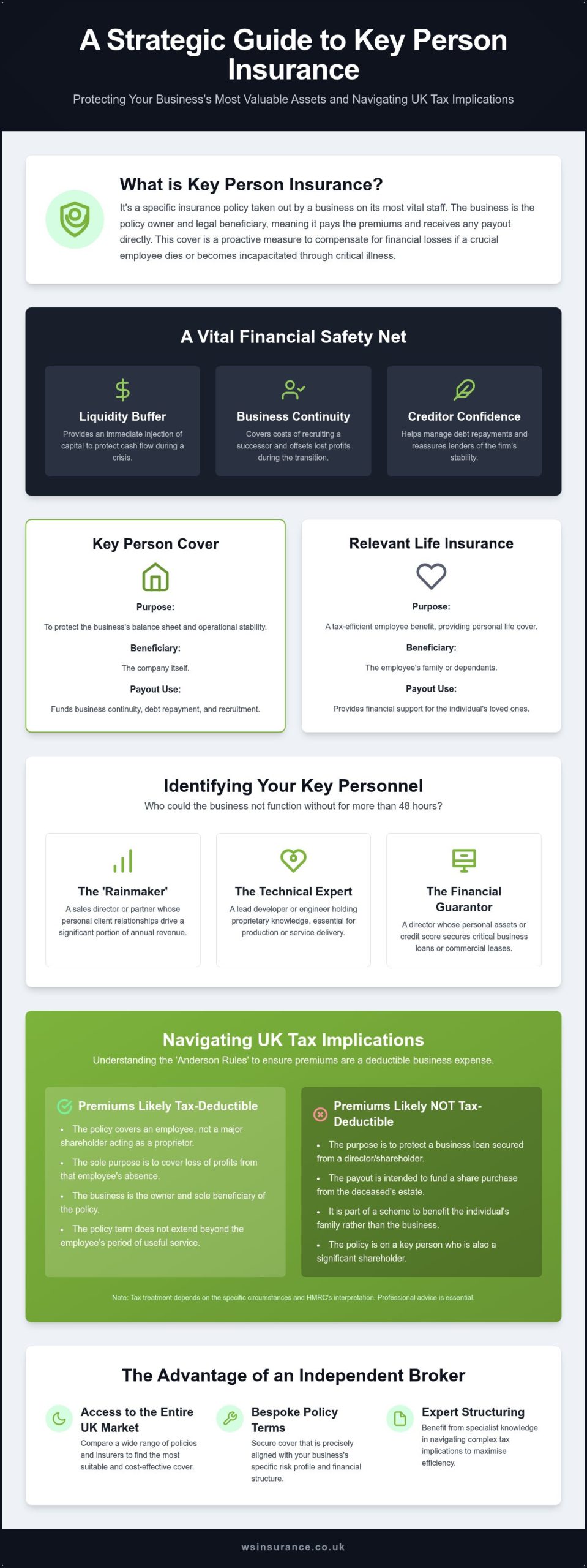
A business is only as strong as its most influential contributors. When you ask What is Key Person Insurance?, you’ll find it’s a specific policy a company takes out on its vital staff. Unlike personal life insurance, the business is the legal beneficiary and policy owner. This means the firm pays the premiums and receives any eventual payout directly into the company bank account. It’s a proactive measure designed to compensate for financial losses if a vital employee dies or becomes incapacitated. Most comprehensive plans offer a dual layer of protection, combining life insurance with critical illness options to create a robust safety net for the organisation.
The core value of this cover lies in its function as a liquidity buffer. It provides an immediate injection of capital when a crisis hits, acting as a financial shock absorber. This cash flow allows the company to cover recruitment costs for a successor, offset lost profits, or manage debt repayments whilst the remaining team reorganises. Understanding key person insurance tax implications uk is essential here. If the policy is structured correctly, it buys the time needed for recovery without draining existing reserves or forcing a fire sale of assets.
The Financial Impact of Losing a Key Individual
The loss of a “rainmaker” or lead salesperson represents an immediate threat to a firm’s cash flow. When a single individual drives a significant portion of annual turnover, their absence creates a void that can’t be filled overnight. Beyond the direct revenue drop, there’s a significant risk to creditor confidence. Banks and lenders often view a director’s death as a material change in risk; they may even call in outstanding loans or reduce credit facilities. Business continuity in this context is simply the ability to survive the loss of human capital and expertise without total collapse.
Key Person Cover vs. Relevant Life Insurance
It’s easy to confuse these two products, but they serve different masters. Key person cover protects the business’s balance sheet and operational stability. Conversely, Relevant Life Insurance is a tax-efficient way for a business to provide personal life cover for an employee’s family, often as part of a benefits package. Many firms find they need both to be fully shielded against corporate and personal loss. WS Insurance Brokers can help you identify business risks to insure against across all categories, ensuring no gaps remain in your protection strategy. Navigating key person insurance tax implications uk requires this level of precision to ensure the business remains compliant whilst protecting its most valuable assets.
Identifying Your Vital Assets: Who Qualifies as a Key Person?
Identifying the right individuals for protection begins with a rigorous Vulnerability Audit. You should ask yourself: who could the business not function without for more than 48 hours? This isn’t just about job titles; it’s about identifying the specific dependencies that keep your operations running. For example, a “Rainmaker” is often a sales director or partner whose personal client relationships drive a significant portion of annual revenue. If they were to leave suddenly, those accounts might follow them, leading to a sharp drop in turnover that could destabilise the firm’s future.
Technical experts also fall into this vital category. Consider the lead developer or engineer holding proprietary knowledge or managing legacy systems that aren’t fully documented. Their absence could halt production or service delivery entirely. Similarly, a Financial Guarantor is often overlooked during the risk assessment phase. These are directors whose personal assets or credit scores secure business loans or commercial leases. According to HMRC’s official tax guidance, the underlying purpose of the policy is a deciding factor in its tax treatment. Understanding key person insurance tax implications uk is particularly vital here, as cover intended to protect a loan is treated differently by HMRC than cover intended to replace lost profits.
Beyond the Boardroom: Finding Hidden Key People
Key people aren’t always the highest-paid staff members. They’re often individuals with unique operational knowledge that hasn’t been formalised. In many established UK firms, “Legacy Knowledge” presents a silent risk where vital processes exist only in one person’s head. Reviewing employment contracts for notice periods provides a useful risk indicator; a longer notice period usually signals that a replacement will be difficult or time-consuming to find. Identifying these hidden assets removes the uncertainty that often clouds business continuity planning.
Quantifying the Risk for Each Individual
Different roles require varied levels of cover based on their specific impact on the bottom line. A reliable framework for valuation includes the total recruitment cost, the expected training time, and the projected profit loss during the replacement period. This calculation ensures your protection level is bespoke rather than a generic estimate. Viewing this as part of your wider business insurance strategy helps build a more resilient company. If you’re unsure who qualifies, you might speak with a specialist broker at WS Insurance Brokers to gain an objective perspective on your firm’s dependencies. This removes the guesswork and ensures key person insurance tax implications uk are managed correctly from the outset.
Calculating the Value: How Much Coverage Does Your Business Require?
The Multiple of Profits Approach
This method is often preferred for “rainmakers” or technical leads whose work directly correlates with the firm’s bottom line. A common industry standard involves calculating either two times the gross profit or five times the net profit attributable to that individual. To do this, you must first isolate the percentage of profit the key person is responsible for generating. HMRC looks favourably on this method because it links the insurance directly to the potential trading loss. As detailed in HMRC’s Business Income Manual (BIM45525), the purpose of the policy must be to replace lost profits for the premiums to be tax-deductible. We recommend keeping detailed records of these calculations to satisfy any future tax queries from the authorities.
Accounting for Recruitment and Headhunter Fees
Structuring your policy is about more than just choosing a sum assured. It requires a clinical understanding of how HMRC views your intentions. The “Anderson Rules” serve as the primary framework for determining whether your premiums are a tax-deductible business expense. To qualify, the policy must meet specific criteria designed to ensure the cover is “wholly and exclusively” for the purposes of the company’s trade. This removes the anxiety of a surprise tax bill at year-end.
The first condition focuses on the policy’s purpose. It must be for “revenue” purposes, such as replacing lost profits or covering recruitment costs, rather than “capital” purposes like repaying a business loan. If the payout is intended to clear a debt, HMRC generally views this as a capital benefit, making the premiums non-deductible. The second condition concerns the individual being insured. They must be an employee or director with no significant shareholding, which HMRC typically defines as less than 5%. When a founder owns a majority of the firm, the policy is often seen as benefiting them personally rather than just the business trade.
In most straightforward scenarios, the business owns the policy directly. This keeps the structure simple and ensures the funds land where they are needed most during a crisis. However, more complex setups, such as partnership protection or multi-layered shareholding, may require the use of a Trust. Trusts can help manage how the money is distributed and protect it from certain liabilities. Experienced insurance brokers provide the necessary documentation and technical support to ensure your ownership structure remains compliant with current UK regulations.
Shareholder Protection: A Related Necessity
It’s easy to confuse key person cover with Shareholder Protection, yet they solve different problems. Key person insurance provides the cash to keep the business running, whilst Shareholder Protection provides the funds for surviving owners to buy out a deceased partner’s shares. These two policies often work in tandem to prevent hostile takeovers or the forced sale of the business to pay out an estate. A professional risk assessment is the most reliable way to determine the correct mix of protection for your specific needs. If you’re ready to secure your company’s future, you can request a bespoke consultation with our team to remove the doubt from your protection strategy and ensure key person insurance tax implications uk are handled correctly.
Securing Your Company’s Future: The Role of an Independent Broker
An independent broker acts as your diligent advocate in a crowded and often confusing market. Unlike restricted panels or automated quote engines that prioritise volume, we access the entire breadth of the UK market to find the precise fit for your unique needs. This autonomy ensures our loyalty remains firmly with you, the client, rather than any single insurance provider. We provide essential underwriting advocacy, presenting your business’s specific risk profile to insurers to secure more favourable rates. This professional representation is particularly vital when managing key person insurance tax implications uk, as the structure of the policy must be airtight to withstand HMRC scrutiny whilst remaining commercially viable.
Should the unthinkable happen and a claim arise, having a dedicated advocate simplifies the complexities of a major business payout. We act as a protective shield between you and the insurer, ensuring the process is handled with integrity and transparency. It’s also vital to view this cover as part of a holistic safety net. By integrating key person protection with your commercial property insurance and liability framework, you create a seamless barrier against both physical and human capital risks. This joined-up approach removes the gaps that often leave businesses vulnerable during a crisis.
Customising Your Coverage for 2026
The economic environment in 2026 requires a dynamic approach to protection. Inflation-linked cover is no longer optional; it’s a necessity to ensure the sum assured maintains its real-world value over time. We also recommend adding Guaranteed Increase Options (GIOs) to your policy. These allow you to increase your level of cover as the business grows or as key staff roles evolve, usually without the need for further medical underwriting. Annual reviews are a cornerstone of our service. They ensure your protection keeps pace with your firm’s valuation and the changing responsibilities of your most vital staff members.
Next Steps: From Risk Assessment to Placement
The path to secure protection is methodical and transparent. It begins with an initial consultation to understand your firm’s unique dependencies and long-term financial goals. If medical underwriting is required for your key individuals, we handle the administrative burden and act as the primary point of contact with the insurers. Once the terms are agreed, policy activation provides immediate peace of mind. Protecting your legacy shouldn’t be a source of anxiety. We invite you to organise a professional consultation today to eliminate uncertainty and ensure your business is prepared for whatever the future holds.
Building a Resilient Legacy for Your Organisation
Protecting your firm against the loss of a vital contributor requires more than just a standard policy; it demands a strategic alignment of risk assessment and financial precision. By conducting a thorough vulnerability audit and applying the correct valuation methods, you ensure your liquidity buffer is robust enough to weather any transition. Navigating the key person insurance tax implications uk remains a priority, as structuring your cover according to the Anderson Rules allows you to manage premiums and payouts with absolute clarity and compliance.
As an independent, FCA-regulated brokerage, we act as your trusted advisor, providing access to the entire UK insurance market to secure bespoke terms. We believe in removing the anxiety from protection planning, offering expert advocacy throughout the underwriting and claims processes to shield your business from market complexities. You don’t have to manage these technicalities alone. Take the next step today and secure your business’s future with a bespoke Key Person Insurance consultation from WS Insurance Brokers. With a steady hand and expert guidance, you can protect your most valuable assets and focus on your company’s long-term growth.
Frequently Asked Questions
Is Key Person Insurance a legal requirement for UK businesses?
No, key person cover isn’t a legal requirement in the United Kingdom, unlike Employers Liability Insurance. While it isn’t mandated by law, many lenders and investors require it as a condition of funding to protect their capital. It serves as a commercial safeguard rather than a regulatory obligation. For most firms, the decision to invest in protection is based on a risk assessment of how the business would survive the loss of its leaders.
Can a business claim tax relief on Key Person Insurance premiums?
Businesses can often claim tax relief on premiums if the policy meets HMRC’s “wholly and exclusively” criteria. This typically requires the cover to be for revenue purposes, such as replacing lost trading profits, rather than capital purposes like loan repayment. Understanding key person insurance tax implications uk is essential here, as the insured individual must also be an employee or director without a significant shareholding, usually defined by HMRC as less than 5%.
What happens to the policy if the key person leaves the company?
When a key person leaves your firm, the business typically cancels the policy as the insurable interest no longer exists. Since the company owns the plan, they simply stop paying the premiums to the insurer. In some specific cases, a policy might be assigned to the departing employee as a personal benefit, but this is rare for pure key person protection. We recommend reviewing your cover annually to ensure it reflects your current staff structure.
How is Key Person Insurance different from Life Insurance for employees?
The primary difference lies in who receives the financial benefit. Key person insurance protects the company’s balance sheet by paying the business directly to cover operational losses or recruitment costs. Conversely, standard life insurance for employees, such as Relevant Life Insurance, is designed to provide a tax-efficient death-in-service benefit for the employee’s family. A robust protection strategy often includes both to ensure the organisation and the individual’s dependents are fully shielded from financial hardship.
Does the key person need to have a medical exam?
A medical examination isn’t always a prerequisite for securing cover. For many applicants, a simple health questionnaire is sufficient to satisfy the insurer’s requirements. However, if you are seeking a high sum assured or if the individual is older or has pre-existing conditions, the insurer may request a nurse visit or a report from a GP. WS Insurance Brokers handles the coordination of these requirements, acting as a shield between you and the administrative burden.
Can a small start-up get Key Person Insurance?
Start-ups can and should consider this protection, as they are often heavily dependent on a few founding members. Insurers will typically review the company’s funding, business plan, and the specific expertise of the individuals involved. While a start-up may not have years of profit history, the cover can be justified based on the cost of finding a replacement with similar niche skills. This ensures the venture remains viable even if a founder is lost.
Are the payouts from Key Person Insurance tax-free?
The taxability of a payout depends entirely on how the premiums were treated. If your company claimed the premiums as a tax-deductible business expense, HMRC will usually treat the payout as taxable trading income. If the premiums were paid from post-tax profits without relief, the payout is generally received tax-free. This “mirror” principle is a fundamental part of key person insurance tax implications uk and helps firms predict the net benefit of their policy during a crisis.
What is the difference between revenue and capital purposes in business insurance?
Revenue purposes refer to protection against lost trading profits or the costs of recruiting a successor; these are generally tax-deductible. Capital purposes involve policies intended to clear a business debt or facilitate a shareholder buyout. HMRC views capital-related premiums as non-deductible because they provide a lasting financial benefit to the company’s structure. Distinguishing between these two is vital for ensuring your policy is structured with maximum tax efficiency and matches your commercial goals accurately.