
What could a cyber incident mean for your organisation beyond the immediate technical disruption? A compromised email account, unavailable systems or exposed data could affect operations, customers and confidence in the business. For a board, the challenge is to understand those consequences and decide whether cyber liability insurance for company directors belongs in a clear, well-considered risk plan.
Cyber risk can be difficult to translate into practical board decisions, and cyber cover can seem to overlap with directors’ and officers’ (D&O) insurance. They serve different purposes, although one incident may raise questions for both policies. This guide explains how to describe cyber exposure in business terms, what cyber insurance may cover and how it differs from D&O cover. It also sets out practical questions for reviewing risks, policy wording, security measures and incident plans, so your board can agree informed next steps without relying on technical jargon or assumptions about what insurance will cover.
Key Takeaways
- Map cyber incidents to the business services and dependencies they could disrupt, so the board can prioritise exposure.
- Review how cyber liability insurance for company directors may respond to specified incident costs, subject to the policy wording.
- Keep cyber cover and D&O insurance distinct in the risk programme, while considering how one incident could raise issues for both.
- Use five clear steps to connect technical risks with business impacts, control reviews and agreed board actions.
- Compare policy limits, conditions and response arrangements against realistic scenarios, rather than relying on the headline limit alone.
Why cyber liability insurance belongs in a company directors’ risk discussion
The board’s decision is not simply whether to buy a policy. It is to understand the organisation’s cyber exposure, review its controls and decide whether insurance has a useful role in the wider risk programme. A focused discussion connects technology risks with business priorities, rather than treating cyber security as an issue for the IT team alone.
Cyber exposure is the possibility that an incident disrupts operations, affects data or leads to other business consequences. Cyber liability insurance is intended to respond to selected losses arising from such incidents, subject to the policy wording. Scope varies between policies. A neutral overview of Cyber liability insurance provides helpful background, but the wording of your organisation’s policy determines how it may respond.
For directors considering cyber liability insurance for company directors, start with the organisation’s actual exposure, not an assumption that a policy prevents attacks or pays every resulting cost. Insurance can support risk management, but it does not replace effective security controls, preparation or sound decisions during an incident.
What cyber risk means in business terms
Translate a technical threat into a business scenario. If a key system becomes unavailable, which services would be interrupted? If business data were compromised, what investigation, recovery or communications work might be needed? Could customers or suppliers be affected? The answers depend on the organisation’s operations, data and reliance on suppliers and digital systems.
An incident may require time and resources for investigation, recovery and communications. It could also raise questions about obligations to affected parties or lead to third-party claims. Assess these consequences in context: the type of data involved, the services affected and the organisation’s role in handling that data all matter.
Why directors need a clear oversight conversation
Board oversight is about preparedness and informed accountability, not assigning blame in advance. Directors can ask whether critical business services and dependencies are understood, whether controls are reviewed, and whether responsibilities for responding to an incident are clear. These questions turn complex technical updates into practical decisions.
Directors’ responsibilities depend on the circumstances and applicable law, so an insurance discussion should not be treated as legal advice or a promise of personal protection. Cyber cover and D&O insurance have distinct purposes, and neither should be assumed to respond to every claim. For a broader view of how this exposure sits alongside other organisational risks, see this guide to business risks to insure against.
How cyber liability insurance may respond to a company cyber incident
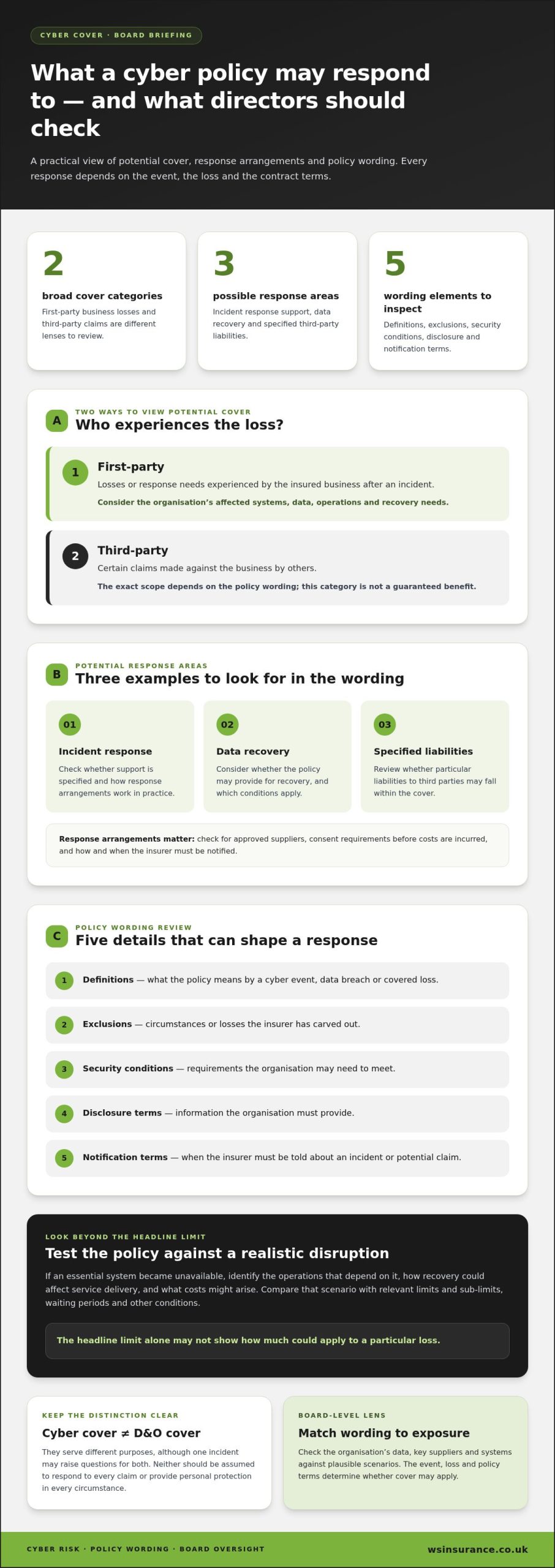
A cyber policy may help address certain costs after an incident, but its response depends on the event, the loss and the contract wording. Cover depends on the insured event and the policy terms. Directors should look beyond the headline limit and consider how the cover relates to the organisation’s data, suppliers and operational dependencies.
Potential cover is often considered in two broad categories. First-party cover concerns losses or response needs experienced by the insured business. Third-party cover concerns certain claims made against it by others. These are categories to examine, not guaranteed benefits. The exact scope depends on the policy.
Which policy features should directors understand?
Review whether the wording may provide for incident response support, data recovery or specified liabilities to third parties. Check how response arrangements work in practice: does the policy specify approved suppliers, require consent before particular costs are incurred, or explain how and when the insurer should be notified? Understanding these steps in advance can reduce uncertainty during a pressured incident.
Compare limits and sub-limits with plausible scenarios. For example, if an essential system became unavailable, identify which operations depend on it, how recovery could affect service delivery and what costs might arise. Then compare the scenario with the relevant limits and any waiting periods or other conditions in the wording. The headline limit alone may not show how much could apply to a particular loss.
What may affect a claim or the scope of cover?
Definitions matter. A policy’s meaning of a cyber event, data breach or covered loss may differ from everyday usage. Exclusions identify circumstances or losses the insurer has carved out, while security conditions set requirements the organisation may need to meet. Disclosure and notification terms explain what information must be provided and when the insurer must be told about an incident or potential claim.
Make the document review practical. Match the wording against the organisation’s data, key suppliers and systems, then note where a definition, exclusion, condition or sub-limit could affect a realistic scenario. The circumstances and policy wording determine whether a particular event or loss falls within cover. Do not assume a policy responds to every cyber incident.
For a broader governance perspective, the US government’s Explaining Cyber Risk to the Board resource discusses cyber risk oversight. It is not a statement of UK legal duties, but it reinforces the value of making cyber risk a clear board-level conversation.
Review cyber liability insurance for company directors alongside the organisation’s wider protection, not in isolation. WS Insurance Brokers provides cyber and data breach insurance and can help review your organisation’s exposure and policy wording. For a tailored discussion, explore WS Insurance Brokers’ cyber insurance support.
Cyber liability insurance vs D&O: clarify the difference for directors
Cyber insurance and directors’ and officers’ (D&O) insurance address different kinds of exposure. Cyber insurance may respond to specified cyber-related business losses and incident response needs. D&O insurance concerns specified claims against directors or officers. Neither is a substitute for the other, and neither automatically covers every consequence of a cyber event.
| Area to compare | Cyber insurance | D&O insurance |
|---|---|---|
| Primary purpose | May address specified losses or response needs affecting the organisation after a cyber incident. | May respond to specified claims alleging wrongful acts by directors or officers in their management role. |
| Possible insured interests | The organisation’s covered costs or liabilities, as set out in the policy. | Directors, officers or the organisation in relation to insured claims, depending on the wording. |
| Questions for review | Which events and costs are defined as covered, and what exclusions, limits or conditions apply? | Which people and types of claim are insured, and how are cyber-related allegations treated? |
What is the difference between cyber insurance and D&O insurance?
The distinction is between a business loss and an allegation against a decision-maker. If a cyber incident disrupts a company’s systems, its cyber policy may address specified recovery or response costs, subject to its terms. If a director is later accused of failing to oversee cyber risk appropriately, that allegation may raise a separate D&O question. The facts and each policy’s wording determine whether either policy responds.
Can D&O cover a cyber-related claim against a director?
It may be relevant if a claim against a director falls within the D&O policy’s definitions and terms, but a cyber event alone does not establish cover. Equally, cyber insurance should not be assumed to protect directors against every allegation arising from an incident. Consider cyber liability insurance for company directors alongside, not in place of, D&O cover.
A single event could produce different issues: the organisation may face recovery demands, while a customer or another party may separately allege that a director’s decisions caused or worsened the harm. These are hypothetical possibilities, not predictions of cover. Review both policies together, paying particular attention to definitions, exclusions, insured persons and provisions explaining how the policies interact. This comparison can help the board identify gaps or overlaps without assuming either policy will meet every loss or claim.
Explaining Cyber Risk to the Board in Five Steps
A useful board briefing turns technical information into decisions about business services, dependencies and priorities. Keep it concise, distinguish confirmed evidence from assumptions, and flag questions that need further analysis. This five-step structure helps directors focus on what matters and agree practical next steps.
- Identify what matters. Use the organisation’s current risk assessment to list critical systems, important data, key suppliers and the services that rely on them. Note where disruption or compromise could affect day-to-day operations.
- Prioritise the exposure. Rank scenarios by their potential business effect and the organisation’s reliance on the affected service or supplier. Be clear about what is known, what is an assumption and what remains an open question.
- Explain the impact. Describe a plausible scenario in plain language. For example, if a system supporting order processing became unavailable, explain which service could be interrupted and what response work might follow. Label it as a scenario, not a prediction.
- Review controls and gaps. Summarise relevant safeguards, response arrangements and identified gaps. Keep technical detail proportionate: directors need to understand what a control is intended to achieve and where further action or assurance may be needed.
- Agree actions. Record decisions, named owners and review dates. Identify which actions need board approval, what should be escalated and when progress will return to the board.
Build a board-ready cyber risk summary
A concise risk register or one-page summary can make the discussion easier to follow. For each priority scenario, show the affected service or dependency, likely business effect, existing controls, known gaps, accountable owner and next review date. Separate evidence from assumptions so directors can see where conclusions are firm and where further assessment is needed.
Keep the summary specific to the organisation. A supplier supporting a core service may create a different exposure from a system used only for occasional internal tasks. The aim is not to catalogue every technical threat, but to show which risks could influence business continuity, response planning or insurance decisions.
Turn the discussion into proportionate board actions
Ask directors to agree priorities across prevention, incident response planning, reporting and insurance review. Set a review cadence and escalation route that reflect the organisation’s exposure, and revisit them when important systems, suppliers or operations change. Include cyber liability insurance for company directors by linking policy review to the scenarios and dependencies already identified, rather than treating insurance as a stand-alone decision.
For help considering how insurance fits within the wider programme, explore the wider risk placement approach. You can also review your organisation’s cyber insurance and risk placement with WS Insurance Brokers.
How directors can review cyber insurance and decide the next step
A useful review starts with the organisation’s real-world exposure, then tests whether its controls, policy wording and response arrangements align. For directors considering cyber liability insurance for company directors, the aim is not to find a policy that promises to cover every scenario. It is to understand where protection may fit, what conditions apply and where other risk measures remain essential.
Create a practical cyber insurance review checklist
Bring the relevant documents and business information together before comparing options. A focused checklist helps the board and its advisers work through four areas:
- Exposure: Note the organisation’s important data, business activities, key suppliers and systems, alongside recovery priorities if an essential service is disrupted.
- Existing controls: Summarise the safeguards and incident response arrangements already in place, and identify gaps or dependencies that could affect recovery.
- Policy wording: Inventory current cyber, D&O and other relevant business policies, including renewal dates and endorsements. Record questions about insured events, exclusions, sub-limits, notification requirements and consent for response costs.
- Response arrangements: Establish who would notify the insurer, which response suppliers or processes are specified, and how the organisation would coordinate its actions during an incident.
Then compare policy limits and conditions with plausible scenarios drawn from the organisation’s own operations. Consider what disruption could mean for key services, data and suppliers. A headline limit may not reflect the amount available for a particular loss if sub-limits, exclusions or other conditions apply.
Discuss your business insurance requirements with WS Insurance Brokers to explore a tailored review of your organisation’s protection.
What happens when directors seek a tailored review?
An independent broker can assess the organisation’s requirements, help interpret relevant policy wording and source suitable options from insurers. WS Insurance Brokers provides insurance placement and policy management, including risk assessment, sourcing tailored cover from a panel of UK insurers and ongoing policy administration. Its support can help directors consider cyber and D&O cover as distinct parts of the wider risk programme.
If an incident leads to a claim, WS Insurance Brokers can provide support during the claims handling process. This does not guarantee that a claim will be accepted or that every loss will fall within cover; the circumstances and applicable policy terms determine the response. A clear review helps the board understand those boundaries and make informed decisions about protection, controls and next steps.
Turn board discussion into a clear protection plan
Effective cyber oversight starts with the organisation’s own exposure: which services and data matter most, how incidents could disrupt them, and what controls and response arrangements are in place. Cyber insurance and D&O cover address different risks, so directors should review their wording together and compare limits, exclusions and conditions with realistic business scenarios.
Reviewing cyber liability insurance for company directors as part of the wider risk programme helps the board identify informed next steps without assuming that insurance prevents an incident or covers every resulting loss or claim.
WS Insurance Brokers is an independent UK insurance brokerage authorised and regulated by the Financial Conduct Authority. With access to major UK insurers and support during the claims handling process, the team can help review your organisation’s requirements and policy options.
Discuss your business insurance requirements with WS Insurance Brokers and take the next step towards a clearer, more tailored protection plan.
Frequently Asked Questions
Does cyber liability insurance protect company directors personally?
Not automatically. Cyber liability insurance for company directors does not, by its name alone, mean that directors have personal protection. The policy may insure the organisation’s specified cyber-related losses, while claims against individual directors may raise separate questions under a D&O policy. Check who is insured, what claims are covered and how exclusions apply. The event, allegations and wording of each policy determine whether cover may respond.
Is cyber liability insurance the same as directors’ and officers’ insurance?
No. Cyber insurance is generally intended to address specified business losses or response needs arising from a cyber incident. Directors’ and officers’ insurance concerns specified claims against directors or officers in connection with their management responsibilities. The two policies may relate to the same event, but they serve different purposes. Review their definitions, insured persons, limits and exclusions together rather than assuming one policy replaces the other.
Can D&O insurance cover a claim linked to a cyber incident?
It may, if a claim against a director or officer falls within the D&O policy’s terms. For example, after a data incident, a claimant might allege that a director failed to oversee relevant risks. That allegation is distinct from the company’s costs of responding to the incident. Whether D&O cover applies depends on the facts and wording, including definitions, exclusions and who qualifies as an insured person.
What does cyber liability insurance typically cover for a company?
Depending on the policy, cover may address specified incident response costs, data recovery, business interruption losses or liabilities to third parties. Some policies may also set out response support and arrangements for approved suppliers. These are areas to examine, not guaranteed benefits. Check the definitions, limits, sub-limits, excesses and conditions to understand how the cover relates to your organisation’s systems, data, suppliers and recovery needs.
What is usually excluded from cyber liability insurance?
There is no standard list of exclusions that applies to every cyber policy. Wording may exclude certain events, types of loss or circumstances, and may impose security, disclosure or notification conditions. A claim could also be affected by a sub-limit or an excess. Read the policy schedule and wording together, focusing on exclusions and conditions relevant to your business activities and likely incident scenarios. Do not assume every cyber-related cost is covered.
How should directors explain cyber risk to a company board?
Connect each cyber scenario to a business service, dependency or decision. Identify important systems, data and suppliers, then explain how an incident could affect operations, response work or customers. Separate evidence from assumptions and open questions. Review existing controls and conclude with proportionate actions, named owners, review dates and any decisions requiring board approval. This keeps the discussion focused on business impact rather than technical detail alone.
Is cyber insurance a legal requirement for UK companies?
Cyber insurance is not generally a legal requirement for UK companies. However, an organisation may need to consider contractual terms, regulatory expectations and its own risk responsibilities when deciding what protection is appropriate. Insurance does not replace legal or regulatory compliance, effective security controls or incident planning. Requirements depend on the organisation’s circumstances, so seek appropriate professional advice where you need a definitive view of an obligation.
When should a company review its cyber liability insurance?
Review the policy at renewal and when the organisation’s exposure changes materially. Examples include adopting a new critical system, changing how personal or business data is handled, relying on different suppliers, expanding operations or revising recovery plans. Also revisit the wording after an incident or a significant change to security controls. Compare limits, exclusions, notification terms and response arrangements with current business scenarios, rather than relying on a previous assessment.