
A client says a software release caused financial loss; another alleges a data breach exposed customer information. Both claims may land on your desk, but they do not necessarily call for the same protection. Choosing insurance for a software development company by job title alone can leave important gaps.
Your cover should reflect what your business actually does, who it works for and what its contracts require, not just the fact that it develops software. Start by identifying the services you provide, how you deliver them and the risks that could lead to a claim.
This guide explains how professional indemnity, cyber and data breach, public liability and employers’ liability insurance may fit into a considered protection plan. It also covers what to compare in policy limits, exclusions and conditions, and how to assess cover against your services, workforce and contractual obligations. WS Insurance Brokers can assess your business risks, source cover from a panel of UK insurers and support policy administration and claims advocacy as your business changes. The aim is to give you a clearer basis for making an informed decision about protection.
Key Takeaways
- Record your services, delivery model, client types and workforce to build a clearer picture of your business’s exposures.
- Insurance for a software development company can involve several types of protection. Assess each against the risks it is intended to address.
- Compare policy wording, limits, exclusions and conditions, not just policy names or headline figures.
- Review client contract requirements alongside your existing cover before buying or renewing.
- An independent broker can help translate your business activities and contracts into a considered placement, and support policy administration over time.
Insurance for a software development company: which business risks matter?
Start with the work, not a policy label. Record what you build or maintain, how you deliver it, who your clients are and what your contracts require. A company developing bespoke systems for one client may face different exposures from one hosting a product or providing ongoing support. The right insurance for a software development company depends on those activities and the losses a client or third party might allege.
Use your project types and working arrangements to identify the main risk areas:
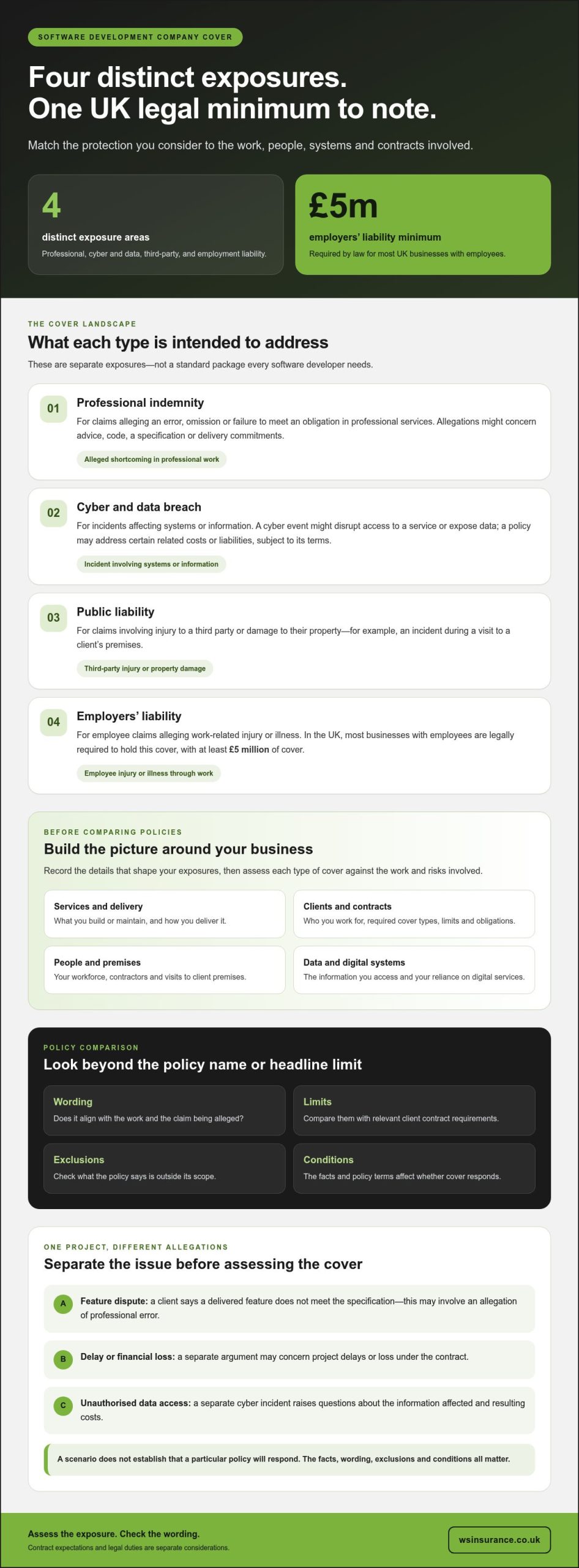
- Professional liability: A client alleges that advice, code or project delivery fell short of agreed obligations. Professional indemnity insurance is designed for claims arising from professional services, such as alleged errors or omissions. Professional indemnity insurance provides a general overview of this type of cover.
- Cyber and data: A security incident affects systems or information. Cyber insurance may address certain costs or liabilities connected with cyber events, subject to the policy terms.
- Third-party and employment liability: Public liability insurance is intended for claims involving injury to a third party or damage to their property. Employers’ liability relates to claims by employees who say they have suffered injury or illness through their work.
These are distinct exposures, not a standard package every developer needs. Map them against your working arrangements, including staff, contractors, visits to client premises and access to data. For each exposure, note what could happen, who might bring a claim and which contract or business activity is involved.
How software work can lead to a claim
Suppose a client disputes whether a delivered feature meets the specification. They might allege a professional error, while a separate argument concerns project delays or financial loss under the contract. If an unauthorised party also accesses data during the work, that raises a cyber incident and different questions about the information affected and resulting costs. One project can therefore produce several allegations, each requiring careful assessment. A scenario does not establish that a particular policy will respond: the facts, wording, exclusions and conditions all matter.
Does a software development company need insurance?
Client contracts may require particular insurance types or minimum limits before work begins. Treat those terms as part of the buying decision. Note the required cover, limits and relevant contract obligations, then compare them with the policy wording. A headline limit alone will not show whether the cover aligns with the work or the claim being alleged.
Contractual expectations are separate from legal duties. In the UK, employers’ liability insurance is legally required for most businesses with employees, with a minimum of £5 million cover. For a broader overview of how different protections fit into UK business risks, see this UK business insurance guide. A risk review helps turn your activities and contract terms into a clearer basis for comparing cover.
What insurance can protect a software development company?
There is no standard set of policies for every developer. The right insurance for a software development company depends on its services, people and contracts. Consider each type of cover as a separate response to a particular exposure, then compare its wording with the risks your business actually faces.
Professional indemnity insurance covers claims alleging that professional services involved an error, omission or failure to meet an obligation, subject to the policy terms. For a developer, allegations might concern advice, code, a specification or delivery commitments. The policy wording determines which claims and costs may fall within scope. The name of the cover alone does not establish whether a claim is covered.
Professional indemnity, public liability and employers’ liability
Professional indemnity relates to alleged shortcomings in your professional work. Public liability is a different consideration: it concerns claims alleging injury to a third party or damage to their property, such as an incident during a visit to a client’s premises. Employers’ liability relates to employee claims involving work-related injury or illness.
In the UK, most businesses with employees are legally required to have employers’ liability insurance, with at least £5 million of cover. Contract terms may separately specify insurance types or limits. For all three covers, check the wording, exclusions, conditions and contractual requirements rather than assuming a policy name or limit tells the whole story.
Cyber, directors’ and officers’, and business interruption cover
Cyber and data breach insurance is a separate area to assess for incidents involving systems or information. A cyber event might disrupt access to a service or expose data, raising questions distinct from an allegation that code or advice was deficient. Consider how your business handles information and depends on digital systems, then examine what the policy says about relevant incidents and conditions.
Directors’ and officers’ insurance is another distinct option. It relates to claims made against directors in connection with their management responsibilities, rather than claims about software performance itself. Business interruption cover may be relevant if an insured disruption affects trading, but the trigger and terms are set out in the policy. Neither should be treated as an automatic extension of professional indemnity or cyber cover.
When comparing insurance options, map each one to a plausible loss and the relevant contract or business activity. This can help you see where two policies address different parts of an incident, or where wording and exclusions could affect how they apply. WS Insurance Brokers assesses business risks and sources cover from a panel of UK insurers, then supports policy administration as your business changes. Read more about independent insurance guidance.
How to compare software development company insurance
A useful comparison starts with your business, not a shortlist of policy names. Record your services, where your clients are based and the insurance requirements in your contracts. Then compare what each policy is intended to address, how its limits work and which conditions could affect a claim. The appropriate cover depends on your activities, contracts and policy terms.
Use this framework to review options side by side:
| Comparison point | What to examine |
|---|---|
| Exposure | Which work, people, systems or third parties could give rise to a claim or loss? |
| Policy purpose | What type of event or allegation is the cover designed to address? |
| Limits | What is the maximum payable, and does it apply per claim or across the policy period? |
| Exclusions | Which circumstances, activities or losses are excluded or restricted? |
| Contract relevance | Does the wording and limit align with client requirements and your obligations? |
Keep the policy wording beside the relevant contract clause as you compare. A headline limit may look sufficient, but it will not show whether the policy responds to the activity, allegation or contractual commitment at issue. The same applies to policy labels: similarly named covers can differ in definitions, exclusions and conditions.
Which limits and exclusions deserve close attention?
Check the limit alongside any excess, the amount you may need to contribute towards a claim. Establish whether the limit applies to each claim or is an aggregate shared across multiple claims during the policy period. Review exclusions and notification conditions, including how and when circumstances must be reported. For relevant policies, note any retroactive date, which can affect how far back work may be considered. Relate these details to actual contract requirements and assessed exposures, rather than assuming one limit suits every company.
What can a broker add to the comparison?
An independent broker can help translate your activities and contract wording into a considered insurance placement. WS Insurance Brokers assesses business risks and sources bespoke cover from a panel of UK insurers, then supports policy administration and mid-term adjustments as the company’s work changes. This can help you revisit cover when services, client requirements or operating arrangements evolve. The guide to choosing an independent insurance broker explains what to consider in that relationship.
For a clearer comparison, bring together your current policies, key contracts and a concise description of your work. WS Insurance Brokers can help you review your software business insurance needs with those details in view, so decisions are based on the wording and your circumstances, not price or policy names alone.
A practical insurance checklist for software development companies
A structured review makes it easier to describe your business accurately and compare cover against real work, rather than relying on a broad label such as “software developer”. Use these steps before buying or renewing insurance for a software development company, and update the information when your services, clients or contracts change.
Prepare a clear picture of your business
Begin with how the company operates. Record the services it provides, how work is delivered and who contributes to it. Include relevant details about data, systems and dependencies, then note changes expected during the policy period. A clear summary gives you a practical reference for reviewing policy information and discussing the risks that matter.
- Describe your services. List software development, consultancy, maintenance, support, hosting or other work you perform. Be specific about what the company is responsible for, such as designing, testing, implementing or maintaining software. Distinguish ongoing services from one-off projects.
- Map delivery arrangements. Note whether work is delivered directly to clients, through contractors or under client-specific contracts. Record where clients are based and whether work involves client premises, third-party platforms or subcontracted activity. These details help clarify which activities and relationships should be reflected in your insurance information.
- Record people and information. Include staff roles and contractor involvement, alongside the types of data your business handles and the systems or services it depends on. Note business-critical dependencies and planned changes, such as taking on a new service or changing how projects are delivered.
- Gather claims and policy records. Assemble current schedules and policy documents, renewal dates, claims history and any circumstances already notified to insurers. Keeping these together helps you compare existing cover with your present operations and provide consistent, accurate information during a review.
- Identify contract requirements. Pull out relevant clauses specifying insurance types, limits or other obligations. Set these beside the activities covered by each policy, so gaps between a contract requirement and the wording are easier to identify and discuss.
Review the policy before purchase or renewal
Compare your business summary and contract requirements with the policy’s stated activities, limits, exclusions and conditions. Check proposal and renewal information for accuracy, including changes in services or working arrangements, and note renewal dates and notification requirements. Keep a record of questions, decisions and the final documents for future reference. A guide to identifying business risks can help you organise this review around the risks your company faces.
WS Insurance Brokers assesses business risks and sources cover from a panel of UK insurers, with policy administration and mid-term adjustments to support you as circumstances change. For a considered review of your software business’s insurance needs, discuss your cover requirements with WS Insurance Brokers.
Arrange insurance for your software development company with confidence
A sound decision connects three things: the work your company does, the risks that follow from it and the wording of the cover you are considering. Map your activities and contractual obligations, compare limits and exclusions, then select protection around your business rather than a generic software developer profile. This gives you a clearer basis for deciding which policies are relevant and where terms need closer attention.
WS Insurance Brokers assesses business risks and sources bespoke cover from a panel of UK insurers. The brokerage helps translate your services, contracts and operating arrangements into a considered placement. This means looking beyond a policy label or headline limit to understand how the proposed wording relates to your circumstances. No policy should be treated as a guarantee that every claim will be covered; the terms and facts remain important.
What to expect when arranging cover through a broker
An initial discussion is an opportunity to review what you do, how you deliver your work and the key requirements in your contracts. Sharing a clear account of your services, clients, staff and identified exposures helps build an accurate picture for the assessment. The details matter: a company providing ongoing support or hosting may have different considerations from one delivering defined development projects.
Recommendations and placement are shaped around that picture, alongside the available policy wording and your stated requirements. An independent broker can source options from its insurer panel and help explain relevant differences, so you can make a more informed decision without assuming a particular insurer, price, policy term or claim outcome in advance.
Keep cover aligned as the business changes
Insurance needs can shift as a company takes on new services, changes its delivery model, hires staff or agrees different contract terms. Review your arrangements when those changes occur, as well as at renewal. Keeping the broker informed helps ensure the information held about the business remains current and gives you a chance to consider whether the existing placement still reflects its work.
Support can continue after placement. Policy administration includes managing changes, and mid-term adjustments can help keep records aligned as circumstances evolve. If a claim arises, claims advocacy can help you through the claims process, although the policy wording and circumstances determine how the insurer responds.
To review your requirements, discuss your business insurance with WS Insurance Brokers. A clear account of your software company’s work and contracts can help bring greater confidence to your next insurance decision.
Make your next insurance decision with greater clarity
Your software business will keep evolving: new services, client expectations and delivery arrangements can all change its risk profile. Treat insurance as part of that ongoing planning, not just an annual renewal task. A regular review can help keep your cover aligned with the work you are taking on and the obligations you are accepting.
For insurance for a software development company, WS Insurance Brokers offers an independent assessment and sources bespoke cover from a panel of UK insurers. The firm is FCA-authorised and regulated, with support that can continue through policy administration, mid-term adjustment processing and claims advocacy. Policy terms and circumstances still determine how any claim is handled, but considered guidance can help make the choices clearer.
When you are ready to review your requirements, discuss insurance for your software development company with WS Insurance Brokers. A review of your business activities and contractual obligations can help you make a more informed decision about protection.
Frequently Asked Questions
Does a software development company need professional indemnity insurance?
Not every software company is legally required to hold it, but professional indemnity insurance may be required by a client contract or considered in light of the work you perform. For example, a contract for developing a business-critical platform may specify a particular type or level of cover. Compare that obligation with the policy’s definition of your services and any exclusions, then make sure the details you provide accurately reflect the project work.
What insurance should a software development company consider?
Potential options include professional indemnity, public liability, employers’ liability, cyber and data breach, directors’ and officers’, and business interruption insurance. Which are relevant depends on how the company operates. A consultancy with employees, for instance, has different considerations from a solo developer working remotely. Treat each cover as a separate decision, and consider whether your contracts, workforce or reliance on digital systems create a reason to assess it.
Does professional indemnity insurance cover software bugs?
It may be relevant if a client alleges that a bug resulted from an error in your professional work, but a defect alone does not establish that a claim is covered. The insurer will assess the facts against the policy wording, including definitions, exclusions and conditions. A useful review question is whether the policy description reflects the kind of coding, testing, integration or maintenance work your company actually carries out.
Is cyber insurance the same as professional indemnity insurance?
No. They address different types of potential exposure, although one incident can raise questions about both. For example, a software fault might be alleged to have caused a client’s loss, whilst unauthorised access to information could create a separate cyber issue. The policies may use different definitions, exclusions and notification requirements. Read each wording independently and avoid assuming one policy automatically fills a gap in the other.
Do software development companies need employers’ liability insurance?
Most UK businesses with employees must hold employers’ liability insurance, with at least £5 million of cover. Whether the requirement applies can depend on the company’s employment arrangements and any applicable exception, so do not assume every organisation has the same position. Review current UK requirements against your circumstances and ensure any contractual evidence requirements are understood. Policy limits and terms should also be considered alongside the applicable duty.
How much professional indemnity insurance does a software company need?
There is no single limit that suits every software business. Start with any amount specified in client agreements, then consider the scale of the work and the potential financial consequences of an allegation. Check whether the limit applies to each claim or is shared across the policy period, as well as any excess and exclusions. For insurance for a software development company, a headline limit is only one part of the assessment.
Will software development company insurance cover a missed deadline?
Not automatically. A dispute may turn on the contract’s delivery terms, the reason for delay, agreed changes and each party’s responsibilities. Professional indemnity insurance may be relevant to an allegation about professional services, but the policy wording and circumstances determine whether a claim falls within cover. Keep a clear record of agreed milestones and variations, and review the contract alongside relevant policy conditions rather than relying on the policy name.
Can a software development company arrange several types of cover together?
Several types of cover can be considered as part of the company’s insurance placement, but the structure and terms depend on the business’s requirements and the insurers involved. Compare each policy’s scope, limits, exclusions and conditions, including how they may apply to related circumstances. WS Insurance Brokers assesses client risks and sources bespoke cover from a panel of UK insurers, helping connect the proposed placement with the company’s activities and obligations.