
What if the cover your charity relies on for an injured visitor is not the same cover that may respond when a volunteer is hurt? Insuring a charity against volunteer injury starts with understanding who could bring a claim, what the volunteer was doing and how your policy wording applies to that situation.
It is understandable to be unsure whether volunteers are included in existing insurance, particularly when their roles range from office support to events or practical work. Employers’ liability and public liability insurance address different risks. Neither should be assumed to cover every volunteer injury automatically.
This guide explains the main types of cover to consider, the activities and policy terms to review, and practical steps for managing risk. It also explains why accurate details about volunteer roles matter when arranging cover, and how tailored charity insurance and broker support can help clarify wording and support you through the claims process.
Key Takeaways
- Insuring a charity against volunteer injury means considering a combination of covers, rather than relying on one universal policy.
- Compare public liability, employers’ liability and personal accident cover by the risks and people each is intended to address.
- Review how your policy defines volunteers and activities, alongside its exclusions, conditions, limits and claims procedures.
- Before an activity begins, set clear volunteer roles, assess hazards, provide briefings and keep records of incidents.
- Tailored charity insurance can help align cover with volunteers’ roles and activities, with broker support to clarify policy wording.
Insuring a charity against volunteer injury: what protection is at stake?
Trustees need a clear picture of the risks volunteers face, because duties can vary widely across a charity. Someone sorting donations in a supervised room has a different risk profile from a volunteer moving equipment at an event or providing regular, hands-on support to service users. Insuring a charity against volunteer injury means considering those actual activities and the policy wording, rather than relying on a general label such as “volunteer cover”.
Volunteer injury protection involves insurance covers that may respond to different risks, depending on the policy wording and circumstances. There is no one universal policy that automatically addresses every injury. A volunteer being hurt is also different from a volunteer accidentally injuring another person or damaging their property. The latter may involve a third-party liability claim; an injury to the volunteer raises a separate question about which cover, if any, applies.
What counts as volunteer injury in a charity setting?
An injury might happen while a volunteer handles donated goods, helps set up an event, serves refreshments or assists a service user. The task, location, equipment and level of supervision all help describe the risk. A one-off fundraising event may involve short-term hazards such as lifting boxes or managing a busy space, while regular practical activities can bring repeated exposure to particular tasks. These examples do not determine whether a claim is covered, but they help trustees describe the work accurately.
Role descriptions should reflect what volunteers actually do. If a role is described as “event support” but the volunteer regularly moves heavy equipment, that broad label may not give a full account of the activity. Record duties, locations, frequency and unusual tasks, then use those details when reviewing insurance. Clear descriptions make it easier to identify whether the arrangements reflect the charity’s operations.
Why volunteer status alone doesn’t settle the insurance question
A person’s volunteer status, by itself, does not establish whether a policy applies. Trustees need to read how the wording defines insured people, which activities are described and what conditions, exclusions or limits may affect the response. The same volunteer may carry out different duties at different times, so the activity matters as much as the person’s title.
Legal responsibilities also depend on the circumstances. The Health and Safety at Work etc. Act 1974 places duties on employers in relation to people affected by their work, and health and safety obligations can be relevant to volunteers. A charity may also owe volunteers a duty of care under common law, including where it has no paid employees. Employers’ liability insurance is legally required for charities with employees; volunteers alone do not make it a legal requirement, although arranging cover that includes them is widely recommended. This distinction does not mean any particular policy will pay following an injury.
Start with the work being done, not assumptions about status. A precise account of volunteer roles gives trustees a sounder basis for considering suitable cover and reviewing how the wording applies.
Does public liability cover volunteer injuries? Compare the main options
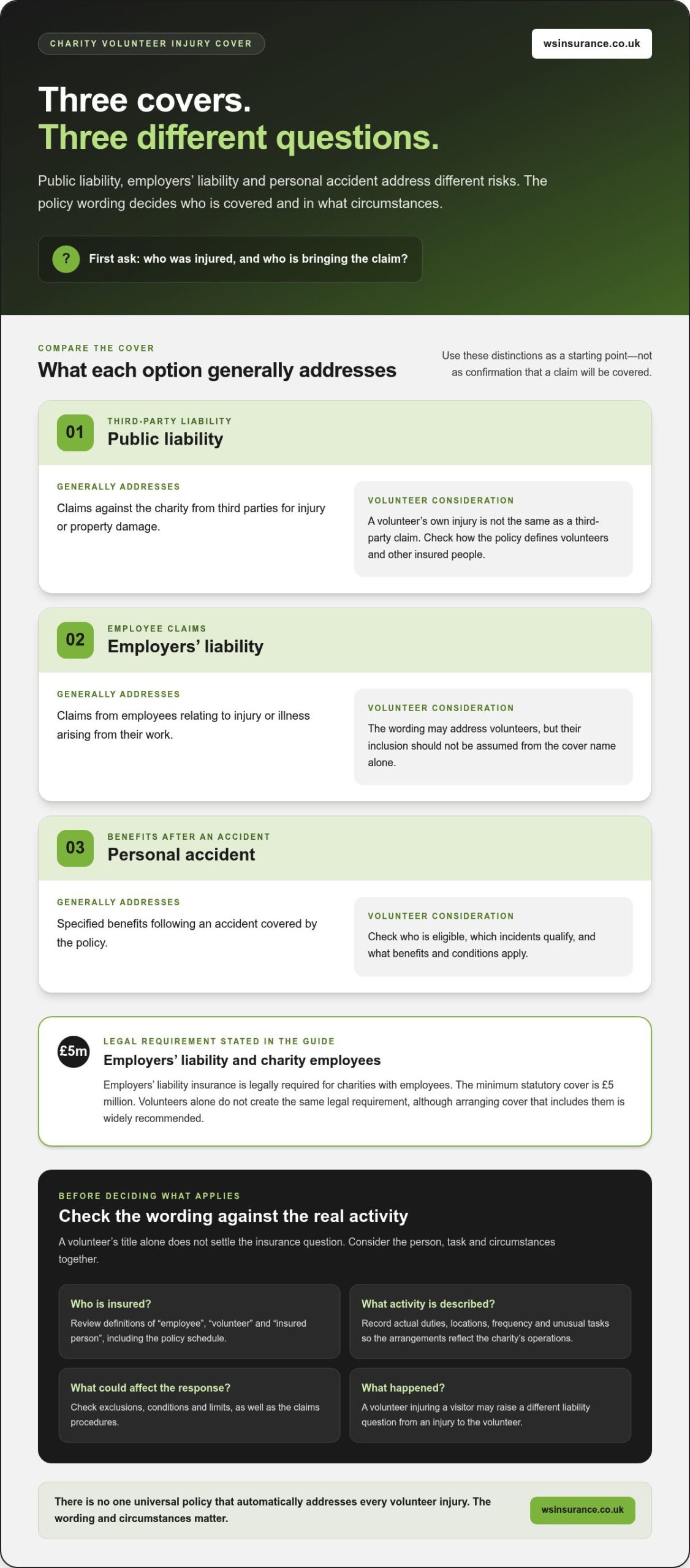
Public liability, employers’ liability and personal accident cover address different questions. Public liability generally concerns claims against the charity from third parties who are injured or whose property is damaged. It should not be assumed to cover a volunteer’s own injury. Employers’ liability relates to claims by employees injured or made ill through their work, while personal accident cover may provide specified benefits after an insured accident. The policy wording determines who is insured and what circumstances are covered.
Use this comparison as a starting point, then check the policy schedule and wording against the charity’s actual activities:
Cover type
What it generally addresses
Volunteer consideration
Public liability
Third-party claims against the charity for injury or property damage.
A volunteer’s own injury is not the same as a third-party claim. Check how the policy defines volunteers and other insured people.
Employers’ liability
Claims from employees relating to injury or illness arising from their work.
The wording may address volunteers, but their inclusion should not be assumed from the cover name alone.
Personal accident
Specified benefits following an accident covered by the policy.
Check who is eligible, which incidents qualify, and what benefits and conditions apply.
Public liability and employers’ liability: different questions, different cover
In the UK, employers’ liability insurance is legally required for charities with employees. The minimum statutory cover is £5 million. Volunteers alone do not create the same legal requirement, but insurers may treat volunteers as employees for policy purposes, so the wording matters. Employment status and legal duties can depend on the circumstances; seek appropriate advice if the charity’s position is unclear.
When personal accident cover may be relevant to volunteers
Personal accident cover may be considered where a charity wants a policy designed to provide defined benefits after certain accidental injuries. The policy terms determine what counts as a covered accident, who can claim and what benefits may apply. It is not a substitute for liability insurance and does not guarantee compensation for every injury. Compare it alongside liability cover, not as a replacement.
For trustees assessing insuring a charity against volunteer injury, the practical next step is to match each cover type to the people and activities involved. WS Insurance Brokers arranges tailored Charity & Not-for-Profit Insurance and can help clarify policy wording, making the distinctions easier to review.
How to compare charity insurance for volunteer injury
A useful comparison starts with your charity’s actual work, not just the name of a policy. Set out who the volunteers are, what they do, where and how often they do it, then compare that picture with the wording and schedule of each policy. This gives trustees a practical basis for identifying where cover appears aligned and where the terms need closer attention.
Which policy wording should a charity review?
Read the policy definitions for “volunteer”, “employee”, “insured person” and the activities covered. Then review the exclusions, conditions, limits and claims procedures in the actual wording, including any incident-reporting requirements. Do not rely on a summary or a general statement about volunteer cover alone. Compare the schedule with current roles and services, and note any descriptions that no longer reflect what volunteers do.
For an organised review, trustees can work through these points:
- People: Who is insured, and how does the policy define volunteers, employees and other relevant people?
- Activities: Are the charity’s current services, events, locations and volunteer duties accurately described?
- Terms: What exclusions, conditions, limits or notification requirements could affect how cover responds?
- Claims: What does the wording say about reporting an incident and providing information to support a claim?
How to assess cover against real volunteer roles
Map the work in practical terms. A volunteer greeting visitors at a regular drop-in session has a different work setting from someone helping with an outdoor community project. Record the task, location, frequency, contact with the public, equipment involved and level of supervision. The number of volunteers and how often they take part also help create an accurate picture of the charity’s activities.
Keep the review current. If the charity adds a service, changes how it supports beneficiaries or introduces a new event, update role descriptions and risk information. A written risk assessment can help identify hazards and document the steps taken to manage them. It also supports clear, accurate information when insurance is arranged or reviewed. It does not replace insurance or prove that a particular claim will be covered.
Training, supervision and incident procedures are useful parts of the same record. Note what volunteers are briefed to do, who oversees their work and how an incident is reported internally. These details help trustees compare arrangements consistently and explain the charity’s activities clearly. They can also reveal a gap between written role descriptions and day-to-day practice.
WS Insurance Brokers can help clarify policy wording and arrange tailored charity cover around volunteer roles and activities. Discussing tailored charity insurance can help trustees make an informed comparison with the relevant policy terms in view.
What should a charity do before volunteers start an activity?
A short preparation process can make activities safer and help trustees keep insurance arrangements aligned with the work volunteers actually do. Before a new task or event begins, define responsibilities, assess hazards, brief everyone involved, set out how incidents will be handled and review whether the charity’s cover reflects the activity. Good safety practices support risk management, but they do not replace insurance or determine whether a claim will be covered.
- Define the role. Record the tasks volunteers are expected to carry out, where they will work, who they report to and any tasks outside their responsibilities. Clear boundaries help volunteers understand what to do and make it easier to spot when the activity changes.
- Assess the hazards. Consider the location, equipment, manual tasks, contact with the public and the experience or support volunteers may need. Decide how risks can be reduced and who is responsible for putting those measures in place.
- Brief and support volunteers. Give instructions that fit the activity, provide suitable induction or training, and explain who will supervise the work. Make sure volunteers know how to raise a concern or stop and seek help if conditions become unsafe.
- Set an incident process. Explain who should be told about an injury or near miss, how to record it and who will manage follow-up. Keep the process accessible to volunteers and supervisors.
- Review the arrangements. Revisit the risk assessment and insurance details when activities, locations or responsibilities change, and after an incident or near miss.
Build injury prevention into volunteer management
Safety guidance should be specific to the role, not just a general welcome pack. A volunteer setting up event equipment may need different instructions and supervision from someone greeting visitors or assisting service users. Explain relevant procedures before the activity starts, confirm who volunteers can approach with questions, and review arrangements if the work changes. A near miss can also show that instructions or controls need attention.
Trustees should consider the guidance of the charity regulator for their organisation’s jurisdiction: the Charity Commission for England and Wales, the Office of the Scottish Charity Regulator (OSCR) in Scotland, or the Charity Commission for Northern Ireland. Refer to current regulator guidance when reviewing trustee responsibilities, risk management and insurance; requirements and guidance can differ across the UK.
Keep records that help with risk and claims handling
Maintain up-to-date role descriptions, training and induction records, risk assessments, supervision arrangements and incident reports. For an injury or near miss, record the date, activity, location, people involved, what was reported and the steps taken afterwards. Keep relevant records securely and follow the charity’s procedures for handling personal information.
Record when an incident is reported to the insurer and who is managing the follow-up. Notification requirements and timescales depend on the policy wording, so include the relevant procedure in your incident plan and follow the applicable terms. Clear records can support an orderly review, though they do not guarantee a particular claims outcome.
For support aligning practical risk information with policy arrangements, discuss tailored charity insurance with WS Insurance Brokers.
Arrange tailored charity insurance with confidence
There is no single cover arrangement that suits every charity. A useful review starts with volunteers’ actual roles and activities, then tests those details against the policy wording. For trustees, insuring a charity against volunteer injury means understanding the risks, identifying relevant cover and making informed decisions, rather than assuming a policy will respond to every incident.
What information helps shape suitable charity cover?
A clear overview helps a broker understand how your charity operates and what protection it may need. Before discussing arrangements, bring together information about the charity’s services, volunteer duties, work locations and how frequently activities take place. Include planned changes, such as a new service, event or way of supporting beneficiaries, as these may alter the risk picture.
Existing documents are useful too. Gather current policy schedules and wording, along with relevant risk assessments, role descriptions, induction or training records and incident procedures. These explain both the activities and the steps your charity takes to manage risk. Where documents use broad descriptions, note what volunteers do in practice, including occasional tasks that may not be obvious from a role title.
Accurate, up-to-date information helps a broker assess your requirements and source suitable options. It also gives trustees a better foundation for comparing cover and understanding how proposed arrangements relate to volunteer roles. If your charity’s activities have changed since the last renewal, explain what has changed rather than relying on older descriptions.
How WS Insurance Brokers can support your charity
WS Insurance Brokers arranges tailored Charity & Not-for-Profit Insurance, drawing on a panel of UK insurers. As an independent brokerage, it considers your charity’s activities and volunteer roles when sourcing options, then helps clarify policy wording so you can understand how the terms relate to your needs. This supports a considered fit, rather than a one-size-fits-all assumption.
Support can continue after insurance is arranged. Policy administration helps manage the arrangements, while dedicated claims support can assist your charity through the claims process. The policy wording and circumstances remain central to any claim, so support is not a promise that a particular injury will be covered or compensated.
To make the discussion productive, trustees can share an overview of activities, current policy documents and questions about volunteer roles. This creates a clear starting point for reviewing the charity’s needs and considering tailored options. For a considered conversation about your organisation’s requirements, discuss charity insurance with WS Insurance Brokers.
Take the next step towards clearer cover
Volunteer roles can change as a charity develops, so review insurance arrangements when activities or responsibilities shift. Treat insuring a charity against volunteer injury as an ongoing part of planning, not a decision to revisit only after an incident. A clear record of what volunteers do helps trustees have a focused conversation about the protection their organisation needs.
WS Insurance Brokers is an FCA-authorised and regulated UK brokerage. Its team can consider your charity’s requirements and discuss tailored insurance options, while policy management and dedicated claims support provide assistance beyond arranging cover. The terms of any policy remain decisive, so a focused discussion can bring your organisation’s activities and insurance questions into view.
Discuss tailored charity insurance with WS Insurance Brokers and take a practical next step towards arrangements that reflect your charity’s work.
Frequently Asked Questions
Is a charity legally required to insure its volunteers?
No, volunteer status alone does not make employers’ liability insurance a legal requirement. A charity with employees must generally have employers’ liability insurance, but volunteers are not automatically treated as employees for this legal requirement. This does not remove the charity’s responsibility to manage risks to volunteers. Trustees should consider suitable cover for the organisation’s activities and check current requirements if a person’s working arrangement or status is unclear.
Does public liability insurance cover an injured volunteer?
Not necessarily. Public liability is generally designed for third-party claims against the charity, such as a visitor alleging injury during an event. A volunteer’s own injury is a different situation, so do not assume it falls within this cover. For example, if a volunteer is hurt while putting up a stall, the policy’s definitions and terms will matter. Check the wording and schedule to understand who is insured and in what circumstances.
Can volunteers be covered by employers’ liability insurance?
They may be, if the policy wording includes them. Employers’ liability insurance is legally required for charities with employees, but whether volunteers are included for insurance purposes depends on the insurer’s definitions and terms. Check the wording and schedule rather than relying on the policy title. If volunteers carry out duties similar to employees, describe those tasks accurately when arranging or reviewing cover so the insurer can assess the risk information.
What insurance covers a volunteer injured while volunteering?
There is no single answer for every injury. Depending on the circumstances and policy terms, employers’ liability may be relevant if the volunteer is included, and personal accident cover may provide specified benefits for eligible people following a covered accident. Public liability usually concerns claims from third parties, not the volunteer’s own injury. When insuring a charity against volunteer injury, consider the activity, the person’s role and the wording across relevant policies.
Are trustees personally responsible if a volunteer is injured?
Not automatically. Whether trustees could face personal liability depends on the charity’s legal structure, the circumstances of the injury and whether relevant duties were breached. Trustees should take reasonable steps to oversee health and safety, manage risks and maintain suitable insurance arrangements. A documented risk assessment, clear volunteer instructions and a process for reporting incidents can support responsible oversight, but they do not determine legal liability or guarantee that an insurance claim will be paid.
What information should a charity provide when arranging volunteer insurance?
Give a clear account of the charity’s activities and the volunteers involved. Include the tasks they perform, where and how often they work, their contact with the public, and any equipment or higher-risk duties. Share existing policy documents, relevant risk assessments and details of planned changes, such as a new service or event. Accurate information helps the broker assess the charity’s requirements and source appropriate options for consideration.