
What if a cyber incident starts with a supplier’s compromised account, spreads through your systems and disrupts a cloud service? Whether your policy responds may depend on how its exclusions and conditions apply to each part of the event. The cyber insurance policy exclusions to check are those that intersect with your business’s actual incident pathways, not just the headings that stand out on a schedule.
Policy wording can be difficult to compare. Technical definitions, connected causes and security requirements can obscure where cover may be limited, particularly if the controls described in an application differ from day-to-day practice.
This checklist highlights wording to review before you buy or renew, including ransomware, third-party incidents, system maintenance, prior-known events and security conditions. It also shows how to compare policy terms with your systems, suppliers and realistic incident scenarios. Because exclusions and definitions vary between policies, read each clause in context. An independent broker can assess your business risks and compare policy options against your requirements.
Key Takeaways
- Read exclusions alongside definitions, conditions and endorsements, because policy wording varies.
- Use the cyber insurance policy exclusions to check as a starting point for comparing third-party incidents, security requirements and state-backed attacks.
- Map your operations and likely incident scenarios, then match each one to the relevant policy wording, sub-limits and conditions.
- Review your cover when your systems, suppliers, data practices or security controls change, and keep application answers aligned with your current safeguards.
- An independent broker can assess your business risks and compare tailored cover from insurer panels to help you make an informed choice.
Cyber insurance policy exclusions to check before comparing cover
An exclusion limits cover for defined circumstances, losses or causes. To understand its effect, read it alongside the policy’s definitions, conditions and endorsements. Definitions explain how terms are used; conditions set requirements the policyholder must meet; endorsements amend or add to the standard wording. These elements work together, and the detail can differ between insurers. A heading alone is not enough to compare policies.
A policy exclusion is wording that restricts cover for specified circumstances, causes or types of loss, as set out in that policy. Treat this as a starting point, not a substitute for reading the clause. The general overview of Cyber insurance provides background, but the wording that matters is in the policy being considered.
An exclusion is different from a condition. An exclusion may remove cover for a defined situation; a condition may require the business to take specified steps or meet stated requirements. The effect of a condition depends on its wording and how it relates to the claim. Check for cross-references, qualifications and exceptions, and note whether another section changes or limits the clause. Review the cyber insurance policy exclusions to check as part of the complete contract, not as a standalone checklist.
What a cyber insurance exclusion means in practice
An exclusion may concern a particular event, cause or category of loss, but its scope depends on the wording and relevant definitions. A clause might use terms defined elsewhere or distinguish between direct and indirect loss. Read the complete clause, including exceptions, and follow its references through the policy. The presence of an exclusion does not, by itself, determine the outcome for every part of a claim. Other clauses, conditions, limits or endorsements may also matter.
Why the same incident can raise different policy questions
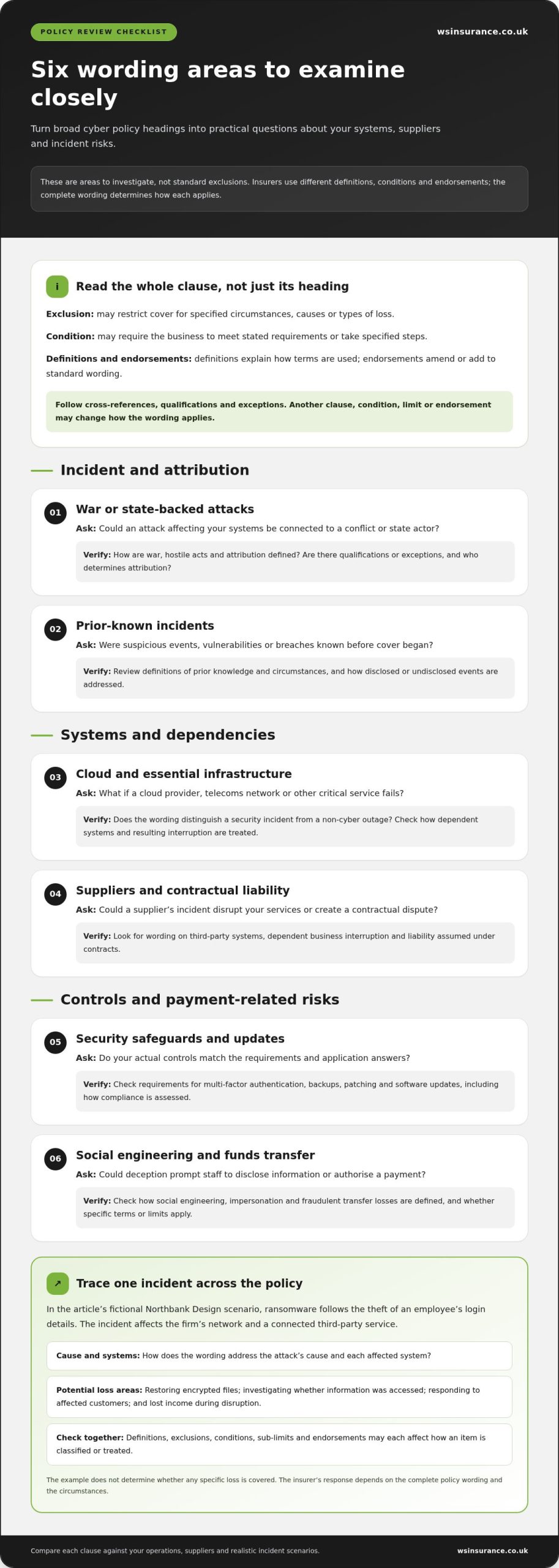
Consider a fictional business, Northbank Design, hit by ransomware after an employee’s login details are stolen. The cause may raise questions about how the attack began and whether the wording addresses that type of event. The affected systems might include the firm’s own network and a connected service supplied by a third party, so check how the policy treats each.
The business may then face several kinds of loss: restoring encrypted files, investigating whether information was accessed, responding to affected customers or lost income during disruption. Assess each item against the policy. Definitions may shape how an incident or loss is classified; exclusions may apply to particular circumstances; and conditions, sub-limits or endorsements may affect the response. One clause’s relevance does not settle every other part of a claim. The insurer’s response depends on the complete policy wording and the circumstances, so this example cannot establish whether any specific loss would be covered.
Common cyber insurance exclusions and conditions to examine closely
Use this table to turn broad policy headings into questions about your operations. These are areas to investigate, not standard exclusions. Insurers use different definitions, conditions and endorsements, so the full wording determines how each applies.
| Wording area | Business question | Details to verify |
|---|---|---|
| War or state-backed attacks | Could an attack affecting our systems be connected to a conflict or state actor? | How are war, hostile acts and attribution defined? Are there qualifications or exceptions, and who determines attribution? |
| Cloud and essential infrastructure | What if a cloud provider, telecoms network or other critical service fails? | Does the wording distinguish a security incident from a non-cyber outage? Check how dependent systems and resulting interruption are treated. |
| Prior-known incidents | Were any suspicious events, vulnerabilities or breaches known before cover began? | Review definitions of prior knowledge and circumstances, and how disclosed or undisclosed events are addressed. |
| Security safeguards and updates | Do our actual controls match the requirements and application answers? | Check any requirements for multi-factor authentication, backups, patching and software updates, including how compliance is assessed. |
| Suppliers and contractual liability | Could a supplier’s incident disrupt our services or create a contractual dispute? | Look for wording on third-party systems, dependent business interruption and liability assumed under contracts. |
| Social engineering and funds transfer | Could a deception prompt staff to disclose information or authorise a payment? | Check how social engineering, impersonation and fraudulent transfer losses are defined, and whether specific terms or limits apply. |
Cyber attack, war and infrastructure wording
Read war and state-backed attack clauses closely. Definitions, attribution tests and exceptions are policy-specific; neither the label nor the suspected identity of an attacker settles the question by itself. For infrastructure, trace what happens if a provider becomes unavailable without a direct attack on your business. Check whether the wording treats the outage, resulting interruption and associated incident differently.
Security requirements, known incidents and human factors
Treat security requirements as practical obligations, not just technical language. Compare any requirements for backups, multi-factor authentication and updates with what your business actually does, including how often safeguards are tested. Then compare application answers with current records. Be precise about previous incidents and known vulnerabilities. Check how the policy treats social engineering or payment diversion instead of assuming those losses fall within cover.
These are useful cyber insurance policy exclusions to check, but the priorities depend on your systems, suppliers and likely incident scenarios. WS Insurance Brokers offers cyber insurance and can assess those risks against insurer wording to help you compare options. Read more about independent cyber insurance advice.
How to compare cyber insurance exclusions against your business risks
Start with your business, not a list of policy headings. Map the systems, information and suppliers your operations depend on, then test realistic incident scenarios against each policy. This helps show where an exclusion, condition or limit may matter. A wider business risks to insure against review can also put cyber exposures in context.
Build a shortlist of realistic cyber incident scenarios
Identify which services and processes would be hardest to maintain if digital systems were compromised or unavailable. Consider data theft, ransomware, accidental disclosure and interruption to digital services. Map the systems holding sensitive information, the teams that rely on them and essential third-party dependencies, such as hosted platforms or payment services. Prioritise scenarios by potential operational impact, rather than treating an event as important only because you think it is likely.
- Map operations: List critical systems, data, business processes and the external services they rely on.
- Describe scenarios: Note how an incident could begin, which systems or suppliers it could affect and what disruption might follow.
- Locate the wording: For each scenario, find relevant definitions, exclusions and conditions, then check sub-limits or endorsements that may alter how the wording applies.
- Record differences: Compare clauses side by side and note uncertainties or questions to resolve before choosing cover.
Turn policy wording into a side-by-side comparison
Use the same scenarios for every policy under consideration. Record clause references and defined terms, not just your interpretation of a heading. Separate exclusions from conditions, and note any extensions, sub-limits or endorsements. If wording is unclear, flag the exact phrase and scenario for discussion with your broker. This keeps the comparison focused on how each policy addresses your risks, without assuming similar labels mean identical terms.
| Scenario | Wording reference | Uncertainty | Follow-up |
|---|---|---|---|
| Ransomware affects essential files | Relevant definitions, exclusions and conditions | How are restoration and disruption addressed? | Trace related limits and requirements |
| Sensitive data is taken | Data and incident definitions | How does the wording treat the affected information? | Check relevant extensions and conditions |
| An employee discloses information accidentally | Exclusions and any applicable extensions | Does the clause distinguish accidental acts? | Record the exact wording and seek clarification |
| A digital service becomes unavailable | Interruption wording and sub-limits | How are dependencies on suppliers treated? | Compare the clause with your service map |
The result is a practical comparison of the cyber insurance policy exclusions to check against your operations. Keep each scenario with its relevant clause and unresolved question, so policy differences are clear when you assess your options.
A renewal checklist for testing exclusions, security conditions and claims readiness
Cyber cover needs to keep pace with the business it protects. A new cloud platform, supplier, data practice or security control can change how an incident might unfold and may affect the accuracy of information already provided to insurers. Review the policy at renewal and whenever a material change occurs, rather than relying on last year’s answers to describe today’s operations.
What to review before renewal or a material business change
Start with the details used to arrange the cover. Check that declared turnover, locations and business activities remain accurate, and identify any new reliance on third-party systems. Compare stated safeguards with current practice: for example, whether the business still uses the backups, access controls and software-update processes described in its application. Record any questions a change raises about the wording and consider their implications before assuming the cover is unchanged.
- Business profile: Check declared turnover, locations, operations and changes to the services you provide.
- Systems and suppliers: Note new platforms, outsourced functions and other dependencies that could affect operations during an incident.
- Security controls: Compare application answers and declared safeguards with what is implemented and maintained now.
- Policy wording: Revisit relevant exclusions, conditions, sub-limits and endorsements in light of those changes.
- Amendments: Keep a record of requested changes and retain the resulting policy wording in writing.
A wider business insurance review can help put cyber cover in context alongside other protections a business may need. The priority is to make sure your cyber policy still reflects the risks, systems and safeguards you actually have.
Prepare for a potential notification or claim
Read the policy’s notification instructions before an incident occurs. Make the relevant insurer contact details easy to find, and note any stated reporting process or time-sensitive requirements. Keep the current policy schedule and wording accessible to the people who may need to act, alongside an incident-response contact list.
Good records can help establish what happened and how the business responded. Organise relevant security evidence, such as records of safeguards and updates, and maintain incident records that capture key decisions and actions. Preserve information that may be relevant to an event, following the policy’s instructions and appropriate internal processes.
No checklist can determine a claim outcome in advance. The circumstances, the information provided and the complete policy wording all matter. When preparing for renewal, ask WS Insurance Brokers to review your cyber policy against your business’s current risks and clarify points that need attention.
Get help assessing cyber insurance policy exclusions before you choose
A sound comparison comes down to three practical steps: prioritise the cyber scenarios that matter to your business, compare the relevant policy wording and understand how exclusions interact with conditions, limits and endorsements. The most useful option is not necessarily the one with the shortest exclusion list. It is the one whose terms you can assess against your operations and risk profile with greater clarity.
Comparisons can become more involved when an incident might affect several systems, suppliers or types of loss. A compromised account, for example, could lead to data exposure, disruption to your services and a dispute involving a supplier. Different clauses may apply to each part. WS Insurance Brokers can assess your business risks, compare wording from a panel of UK insurers and explain differences that may affect your decision. This can bring technical language into focus without treating any policy term as a promise that a future claim will be accepted.
When specialist guidance can make the comparison clearer
Broker support can be particularly helpful where exclusions, definitions and conditions overlap. WS Insurance Brokers can help identify which wording differences relate to your systems, suppliers and likely loss scenarios, and explain the questions to resolve before you choose. If a phrase or cross-reference is uncertain, understanding what it says and what it does not say can help you make a more informed decision.
Support can continue after a policy is arranged. Policy management helps keep cover under review as the business changes, while claims advocacy can assist with presenting and managing a claim. The insurer assesses the claim under the policy wording and circumstances; no broker can guarantee that an insurer will accept it or pay a particular amount.
What to bring to a cyber insurance discussion
A concise picture of your business gives the review a practical starting point. You do not need to turn it into a technical audit. Focus on the information that connects policy wording to how your organisation works:
- Operations: Summarise your main activities, essential services and the processes most affected by system disruption.
- Systems and data: Identify critical platforms, where important or sensitive data is held, and who relies on it.
- Safeguards: Describe existing security controls, including how backups, access controls and software updates are managed.
- Suppliers and changes: Note key technology providers and material changes to systems, services or data practices.
- Questions: List priority incident scenarios and unclear clauses, so each can be considered against the wording.
With these details in hand, you can focus the discussion on the cyber insurance policy exclusions to check for your business, rather than comparing headings in isolation. To discuss your cyber insurance requirements with WS Insurance Brokers, get in touch with the team.
Make your next cyber cover decision with greater confidence
Use your next renewal or purchasing decision to turn uncertainty into a clear set of questions: which scenarios matter most, which policy terms need explanation, and where would your business benefit from a closer comparison? The cyber insurance policy exclusions to check are those that could affect your systems, suppliers and operations, not simply the clauses that look most technical.
WS Insurance Brokers can assess your risk profile and compare tailored options from major UK insurers. As an independent brokerage authorised and regulated by the Financial Conduct Authority, the firm also provides policy management and claims advocacy, while insurer decisions remain subject to the policy wording and circumstances of any claim.
Take the next step with a focused conversation. Discuss your cyber insurance requirements with WS Insurance and bring your questions to the team. A clearer understanding of the wording can help you choose cover with greater confidence.
Frequently Asked Questions
What are the most common cyber insurance policy exclusions to check?
Common areas to examine include war or state-backed attack wording, prior-known incidents, security requirements, supplier-dependent outages and losses involving social engineering. These are not universal exclusions, and policies can treat the same topic differently. Check definitions and linked conditions instead of relying on a schedule heading. For example, a supplier outage might be treated differently depending on whether a cyber event caused it and how the policy defines interruption.
Does cyber insurance cover ransomware attacks?
It may respond to some losses arising from ransomware, but cover depends on the policy wording and circumstances. Separate costs associated with restoring systems, investigating data exposure, responding to an extortion demand and interruption to operations. Each may raise a different policy question. Check relevant exclusions, conditions, limits and notification requirements, and do not assume cover for one part of an incident means every associated loss is covered.
Can a cyber insurance claim be declined because security requirements were not met?
Not meeting a policy requirement could affect a claim, depending on the wording and circumstances. If a policy sets out a safeguard and an incident involves the system that safeguard was meant to protect, the insurer may examine whether the requirement was met and how it relates to the loss. Keep records of controls and changes, and compare them with the policy and application answers. The insurer determines the claim under the contract.
Does cyber insurance cover an outage at a cloud or technology provider?
It depends on the policy and why the provider’s service became unavailable. An outage caused by a cyber incident may raise different questions from a technical failure or wider infrastructure disruption that was not caused by a security event. Check how the wording addresses dependent systems, interruption and third-party services. If your business relies on hosted software for essential operations, consider what happens if access is lost, even when your own network remains unaffected.
Are social engineering and funds-transfer losses covered by cyber insurance?
They may be addressed by specific wording, but do not assume cyber insurance automatically covers a fraudulent payment. Policies can distinguish between a system compromise, an employee being deceived into authorising a transfer and other forms of payment fraud. Review the relevant definitions and any extensions, exclusions or sub-limits. A practical comparison is to trace a realistic impersonation scenario from the first deceptive message through to the attempted payment and resulting loss.
How often should a business review cyber insurance exclusions?
Review exclusions at each renewal and after a material change to your operations, systems, suppliers, data practices or security controls. Adopting a new hosted platform or outsourcing a key process, for instance, may change your exposure to service interruption. Keep a short record of what has changed and any related policy questions. This makes it easier to revisit relevant wording and identify whether application details or declared safeguards need updating.
Who can help explain cyber insurance policy exclusions in the UK?
An independent insurance broker can assess a business’s risks, compare policy wording from insurer panels and explain differences relevant to its operations. WS Insurance Brokers is a UK brokerage authorised and regulated by the Financial Conduct Authority. Its support includes policy management and claims advocacy, but insurers make claim decisions under the policy terms and circumstances. Bring your current wording and a concise outline of your systems, suppliers and priorities to make the discussion more focused.