
What makes a business interruption claim easier to review? A clear trail connecting the event, the disruption to your operations and the financial loss. When you’re documenting a business interruption claim, it can be difficult to know which evidence to gather, how far back to go and how to separate the event’s impact from normal business fluctuations.
Incomplete records or an unclear calculation can make it harder to explain how the interruption affected your business. A dated, organised evidence file helps show what happened and how you arrived at the figures, while keeping the policy wording and circumstances of the claim in view.
This guide explains which records may help, how to organise them and how to build a transparent loss calculation supported by evidence. It also covers how to submit a claim and manage follow-up discussions. The evidence needed depends on the policy wording and circumstances, so use these steps as a practical framework rather than a universal checklist.
Key Takeaways
- Link the event, interruption and financial impact with dated records, guided by the policy wording and circumstances of the claim.
- Organise evidence into clear categories and use a document index to explain what each record covers and why it matters.
- When documenting a business interruption claim, distinguish actual figures from estimates, assumptions and adjustments so the calculation can be followed.
- Follow the insurer’s instructions on submission format and any stated timeframes, and keep a record of what you send.
- An independent broker can help interpret policy wording and organise claim discussions, but cannot promise a particular outcome.
Documenting a business interruption claim: start with the event and its impact
Start with a clear account of what happened and how it affected the business. For documenting a business interruption claim, the aim is to connect a potentially insured event to a disruption in operations and the financial impact being claimed. Dated records help the insurer follow that sequence instead of piecing it together from disconnected documents.
The policy wording and circumstances determine what may be covered and which evidence is relevant. Don’t assume that damage, restricted access or a supply problem automatically meets the policy terms. Read the wording alongside the facts of the incident. Understanding Business Interruption Insurance also provides general background on the purpose of this cover. A record made close to the time of the event can help clarify what was known and how the business responded. Identify later estimates or recollections as such.
Evidence of the event shows what happened; evidence of financial loss shows how the resulting interruption affected the business’s finances. Keeping these strands distinct makes the claim easier to review and helps avoid treating every change in trading as a consequence of the incident.
Create a dated chronology of the interruption
Build a timeline from the first discovery through changes to operations and important communications. Record dates and, where available, times. Note the affected site, activity, product or service, and be precise about what continued as well as what stopped. For example, an event might affect one work area or service while other parts of the business continue. This detail helps show the actual scope of the interruption.
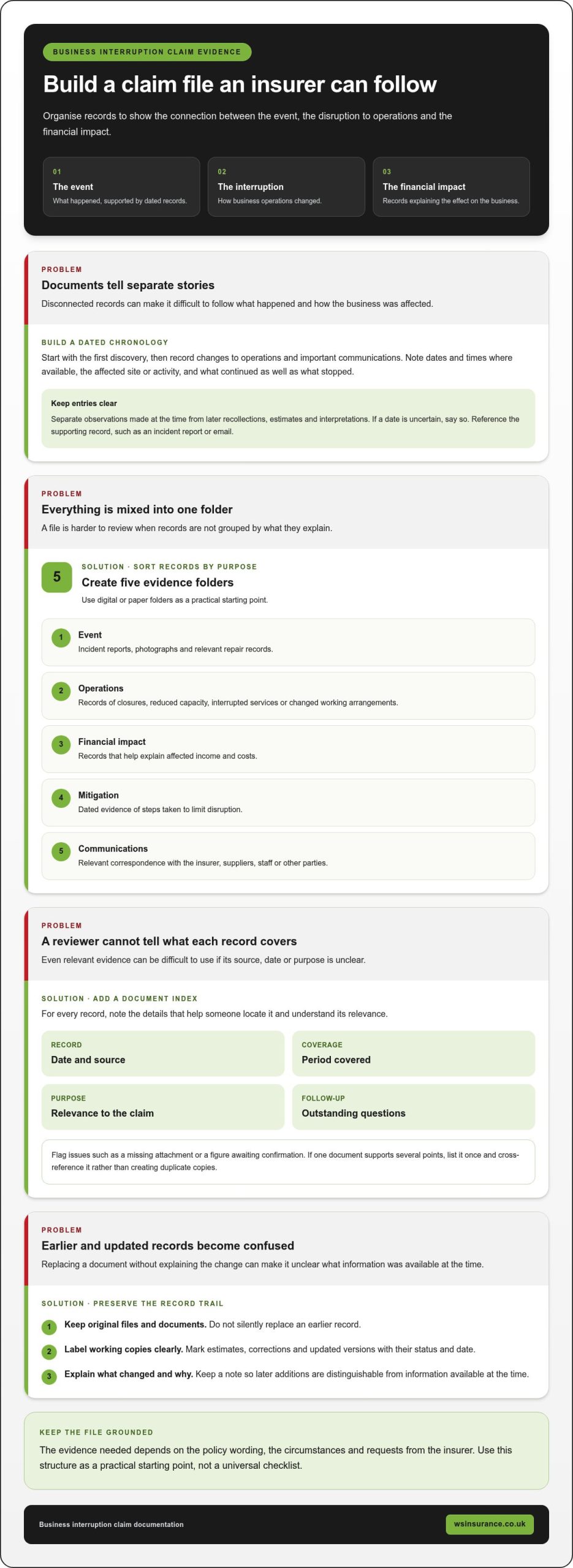
Keep entries factual. Separate observations recorded at the time from later recollections, estimates and interpretations. If a date is uncertain, say so rather than presenting an approximation as confirmed. Reference supporting records, such as an incident report or email, so each key entry can be traced to its source.
Connect the event to the business interruption
Next, describe what changed after the event. This might include reduced capacity, altered opening arrangements, interrupted access or delayed supplies. Record when the change began, how it developed and when operations changed again. Avoid implying that the whole business was affected if only particular activities or periods were disrupted. Note what continued and any alternative arrangements put in place.
Keep relevant material together, including incident reports, correspondence, photographs and operational records. Focus on records that explain the sequence of events and their operational effect, taking the policy wording into account. Where the interruption relates to damage to premises or property, the commercial property insurance guide provides related cover context. A chronology supported by source records gives the financial assessment a clear factual foundation.
Build a business interruption claim evidence file insurers can follow
A well-organised file helps connect records to the event and its effect on the business. When documenting a business interruption claim, sort documents by purpose rather than placing everything in one folder. The evidence required depends on the policy wording, the circumstances and any requests from the insurer. Use this structure as a practical starting point, not a universal checklist.
Create five folders, either digitally or on paper:
- Event: incident reports, photographs and relevant repair records.
- Operations: records of closures, reduced capacity, interrupted services or changed working arrangements.
- Financial impact: records that help explain affected income and costs.
- Mitigation: dated evidence of steps taken to limit disruption.
- Communications: relevant correspondence with the insurer, suppliers, staff or other parties.
Create a document index so a reviewer can locate and understand each item. For every record, note its date, source, period covered and relevance to the claim. Add outstanding questions, such as a missing attachment or a figure awaiting confirmation. If one document supports several points, list it once and cross-reference it to avoid duplicate copies that could later become inconsistent.
Preserve original files and documents. Label working copies clearly, and mark estimates, corrections or updated versions with their status and date. Don’t silently replace an earlier record. Keep a note explaining what changed and why, so it is clear which information was available at the time and what was added later.
Gather operational and incident records
Include incident reports, repair records, supplier updates and correspondence that help explain how the event affected day-to-day work. Pair these with records showing when a site closed, capacity fell, a service was interrupted or working arrangements changed. Keep dated evidence of steps taken to limit disruption, such as alternative arrangements. Together, these records can show both the interruption and the business’s response without implying that every activity stopped.
Gather financial records for the relevant periods
Consider management accounts, sales records, invoices, payroll and relevant bank records where they help explain the financial impact. Choose periods that make sense for the claim and state the dates they cover, so figures can be compared and traced. Accounting or tax records may clarify a point, but aren’t automatically relevant to every claim. For broader preparation, including identifying exposures before an event, see this business risks guide.
If you need help matching documents to policy wording or organising claim discussions, WS Insurance Brokers provides claims-handling support. A clear file won’t determine the outcome, but it can make the evidence and any gaps easier to discuss.
Calculate and explain the financial loss behind your claim
A financial calculation should be traceable from the amount claimed back to the records and reasoning behind it. Start with the policy wording, as relevant definitions, limits and other terms can affect how a loss is assessed. Don’t assume an accounting label automatically matches a policy definition. If the wording is unclear, a broker can help interpret it and organise questions for the claim discussion.
Make the calculation readable as well as accurate. Separate recorded figures from estimates, assumptions and adjustments, and explain each in plain language. A clear reconciliation makes complex figures easier to review, but can’t guarantee that an insurer will accept a particular amount.
Establish a sensible financial baseline
Identify the trading periods used to estimate expected performance and explain why they provide a fair comparison for the affected period. Consider seasonal patterns, unusual events and changes in trading conditions that may make one period less representative. A simple comparison before and after the event may miss these factors, so describe the context rather than presenting the comparison as conclusive. Keep dates and source records visible, and distinguish historical results from forecasts or estimates.
Reconcile claimed figures with supporting records
For each figure, show how it connects to sales records, invoices, management accounts or other relevant documents. If you have adjusted a figure, state what changed, why and how you made the calculation. Mark incomplete information, disputed items and estimates clearly; don’t present them as confirmed facts. This is especially useful when records cover different periods or use different descriptions for the same activity.
A simple reconciliation can use these fields:
Claim figure
Source record
Explanation
Income or sales item
Relevant sales report and period covered
How the figure relates to the affected trading period
Cost or adjustment
Invoice, account entry or other supporting record
Reason for inclusion, exclusion or adjustment
Estimate or assumption
Underlying records used, if available
Method, date prepared and any uncertainty
Use consistent labels and dates throughout the calculation, then check that totals agree with the supporting schedules. If a figure can’t yet be substantiated, flag it and explain what information is missing. This gives reviewers a transparent route through the working and keeps the calculation connected to the policy wording and circumstances of the claim. It is a practical discipline when documenting a business interruption claim.
Submit and manage business interruption claim documents methodically
Submitting a claim is easier to manage when each document has a clear place and every exchange is recorded. Requirements can vary, so follow the insurer’s instructions on submission channel, file format and stated timeframes rather than relying on a general checklist. A consistent process helps you track what has been sent, what remains outstanding and which version is current.
Use this workflow before and after submission:
- 1. Check the instructions. Note the requested documents, format, submission channel and any stated timeframes.
- 2. Index the evidence. Give each document a clear reference and include it in the index or contents list.
- 3. Review the calculation. Check figures against their supporting records and make sure the explanations are consistent.
- 4. Submit and retain copies. Keep a copy of the complete submission and record when and how it was sent.
Keep a correspondence log alongside the evidence index. Record the date of each contact, the question raised, your response, the documents sent and any follow-up action. If a discussion takes place by telephone, make a brief factual note afterwards, including agreed next steps. This audit trail helps you keep track of requests among routine business activity. For wider context on commercial cover and claims, see the commercial insurance claim process.
Review the file before sending it
Set aside time for a final check. Confirm that each claimed figure points to a source and that document labels and dates align across the chronology, index and calculation. Remove duplicates and material that doesn’t help explain the claim, while retaining records needed to understand the evidence. Include a short summary and contents list so the reviewer can see the main points and locate supporting documents without searching through an unstructured bundle.
Respond to follow-up questions with a clear audit trail
Answer each request directly, identify the relevant document or calculation and state if information is still being gathered. When you submit new material or correct an earlier item, update the index and chronology, label the new version and retain the earlier submission. Log the response date, documents provided, outstanding questions and next steps. This keeps later discussions anchored to a clear record of what was supplied and when.
Careful record-keeping can make documenting a business interruption claim more orderly, but it can’t determine whether a claim will be accepted. If you need help interpreting policy wording or organising claim discussions, WS Insurance Brokers provides claims support.
Get support with a business interruption claim and its documentation
Even a carefully assembled claim file can leave questions about how the policy wording applies or how to respond to insurer correspondence. An independent broker can help explain relevant cover terms, organise claim discussions and clarify what a request is asking for. This support can bring order to a complicated process, but it can’t determine the insurer’s decision or guarantee a settlement.
WS Insurance Brokers provides policy management and dedicated claims-handling support for businesses with business interruption cover. As you document a business interruption claim, a broker can help organise communications and outstanding actions, giving you a clearer view of what has been discussed, what evidence has been provided and what still needs attention.
When broker support can help clarify the process
Support can be useful if a policy term is difficult to interpret, a letter asks for information that isn’t clear, or several requests need coordinating. A broker can help you understand the wording in context and organise questions for discussion with the insurer. Recording requests, responses and next steps also helps keep unanswered points visible among day-to-day work. The insurer remains responsible for assessing the claim.
Prepare for a focused conversation about your claim
A focused discussion starts with a concise set of documents. Gather the policy schedule and wording, incident chronology, financial summary and index of supporting evidence. You don’t need to resolve every uncertainty before raising a question. Flag what remains unclear and explain what you’re doing to address it.
It can help to prepare a short list covering:
- Questions about policy terms or insurer correspondence.
- Figures that are estimated, disputed or awaiting confirmation.
- Documents still being gathered and when you expect to update the file.
- Any response or action you’re waiting for, with the relevant date or correspondence reference.
This preparation gives the conversation a clear purpose and focuses it on decisions or information still needed. Keep notes of any guidance discussed and record agreed actions afterwards, so your chronology and claim file remain current. If you provide additional documents or corrected figures, note what changed and retain a copy of the updated material.
For support with business interruption cover or a claim, WS Insurance Brokers can help you organise policy and claims discussions. A clear, open discussion can help you understand the next steps while keeping expectations realistic and the insurer’s decision separate.
Take the next step with a clearer plan
A claim file can develop as new information becomes available. Treat documenting a business interruption claim as an ongoing process: keep important records together, note unanswered questions and update working documents when details change. This helps you approach each discussion with a clearer picture of what’s known and what still needs attention.
WS Insurance Brokers is an independent brokerage with access to major UK insurers and provides dedicated support during claims handling. The firm is authorised and regulated by the Financial Conduct Authority. A broker can help you consider policy wording and organise claim discussions, but the insurer decides how the claim is assessed.
Discuss your business insurance needs with WS Insurance Brokers for support with policy wording and claim discussions.
Frequently Asked Questions
What documents do I need for a business interruption claim?
Gather documents that help show the event, its effect on operations and the financial impact, then compare them with the policy wording and the insurer’s requests. Depending on the circumstances, useful records might include a policy schedule, incident correspondence, sales reports, supplier notices or repair paperwork. Cancelled orders, for example, may help explain a change in trading. There isn’t one universal document list, so focus on records that relate directly to your claim.
How do I prove loss of income for a business interruption claim?
Support the claimed loss with records showing actual trading and a reasoned comparison with expected income for the affected period. Sales ledgers, till reports, invoices and customer cancellations can help explain what changed. Bank receipts may help reconcile payments, although timing differences can matter. Explain unusual factors, such as a delayed invoice or a seasonal peak. The aim is to show how the figures were derived, not simply present a drop in turnover.
Can I make a business interruption claim without complete accounts?
You can start organising and discussing a claim even if final accounts aren’t ready. Use the records available, such as sales reports or interim management figures, and identify what’s provisional, missing or still being prepared. For example, explain if a month-end report is incomplete because invoices haven’t been reconciled. Ask how the insurer wants the gap addressed, record the response and provide updated figures when available. Missing accounts don’t by themselves establish whether cover applies.
How should I document business interruption caused by a supplier issue?
Record which supply was delayed or unavailable, the affected orders or services, and when the disruption began and eased. Keep supplier notices, purchase orders, delivery updates and messages about alternatives. Explain the connection to your business, such as how a missing component held up a particular product line, while noting work that continued. Supplier disruption isn’t automatically covered. The policy wording and circumstances determine whether the event falls within the cover, including any relevant extension.
How do I calculate the loss for a business interruption claim?
Start with the policy’s calculation basis and definitions, then compare actual results with a justified estimate of expected performance for the affected period. Explain how you selected the comparison period and account for relevant changes, such as a new contract or seasonal trading pattern. Show the source for each figure and explain any adjustment, including costs that changed or were avoided. Don’t rely on a single turnover comparison without explaining what it leaves out.
How long should I keep business interruption claim records?
Keep claim records throughout the assessment and any related discussions. Don’t discard them just because an initial payment or response has arrived, as later questions may concern how a figure was calculated or which document supported it. After the claim is resolved, consider the policy and insurer’s instructions alongside your business’s accounting, tax and record-retention arrangements. If the claim remains disputed or unresolved, seek appropriate professional guidance before disposing of relevant material.
What should I do if an insurer asks for more evidence?
Read the request carefully, identify the specific point it concerns and note any timeframe stated. Reply to each question in turn, refer to the documents supplied and explain clearly if something is unavailable or still being prepared. Keep a copy of your response and the evidence sent. If the request is unclear, ask for clarification through the appropriate claims contact, then record the response and next steps so nothing is overlooked.