
If you’re asking “how does directors and officers insurance work?”, start with a key detail: cover usually responds to claims made and notified during the policy period, subject to the wording. The allegation, timing and notification steps can all affect whether protection applies, even if the alleged decision happened earlier.
D&O insurance can protect directors and officers personally and, in specific circumstances, the company. It won’t automatically respond to every allegation or loss. The policy’s terms, exclusions and extensions determine the scope of cover.
This guide explains how a D&O policy is structured and what can happen when a claim is made, from notification to the insurer’s response. You’ll learn how individual and company cover can differ, why claims-made wording matters, and which policy details to review. Tailored placement, policy administration and claims support can help make the process easier to understand.
Key Takeaways
- Understand how does directors and officers insurance work, including why the date a claim is made and notified can matter.
- See how cover may protect individual directors, reimburse a company that indemnifies them, or extend to the organisation itself, depending on the wording.
- Learn why defence costs and settlements depend on policy definitions, conditions and exclusions, rather than being automatically covered.
- Use a practical checklist to review insured persons, the retroactive date, limits, excess, exclusions and notification requirements.
- Find out how broker guidance can relate policy terms to your organisation’s risks and clarify claims and policy administration steps.
How does directors and officers insurance work, and who does it protect?
D&O insurance may protect directors and officers against the costs of responding to claims that they committed a wrongful act while managing an organisation. A wrongful act might involve an alleged breach of duty, error, omission or misleading statement. This is a useful starting point for understanding how does directors and officers insurance work, but it doesn’t mean every claim will be covered. The policy wording, the person insured, the circumstances and any applicable exclusions all affect how cover responds. The Directors and Officers Liability Insurance overview provides further general background on the purpose of this type of protection.
A claim may be brought against a director personally, rather than against the company alone. Some policies may also cover the organisation itself for particular claims, or reimburse it if it has indemnified an insured person. This depends on the policy structure and wording. D&O cover is distinct from protection for the company’s professional services. The key question is whether the allegation concerns management or governance, and whether the policy responds to it.
Who can be insured under a D&O policy?
Policies commonly identify directors and officers as insured persons, but the definition matters. It sets out which roles qualify and may include past, present or future office-holders where the wording provides for them. Non-executive directors and employees aren’t automatically covered simply because of their relationship with the organisation. Their inclusion depends on the definition of an insured person and the capacity in which they acted. Compare that definition with your organisation’s structure and responsibilities, including the roles of board members and other senior personnel.
What kinds of allegations can lead to a D&O claim?
Examples include an allegation that a director breached a duty, made a misleading statement, failed to meet responsibilities or made a decision that caused loss. Depending on the circumstances, a shareholder, employee, regulator or another party might bring a claim. These are allegations, not proof of wrongdoing, and they don’t establish that the insurer will accept the claim.
The policy response depends on the facts and terms, including any exclusions for particular conduct. Deliberate misconduct, fraud, criminal acts, fines or penalties may be excluded or subject to legal restrictions. Don’t assume they are covered. The insurer assesses the claim against the applicable wording, so definitions and exclusions are central to understanding the protection in place.
How D&O insurance works from notification to claim decision
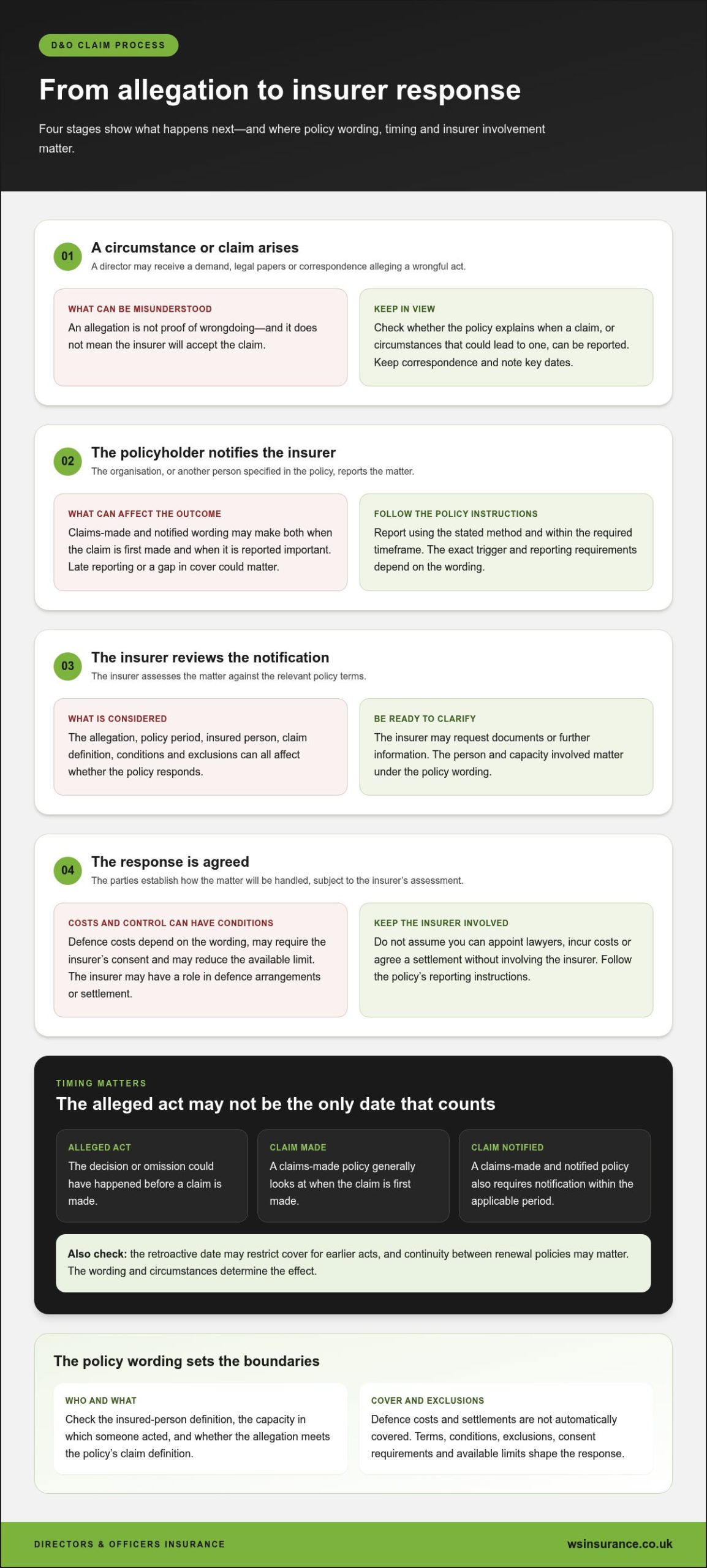
D&O policies are commonly written on a claims-made and notified basis. The date of the alleged act may not be the only date that matters: the policy may focus on when a claim is first made against an insured person and when it’s reported to the insurer. The exact trigger and reporting requirements depend on the wording.
A claim may move through these stages:
- A circumstance or claim arises. A director might receive a formal demand, legal papers or correspondence alleging a wrongful act. Some policies also explain when circumstances that could lead to a claim can be reported.
- The policyholder notifies the insurer. The organisation or another person specified in the policy reports the matter using the stated method and within the required timeframe.
- The insurer reviews the notification. It considers the allegation, policy period, insured person and relevant terms, including conditions and exclusions.
- The response is agreed. Depending on the insurer’s assessment, the parties establish how the matter will be handled, including defence arrangements, costs or settlement discussions.
Prompt notification in line with the policy’s reporting instructions gives the insurer the opportunity to assess the matter under the relevant terms.
What does claims-made and notified mean?
The alleged decision or omission could have happened before a claim is made. A claims-made policy generally looks at when the claim is first made, while a claims-made and notified policy also requires notification within the applicable period. A retroactive date may restrict cover for acts before that date, and continuity between renewal policies may matter. Late reporting or a gap in cover could affect the outcome. The wording and circumstances determine the effect.
What happens after the insurer receives notification?
The insurer assesses whether the matter falls within the policy. This includes considering whether the claimant’s allegation concerns an insured person and meets the policy’s definition of a claim. The insurer may ask for documents or further information. Defence costs may be covered, depending on the wording, any requirement for the insurer’s consent and whether those costs reduce the available limit.
Don’t assume you can appoint lawyers, incur costs or agree a settlement without involving the insurer. The policy may require consent or give the insurer a role in selecting or agreeing defence arrangements. Follow the reporting instructions, retain correspondence and note key dates. WS Insurance Brokers provides claims support and policy administration to help clarify notification steps. Read our D&O insurance guidance to understand which cover details to review.
What D&O insurance may cover, and where its limits lie
Understanding how does directors and officers insurance work also means looking at who receives protection and how the policy treats the organisation. D&O insurance isn’t a guarantee against personal liability or every loss linked to a management decision. Definitions, conditions, exclusions and limits determine whether a particular claim can be covered and how much may be available.
Individual cover, company reimbursement and entity cover
D&O policies may combine different forms of protection. These are often described as individual cover, company reimbursement and entity cover, but the scope of each varies between policy wordings.
| Cover section | What it may do | What to bear in mind |
|---|---|---|
| Individual cover | May respond to covered loss incurred by an insured person, such as a director, where the company cannot or does not indemnify them. | Eligibility depends on the insured-person definition, circumstances and policy terms. |
| Company reimbursement | May reimburse the company for eligible amounts it has paid to indemnify an insured person. | The payment must fall within the policy’s scope and satisfy its conditions. |
| Entity cover | Wording-dependent. May protect the company itself against specified claims. | It isn’t universal and may have a distinct scope, conditions or limits. |
Defence costs, settlements and other covered loss are subject to the policy’s definitions and claims process. A limit of indemnity is the maximum the insurer may pay for covered claims, subject to the wording. A sub-limit caps cover for a particular category, while an excess is the amount the policyholder may need to contribute. Check whether defence costs reduce the available limit. If they do, legal expenses can leave less available for a settlement or other covered loss.
Common exclusions and policy limits to understand
Allegations involving fraud, dishonesty or personal profit need careful attention. Policies may contain exclusions for these matters, and their precise effect depends on the wording, facts and applicable law. Prior-known circumstances may also be relevant, particularly if an issue existed before cover began. Don’t treat an allegation as proof or assume an exclusion applies without considering its terms.
Professional Indemnity Insurance addresses a different risk category, generally relating to professional services. It isn’t interchangeable with D&O cover for management and governance risks. For a broader view of how commercial policies can fit together, read our guide to business insurance in the UK. Reviewing the policy as a whole helps clarify how its sections, exclusions and limits relate to your organisation’s risks.
How to assess D&O cover for your organisation
Start with how your organisation operates, not with a policy limit in isolation. To assess how does directors and officers insurance work for your business, compare the people, responsibilities and risks that need addressing with the protection described in the wording. WS Insurance Brokers can arrange tailored cover and help relate policy terms to your organisation’s risk profile.
Which organisation and governance factors matter?
Map the organisation’s structure and responsibilities before reviewing the policy. Consider:
- Structure: identify the insured company, subsidiaries and any connected entities, then check how the wording treats them.
- People and roles: compare the insured-person definition with the board, non-executive directors and other roles whose responsibilities may be relevant.
- Governance: consider changes to oversight, reporting or decision-making responsibilities that could alter the issues directors face.
- Financial position: assess how growth, financial pressure or insolvency concerns may affect the organisation’s risk profile and scrutiny of management decisions.
Acquisitions, restructuring and board changes can alter the organisation or the people requiring protection. Treat them as prompts to review the policy, rather than assuming existing terms will automatically address a changed risk. For a broader framework to identify exposures, see our guide to business risks to insure against.
Which policy details should be checked at renewal?
Compare the expiring wording with the renewal terms, paying particular attention to:
- Definitions and policy period: check who and which entities are insured, and when cover applies.
- Continuity and retroactive date: note any changes that could affect how earlier acts or circumstances are treated.
- Limits, excess and defence costs: check the available limit, any sub-limits or excess, and whether defence costs reduce the limit.
- Exclusions and notification conditions: understand which allegations may be excluded and how, when and where claims or circumstances must be reported.
Don’t compare policies on headline limits alone. Differences in definitions, exclusions and notification requirements can affect how protection responds. WS Insurance Brokers can review the wording, relate it to your organisation’s changing responsibilities and administer policy changes. For context on insurance placement and advice, read about choosing an independent insurance broker, then review your D&O cover with WS Insurance Brokers.
How a D&O insurance broker can help you understand next steps
Once you understand how does directors and officers insurance work, connect the policy to your organisation’s responsibilities and exposures. WS Insurance Brokers can review those risks, explain relevant wording and arrange tailored cover. When circumstances change, policy administration helps keep the information held on the policy up to date.
What information helps with a D&O review?
A clear picture of the organisation makes a review more useful. Gather information that explains who makes decisions, how responsibilities are shared and what has changed since the policy began:
- Organisation structure: note the company and any subsidiaries or connected entities that may be relevant.
- Board and management roles: outline directors’ roles, non-executive positions and other responsibilities the policy may need to address.
- Governance and changes: summarise relevant governance arrangements and changes such as a board appointment, acquisition or restructuring.
- Policy documents: have the current wording, renewal information and details of any circumstances already notified available for review.
If a claim or sensitive circumstance has arisen, follow the policy’s notification instructions and use an appropriate secure channel to share relevant information. Keep a record of key dates, correspondence and documents. This helps clarify what has been reported and supports a more organised discussion of next steps.
What to expect from tailored D&O placement
WS Insurance Brokers uses your risk information to identify which policy terms deserve close attention, where the wording may not align with current responsibilities and what questions to resolve during placement or renewal. This isn’t a promise that every allegation will be covered. The insurer’s wording and assessment determine the policy response.
As an independent UK insurance brokerage, WS Insurance Brokers provides access to major UK insurers, tailored insurance placement and policy administration. If a claim arises, our claims support can help you understand reporting steps and communicate with the insurer. This is practical assistance through the process, not a guarantee of a particular claim outcome.
Preparing your organisation details, policy documents and questions is a useful starting point. For a considered discussion about your requirements, discuss your Directors & Officers Insurance needs with WS Insurance Brokers.
Make your D&O cover clearer and more considered
Understanding how does directors and officers insurance work comes down to more than knowing who may be insured. The policy wording shapes which people and allegations may be covered, while claims-made notification requirements make timing and reporting important. Limits, exclusions and defence-cost provisions also affect how protection may respond.
A regular review can help keep cover aligned with your organisation’s structure, governance and changing responsibilities. Check who is insured, how claims must be notified and whether the policy terms still reflect your risk profile. If a concern arises, keep relevant records and follow the policy’s reporting instructions promptly.
WS Insurance Brokers is an independent, FCA-authorised and regulated UK insurance brokerage with access to major UK insurers. Our tailored placement, policy administration and claims support can help you understand wording and next steps, without promising a particular claim outcome.
Discuss your Directors & Officers Insurance needs with WS Insurance Brokers for a clear, considered conversation about your organisation’s protection. A careful review can help you move forward with greater confidence.
Frequently Asked Questions
What does directors and officers insurance cover?
Directors and officers insurance may cover eligible defence costs, settlements and other losses arising from claims alleging wrongful acts in management or governance. Examples include alleged breaches of duty, errors or misleading statements. The answer to “how does directors and officers insurance work” depends on the policy’s definitions, conditions, exclusions and limits. It doesn’t automatically cover every claim or loss, so consider the wording alongside the circumstances.
Is directors and officers insurance compulsory in the UK?
No, D&O insurance is not generally a legal requirement for UK organisations. A business may still decide to arrange it because directors can face claims connected with their management responsibilities, and the potential response depends on the policy wording. Whether cover is appropriate depends on the organisation’s structure, governance and risk profile. Distinguish D&O from other types of insurance that may be legally required in particular circumstances.
How does a D&O insurance claim work?
A D&O claim generally begins when an insured person or organisation receives a claim or becomes aware of a relevant circumstance. The policyholder should follow the policy’s notification instructions and report it promptly. The insurer then reviews the allegation, policy period, insured person and applicable terms. Defence arrangements and settlement discussions may involve the insurer’s consent or participation. Keep relevant documents and records, and don’t assume cover until the insurer has assessed the matter.
Who is protected by directors and officers insurance?
D&O insurance is designed primarily to protect directors and officers against claims arising from their management decisions or conduct, subject to the policy. The insured-person definition determines which roles are covered and may address current, former or future office-holders. Non-executive directors or employees aren’t necessarily included automatically. Some policies also provide company reimbursement or entity cover, but those sections and their scope vary. Check the wording against the organisation’s structure and the roles requiring protection.
Does D&O insurance cover defence costs?
It may cover legal defence costs for an eligible claim, depending on the policy terms and the insurer’s assessment. Policies may require the insurer’s consent before legal costs are incurred or particular defence arrangements are made. Check whether defence costs are included within the limit of indemnity, as they may reduce the amount left for a settlement or other covered loss. Follow notification and consent requirements before committing to costs.
What does claims-made and notified mean for D&O insurance?
A claims-made policy generally focuses on when a claim is first made against an insured person, rather than solely on when the alleged act happened. A claims-made and notified policy also requires the claim to be reported within the applicable period. The wording may set a retroactive date that affects cover for earlier acts. Late notification or a break between policies could affect cover, so check the policy period, continuity and reporting requirements carefully.
Does D&O insurance cover fraud or deliberate wrongdoing?
Don’t assume it does. D&O policies commonly contain exclusions relating to fraud, dishonesty, deliberate wrongdoing or unlawful personal profit, but the precise wording and its application to the facts matter. An allegation alone doesn’t establish that misconduct occurred or determine whether an exclusion applies. Fines and penalties may also be excluded or restricted by the policy or applicable law. The insurer assesses the claim under the wording, and legal treatment can depend on the circumstances.
What is the difference between D&O and professional indemnity insurance?
D&O insurance addresses claims alleging wrongful acts in a person’s management or governance role, such as an alleged breach of duty. Professional indemnity insurance relates to a different risk category, generally claims connected with a firm’s professional services. A claim about a director’s oversight may raise a different policy question from a claim alleging an error in professional work. The policies aren’t interchangeable, and each responds according to its own definitions, conditions and exclusions.