
The policy with the longest list of benefits may not be the best fit for your household. Choosing private medical insurance for family UK cover means looking beyond headline benefits to what each person needs and where the policy’s limits sit.
It’s understandable to find the options confusing. Core benefits and optional extras vary between policies, and a family member’s medical history may affect what is covered. Policies often focus on eligible acute conditions that arise after cover begins, while pre-existing conditions and chronic illnesses may be excluded. The detail matters.
This guide explains what family private medical insurance may cover, how policies differ and what to check before choosing. You’ll learn how to compare benefits, exclusions, underwriting, excesses and hospital lists, and which questions to ask an insurer or broker about each family member’s needs. We’ll also explain how private cover can sit alongside NHS care, so you can make a considered choice without assuming a policy will cover every condition or treatment.
Key Takeaways
- Private medical insurance for family UK cover varies by insurer, so check the policy wording rather than relying on headline benefits.
- Compare possible benefits such as consultations, diagnostics, therapies and mental health support, including any limits or conditions that apply.
- Private cover sits alongside the NHS. Understand what care may remain outside the policy before deciding what your household needs.
- Use a consistent checklist to compare benefits, exclusions, underwriting, excesses and claims steps across policies.
- A broker can help clarify insurer terms against your family’s priorities and support policy placement and administration, without guaranteeing cover or claims acceptance.
What is UK Family Private Medical Insurance?
Private medical insurance (PMI) may pay for eligible private medical treatment, subject to the policy’s terms, exclusions and any required authorisation. Benefits and treatment pathways vary between insurers and policies, so a benefit mentioned in a summary isn’t automatically available in every situation. For a wider introduction to the healthcare system, see Private healthcare in the UK and its relationship with NHS services.
PMI is different from other types of health-related cover. A health cash plan may contribute towards specified everyday healthcare costs, while critical illness cover is designed to pay a benefit if the insured person meets the policy’s definition of a listed serious condition. Income protection is intended to help replace part of someone’s income if illness or injury prevents them from working, subject to its terms. These policies serve different purposes and shouldn’t be assumed to provide the same benefits as PMI.
Private cover sits alongside the NHS, not in place of it. Families can continue to use NHS services, including for care that isn’t covered by their policy or is more appropriately provided through NHS or emergency services. Keeping this distinction in mind helps set realistic expectations before comparing cover.
How family private medical insurance can be arranged
Some insurers allow household members to be included under one policy, but family arrangements and rules differ. Eligibility, underwriting and terms may depend on each person’s age, health history and selected cover. Children’s eligibility and benefits can also vary, so don’t assume one insurer’s approach applies across the market. Check who can be included, how each person is assessed and whether individual terms or exclusions apply.
When comparing private medical insurance for family UK options, list each member’s priorities before considering a shared policy. This can help you assess whether one arrangement suits the household or whether differences in needs and eligibility require closer attention.
What private medical insurance is not designed to guarantee
Having a policy doesn’t guarantee that a particular condition, consultation or treatment will be covered. The insurer assesses claims against the policy wording, applicable exclusions and any authorisation requirements. If you’re unsure whether proposed treatment is eligible, check with the insurer before proceeding.
Emergency care is a separate matter. Seek appropriate NHS or emergency services when urgent medical help is needed, rather than relying on PMI to arrange emergency treatment.
In short, PMI may cover eligible private treatment under agreed terms. It isn’t a promise that every treatment will be funded or available.
What does family private medical insurance typically cover, and what may be excluded?
Family policies may cover eligible consultations, diagnostic tests and treatment, but the precise scope depends on the insurer and plan selected. Outpatient appointments, scans, therapies and mental health support may be included, limited to an allowance, subject to referral rules or available only as an optional benefit. A benefit listed in a brochure isn’t necessarily available without conditions.
Check the policy documents for the definitions that determine whether a symptom, condition or treatment qualifies. Look for requirements to get insurer authorisation before arranging an appointment or starting treatment. Review limits, exclusions and claims procedures, and confirm anything unclear before relying on a benefit.
Benefits to compare for adults and children
Compare the same categories for every family member. Ask whether the policy covers eligible specialist consultations, diagnostic tests and any treatment that may follow, and whether a GP referral is required. Check the outpatient limit and what happens if it’s reached. For children, confirm who is eligible, whether age limits apply and which child-specific benefits are included. These terms aren’t necessarily the same across insurers.
Routine dental and optical treatment, maternity care and treatment for chronic conditions may be excluded, limited or handled differently between policies. Check each item in the wording rather than assuming it’s included because the cover is described as comprehensive.
Pre-existing conditions, underwriting and exclusions
Underwriting is how an insurer assesses an applicant’s health information when deciding the terms of cover. Medical history may affect eligibility, exclusions or how a future claim is assessed. Full medical underwriting and moratorium underwriting describe different approaches, but their operation and conditions can vary by insurer. Ask the insurer or broker to explain the approach in writing, including how pre-existing conditions are treated and what information is required for each family member.
Answer health questions accurately and completely, and raise anything you’re unsure about before cover begins. This helps clarify the terms that apply to each person instead of relying on assumptions about a shared family policy.
The policy schedule and wording determine what’s covered for each person, including applicable limits, exclusions and authorisation requirements. If you’d like help relating policy terms to your household’s priorities, you can discuss family private medical insurance with an insurance broker.
Is family private medical insurance worth considering alongside the NHS?
It may be worth considering if your household values an additional route to eligible private consultations, diagnostic tests or treatment. Suitability depends on what the policy covers, each family member’s circumstances and how you prefer to access care. Private medical insurance doesn’t replace NHS access or guarantee a particular appointment, treatment or outcome.
Start with your priorities, rather than assuming private cover is right for every family. One adult may value access to eligible diagnostic investigations, while another may be more concerned about how a policy treats their health history. A child’s needs and eligibility may differ again. Considering each person separately can help you decide whether a shared policy fits and which limits or exclusions need attention.
When private cover may fit a household’s priorities
Consider whether your family would use eligible private consultations or diagnostic pathways if the policy covered and authorised them. Then check the practical details: whether referrals are needed, which providers or treatment pathways are available under the terms, and whether outpatient limits could affect the care you have in mind. These answers help you judge whether the cover matches your preferences, rather than relying on how extensive it looks on paper.
For private medical insurance for family UK cover, consider whether differences in health history make a shared policy less straightforward. Underwriting can affect the terms that apply to individuals, and some conditions or treatments may be excluded. Make sure you understand the insurer’s process, including any steps required to confirm eligibility before arranging care.
What private cover cannot replace
The NHS remains important for emergency care and other services appropriate for NHS treatment. Private medical insurance isn’t emergency cover, so seek suitable NHS or emergency help when urgent care is needed. Don’t assume private treatment will always be quicker or lead to a preferred outcome. Availability and eligibility depend on the circumstances and policy terms.
There may be gaps between what a family hopes to use and what its cover provides. A pre-existing condition, policy exclusion, benefit limit or failure to follow authorisation requirements could mean a particular claim isn’t covered. Before deciding, weigh eligible treatment against these limitations and consider whether the insurer’s requirements are workable for your household.
There’s no universal answer. Reviewing your priorities, health history and policy limits can help you decide whether private cover offers a useful option alongside NHS care, without treating it as a substitute or a promise of treatment.
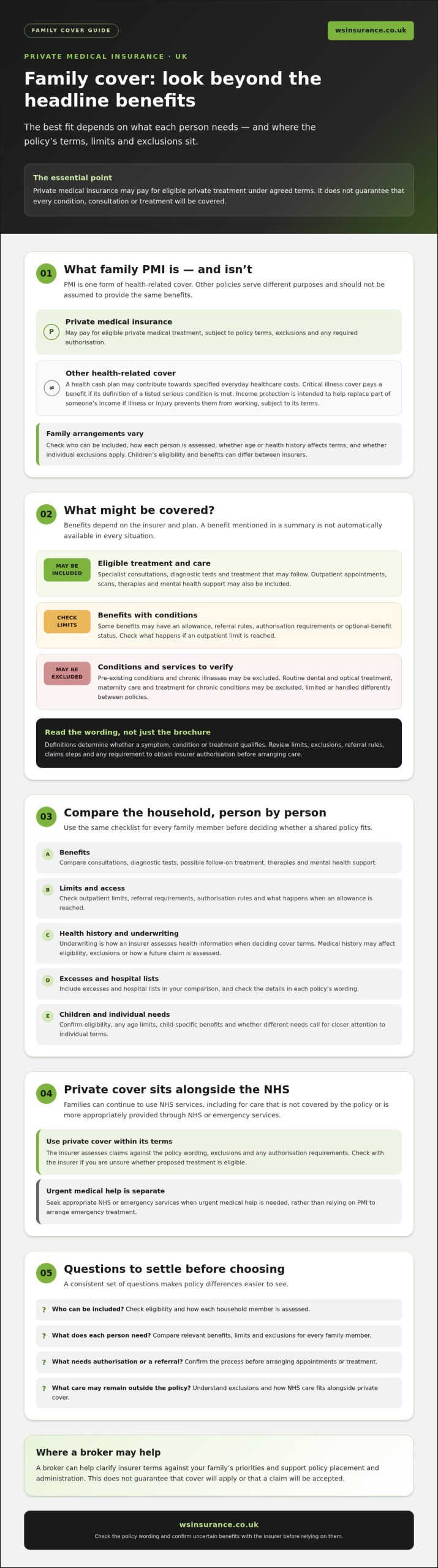
How to compare private medical insurance for your family
A clear comparison starts with your household’s needs, not the longest list of advertised benefits. For private medical insurance for family UK policies, use the same checklist for each option and check the current policy documents. This makes differences in benefits, exclusions and terms easier to identify.
Build a household comparison checklist
Note each family member’s priorities without recording unnecessary sensitive medical details. Mark each possible benefit as essential, optional or not relevant. Then compare the same categories across policies instead of relying on headline descriptions.
- List household needs. Record the kinds of consultations, diagnostics or treatment pathways each person may value, and note any different eligibility considerations.
- Compare benefits. Check which benefits are included, optional or unavailable, and whether referral requirements apply.
- Check exclusions and limits. Compare benefit definitions, outpatient limits, excesses and exclusions in the policy documents.
- Review underwriting. Ask how each person’s health history is assessed and whether different terms may apply to household members.
- Confirm claims steps. Find out how to seek authorisation, make a claim and check whether a proposed consultation or treatment is eligible before arranging it.
A simple table can help: use one column per policy and one row per benefit or condition to check. Record the relevant limit, excess, referral rule and authorisation requirement from the current documents. If a term is unclear, note the question and ask the insurer or broker before applying.
Check policy terms before making a decision
Read beyond the benefits summary. Check how the policy defines eligible treatment, which exclusions apply, what conditions attach to selected benefits and what the renewal terms say. Ask how pre-existing conditions are treated, whether changes in health history affect the assessment and what information is needed for each family member. Don’t assume one person’s terms automatically apply to everyone on a household policy.
A broker can help clarify differences between insurer terms and your family’s priorities. For an overview of the role brokers can play, read this guide to insurance brokers. Keep written answers with the policy documents so you can refer back to them when reviewing your decision.
Once you’ve identified what matters and where the uncertainties lie, you can discuss your family’s cover requirements with an insurance broker. Clear questions make it easier to understand the options, though only the insurer’s policy terms and assessment can confirm the cover that applies.
How a UK insurance broker can help arrange family private medical insurance
Comparing policies is easier when you have a clear picture of who needs cover and what matters to your household. An insurance broker can gather those priorities, explain differences between insurer terms and help you consider suitable options from the insurers they can access. Available policies and advice depend on the broker’s market access and your family’s circumstances, so ask which insurers have been considered.
A broker can also support policy placement and ongoing administration, helping clarify what information is needed and where to find the relevant terms. This support doesn’t determine whether a claim will be accepted. Claims remain subject to the policy wording, applicable exclusions and the insurer’s assessment.
What to prepare before speaking to a broker
Start with a practical outline of who needs cover and each person’s priorities. You don’t need to share more sensitive medical information than requested. Ask how medical history may affect terms, what exclusions or limits could apply, and how policy changes and claims queries are handled. Share health details securely and only when the insurer or broker requests them through an appropriate process.
Questions to ask before choosing a policy
Use your questions to clarify how the arrangement would work for each household member. For example, ask:
- How will underwriting and any exclusions apply to each person, and what happens if the insurer needs more information?
- Which benefits require referral or authorisation, and what should we do before arranging a consultation or treatment?
- What support is available for policy changes, renewals and claims queries?
- Which insurers and policy options have been considered, and how do their terms differ?
- Are there any broker fees or other charges, and how is the advice process carried out?
Ask for explanations of important terms and relevant information in writing, then review the policy documents before deciding. This gives you a clearer record of the cover being considered without assuming every family member will have identical terms.
WS Insurance Brokers is an independent UK broker offering private medical insurance, with policy placement and policy management support. If you’re considering private medical insurance for family UK cover, prepare your questions and review the documents at your own pace. You can discuss family private medical insurance with WS Insurance Brokers to explore your household’s requirements. Any cover and claim remain subject to the insurer’s terms and decision.
Choose family cover with clarity
The right private medical insurance for family UK policy is one that fits your household’s priorities and makes its limits clear. Compare the same benefits across policy documents, check exclusions and underwriting for each family member, and understand referral or authorisation steps before relying on cover.
Private medical insurance sits alongside NHS care, not in place of it, and a listed benefit doesn’t guarantee that a particular treatment will be covered. Taking time to clarify the terms can help you weigh the options with realistic expectations.
WS Insurance Brokers lists private medical insurance among its services and describes itself as an independent broker authorised and regulated by the Financial Conduct Authority. Check its current register details, and confirm insurer-specific terms directly before proceeding. If you’re ready to discuss your household’s needs, discuss your family’s private medical insurance requirements with WS Insurance Brokers.
A considered comparison is a good starting point. With clear questions and the right documents to hand, you can move forward with greater confidence.
Frequently Asked Questions
Can a family have private medical insurance on one policy?
Yes, some insurers allow multiple household members to be covered under one policy, subject to their eligibility rules. The arrangement may depend on applicants’ ages and health histories, and terms or exclusions can differ between family members. Check who can be included, how each person is assessed and whether the policy allows individual cover choices. Don’t assume every insurer offers the same family arrangements.
Does private medical insurance for families cover children?
Children may be included on a family policy if they meet the insurer’s eligibility rules, but this isn’t universal. Check the policy documents for age limits, how children are added and which benefits apply to them. Referral requirements, limits and exclusions may also affect access to consultations, tests or treatment. Confirm the terms for each child before choosing cover, rather than assuming their benefits match the adults’.
Are pre-existing conditions covered by family private medical insurance?
Pre-existing conditions may be excluded or treated differently depending on the insurer’s underwriting and policy terms. Underwriting is the process used to assess medical history when setting cover. Ask how each family member’s history will be considered, what information is required and whether individual terms or exclusions could apply. Answer health questions accurately, and get unclear points explained before cover starts. Never assume a condition is covered without confirmation.
Is private medical insurance worth having if we can use the NHS?
It depends on your household’s priorities and whether the eligible private treatment offered by a policy is useful to you. Private medical insurance sits alongside NHS care, which remains available for emergency and other appropriate services. Consider the policy’s benefits, exclusions, limits and authorisation process, as well as each family member’s needs. Cover doesn’t guarantee faster treatment, a particular outcome or payment for every claim, so weigh the terms carefully.
What is usually excluded from family private medical insurance?
Exclusions vary, but policies commonly exclude or restrict pre-existing conditions, chronic conditions, emergency care and routine pregnancy. Routine dental and optical treatment may also be excluded or subject to separate limits. The exact position depends on the policy wording and any terms applying to each person. Check definitions, benefit limits and authorisation rules, and ask the insurer or broker to clarify any exclusion you don’t understand before relying on cover.
Can family members have different levels of cover on one policy?
That depends on the insurer and the policy structure. Some arrangements may allow choices or terms to differ between members, while others may apply shared benefits or limits. Ask whether each person can select different benefits, excesses or outpatient limits, and whether underwriting creates individual exclusions. Check the schedule to see exactly what applies to each insured person. Don’t assume a family policy gives everyone identical cover or flexibility.
How do I compare private medical insurance policies for my family?
Compare the same benefit categories across each policy’s current documents, not just headline summaries. List household priorities, then review consultations, diagnostics, limits, excesses, referral and authorisation requirements, exclusions and underwriting for each family member. Check how claims are started and what steps need insurer approval. Record questions and ask for unclear terms to be explained before applying. This makes it easier to judge whether a policy’s practical terms suit your family.