
A customer misses a major invoice, and suddenly payroll, supplier payments and other commitments are harder to manage. Could trade credit insurance to protect cash flow help? It may reduce the impact of certain customer non-payments, but protection depends on the policy wording, the buyer and the circumstances of the loss.
Unpaid invoices can put pressure on working capital. Insurance is not a substitute for sound credit management, and it will not necessarily cover every customer or situation. The key is to understand how a policy fits your trading risks and existing credit-control process.
This guide explains how trade credit insurance may respond to customer non-payment, what to compare across policies, and which limits, exclusions and claim conditions to check. It also compares cover with other cash-flow tools and outlines what to prepare before speaking with a broker. A clear picture of your customers, turnover and bad-debt history can help you have a more informed discussion about the cover that may suit your business.
Key Takeaways
- Understand which customer non-payment risks a policy may cover, and why the wording matters.
- See how customer assessment, credit limits and claim procedures can affect how cover responds.
- Compare trade credit insurance with credit control, factoring and other cash-flow tools by purpose and limitations.
- Review customer concentration, debtor exposure, territories and payment terms with a practical checklist.
- Explore how trade credit insurance to protect cash flow could fit your business, and what to prepare before speaking with a broker.
How can trade credit insurance protect cash flow?
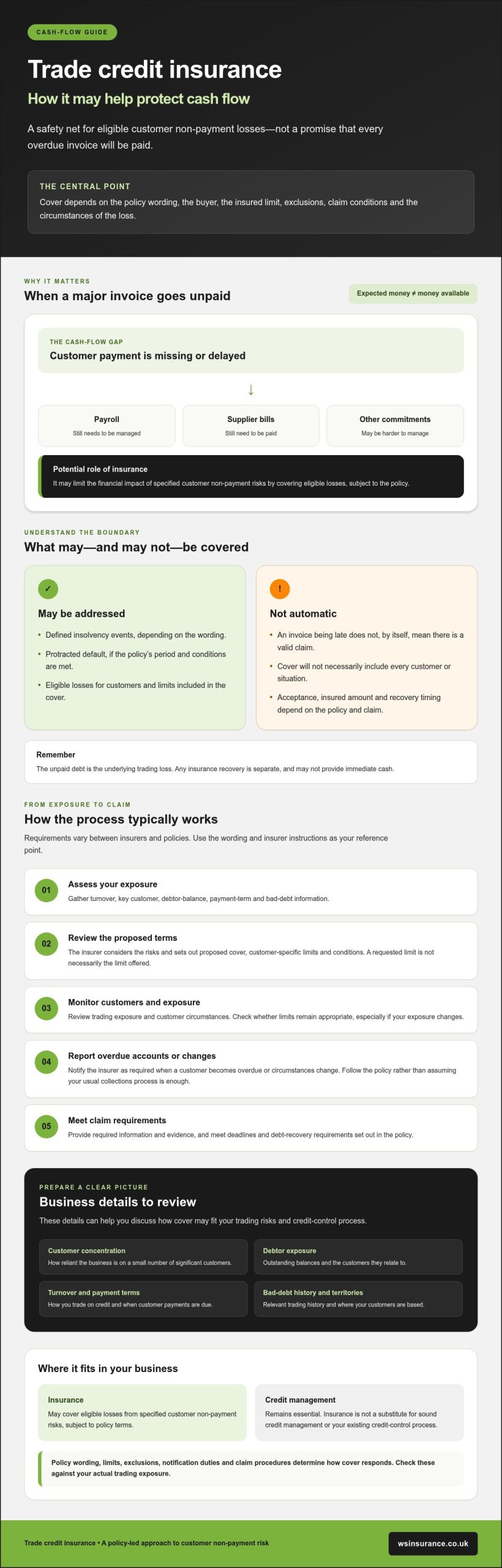
A customer invoice remains unpaid, but wages, supplier bills and other business costs are still due. The gap between money expected and money available can put pressure on working capital, particularly when a business relies on a small number of significant customers.
Trade credit insurance covers eligible losses arising from specified customer non-payment risks. It may help limit the financial impact if an insured customer fails to pay in circumstances covered by the policy. For a neutral overview of what trade credit insurance is, see this general reference.
Trade credit insurance may protect cash flow by covering eligible losses from specified customer non-payment risks, subject to the policy wording, insured customers, limits, exclusions and claim conditions. It is a potential financial safety net, not a promise that every overdue invoice will be reimbursed. The amount and timing of any recovery depend on the policy and the circumstances of the claim.
Which customer payment risks may a policy address?
Depending on the wording, cover may address defined insolvency events or protracted default, where a customer has not paid within the period and conditions set out in the policy. An invoice simply being late does not automatically mean there is a valid claim. Check which events are insured, which customers are included, and what notification duties, evidence requirements and claim procedures apply. If the policy sets a customer-specific credit limit, confirm how it affects the eligible loss.
Why can unpaid invoices put cash flow under pressure?
Customer receipts help fund ongoing commitments. When expected payments are delayed, a business may have less working capital available for payroll or supplier invoices, and may need to postpone planned investment. The unpaid debt is the underlying trading loss. Any insurance recovery is separate and depends on the policy responding.
Hypothetical example: A business supplies goods on credit to a customer, then the customer stops paying. The business still has its own costs to meet while it follows up the debt and checks whether the circumstances meet the policy’s claim requirements. Even if a claim is accepted, the insured amount and payment timing depend on the policy terms and claim process. This is why trade credit insurance works best as part of considered credit management, rather than as a guarantee of immediate cash.
How does trade credit insurance work, from customer assessment to claim?
Trade credit insurance involves more than arranging cover and waiting for a claim. Your business needs to understand its exposure, meet the policy requirements and monitor changes in customer risk. The process varies between insurers and policies, so use the wording and any insurer instructions as your reference point.
A typical sequence is:
- Assess exposure: Gather information about turnover, key customers, debtor balances, payment terms and bad-debt history.
- Arrange terms: The insurer considers the risks and sets out proposed cover, including any customer-specific limits or conditions.
- Monitor customers: Review trading exposure and customer circumstances, and check whether policy limits remain appropriate.
- Report issues: Notify the insurer as required if a customer becomes overdue or circumstances change.
- Follow claim procedures: Provide the required information and evidence, and meet the policy’s deadlines and debt-recovery requirements.
This risk-planning process sits alongside other forms of commercial protection. For context, see this UK business insurance guide. Whether trade credit insurance to protect cash flow is suitable depends not only on the cover selected, but also on how well it fits the way your business sells on credit and manages customer accounts.
What happens before and during the policy?
Before offering terms, an insurer may ask about your trading practices, turnover, customer concentration and outstanding debts. It may assess individual customers and set or review credit limits, but a requested limit is not necessarily the limit offered. Compare any decision with your actual exposure, and ask what happens if your trading with that customer grows. Revisit the position if the customer’s circumstances or your exposure changes.
What should a business do when an invoice becomes overdue?
Act promptly, but follow the policy rather than assuming your usual collections process is enough. Notification periods, overdue-account requirements and debt-recovery instructions can differ. Delays or missed steps may affect how a claim is considered, so check the wording as soon as an account becomes overdue.
Keep a clear record of the transaction and your follow-up. This may include invoices, contracts, delivery or service records, correspondence with the customer and notes of collection activity. Check the policy documents for applicable claim deadlines and required evidence. Contact the insurer or broker if you are unsure how to report the situation.
A broker can help you compare available insurer terms with your trading risks and clarify points that need checking. If you are assessing cover, you can discuss your circumstances with a broker experienced in trade credit insurance, without assuming that particular terms or a claim outcome are guaranteed.
Trade credit insurance versus credit control, factoring and other cash-flow tools
These options address different parts of the same problem: the risk of a customer not paying, the time it takes to receive money, or the work involved in recovering a debt. Trade credit insurance to protect cash flow may help with eligible insured losses, but it does not replace day-to-day credit management or perform the same function as invoice finance.
| Approach | Purpose and possible benefit | Limitations and questions to ask |
|---|---|---|
| Credit control | Checks customers, sets credit limits and payment terms, monitors accounts and follows up overdue invoices. It can help identify and address payment concerns early. | It is not insurance and cannot ensure a customer will pay. Are checks and account reviews consistent, and is overdue follow-up clear? |
| Trade credit insurance | May cover eligible losses from specified customer non-payment risks, subject to policy terms. It can help manage the financial impact of an insured loss. | Insured customers, limits, exclusions and claim conditions matter. Which risks and debts are covered, and what account-management duties apply? |
| Factoring or invoice finance | May provide earlier access to funds against invoices, subject to the provider’s terms. This addresses the timing of receipts rather than simply insuring a debt. | Availability, obligations and the treatment of unpaid invoices depend on the agreement. What are the terms, and how might the arrangement affect customer relationships? |
| Debt collection | Seeks payment of an overdue debt through collection activity. | Collection pursues the receivable but does not insure it or guarantee recovery. What process will be followed, and how does it fit with any policy requirements? |
How does insurance differ from strong credit control?
Credit control is preventive and ongoing. Customer checks, sensible credit limits, clear payment terms and prompt follow-up help a business manage its exposure. Insurance may provide another layer of protection, but it does not remove the need to manage accounts or meet the policy’s reporting and collection requirements. The two approaches work best when they fit together.
When might a business compare insurance with invoice finance?
Start with the problem you need to solve. If the main concern is an eligible loss following customer non-payment, insurance may be relevant. If the pressure comes from waiting for invoices to be paid, invoice finance may be worth examining. Debt collection focuses on pursuing payment. Before choosing, review the full obligations, customer impact and cash-flow timing of each option. A broker can help compare insurance terms with your trading risks. To discuss whether cover may suit your circumstances, explore trade credit insurance options.
How to assess trade credit insurance cover for your business
A useful comparison starts with your actual trading exposure, not a general assumption about what a policy should cover. Consider whether the cover addresses the customers and territories where you trade, and whether you can meet its conditions through your existing credit-control process. Wider priorities can also help shape the discussion. See this guide to identifying business risks to insure against.
Core policy-fit questions include: which non-payment events and debts are covered, what customer limits and territorial scope apply, which exclusions or excesses affect a claim, and what reporting and claim procedures must you follow? There is no universally best policy. The aim is to understand how the wording relates to your business’s specific risks.
Which policy terms deserve close comparison?
Read the wording, schedule and any relevant endorsements together. Check how the policy defines insured non-payment events and eligible debt, then compare customer limits with your exposure to each buyer. Review territorial scope, exclusions and any retention or excess that could affect a recovery. Ask the insurer or broker to clarify unclear terms, including how changes to limits are handled.
- Confirm which customers and invoices are included, and how insured debt is calculated.
- Check notification, collection and record-keeping duties, including when you need to report an overdue account.
- Verify claim procedures, deadlines and required evidence against the policy wording.
Pay particular attention to operational fit. If the policy requires a step your team does not currently take, decide how to incorporate it before relying on cover. This helps make trade credit insurance to protect cash flow a workable part of your credit-control approach, rather than a separate process that is easy to overlook.
What business information should you prepare?
- Customer exposure, including concentration in key accounts and outstanding debtor balances.
- Payment patterns, overdue balances, payment terms and relevant bad-debt history.
- Existing customer checks, credit approval steps and collections procedures.
- Changes in customers, markets, territories or trading terms that may alter your exposure.
WS Insurance Brokers assesses client risks and can compare terms available from its panel of UK insurers. Discuss your trade credit insurance requirements to explore how the wording and proposed cover may relate to your trading circumstances. Availability and terms vary, and any cover depends on the policy arranged.
Arranging trade credit insurance: what to expect from a broker
Arranging cover starts with understanding how your business trades on credit. An independent broker can assess your exposure, discuss the risks you want to address and approach a panel of insurers to compare available terms. Options, limits and conditions vary, so the aim is to establish how each proposal fits your circumstances, not to assume every insurer will offer the same cover.
For a wider view of the broker’s role, read this guide to choosing an independent insurance broker. A considered process can help you judge whether trade credit insurance to protect cash flow fits alongside your existing credit-control approach and business commitments.
What should you have ready for an initial discussion?
You do not need to have every detail resolved before speaking with a broker. A concise overview of your trading activity can make the conversation more focused and support a tailored risk assessment. Useful information to gather includes:
- Your main customers, invoice exposure and any concentration in key accounts.
- Typical payment terms, trading territories and the nature of your sales on credit.
- Payment patterns, overdue-account concerns and relevant bad-debt history.
- How you check customers, approve credit, review exposure and follow up late payments.
- Questions about customer limits, exclusions, reporting duties and the support available if an account becomes overdue.
These details give a broker a clearer picture of your trading risks before approaching insurers. If you do not have information to hand, explain what you can and ask what else may be needed to assess the options.
How can a broker help clarify the next steps?
A broker can use your risk information to discuss requirements with insurers and compare the terms available through their panel. Ask for a plain explanation of significant differences in cover, limits, exclusions and policy conditions. Check that reporting, collection and claim requirements are clear and workable for your team before deciding how to proceed.
WS Insurance Brokers arranges trade credit insurance and provides policy administration and support during claims handling. It does not directly underwrite policies, and any cover or claim response depends on the insurer’s terms and the policy wording. Take the time you need to review proposals and raise any points that remain unclear.
If you would like to explore the options for your business, discuss trade credit insurance with WS Insurance Brokers. A conversation can help clarify what information is relevant and what terms may be available, without committing you to a particular policy.
Take a clearer next step for your business
Trade credit insurance to protect cash flow may help manage the impact of eligible customer non-payment, but the policy needs to match your trading risks. Review the insured events, customer limits, exclusions and claim conditions, and consider how reporting requirements fit your credit-control process. Insurance, credit control and invoice finance serve different purposes, so compare them against the pressure your business is trying to address.
An independent broker can assess your exposure and compare available terms from a panel of UK insurers. WS Insurance Brokers is authorised and regulated by the Financial Conduct Authority, and provides policy administration and support during claims handling. Any cover and claim response depend on the insurer’s terms and the policy wording.
If you are ready to explore the options, discuss your trade credit insurance requirements with WS Insurance Brokers. A conversation can help clarify what to ask and what to compare, so you can make your next decision with greater confidence.
Frequently Asked Questions
Does trade credit insurance protect cash flow from every unpaid invoice?
No. A policy only responds to eligible losses involving insured customers and events covered by its wording. Exclusions, customer-specific limits, excesses and claim conditions can affect whether, and how much, may be recovered. An overdue invoice alone does not guarantee a claim will be accepted. Before arranging cover, check which debts are eligible, what you must report and what evidence you will need if a customer does not pay.
Can small businesses get trade credit insurance?
Small businesses may be able to arrange trade credit insurance, but availability and terms depend on the business’s circumstances and the insurer’s assessment. Relevant factors may include customer exposure, trading activity, payment terms and the cover sought. There is no guarantee that a particular customer or requested limit will be accepted. A broker can discuss your requirements and approach insurers, helping you understand the options available for your business.
How much does trade credit insurance cost?
There is no standard price. The premium depends on factors such as the business’s insured exposure, customer profile, trading activity, policy scope and terms offered by the insurer. Because those details differ between businesses, an indicative industry figure may not reflect the cost or cover available to you. Prepare information about your customers, turnover, overdue accounts and bad-debt history so a broker can seek terms for your circumstances.
What happens if an insured customer becomes insolvent?
If an insured customer becomes insolvent, notify the insurer or broker promptly and follow the policy’s claim and debt-recovery instructions. The insurer will assess the circumstances against the wording, including whether the customer and debt are covered, the applicable limit and any exclusions or conditions. Keep relevant invoices, contracts and correspondence organised. Insolvency does not guarantee reimbursement, and any claim outcome and recovery depend on the policy terms and evidence provided.
Does trade credit insurance cover late payment?
It may cover defined protracted-default scenarios, depending on the policy, but an invoice being late does not automatically qualify for a claim. The wording may set specific conditions, reporting duties and procedures for pursuing payment. Check how the policy defines a covered default, when you must notify the insurer and what collection steps you are expected to take. Follow the policy wording rather than assuming an ordinary payment delay is insured.
Is trade credit insurance the same as invoice finance?
No. Trade credit insurance may protect against eligible losses from specified customer non-payment risks, subject to the policy. Invoice finance is a separate arrangement that may provide earlier access to funds against invoices, depending on the provider’s terms. One concerns risk protection; the other concerns the timing of funds. Compare each option’s conditions, obligations and effect on customer relationships, and consider whether it addresses your business’s particular cash-flow pressure.
Can trade credit insurance help a business trade with new customers?
It may help a business assess and manage the risk of selling on credit to new customers, but it does not guarantee that a buyer will be accepted or that a requested credit limit will be available. Insurers may assess customer information and set or review limits under the policy. Check how new buyers are considered, when cover begins and what you must do before extending credit. Continue using appropriate customer checks and credit controls.