
Could your business meet its GDPR responsibilities and still discover that its cyber policy does not respond as expected after a data breach? GDPR compliance and cyber insurance address different parts of the risk: compliance is an ongoing legal responsibility, while insurance is a separate, wording-dependent layer of financial protection.
It is understandable to want clarity about what a policy may cover, particularly when regulatory investigations, legal expenses and breach response costs are involved. Cover varies, and you should not assume that a fine or any particular loss will be insured. The policy wording, exclusions and applicable law all matter.
This guide explains how UK data protection duties relate to cyber cover, and how insurance may support risk management without replacing compliance. It covers the policy terms and insurer questions worth comparing, including claims processes and response costs. You will also find practical steps for reviewing security controls and preparing information about your data handling, so you can have a more informed conversation with a broker and assess whether the cover fits your business.
Key Takeaways
- Map the personal data, systems and suppliers your business relies on to clarify the risks to discuss when seeking cover.
- GDPR compliance and cyber insurance serve different purposes. Understand your responsibilities separately from the risks a policy may cover.
- Compare policy definitions, exclusions and sub-limits, not just headline descriptions. Check how response support and business interruption are treated.
- Gather evidence of your security controls and incident response planning before completing insurer questions.
- Prepare specific questions for a broker about wording, claims processes and how policy terms relate to your business risks.
GDPR Compliance and Cyber Insurance: What Each One Does for Your Business
GDPR compliance is an organisational responsibility. Cyber insurance may transfer specified financial risks, subject to the policy. One does not replace the other. A policy does not certify that your business meets its data protection obligations, and it cannot replace sound security, governance or incident planning.
That distinction is central to understanding GDPR compliance and cyber insurance. Compliance concerns how your organisation handles personal data and demonstrates responsible decision-making. Insurance may help with certain costs arising from covered cyber incidents, but only where the wording, conditions and applicable law allow.
What does GDPR compliance mean for a UK business?
UK businesses should consider the UK GDPR alongside the Data Protection Act 2018, checking current Information Commissioner’s Office (ICO) guidance for requirements relevant to their circumstances. For background on the regulation’s origins and principles, see this overview of the General Data Protection Regulation (GDPR).
Your responsibilities depend on the personal data you process, why and how you process it, and your role. For example, an organisation deciding the purposes and means of processing may have different responsibilities from a service provider processing information on another organisation’s instructions. Avoid assuming that the same checklist applies to every business.
Accountability means being able to explain and evidence your approach. This may involve choosing appropriate technical and organisational measures, keeping relevant records, and documenting decisions about personal data and security. Good records help you review your approach and show how responsibilities are managed, but they do not prove compliance by themselves.
What can cyber insurance help with?
Cyber insurance is policy-based cover for specified cyber incidents. Depending on the policy wording and circumstances of a claim, it may provide access to or cover for incident response support. Examples may include forensic investigation, legal advice or help with notifications. These are not promises of cover. Check the actual terms, including conditions, exclusions and sub-limits.
Before relying on a policy for investigation or response costs, find out how the insurer expects a claim to be reported and whether you need approval before appointing specialists or incurring costs. Check what the policy says about regulatory investigations and penalties, too. Whether a particular loss is insured depends on the wording and applicable law, so do not assume a fine will be covered.
In short, data protection law sets your duties. Cyber insurance may help with specified incident costs, but it does not remove those duties.
Which GDPR Controls Can Strengthen Your Cyber Insurance Readiness?
Insurers may ask about your security controls and governance when assessing an application or renewal. Questions and requirements differ between insurers and policies, so one set of measures cannot guarantee cover. Clear, current records can help you explain how your business manages risk and answer underwriting questions consistently.
This is where GDPR compliance and cyber insurance connect in practice: good governance can help you understand and communicate your exposure, but it does not certify compliance or ensure a claim will be paid. The NCSC cyber insurance guidance offers further points to consider when assessing cover alongside your security arrangements.
Data governance, access and supplier oversight
Start with the information your organisation actually handles. Review what personal data you hold, where it is stored, who can access it and how long you retain it. Check permissions against people’s roles and business processes, and record how access is reviewed or changed.
Clarify whether your organisation acts as a controller, processor or both across different activities. Document relevant supplier arrangements and responsibilities, including how suppliers handle data and security issues. Staff training, records of security decisions and periodic reviews can help show how your approach works in practice.
Incident response and breach readiness
A written incident plan should make the first steps clear. Identify who leads the response, who must be informed internally, how an incident is escalated and how communications are managed. Include steps for recording what happened and preserving relevant evidence. Check that the people named in the plan understand their responsibilities.
Not every security incident has the same data protection implications. Whether a personal data breach needs to be reported depends on the circumstances, so consult current Information Commissioner’s Office (ICO) guidance rather than relying on a blanket assumption. Test your response arrangements where practical, then record what the review revealed and what you changed.
These records can make insurer discussions more focused. You will be better placed to explain your systems, suppliers, safeguards and response procedures, and to clarify underwriting questions instead of guessing. They are evidence of risk management, not a guarantee of regulatory compliance or insurance cover.
If you are reviewing Cyber & Data Breach Insurance, consider how the policy wording and insurer questions relate to your business’s specific risk profile. Discuss cyber insurance for your business as one step towards understanding which terms and conditions to examine.
How to Compare GDPR-Related Cyber Insurance Features and Policy Wording
Compare the policy wording, not just the product label or a headline summary. Two policies described as cyber cover may define incidents, eligible costs and claim conditions differently. Read the definitions and exclusions alongside the schedule, and check that the cover reflects your systems, suppliers and likely disruption. For wider context on the legal framework, consult the government’s guidance on UK data protection legislation.
Use the same questions to assess each option. This makes meaningful differences easier to spot and unclear terms easier to follow up.
| Cover area | What to compare |
|---|---|
| Incident response | Are forensic investigation or legal advice included? How do you access them, and is insurer approval required before costs are incurred? |
| Business interruption | What disruption is covered, how is the loss calculated, and does a waiting period apply? What evidence must you provide? |
| Notification support | Does the wording address notification expenses or practical support, and what limits or conditions apply? |
| Data restoration and claims | Are data restoration costs and third-party claims addressed? Check definitions, exclusions and any relevant sub-limits. |
Which cover areas should a business examine?
Look closely at how response services work in practice. A policy may refer to specialist support, but the wording should clarify how it is arranged, who authorises it and which costs are eligible. For interruption cover, check how the policy defines a covered event and what evidence is needed to demonstrate its impact on your business.
Establish whether notification support and data restoration are included, restricted or subject to separate limits. These details help you compare cover against likely response needs rather than relying on broad labels.
How should exclusions and conditions affect the comparison?
Read exclusions and conditions carefully, especially those relating to security controls, backups, known incidents and reliance on suppliers. Check whether the policy sets requirements your organisation must maintain, and what could happen if a condition is not met. Note any waiting periods, retroactive dates and sub-limits that could affect a claim.
Ask specifically how regulatory investigation costs are treated, including any restrictions or exclusions. Do not assume fines or penalties are insured. Whether a loss is covered depends on the policy wording and applicable law. If you are reviewing wider commercial protection too, compare how cyber cover fits with your other business policies rather than assuming one policy fills every gap. Clear answers help you assess how GDPR compliance and cyber insurance relate to your business risks without confusing insurance protection with data protection responsibilities.
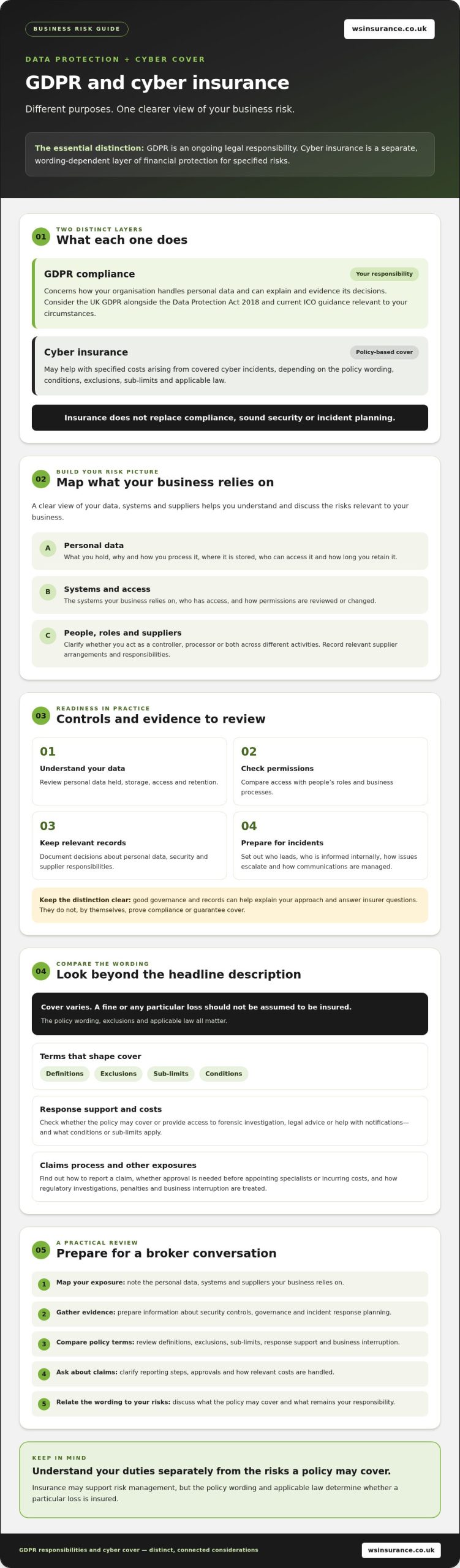
A Practical GDPR and Cyber Insurance Readiness Checklist
Preparation can make an insurance discussion clearer and help you identify where more work may be needed. Use this checklist before requesting or renewing cover. It supports a more informed conversation, but completing it does not automatically establish GDPR compliance or guarantee insurance.
- 1. Map your data, systems and suppliers. Note what personal data your business handles, where it is held, which systems it relies on and which suppliers support those systems or process data. Include operational dependencies that could interrupt services if unavailable.
- 2. Identify likely disruption. Consider which activities would be affected by a cyber incident, how disruption could affect customers or income, and what would need to be restored first. This can help you identify business risks to discuss with a broker and explain your priorities.
- 3. Record your existing controls. Prepare a current overview of access permissions, security measures, backups and staff training. Include how often arrangements are reviewed and who is responsible. Keep evidence practical and accurate rather than relying on broad statements about your security.
- 4. Check your incident arrangements. Document who leads a response, who needs to be informed, how incidents are escalated and where relevant records are kept. Note how you would assess a possible personal data breach, referring to current Information Commissioner’s Office guidance where appropriate.
- 5. Compare your information with insurer questions. Review the application or renewal questions against your records. Answer accurately, disclose information as requested and ask for clarification about anything you are unsure of. Do not assume a control meets a policy condition until you have checked the wording.
- 6. Turn gaps into an action plan. Prioritise gaps by potential impact, likelihood and operational importance. Assign an owner and review date to each agreed improvement, then ask a broker how proposed changes relate to insurer requirements and available policy terms.
Good preparation gives you a firmer basis for discussing GDPR compliance and cyber insurance while keeping compliance responsibilities distinct from policy cover. If you would like to review how Cyber & Data Breach Insurance may fit your risk profile, discuss your cyber insurance requirements with a broker.
Choosing Cyber Insurance with a Broker: From Risk Review to Next Steps
A broker can help turn your business’s specific exposures into clear questions for insurers, then compare the answers against policy wording. This can make the process more manageable, particularly when terms or insurer questions are unclear. It does not guarantee that cover will be available or that a particular loss will be insured. Options and terms depend on insurer appetite, the information disclosed and the individual risk.
WS Insurance Brokers is an independent UK brokerage offering Cyber & Data Breach Insurance from a panel of UK insurers. It can help you understand the options available through that panel and how policy terms relate to your risk profile. The aim is clarity, not a one-size-fits-all answer. GDPR compliance and cyber insurance remain distinct: a broker can help with insurance choices, while your organisation remains responsible for its data protection duties.
What information should you take into a broker conversation?
A concise, accurate picture of your business can make the discussion more useful. Gather information about:
- Your activities, the personal data you handle and the systems that support essential operations.
- Suppliers that store or process data, provide technology or could affect your ability to keep trading.
- Existing policies, security documentation, backup arrangements and incident response responsibilities, where available.
- Changes to your business, systems or suppliers, alongside any concerns about interruption, response support or third-party exposure.
You do not need every document perfectly organised before asking questions. Be open about what you know, what you are still checking and where controls are being improved. Accurate information helps the broker present your circumstances clearly to insurers.
What should you clarify before choosing cover?
Ask for plain explanations of what the policy covers and how key terms apply to your business. Check the scope, exclusions, limits and sub-limits, relevant conditions, and the steps for notifying a claim. If a term is unclear, ask for the explanation to be tied to the policy wording, not just a headline summary.
Clarify how policy administration and claims support work for the proposed arrangement, including who you contact and what information may be needed if an incident occurs. WS Insurance Brokers manages policies and provides claims support, but the insurer’s wording determines the cover and applicable process. Review the final documents carefully so you understand what is included and excluded.
If you are ready to discuss your business risk profile and insurance options, speak with WS Insurance Brokers about cyber cover. A considered conversation can help you understand available terms and decide what to explore next, without confusing insurance protection with GDPR compliance.
Make Your Next Cyber Insurance Review More Informed
Start by understanding your data, systems and suppliers, then keep clear records of your security measures and response plans. This information can help you answer insurer questions accurately and identify policy terms that need closer attention.
The key distinction is simple: GDPR compliance and cyber insurance serve different purposes. Your organisation remains responsible for its data protection duties, while a policy may help with specified losses according to its wording, exclusions and conditions. Compare the cover itself, including claims steps and relevant limits, rather than relying on a product label or assuming a particular cost will be insured.
WS Insurance Brokers is an independent UK brokerage offering Cyber & Data Breach Insurance from a panel of insurers. The firm provides policy management and claims support, and is authorised and regulated by the Financial Conduct Authority.
To discuss your business risk profile and explore insurance options, discuss cyber and data breach insurance with WS Insurance Brokers. A clear, considered conversation is a practical next step towards understanding your cover.
Frequently Asked Questions
Does GDPR compliance mean my business does not need cyber insurance?
No. Meeting your data protection responsibilities does not remove the possibility of a cyber incident or the disruption and costs it may cause. GDPR compliance and cyber insurance address different risks: compliance is your organisation’s responsibility, while a policy may provide cover for specified losses under its terms. Consider insurance alongside appropriate security controls and incident planning, not as a replacement for either.
Does cyber insurance cover GDPR fines or ICO penalties?
Do not assume that a fine or penalty will be insured. ICO fines under UK GDPR are generally not insurable in the UK, and policies commonly exclude them. A policy may address certain legal or investigation costs, but cover depends on the wording, exclusions, conditions and applicable law. Check the specific policy and seek appropriate legal advice if you need clarity about a regulatory matter.
What happens if my business has a personal data breach?
Act promptly to contain the incident, protect affected systems and establish what personal data may be involved. Record what happened, the information affected, likely consequences and the steps you took. Whether you must report a breach to the Information Commissioner’s Office (ICO) or inform affected individuals depends on the circumstances. Check current ICO guidance and review your incident plan and policy notification requirements.
Do small businesses need cyber insurance to comply with GDPR?
No. Cyber insurance is not a requirement for GDPR compliance. Small organisations still need to understand and meet the data protection responsibilities that apply to their activities, though the details depend on how they process personal data and their role. Insurance is a separate risk management choice. Consider your data, systems, suppliers and potential disruption, then decide whether policy-based protection may suit your business.
What should I check in a cyber insurance policy for GDPR-related risks?
Read the policy wording, not only the product description. Check how it defines a covered incident and whether response support, forensic investigation, legal advice, notification expenses, data restoration or business interruption are addressed. Review exclusions, security conditions, waiting periods, limits and sub-limits, along with the steps for notifying a claim. Ask how regulatory investigation costs are treated, and do not assume fines or penalties are covered.
Can cyber insurance make my business GDPR-compliant?
No. Buying a policy does not certify compliance or take over your organisation’s data protection responsibilities. You still need to manage personal data appropriately, maintain suitable security and governance measures, and be able to explain relevant decisions. Insurance may help with specified financial impacts of certain incidents, subject to its wording and applicable law. Keep compliance work and insurance review connected, but treat them as separate tasks.
How can a broker help compare GDPR-related cyber insurance?
A broker can help translate your business risks into questions for insurers, explain policy wording and compare terms across available options. WS Insurance Brokers is an independent UK brokerage offering Cyber & Data Breach Insurance from a panel of insurers. It also provides policy management and claims support, and is authorised and regulated by the Financial Conduct Authority. Available cover and terms depend on the insurer and your individual risk.