
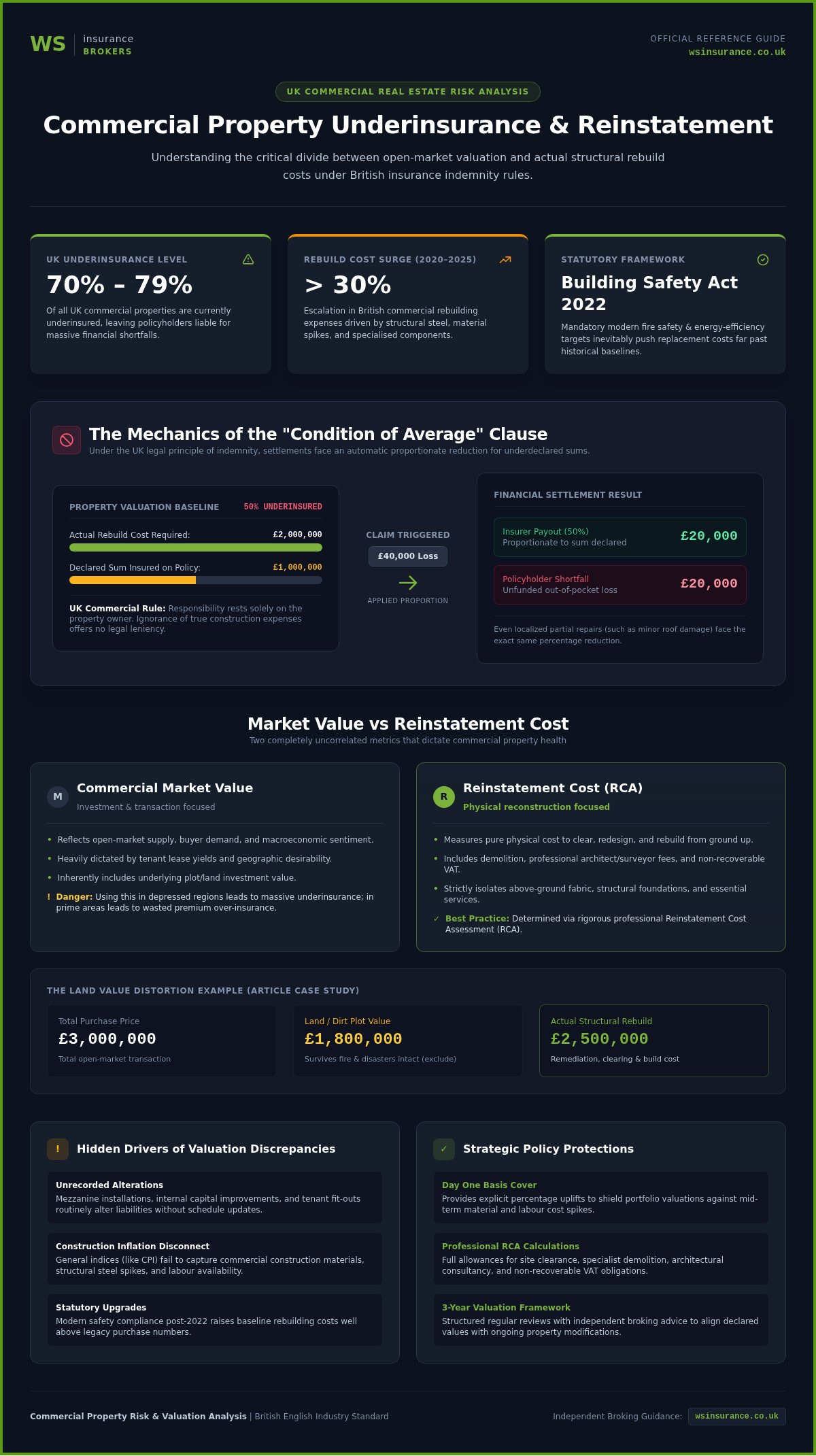
Between 70% and 79% of UK commercial properties are currently underinsured, leaving thousands of policyholders vulnerable to devastating financial shortfalls when disaster strikes. For building owners and portfolio managers, avoiding underinsurance of commercial property has never felt more urgent or complex. It’s entirely understandable why confusion arises; tracking fluctuating labour expenses, structural steel spikes, and broader British construction inflation makes setting accurate sums insured an exhausting task, especially when relying on traditional real estate market valuations that bear little relation to actual rebuild costs.
You deserve absolute certainty that an unexpected property claim won’t trigger the dreaded Condition of Average clause or decimate partial settlements. In this guide, you’ll discover how to accurately calculate commercial building reinstatement costs using robust methodologies, eliminate insurer dispute risks, and implement protective policy structures like Day One Basis cover. We will examine the practical steps required to insulate your commercial premises from volatile construction pressures and ensure your assets remain completely secure.
Key Takeaways
- Understand why commercial market values differ completely from structural rebuild figures, protecting your balance sheet from inaccurate sum insured calculations.
- Discover proven methodologies for avoiding underinsurance of commercial property to stop the Condition of Average clause from slashing claim settlements.
- Learn what a professional Reinstatement Cost Assessment entails, including essential allowances for demolition, architect fees, and non-recoverable VAT.
- Explore how tailored policy provisions, such as Day One Basis cover, shield building portfolios against volatile construction material and labour spikes.
- Establish a structured three-year valuation framework with independent broking advice to keep cover aligned with property modifications.
What Is Commercial Property Underinsurance and Why Does It Occur?
Commercial underinsurance occurs whenever a building’s declared sum insured falls below the actual cost required to clear the site, redesign, and rebuild the structure from the ground up. In practice, this leaves UK commercial landlords and owner-occupiers directly liable for substantial financial shortfalls following an insured event. While some policyholders intentionally trim declared figures to suppress annual premiums, a short-sighted tactic that invalidates essential safeguards, most discrepancies happen inadvertently. Internal oversights represent a primary culprit; unrecorded capital improvements, mezzanine installations, and tenant fit-outs routinely alter reinstatement liabilities without ever being declared on the policy schedule. True diligence in avoiding underinsurance of commercial property requires looking beyond historic balance-sheet values.
The Mechanics of the Condition of Average Clause
Commercial property policies in the UK are fundamentally anchored to the legal principle of indemnity, which dictates that a settlement should restore the insured to their exact pre-loss position without providing financial betterment. Insurers enforce this equity through the Condition of Average clause. If a building requires £2,000,000 to rebuild but carries cover of only £1,000,000, the policyholder is underinsured by 50%. Consequently, any claim settlement faces an automatic 50% proportionate reduction, even for localized repairs such as minor roof damage costing £40,000. Insurers will pay just £20,000, leaving the policyholder to fund the remainder. UK commercial law offers no leniency for valuation ignorance; the responsibility to present an accurate sum insured rests entirely upon the property owner.
The Macroeconomic Drivers of UK Valuation Shortfalls
External economic volatility severely complicates accurate building valuations. Standard general inflation benchmarks like the Consumer Prices Index fail to mirror British construction realities, which experience distinct supply-chain shocks. Between 2020 and 2025, commercial rebuilding expenses escalated by over 30%, driven by concentrated spikes in materials such as fabricated structural steel and specialised building components. Simultaneously, tightening regulatory mandates create hidden cost escalations. Modern rebuilds must comply with the Building Safety Act 2022 alongside stringent fire safety and energy-efficiency targets. These statutory upgrades inevitably push replacement costs far beyond historical construction baselines, ensuring that avoiding underinsurance of commercial property demands specialised, ongoing construction cost tracking rather than simple desktop guesswork.
Market Value vs Reinstatement Cost: The Critical Valuation Distinction
Commercial market value and building reinstatement cost have zero correlation with one another. A property’s market valuation reflects open-market supply, tenant yields, geographical desirability, and economic sentiment. Reinstatement value measures the physical cost of completely rebuilding the bricks-and-mortar structure following a catastrophic loss. Conflating these two figures creates major vulnerabilities. In buoyant commercial districts, using purchase prices pushes landlords into expensive over-insurance, resulting in wasted premium spend on non-existent liabilities. Conversely, in depressed commercial regions, low market transactions often disguise substantial rebuild expenses, leaving substantial assets exposed to average clause penalties. Reviewing our commercial property insurance guide helps clarify how baseline indemnity principles dictate these distinct measures.
Why Land Value Distorts Insurance Calculations
Commercial sale prices naturally incorporate the financial worth of the underlying plot. When a property burns down, the dirt beneath it remains completely intact. Buildings insurance covers purely above-ground fabric, structural foundations, and essential site services. If an investor purchases a site for £3,000,000, land value might represent £1,800,000 of that figure. Insuring the total investment means over-insuring by millions. If that same footprint requires complex structural remediation and specialist clearing, the actual replacement build could run to £2,500,000. Stripping out the land element is crucial when avoiding underinsurance of commercial property, establishing the precise starting line for your real rebuild exposure.
Unique Challenges of Listed and Heritage Commercial Buildings
Period commercial properties amplify valuation discrepancies significantly. Standard building contractors cannot simply order modern stock materials when restoring a Grade II or Grade II* listed facade. Conservation officers legally enforce exact historical authenticity, requiring traditional lime mortars, bespoke stonemasonry, hand-hewn oak framing, and specialist artisan trades. These bespoke requirements multiply labour costs and inflate lead times substantially. Establishing an accurate baseline requires commissioning a formal RICS Reinstatement Cost Assessment from qualified surveyors experienced in historic fabric. Securing reliable valuations ensures complete peace of mind, and discussing your portfolio exposures with WS Insurance Brokers allows you to tailor adequate policy wording around these distinctive architectural risks.
How to Calculate Your Commercial Reinstatement Cost Assessment (RCA)
Calculating an accurate building sum insured involves far more than estimating raw building materials. A formal Reinstatement Cost Assessment captures the complete financial liability required to resurrect a commercial facility following total destruction. Professional fees alone typically add 10% to 15% on top of physical construction and demolition estimates. These outlays cover essential specialists, including structural engineers, architectural draftsmen, mechanical consultants, and local planning supervisors. Rebuilding must also comply with current planning regimes, environmental efficiency standards, and statutory approvals. Organising these elements correctly forms the bedrock of avoiding underinsurance of commercial property, ensuring every indirect expense receives full contractual backing.
When compiling your assessment, verify whether your organisation can reclaim input sales tax from HMRC. If you cannot recover it, an additional 20% VAT must be incorporated into the declared sum insured; leaving it out instantly creates a massive exposure at claim stage.
Demolition, Site Clearance, and Debris Removal
Before any reconstruction begins, contractors must safely prepare the footprint. Clearing commercial debris represents an immense, highly technical operational cost. Assessors routinely account for several crucial site-preparation liabilities:
- Hazardous Materials: Identifying and extracting asbestos or chemical contaminants under strict environmental enforcement rules.
- Structural Stabilisation: Installing steel shoring, sheet piling, and protective scaffolding around compromised adjoining structures.
- Logistical Infrastructure: Paying for municipal highway permits, temporary road closures, crane licences, and formal Party Wall Act awards.
Selecting Between Desktop Valuations and On-Site Surveys
Policy Features That Protect Against Inflation and Volatility
Relying on traditional fixed-sum insurance contracts exposes your balance sheet to severe inflationary erosion. While standard index-linking provides incremental uplifts throughout the twelve-month policy term based on published indices, it often reacts too slowly to sudden industry spikes, such as double-digit rises in structural steel or specialised mechanical components. Proactive property owners instead demand contract mechanisms built specifically to absorb volatility. Pairing robust policy construction with holistic risk profiling, as explored in our business risk identification guide, transforms static insurance into an adaptive defensive shield.
Understanding Day One Basis and Inflationary Uplifts
Day One Basis cover is the gold standard for avoiding underinsurance of commercial property amidst unpredictable cost surges. Under this structure, you declare the precise rebuilding cost on the first day of the policy period, known as the Declared Value. You then agree an additional percentage uplift, typically between 15% and 50%, which creates an upper ceiling termed the Sum Insured.
This contractual buffer provides crucial claims relief. If materials hyperinflate mid-term, the policy pays out up to the heightened Sum Insured. Crucially, insurers assess the Condition of Average solely against your initial Declared Value. Provided that Day One figure was verified and accurate at inception, you completely neutralise the risk of proportionate claim deductions.
Aligning Building Rebuilds with Business Interruption Indemnity Periods
Physical restoration represents only half the financial battle. Severe structural losses immediately trigger extended trading disruptions. Many firms incorrectly restrict business interruption cover to twelve months, assuming this window provides ample time to rebuild. In reality, modern planning constraints, complex site clearances, and specialised supply bottlenecks make full operational recovery within a year nearly impossible.
When commercial premises face complex rebuild programmes, indemnity periods must stretch to twenty-four or thirty-six months. Aligning your structural rebuild timeline with prolonged business interruption cover prevents devastating revenue shortfalls whilst reconstruction takes place. Take control of your portfolio resilience today; request an independent policy review to verify your coverage limits and secure vital Day One protections.
Establishing an Ongoing Review Framework with an Independent Broker
Sound risk governance demands a structured, chronological valuation framework rather than reactive adjustments at renewal. Commercial property owners should adopt a disciplined cycle: commissioning a comprehensive, site-based assessment every three years, supplemented by annual desktop index reviews in intervening periods. Crucially, immediate interim audits are vital whenever a facility undergoes physical transformation. Significant alterations, such as installing extensive solar photovoltaic arrays, constructing structural mezzanines, or overseeing tenant category-B fit-outs, instantly alter your reinstatement liabilities. Partnering with independent insurance brokers gives property owners an authoritative advocate who presents verified valuation documentation to UK composite insurers and specialist Lloyd’s syndicates, removing underwriting ambiguity before any loss occurs.
The Role of Independent Broker Reviews in Risk Elimination
Independent brokers act as vital risk managers who benchmark property portfolios against evolving statutory mandates and macroeconomic fluctuations. Because they remain unaligned with any single insurer, their advice prioritises your balance-sheet protection. A dedicated broking review examines complex terms across competing underwriters, eliminating policy exclusions, overlapping covers, and dangerous reinstatement shortfalls. When structural claims arise, an experienced in-house claims advocacy team champions your position, ensuring loss adjusters evaluate damage against comprehensive, pre-agreed professional valuations rather than disputing settlement calculations.
Creating a Dynamic Property Register for Commercial Portfolios
Managing multi-tenanted estates or expanding property holdings requires meticulous administrative governance. Maintaining a live, digital asset log bridges operational property changes and insurance schedule adjustments. Essential governance practices include:
- Centralised Digital Archive: Logging every formal surveyor report, structural warranty, floor-plan modification, and planning approval within an accessible register.
- Contractual Alteration Triggers: Implementing formal lease covenants requiring tenants to submit written notification alongside design specifications prior to commencing fit-outs or mechanical installations.
- Pre-Renewal Consultations: Reviewing the dynamic asset register with your broker ninety days ahead of renewal to calibrate Declared Values against current building trade benchmarks.
Establishing this continuous governance protocol transforms risk management from an administrative burden into a competitive advantage. Rigorous, up-to-date documentation ensures prompt claims settlements, guarantees statutory compliance, and provides total certainty in avoiding underinsurance of commercial property across diverse UK portfolios.
Protect Your Commercial Assets With Complete Valuation Confidence
Safeguarding your commercial investments requires moving past guesswork and uncalibrated indexation. True resilience relies on separating open-market values from structural rebuild expenses, commissioning formal surveyor assessments every three years, and embedding Day One uplifts to counter sudden material inflation. Proactively managing these details is the only reliable route for avoiding underinsurance of commercial property and shielding your balance sheet from catastrophic average clause deductions.
You don’t have to tackle shifting regulatory standards or complex policy wordings alone. WS Insurance Brokers is authorised and regulated by the Financial Conduct Authority (FCA), offering nationwide independent broking expertise. We secure tailored policy structures from top-rated UK commercial insurers and specialist Lloyd’s syndicates, backed by a dedicated in-house claims advocacy team defending your financial interests at every stage. When disaster strikes, having precise, contractually watertight protection turns an operational crisis into a manageable recovery. Take the decisive step today and request an independent commercial property insurance review to ensure your properties remain comprehensively protected.
Frequently Asked Questions
What is the Condition of Average in commercial property insurance?
The Condition of Average is a standard contractual clause that penalises underinsurance by reducing claim settlements proportionally. If your premises are covered for only 70% of their actual rebuild cost, underwriters will pay just 70% of any claim, regardless of whether you suffer a total loss or minor water damage. The property owner must fund the remaining 30% out of pocket. Understanding this mechanism is fundamental to avoiding underinsurance of commercial property across UK portfolios.
How does an insurer determine if a commercial building is underinsured?
Insurers determine underinsurance by appointing a loss adjuster or quantity surveyor to calculate the building’s true reinstatement cost immediately following a claim. This professional assesses current rebuilding rates, site clearance fees, professional services, and statutory compliance costs against the figures stated in your policy schedule. If this independent assessment reveals that the declared figures fall below actual replacement expenditure, the insurer formally applies average or renegotiates settlement terms.
Can I use a local estate agent market appraisal for insurance purposes?
How often should a commercial property undergo a formal Reinstatement Cost Assessment?
The Royal Institution of Chartered Surveyors recommends commissioning a comprehensive on-site Reinstatement Cost Assessment every three years. In the intervening years, property owners should carry out annual desktop index reviews to keep pace with changing construction costs. Immediate reassessments are also required whenever you complete structural modifications, execute significant tenant alterations, or install substantial fixed plant, ensuring your coverage limits reflect actual physical changes.
What is the difference between Declared Value and Building Sum Insured?
Declared Value represents the baseline cost to rebuild your property on the first day of the policy term, excluding future inflation. The Building Sum Insured includes that baseline figure plus an agreed percentage uplift, typically between 15% and 50%, providing an inflationary buffer under Day One Basis cover. Insurers evaluate the Condition of Average against the initial Declared Value, shielding you from mid-term construction cost spikes throughout the policy period.
What happens if building regulations change between purchasing insurance and a loss occurring?
Comprehensive commercial property policies typically include a Public Authorities extension that funds mandatory upgrades required by new building regulations or environmental laws. However, if your declared building sum insured fails to account for these heightened statutory rebuilding requirements, your overall policy limit may run out before reconstruction finishes. You remain liable for any expenditure exceeding your maximum sum insured, which is why regular professional revaluations remain essential.
Does commercial property insurance automatically cover the cost of removing hazardous debris?
Most policies include an allowance for debris removal, but standard policy sub-limits often prove insufficient for hazardous substances such as asbestos or chemical contamination. Specialised removal protocols require licensed disposal contractors, municipal transport permits, and rigorous environmental containment measures that rapidly inflate costs. If these extensive preparatory outlays are omitted from your initial rebuilding assessment, they quickly consume funds needed for physical reconstruction, highlighting why avoiding underinsurance of commercial property requires meticulous planning.
Why does index-linking not guarantee full protection against commercial property underinsurance?
Index-linking applies broad national percentage increases based on general price trackers, which rarely capture volatile micro-trends within specific commercial building trades. If the original baseline valuation was incorrect, indexation simply compounds an existing shortfall year after year. Blanket indices also cannot account for bespoke architectural features, local labour shortages, or individual tenant fit-outs carried out mid-term, leaving hidden gaps that only tailored professional reviews can resolve.