
What if paying for your family’s financial security out of taxed personal income is completely unnecessary? When weighing up a relevant life policy vs personal life insurance, many UK company directors don’t realise that personal cover requires drawing post-tax salary or dividends just to fund every premium. A relevant life policy flips this conventional approach on its head, turning vital death-in-service protection into an allowable, tax-deductible business expense that shields your personal cash flow.
You already know that protecting your family is essential, yet unravelling strict HMRC regulations, Benefit-in-Kind liabilities, and discretionary trusts often creates confusion and hesitation. In this 2026 guide, you will discover whether a relevant life policy or personal cover delivers superior tax efficiency and dependable protection for your unique situation. We examine Corporation Tax deductions, inheritance tax exemptions, and statutory rules, giving you the clarity needed to choose the right policy structure backed by independent, whole-of-market broker guidance.
Key Takeaways
- Explore how choosing a relevant life policy vs personal life insurance allows limited company directors to fund family protection as an allowable Corporation Tax deduction.
- Discover the mechanics of discretionary trusts, ensuring critical death-in-service benefits reach your chosen beneficiaries promptly without incurring inheritance tax liabilities.
- Understand statutory HMRC rules under ITEPA 2003, avoiding costly Benefit-in-Kind charges whilst securing pure life cover that does not touch your pension allowances.
- Determine strict eligibility boundaries across different corporate structures, distinguishing why salaried directors qualify while sole traders and equity partners must rely on personal cover.
- Learn how independent, whole-of-market broker guidance demystifies complex insurer underwriting philosophies to secure robust, tailored protection for your enterprise.
Understanding Relevant Life Policies and Personal Life Insurance Fundamentals
A relevant life policy is an individual death-in-service plan arranged and paid for by a business to provide tax-efficient personal financial protection for an employee or director’s family. While both arrangements deliver vital capital to surviving dependents upon an untimely passing, the primary distinction in the debate of relevant life policy vs personal life insurance lies in premium funding, legal ownership, and statutory taxation rules.
What Is Personal Life Insurance?
Personal life insurance is a direct agreement between an individual and an insurer designed to shield surviving family members against devastating financial loss. You fund these regular premiums entirely out of personal, post-tax income, whether drawn from standard PAYE earnings or post-dividend withdrawals. Understanding personal life insurance fundamentals helps clarify that without placing the contract into an appropriate trust, any eventual death benefit forms part of your legal estate, potentially triggering significant inheritance tax liabilities and protracted probate delays before reaching your loved ones.
What Is a Relevant Life Policy?
A relevant life policy operates as a company-backed single-life arrangement established under the statutory rules of the Income Tax (Earnings and Pensions) Act 2003. Specifically designed for limited company directors and salaried staff, the business pays the premiums directly on behalf of the employee. Because it qualifies under legislation as an allowable business expense, your company secures essential staff protection without incurring individual Benefit-in-Kind tax assessments on the premiums paid.
Why Policy Structure Matters for Financial Security
Selecting between a relevant life policy vs personal life insurance directly influences your commercial balance sheet as well as your household liquidity. The right policy structure ensures clarity across three vital areas:
- Cash flow efficiency: Relevant policies reduce net corporate trading profits, whereas personal cover drains taxed disposable income.
- Claim distribution speed: Relevant plans must be written into a discretionary trust at inception, bypassing personal estate probate so funds reach nominated beneficiaries swiftly.
- Operational resilience: Company-funded policies maintain protective continuity during changing personal remuneration structures without sacrificing comprehensive cover.
Balancing these distinct legal structures requires careful assessment of your company’s trading setup and your personal responsibilities. Taking an objective look at funding mechanisms prevents needless tax leakage while securing absolute peace of mind for those who depend on you.
Relevant Life Policy vs Personal Life Insurance: Direct Comparison and Tax Relief
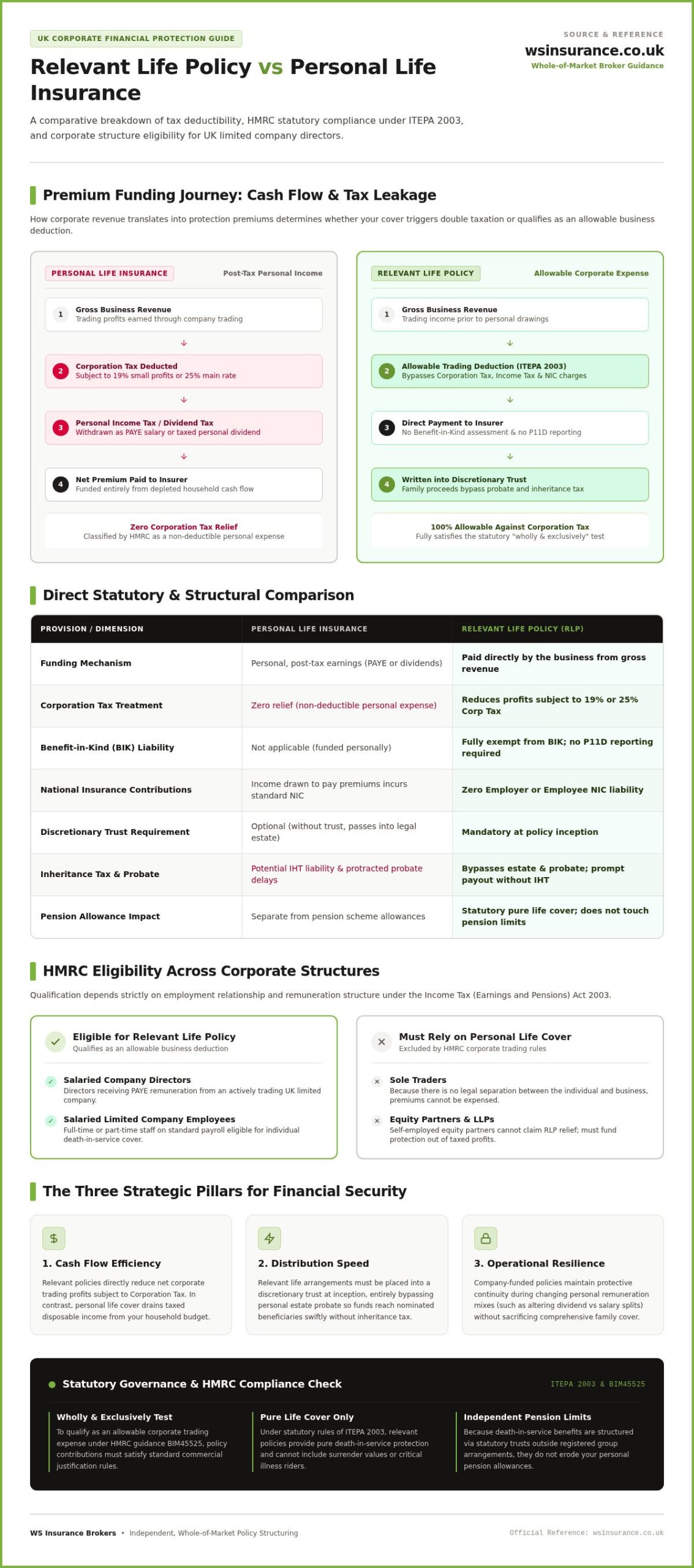
When weighing a relevant life policy vs personal life insurance, the most striking difference emerges in how each contract is funded. To pay for personal cover, a business must generate enough profit to cover Corporation Tax, distribute the remainder as salary or dividends where personal income tax bites, and only then pay the insurer. A relevant life policy bypasses this double-tax hurdle completely by funding cover straight from gross business revenue as an allowable trading expense.
Corporation Tax Relief and Allowable Expenses
Premiums paid towards a relevant life plan directly reduce your company’s trading profits subject to Corporation Tax, whether your firm pays the 19% small profits rate or the 25% main rate. To qualify, contributions must satisfy the statutory wholly and exclusively test outlined within guidance on HMRC Compliance and Tax Relief. Personal life cover, by contrast, offers zero Corporation Tax relief because HMRC views it as an individual personal expense.
Income Tax and National Insurance Contributions
Meeting life cover costs through the business does not trigger a taxable Benefit-in-Kind for the covered director or employee. The arrangement requires no P11D reporting, freeing both the employer and the worker from Class 1 National Insurance liabilities. Consequently, directors don’t need to artificially inflate dividend extractions or push personal earnings into higher income tax thresholds just to maintain high-value family protection.
Inheritance Tax and Estate Planning Mechanics
Statutory rules require relevant life plans to be written into a discretionary trust at the point of application. Because the policy benefits are held by trustees outside the individual’s legal estate, the capital lump sum is shielded from the standard 40% inheritance tax charge. This structure avoids protracted probate processes, ensuring financial support reaches named beneficiaries without delay. If you want to coordinate these arrangements with your broader commercial safeguards, reviewing our guide on business insurance in the UK provides a helpful framework for comprehensive enterprise security.
Working alongside an independent advisor at WS Insurance Brokers helps you clarify these structural choices, identifying policy options from across the entire UK market that best align with your commercial circumstances.
Eligibility Criteria: Assessing Suitability for Company Directors and Sole Traders
Legal structure dictates your protection options. When evaluating a relevant life policy vs personal life insurance, eligibility hinges directly on whether an employer-employee relationship exists in the eyes of revenue authorities. While personal protection remains universally available to any UK resident regardless of their employment status, commercial tax advantages require specific payroll and corporate criteria.
Limited Company Directors and Salaried Employees
Directors and staff of incorporated limited companies qualify for relevant life contracts as long as they receive taxable PAYE earnings. This mechanism suits high-earning directors, critical technical staff, and salaried family members working within a family business. For growing small and medium enterprises, relevant life plans deliver competitive death-in-service provisions for individual personnel without forcing the company to establish costly, administrative-heavy group life schemes.
Sole Traders, LLPs, and Self-Employed Individuals
HMRC explicitly excludes sole traders, equity partners in traditional partnerships, and members of Limited Liability Partnerships (LLPs) from taking out relevant life plans on themselves. Because self-employed professionals do not hold employee status, the business cannot legally fund the cover as an employer-sponsored arrangement. In these trading setups, personal life insurance written into an appropriate trust serves as the proper protective route. Assessing your exposure through strategic insights on how to identify business risks ensures you don’t leave personal family assets unprotected while managing commercial liabilities.
High Net Worth and Existing Pension Cap Considerations
A relevant life policy operates completely independently of registered pension schemes, meaning death benefit payouts do not count towards statutory allowances such as the Lump Sum Allowance (£268,275) or the Lump Sum and Death Benefit Allowance (£1,073,100). The statutory requirements governing these arrangements are outlined clearly within the HMRC guidelines on relevant life policies. High-earning directors who have accumulated substantial pension assets can establish generous family cover without fear of breaching pension limits or triggering punitive recovery charges.
Should your enterprise undergo a structural transition, such as converting from a partnership to a limited company, your insurance requirements must evolve accordingly. Addressing these changes early through a direct review of relevant life policy vs personal life insurance safeguards your coverage continuity, preventing gaps that could leave dependents vulnerable during commercial reorganisations.
HMRC Compliance, Discretionary Trusts, and Common Setup Pitfalls in 2026
Setting up corporate protection demands statutory precision. To preserve tax relief when evaluating a relevant life policy vs personal life insurance, the underlying policy must strictly satisfy Section 393B of the Income Tax (Earnings and Pensions) Act 2003. A minor technical oversight can inadvertently dismantle your tax advantages, exposing premiums and payouts to unexpected HMRC scrutiny.
The Crucial Role of the Discretionary Trust
Common Administrative and Structuring Errors
Even seasoned business owners make simple administrative errors that compromise their arrangements. Some of the most frequent traps include:
- Unexecuted trust deeds: Delaying the completion of trust paperwork, leaving proceeds temporarily exposed to personal estate taxes.
- Outdated trustee appointments: Neglecting to update trustees when fellow directors depart or family relationships shift.
- Misaligned benefit caps: Setting multiples of earnings that exceed individual underwriting allowances or commercial justification.
- Ignoring policy portability: Overlooking options to convert the contract into a personal policy if a director leaves the business.
Eliminating these structural blind spots requires seasoned oversight and careful policy drafting. To ensure your arrangements remain fully compliant with current HMRC legislation, contact the independent team at WS Insurance Brokers for tailored market guidance without high-pressure sales tactics.
Structuring Tailored Protection: Sourcing Independent Policy Advice Across the UK Market
Determining the right approach in the choice between a relevant life policy vs personal life insurance requires aligning your remuneration model with long-term family security. Because individual circumstances, dividend distributions, and corporate goals vary widely, obtaining independent advice across leading providers ensures your chosen structure delivers maximum tax efficiency alongside dependable cover.
Assessing Sum Assured and Multiple-of-Earnings Limits
Calculating the right sum assured demands an accurate assessment of ongoing family commitments, outstanding liabilities, and future living costs. For relevant life plans, UK underwriters typically permit coverage multiples up to twenty-five times annual remuneration, depending on the individual’s age. Crucially, insurers allow you to factor in both your regular PAYE salary and verifiable historical dividend distributions, ensuring company owners can secure high-value cover that truly reflects their overall earnings.
Navigating Medical Underwriting and Policy Options
Insurers take divergent approaches to health history and lifestyle factors. While one underwriter might impose premium loadings for a pre-existing medical condition, another may offer standard rates. When structuring your cover, you must also decide between fixed level benefits or index-linked protection to defend the payout against inflation over time. Exploring these nuances alongside an experienced specialist guarantees you secure appropriate terms without unnecessary exclusions.
Why an Independent Broker Delivers Superior Protection
Direct-to-consumer portals and single insurers restrict you to one set of underwriting criteria. An FCA-regulated, whole-of-market insurance broker provides completely impartial guidance, surveying the entire UK market to locate terms that best match your medical profile and corporate setup. Our comprehensive guide to insurance brokers explains how independent representation works in practice.
Engaging an independent broker also removes friction from the setup process. Your broker works proactively to coordinate the following steps:
- Trust drafting: Establishing the required discretionary trust documentation at inception to prevent unintended tax exposure.
- Administrative liaison: Coordinating policy terms with your corporate accountants to confirm proper Corporation Tax treatment.
- Dedicated claims advocacy: Standing beside your family and trustees during claim settlement to ensure prompt, stress-free payouts.
Resolving the debate over a relevant life policy vs personal life insurance is about protecting what matters most with absolute clarity. Partnering with a dedicated professional gives you the certainty that your protection is structured correctly from day one.
Securing Tax-Efficient Protection for Your Family and Business
Choosing between a relevant life policy vs personal life insurance comes down to your trading status and commercial efficiency. For qualifying limited company directors, funding family protection through pre-tax business revenue delivers legitimate Corporation Tax relief whilst eliminating personal Benefit-in-Kind liability. Combined with an immediate discretionary trust, these arrangements safeguard your family’s future outside the reach of inheritance tax and probate delays.
Navigating HMRC thresholds and insurer underwriting doesn’t have to be daunting. Authorised and regulated by the Financial Conduct Authority, WS Insurance Brokers provides independent whole-of-market access across established UK life insurers. Our proactive specialists coordinate trust structures, align terms with your accountants, and deliver dedicated claims advocacy when your loved ones need it most. Speak with our independent brokers to structure your cover today and establish lasting financial security with complete confidence.
Frequently Asked Questions
Can a relevant life policy be transferred if I leave my limited company?
Yes, most insurers provide a portability option that lets you transfer the policy seamlessly. If you exit the business, you can assign ownership to a new employer willing to take over premium payments, or simply convert it into an individual personal plan. This feature ensures you maintain valuable protection without undergoing fresh medical underwriting or paying higher rates tied to an older entry age.
Is critical illness cover included within a relevant life policy?
No, statutory legislation restricts relevant life policies strictly to death benefits and terminal illness cover. Bundling standard critical illness protection invalidates the policy’s tax-exempt status under Section 393B of ITEPA 2003, triggering unexpected Benefit-in-Kind charges. Business owners wanting serious illness protection can readily arrange standalone critical illness cover alongside their relevant life structure to maintain robust personal security.
How much can a limited company director insure under a relevant life plan?
Insurers typically permit coverage amounts between fifteen and twenty-five times total annual remuneration, depending on your age at application. Crucially, underwriters assess both your PAYE salary and verifiable company dividend draws when setting benefit maximums. When weighing a relevant life policy vs personal life insurance, this calculation enables directors taking low salaries and higher dividends to secure realistic, substantial cover.
Does a relevant life policy count towards the UK pension lifetime allowance?
No, relevant life policies remain entirely separate from registered pension schemes. While the traditional Lifetime Allowance has ended, payouts from these policies are not tested against the Lump Sum Allowance (£268,275) or the Lump Sum and Death Benefit Allowance (£1,073,100). This independence makes the arrangement an excellent choice for high-earning professionals who wish to preserve their pension limits intact.
Can a sole trader take out a relevant life policy in the UK?
No, sole traders cannot utilise relevant life plans because English law recognizes no legal separation between the proprietor and the enterprise. HMRC rules require a genuine employer-employee payroll relationship to qualify for allowable business expense deductions. In the choice between a relevant life policy vs personal life insurance, sole traders and self-employed partners must establish personal cover written into trust.
What happens to the policy if my limited company becomes insolvent?
Because the policy is held within an independent discretionary trust, it does not form part of your company’s trading assets. Liquidators and commercial creditors have no legal claim over the trust structure or future payouts. Most insurers allow you to take over premium funding personally, preventing your family protection from lapsing during unexpected corporate reorganisations.
Are the payouts from a relevant life policy subject to income tax?
No, death benefits distributed from a compliant relevant life plan are completely free from UK income tax and capital gains tax. The policy proceeds flow directly to the discretionary trust rather than passing through company accounts or your personal estate. Consequently, nominated beneficiaries receive the financial lump sum in full without statutory tax reductions or protracted probate holdups.