
Your standard professional indemnity policy might be the single biggest liability blind spot in your digital business. Traditional indemnity protects human advice, yet when a flawed code deployment triggers client downtime, an API integration fails, or an unintentional copyright dispute arises across digital assets, standard wordings frequently fall silent. Securing dedicated technology and media liability insurance has therefore become essential for UK digital agencies, software houses, and SaaS providers seeking to protect their balance sheets and satisfy stringent enterprise client contracts. You shouldn’t have to wrestle with convoluted policy exclusions or worry whether a contract dispute could derail your daily operations.
Discover how technology and media liability insurance protects your digital business against contractual disputes, intellectual property claims, and cyber exposures. By clarifying exact policy triggers across software development, content publication, and data custody, you can establish an airtight, compliant framework that satisfies enterprise tenders without creating dangerous coverage gaps. Here is your definitive guide to understanding modern claims-made protections, resolving overlapping cyber liabilities, and securing robust, market-wide terms for 2026.
Key Takeaways
- Understand why modern digital business requires integrated technology and media liability insurance rather than siloed, legacy professional indemnity policies.
- Discover how unified insuring clauses bridge perilous coverage gaps across defective software, content publication disputes, and network downtime.
- Master the critical mechanics of claims-made triggers, retroactive dates, and enterprise contract warranties to avoid uninsurable liabilities.
- Learn a practical framework for structuring indemnity limits and retentions that satisfy corporate tenders and balance sheet demands.
- See how an independent, FCA-regulated UK broker secures bespoke market-wide terms across Lloyd’s syndicates without costly overlapping covers.
What Is Technology and Media Liability Insurance?
Technology and media liability insurance is an integrated commercial insurance solution engineered specifically for firms that design code, publish content, or manage digital infrastructure. Unlike piecemeal covers that separate professional mistakes from publishing errors, this policy wraps technology errors and omissions (Tech E&O), media liability, and cyber risks into a single, cohesive framework. It eliminates the grey areas that often leave digital businesses vulnerable during contentious client disputes.
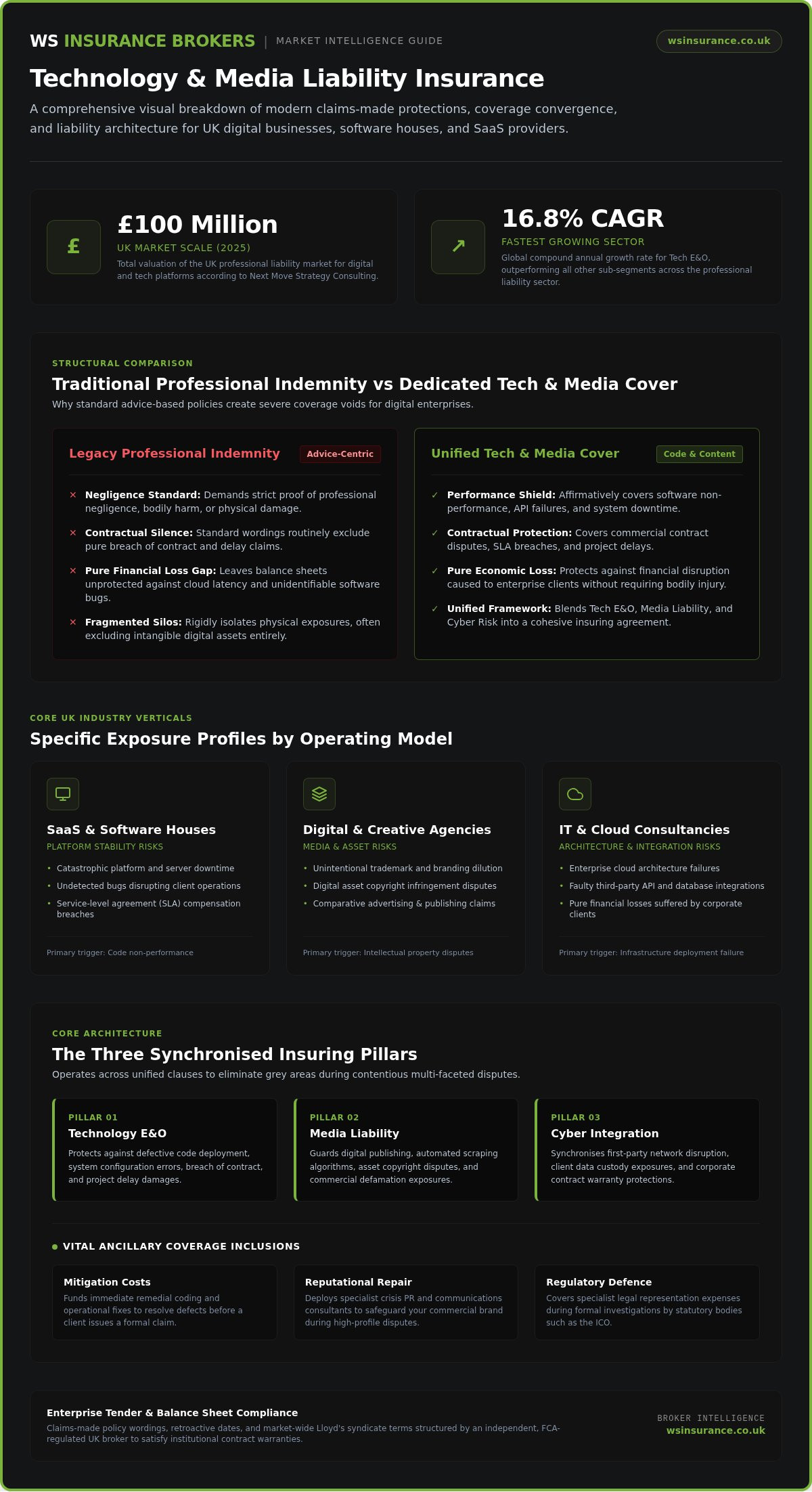
Modern tech operations rarely fit into narrow categories. A digital agency building a bespoke e-commerce platform writes complex code, designs marketing collateral, and handles client customer data simultaneously. If a deployment fails or an asset infringes copyright, pointing fingers between disjointed policies causes costly delays. The market has rapidly adapted: Next Move Strategy Consulting found that the UK professional liability market for digital and tech platforms reached roughly £100 million in 2025, with Tech E&O expanding as the fastest-growing sub-segment globally at 16.8% CAGR.
This specialized protection serves a broad range of UK digital enterprises, including:
- SaaS providers and software houses: Insuring against catastrophic platform downtime, system bugs, and service-level agreement (SLA) breaches.
- Digital marketing and creative agencies: Protecting against unintentional trademark dilution, copyright infringement, and comparative advertising disputes.
- IT and cloud consultancy practices: Guarding against architecture failures, faulty API integrations, and pure financial losses incurred by corporate clients.
The Convergence of Tech Errors and Media Risks
Modern code and visual media are deeply intertwined. Consider an e-commerce agency configuring an automated checkout interface; a flawed script may scrape protected product descriptions or pull unlicensed branding assets automatically. Standard commercial policies rigidly separate physical risks from intangible exposures, often excluding digital property entirely. Unified technology and media liability insurance bridges this gap, ensuring that combined technical glitches and media liabilities trigger protection without friction.
Core Differences Between Traditional PI and Tech Cover
Traditional Professional Indemnity (PI) was created for historic, advice-giving professions such as solicitors, accountants, and surveyors. It demands proof of professional “negligence” causing bodily injury, property damage, or financial harm. Digital companies, however, face complex contract disputes and product performance failures where traditional negligence cannot be proven. Under UK law, a client experiencing severe economic disruption due to cloud latency or unidentifiable software bugs suffers pure financial loss. Specialist tech policies affirmatively cover breach of contract, delay, and software non-performance, shielding your balance sheet where traditional PI wordings fall silent.
Key Coverage Pillars: What Does the Policy Protect?
Understanding where coverage begins and ends across digital operations requires breaking down the core insuring clauses. Rather than treating each exposure as an isolated hazard, modern technology and media liability insurance operates across three synchronized pillars. These sections work together to fund specialist legal defence costs, finance court-awarded damages, and settle legitimate commercial disputes before they escalate to trial.
The policy distinguishes between third-party commercial claims brought by dissatisfied clients and first-party losses sustained directly by your firm. It also bundles vital ancillary protections, including:
- Mitigation costs: Funding immediate remedial work to rectify an error and prevent a client from filing a formal claim.
- Reputational repair: Deploying crisis PR consultants to protect your commercial brand during a high-profile incident.
- Regulatory defence: Paying legal representation expenses during investigations by statutory authorities such as the Information Commissioner’s Office (ICO).
To eliminate ambiguity across these protections, consult an independent specialist like WS Insurance Brokers to benchmark your policy wordings against current market standards.
Technology Errors, Omissions, and Contractual Breach
This pillar shields your business when digital products or services fail to deliver as promised. Cover triggers on software bugs, enterprise cloud outages, implementation delays, or missed project milestones. It extends to contractual indemnities, ensuring legal costs and client compensation are protected when contracts contain strict service delivery warranties. Crucially, reputable wordings automatically encompass liabilities caused by sub-contractors and offshore development teams.
Media Liability and Intellectual Property Protection
Digital communication creates continuous intellectual property exposures. This insuring clause defends against allegations of unintentional copyright infringement, trademark dilution, passing off, and plagiarism across marketing copy, graphics, and codebase assets. It also responds to digital defamation claims, libel, and slander, whilst extending protection to user-generated content hosted across client portals, forums, and collaborative applications.
Integrated Cyber Extortion and Data Incident Support
When technical failures result in a security compromise, cyber coverage steps in. This pillar covers third-party liabilities stemming from accidental malware transmission or client data loss. Under the UK GDPR and the Data (Use and Access) Act 2025, where statutory maximum penalties reach £17.5 million or 4% of global annual turnover, access to forensic investigators, notification handlers, and breach counsel provides essential balance sheet protection.
Evaluating Real-World Tech and Media Risk Scenarios
Enterprise contracts often impose harsh indemnities and strict performance warranties. When signing master service agreements, tech companies frequently face uncapped liabilities for project delays or code defects. Successfully identifying business risks before signing client contracts allows you to secure proportionate indemnity limits rather than relying on chance. Because technology and media liability insurance operates on a claims-made basis, notifying your broker at the earliest sign of a dispute is critical. Delayed notification can jeopardise your indemnity rights under the Insurance Act 2015.
Examining real-world dispute patterns illustrates how policy terms protect ongoing operations:
Software Deployment Failure and SLA Penalties
A UK software house managing an enterprise ERP migration encounters unforeseen database corruption, halting a client’s distribution lines for three days. Facing substantial service-level agreement penalties and threats of breach-of-contract litigation, the firm engages its insurer. The policy deploys mitigation funding to finance emergency data recovery engineers and specialist dispute resolution solicitors. This proactive intervention remedies the technical flaw and negotiates an amicable settlement, preventing formal litigation entirely.
Digital Marketing Campaign Trademark Dispute
During a nationwide rebrand, a creative agency inadvertently designs a visual campaign resembling a competitor’s registered trademark. The competitor files an urgent High Court injunction to halt the launch, demanding asset destruction and substantial damages. Dedicated media cover funds senior intellectual property solicitors to contest the application, ultimately resolving the dispute through an agreed settlement that protects the agency’s working capital.
Cloud Configuration Error Leading to Data Exposure
A SaaS provider unintentionally leaves an Amazon Web Services storage bucket publicly accessible during an infrastructure update, exposing 80,000 corporate records. The client incurs severe reputational harm and sues the provider for downstream losses. Blended technology and media liability insurance responds immediately, funding regulatory legal defence during the Information Commissioner’s Office inquiry whilst indemnifying the firm against the client’s commercial damages claim.
How to Choose and Structure the Right Policy Limits
Structuring indemnity limits requires a precise calculation of your firm’s contractual exposure rather than generic estimates. Across the UK tech sector, commercial benchmarks show that 61% of small technology and professional firms maintain a baseline limit of £1 million, whilst 39% secure £2 million or higher. Mid-market vendors and SaaS providers frequently require £5 million to £10 million to satisfy corporate tenders. Integrating these limits seamlessly into your broader portfolio of business insurance in the UK creates a resilient balance sheet.
To determine appropriate protection, follow this five-step framework:
- Review maximum contract values: Identify the largest financial dependency any single client places on your system.
- Assess downstream outage potential: Estimate the pure financial losses a customer would incur during a 48-hour disruption.
- Examine data custody liabilities: Calculate records held under UK GDPR to calibrate cyber and media limits.
- Select limit basis: Choose between “Any One Claim” (reinstating the full limit for each discrete incident) and “In the Aggregate” (capping total annual pay-outs).
- Calibrate retention levels: Balance internal cash reserves against policy excess tiers to optimise coverage terms.
If you need expert guidance structuring these layers across specialist markets, you can request an independent policy review from WS Insurance Brokers today.
Auditing Client Contracts and Liability Caps
Enterprise procurement teams routinely present master service agreements containing uncapped indemnities for intellectual property infringement or data incidents. Where contract clauses attempt to override standard liability caps, ensure your insurance limits match or exceed those demands before signing. Negotiating mutual liability caps tied directly to your insured limits keeps major corporate partnerships commercially viable without exposing your balance sheet to unlimited exposure.
Selecting Between Claims-Made and Losses-Occurring Wordings
Unlike employers’ liability policies, technology and media liability insurance is underwritten on a claims-made basis. The policy in force when a claim is formally asserted responds, not the policy active when the code was written. You must maintain continuous coverage with an unbroken retroactive date dating back to business inception. If you wind down or sell your agency, secure run-off cover for at least six years to mirror the statutory limitation period under the Limitation Act 1980.
Managing Policy Excesses and Risk Controls
Automated comparison tools and off-the-shelf quote engines were built for standard retail trades, not complex digital architecture. When you feed multi-tenant cloud platforms, automated marketing pipelines, or bespoke code libraries into an aggregator form, algorithms compress your business into crude categories. This oversimplification leaves dangerous coverage gaps that only surface during a dispute. Securing resilient protection requires consultative placement through an independent, FCA-regulated commercial insurance broker. Unlike tied agents or direct insurers who only sell their own proprietary products, an independent broker owes a strict fiduciary duty to you, acting as an autonomous guide focused on your long-term security.
The Advantage of Whole-of-Market Underwriting Access
Dedicated Claims Advocacy and Ongoing Policy Management
Placing your policy is just the beginning of a protective partnership. As your digital agency signs larger enterprise clients, introduces new digital services, or expands contractor networks, your broker manages mid-term adjustments to prevent coverage lapses. When a client asserts a breach of warranty or threatens formal litigation, your broker acts as a dedicated claims advocate. Rather than leaving you to navigate corporate loss adjusters alone, your broker handles early notifications, coordinates with approved legal counsel, and actively defends your commercial interests until the claim is settled.
Securing Long-Term Resilience for Your Digital Operations
Operating without unified cover leaves software houses and creative agencies dangerously exposed to contractual ambiguities. Securing robust technology and media liability insurance removes the friction of disjointed policies, satisfying stringent enterprise warranties while protecting your cash flow against catastrophic system downtime or intellectual property disputes. Maintaining continuous retroactive dates ensures past projects remain shielded under UK statutory limitation rules, eliminating uncertainty as your enterprise scales.
Navigating specialist underwriting markets shouldn’t be an operational burden. As an independent brokerage authorised and regulated by the Financial Conduct Authority (FCA), WS Insurance Brokers provides whole-of-market access across leading UK composite insurers and London market syndicates. Backed by dedicated professional claims handling advocacy throughout the policy lifecycle, you gain a trusted partner committed to eliminating coverage gaps. Take control of your commercial exposures today and discuss your digital risk profile with WS Insurance Brokers to secure complete peace of mind.
Frequently Asked Questions
What is the difference between media liability and technology professional indemnity insurance?
Media liability covers injuries caused by published digital content, including copyright infringement, trademark dilution, and defamation across websites or applications. Technology professional indemnity responds when software code fails, systems crash, or cloud implementations cause pure financial loss for your clients. Securing unified technology and media liability insurance bridges both risks, eliminating coverage gaps when a technical error directly triggers an intellectual property dispute.
Is cyber insurance included within a technology and media liability policy?
Modern modular policies routinely integrate cyber risk alongside technology errors and media liabilities. While standalone cyber policies remain available, packaging cyber into your tech wording prevents disputes between competing underwriters over whether an outage was caused by a software glitch or an external hack. This structure provides immediate access to IT forensic teams, incident response specialists, and legal counsel.
Can our business rely purely on limitation of liability clauses in our client contracts?
Contractual caps provide a useful baseline, but they don’t offer absolute legal protection. Under UK law, including the Unfair Contract Terms Act 1977, limitation clauses can be challenged and deemed unenforceable by courts if judged unreasonable. Enterprise clients also routinely demand contract carve-outs for intellectual property infringement and confidentiality breaches, effectively rendering liability caps useless in high-stakes claims.
What does claims-made mean in technology liability insurance?
A claims-made policy responds only to claims formally brought against you, or circumstances notified to underwriters, whilst the policy remains active. It doesn’t matter when you wrote the code or launched the campaign. To preserve protection for past deliverables, you must maintain continuous coverage with an intact retroactive date, preventing severe retrospective coverage gaps on historical projects.
How much indemnity cover do enterprise technology clients typically require in contracts?
Enterprise procurement teams standardly require limits between £5 million and £10 million, with extensive corporate vendors or public sector tenders occasionally mandating £20 million or more. Conversely, small agency contracts frequently stipulate baseline limits between £1 million and £2 million. Your broker can structure tower layers and excess of loss facilities to satisfy these contractual requirements without overpaying for standard baseline covers.
What happens if a contractor or offshore freelancer writes faulty code for our platform?
In the eyes of your client, your enterprise remains contractually liable for all work delivered by external contractors and third-party developers. Specialist technology liability policies affirmatively extend coverage to defend claims arising from sub-contracted technical work. Insurers will, however, examine whether you maintain written master service agreements and verify that your independent contractors carry their own baseline professional indemnity cover.
Does technology liability insurance protect against intellectual property infringement claims?
Yes, dedicated technology and media liability insurance routinely defends against unintentional copyright infringement, trademark dilution, plagiarism, and passing off. Insurers fund specialist legal representation and negotiated settlement awards. Crucially, standard UK market wordings carve out patent infringement and intentional trade secret theft, meaning internal governance and clear client warranties remain vital safeguards against patent allegations.