
Did you know that recent industry audits reveal between 20% and 40% of UK construction sites are currently underinsured? It’s a sobering figure that often stems from a fundamental misunderstanding of how different policies interact. For many contractors, the debate of contractors all risk vs public liability feels like a maze of complex wording and overlapping clauses. You want to protect your business from financial ruin, but justifying the cost of multiple premiums to stakeholders can be a challenge when the distinctions aren’t clear.
We understand that you need absolute certainty when it comes to your project’s security. This guide removes that anxiety by stripping away the jargon. We’ll help you distinguish between protecting your physical assets and defending against legal accidents, whilst ensuring your project remains resilient against both. We’ll explore the ‘asset vs accident’ framework, examine current JCT contract requirements, and provide a clear structure for choosing the right level of cover for your specific risk profile.
Key Takeaways
- Master the ‘Asset vs Accident’ framework to clearly distinguish between protecting your physical construction works and covering your legal obligations to third parties.
- Understand why Contractors All Risk is essential for safeguarding your materials, plant, and unfinished structures against unpredictable perils like fire, flood, or site theft.
- Learn why the distinction between contractors all risk vs public liability is vital for eliminating the underinsurance gaps that currently threaten up to 40% of UK building projects.
- Discover how to align your insurance limits with modern JCT 2024 contract requirements to ensure full compliance and professional credibility with clients.
- Identify the strategic advantage of using WS Insurance Brokers to access the entire UK market for bespoke, cost-effective construction protection.
Understanding the Fundamental Differences in Construction Cover
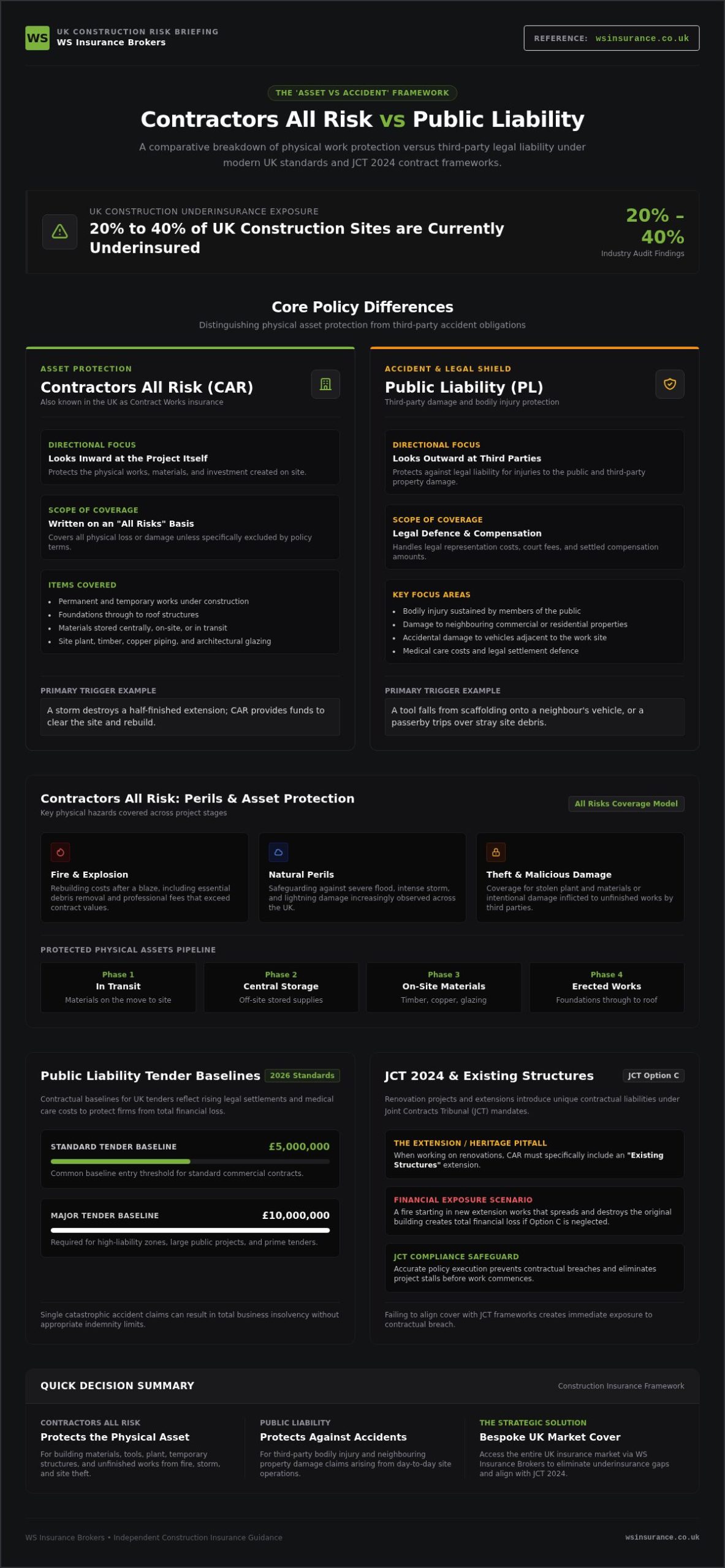
To build with confidence, you must first understand the protective shield your business requires. We often use the ‘Asset vs Accident’ framework to simplify the complex choice between contractors all risk vs public liability. Think of Contractors All Risk (CAR) as the protector of your physical assets; the bricks, mortar, and timber that form the project. Public Liability (PL), conversely, is your safeguard against accidents involving people and their property. Mixing these up or assuming one covers the other is a common pitfall that can leave your business facing devastating out-of-pocket expenses.
The distinction isn’t just a matter of preference. Under modern UK safety regulations and the latest JCT 2024 contract standards, specific coverages are often a non-negotiable requirement. Choosing the wrong policy doesn’t just risk your capital; it can stall a project before the first stone is laid. Our role is to act as your expert guide, ensuring your insurance portfolio mirrors the specific risks of your site rather than offering a generic, one-size-fits-all solution.
Failing to align your cover with the Joint Contracts Tribunal (JCT) mandates can lead to contractual breaches. These frameworks are designed to remove uncertainty, yet they require precise execution to be effective. When you understand the specific triggers for each policy, you eliminate the fear of being underinsured during a major project.
What is Public Liability in a Construction Context?
Public Liability focuses exclusively on your legal responsibilities to third parties. If a member of the public trips over stray site debris or if a falling tool damages a neighbouring vehicle, PL is the mechanism that handles the legal defence and eventual compensation. In 2026, contractual baselines for tenders often start at £5 million or £10 million. This reflects the rising costs of legal settlements and medical care, ensuring that a single accident doesn’t result in total financial loss for your firm.
The Core Purpose of Contractors All Risk (CAR)
Whilst PL looks outward at the public, CAR looks inward at the project itself. Frequently referred to as ‘Contract Works’ insurance in the UK, this policy protects the permanent and temporary works under construction. This includes everything from the foundations to the roof, as well as materials stored centrally or in transit to the site. If a storm destroys a half-finished extension, CAR provides the funds to clear the site and rebuild. It acts as a shield for your balance sheet, protecting the physical investment you’ve worked hard to create.
Contractors All Risk (CAR): Safeguarding the Physical Works
Contractors All Risk acts as a comprehensive safety net for the physical lifeblood of your project. Whilst we have established the broad roles of contractors all risk vs public liability, the depth of CAR protection is where your physical investment truly finds its shield. It’s typically written on an “all risks” basis; this means the policy covers any physical loss or damage unless the insurer specifically excludes it. This broad scope is essential because construction sites are inherently unpredictable environments where the financial stakes are high.
Standard perils covered by a robust CAR policy include:
- Fire and Explosion: Rebuilding costs after a blaze can often exceed the original contract value when debris removal and professional fees are factored in.
- Natural Perils: Protection against flood, storm, and lightning damage, which are increasingly common across the UK.
- Theft and Malicious Damage: Covering stolen materials or intentional damage to the works by third parties, protecting your profit margins.
Navigating the nuances of contractors all risk vs public liability is especially critical when your project involves working on an extension or a heritage property. If you’re undertaking a renovation, you must ensure the policy extends to include “Existing Structures”. Under JCT Option C, this is a contractual necessity. Without this extension, a fire that starts in your new works but destroys the original building could leave you facing a total financial loss. It’s often helpful to consult with the experts at WS Insurance Brokers to ensure these specific JCT requirements are met with precision.
Materials and Site Equipment
Your investment begins long before materials are fixed into the build. CAR provides vital protection for copper piping, expensive timber, and architectural glazing whilst they’re stored on-site or held in central storage. Crucially, this cover should include transit cover. This protects your assets from the moment they leave the supplier until they arrive at your site, removing the uncertainty of who is responsible for damage during the journey.
Plant, Tools, and Machinery
Machinery is the engine of any site, but it’s also a significant risk. A thorough CAR policy differentiates between your owned plant and hired-in equipment. For hired items, the policy should cover continuing hire charges. If a hired excavator is damaged, the rental company will continue to charge you whilst it’s being repaired; CAR ensures these hidden costs don’t drain your project budget. You can also include employee tools, providing a layer of security for your team’s essential gear and removing another layer of site anxiety.
Public Liability: Managing Third-Party Legal Risks
Public liability insurance acts as your primary shield against the legal and financial fallout of accidents involving the public. Whilst it isn’t a statutory requirement in the same way as Employers’ Liability, it’s a non-negotiable contractual standard across the UK construction sector. Without it, you’ll find it nearly impossible to secure access to sites or win tenders from local councils and main contractors. It provides the calm reliability you need when facing the complexity of modern legal claims.
In 2026, the standard limits of indemnity have shifted to reflect rising legal costs and medical inflation. Whilst a £2 million limit might have sufficed for minor domestic trades in the past, most commercial contracts now mandate a minimum of £5 million or £10 million. These higher limits ensure that a single catastrophic incident doesn’t lead to the total financial ruin of your business. We help you navigate these requirements, ensuring your cover matches the specific demands of your clients without unnecessary expense.
A vital distinction in the contractors all risk vs public liability debate is what the policy excludes. Public Liability does not cover damage to the specific work you’re currently performing. If you’re installing a new heating system and you accidentally damage the boiler itself, PL won’t respond. It’s designed to protect everything else; the people around you and the property you aren’t currently working on. You must also manage your sub-contractors with care:
- Labour-only sub-contractors: These individuals work under your direct supervision and are typically covered by your own policy.
Third-Party Injury Claims
Injury claims are often the most expensive and complex risks you’ll face. They’re considered “long-tail” risks because a claimant might not seek compensation until years after an incident. Whether it’s a pedestrian injured by falling scaffolding or a visitor tripping over poorly stored materials, PL handles the medical expenses, legal fees, and loss of earnings. This protection allows you to focus on the build whilst we ensure your legal defence is robust and professional.
Third-Party Property Damage
Construction activities often pose a threat to neighbouring buildings and infrastructure. Excavation work carries the constant risk of striking underground services, such as high-speed fibre-optic cables or water mains, which can lead to massive compensation claims. Public Liability covers the cost of repairing this third-party property. It provides the essential boundary between your project’s balance sheet and the costly reality of accidental damage to the world outside your site perimeter.
The Critical Interplay: Why One Policy Is Rarely Enough
Imagine a fire breaks out on a housing development you’re halfway through building. The structure is reduced to charred wood and twisted steel. Your Contractors All Risk policy is the mechanism that funds the site clearance and the rebuild of the permanent works. However, the smoke and heat also shattered the windows and scorched the brickwork of the existing house next door. This is where Public Liability steps in. It manages the third-party property damage claim from your neighbour, protecting your business from a secondary financial hit. This scenario perfectly illustrates the contractors all risk vs public liability distinction; one protects your work, whilst the other protects your reputation and legal standing.
Relying on only one of these creates a dangerous “gap” risk. If you only held PL, you’d be protected against the neighbour’s claim but would have to fund the entire rebuild of your own project out of pocket. For many firms, this leads directly to insolvency. For complex projects, we often recommend combined portfolios. These bundle CAR and PL into a single package, which effectively eliminates the risk of cross-policy disputes where two different insurers argue over who is responsible for a specific portion of a claim. It’s a methodical way to ensure your business remains a steady hand in an unpredictable market.
Contractual Obligations and Compliance
Professionalism is more than just quality workmanship. Robust business insurance acts as a badge of credibility for mortgage lenders and property owners. Under the 2026 Building Safety Act, insurers now scrutinise safety management more closely for higher-risk buildings. Compliance with the latest JCT 2024 standards ensures you meet these gateway requirements, removing the uncertainty that can delay project commencement and protecting your long-term security.
Financial Protection and Business Continuity
Protecting your cash flow during a prolonged claim is vital for business survival. A fixed-price contract leaves little room for error; a total loss without adequate cover is a fast track to bankruptcy. Conducting a thorough risk assessment allows us to tailor your indemnity limits to the specific perils of your site. We act as your shield, ensuring that even in the worst-case scenario, your business has the liquidity to continue operating. To secure a bespoke evaluation of your current project risks, you can request a comprehensive insurance review from our expert team.
Securing Bespoke Construction Protection with WS Insurance Brokers
Choosing between contractors all risk vs public liability shouldn’t feel like a gamble with your business’s future. As an independent broker, WS Insurance Brokers positions itself as your trusted advisor, removing the anxiety that often accompanies complex insurance decisions. Unlike restricted competitors who are tied to a limited panel of providers, we have access to the entire UK insurer market. This autonomy allows us to secure highly competitive rates whilst ensuring your policy is a precise fit for the specific size and scope of your project.
Our consultative approach focuses on transparency and integrity. We don’t just sell a financial product; we provide a protective outcome that shields your balance sheet from total loss. By conducting a bespoke risk assessment, we eliminate the doubt surrounding your indemnity limits. This methodical process ensures that whether you are a main contractor or a specialist trade, your business is supported by a steady hand in an increasingly complex market.
Expert Placement and Policy Management
Precision is vital in avoiding the coverage gaps that currently threaten many UK construction programmes. WS Insurance Brokers assesses your unique risk profile to ensure that every material, machine, and legal liability is accounted for. As an FCA-authorised and regulated firm, we maintain the highest standards of professional conduct, providing you with essential peace of mind. Should the worst happen, our dedicated advocacy during the claims handling process ensures you aren’t left to face insurers alone. We act as your shield, managing the complexities so you can focus on delivering your project.
Next Steps for Your Construction Project
Early engagement with WS Insurance Brokers is the most effective way to save both time and money. By involving us during the tender or planning phase, we can help you align your cover with specific contract requirements before they become a bottleneck. To begin, you’ll simply need your contract values, details of any hired-in plant, and your projected turnover. This information allows us to build a narrative of security that satisfies stakeholders and lenders alike.
Contact WS Insurance Brokers today for a tailored construction insurance review to ensure your next project is protected by experts who understand the nuances of the UK construction sector.
Building a Resilient Future for Your Construction Business
Securing the longevity of your project requires more than just high-quality materials; it demands a robust protective framework that addresses every possible peril. We’ve explored how the ‘Asset vs Accident’ distinction defines your security, ensuring your physical works and third-party obligations are equally shielded. Understanding the interplay between contractors all risk vs public liability ensures your project isn’t just started, but successfully completed without the fear of financial ruin.
As an independent UK brokerage, we act as your expert guide through the complexities of JCT compliance and modern safety regulations. We are FCA authorised and regulated, providing you with transparent advice and access to all major UK insurers to find the most competitive rates for your specific risk profile. Our methodical approach removes the uncertainty from the selection process, allowing you to focus on the build whilst we manage the complexities of your protection.
Take the first step toward total project security today. Request a Bespoke Construction Insurance Quote from WS Insurance and gain the confidence that comes from working with a steady hand in the insurance market. We look forward to helping you build with absolute certainty.
Frequently Asked Questions
Is Contractors All Risk insurance a legal requirement in the UK?
Contractors All Risk isn’t a statutory legal requirement under UK law, but it’s nearly always a contractual necessity. Most modern JCT and NEC contracts mandate this cover to protect the project’s physical assets. When weighing up contractors all risk vs public liability, remember that CAR is what ensures you can rebuild after a disaster. Without it, you won’t meet the compliance standards required by main contractors or lenders.
Can I add Public Liability to a Contractors All Risk policy?
You can certainly combine these covers. Most insurers offer a “Contractors Combined” portfolio that integrates both elements into one package. This approach removes the uncertainty of having different providers for the same project. It also simplifies the claims process if an incident triggers both policies simultaneously, such as a site fire that also damages a neighbouring property or injures a member of the public.
Does Public Liability cover my own tools and materials on site?
Public Liability doesn’t protect your own assets. It’s strictly designed to cover your legal liability for injury to third parties or accidental damage to their property. To protect your own tools, machinery, and materials, you need a Contractors All Risk policy. This distinction is vital; relying on PL to cover a stolen excavator or burnt timber will leave you facing significant out-of-pocket expenses and project delays.
What happens if a sub-contractor causes damage to the works?
How do I calculate the correct ‘sum insured’ for a CAR policy?
Does Contractors All Risk cover existing buildings during an extension?
Can I get a single policy that covers both CAR and Public Liability?
Yes, a combined policy is the most effective way to manage the contractors all risk vs public liability relationship. These portfolios bundle Contract Works, Hired-in Plant, and Public Liability into a single agreement. This structure helps eliminate cross-policy disputes and ensures there are no gaps in your protection. It’s a methodical way to build a narrative of security for your business whilst simplifying your administrative burden.
What is the difference between Public Liability and Employers Liability?
Public Liability protects you against claims from members of the public or third-party property owners. Employers’ Liability is a statutory requirement under the 1969 Act for any UK business with staff. It specifically covers your legal responsibility if an employee is injured or becomes ill due to their work. Whilst PL is often contractual, EL is a legal mandate with a £5 million minimum, and failing to hold it is illegal.