
If a temporary worker you placed causes a significant health and safety breach at a client’s site, do you know exactly where your legal responsibility ends and your client’s begins? Many recruitment leaders find the distinction between Master Vendor and Neutral Vendor obligations creates a persistent sense of unease. It’s natural to feel concerned when your agency’s reputation rests on the shoulders of individuals working far beyond your direct supervision. Securing the right employers liability insurance for recruitment agencies UK is more than a regulatory hurdle under the Employers’ Liability (Compulsory Insurance) Act 1969. It is a strategic move to stabilise your business against the unpredictable.
This 2026 guide is designed to remove that uncertainty and replace it with professional confidence. You will learn how to master the complexities of recruitment-specific liability, ensuring that both your permanent office team and your temporary placements are protected by a policy that fits your specific risk profile. We will examine how to avoid the trap of high premiums caused by poor risk categorisation and how to secure bespoke terms that reflect your actual daily operations. By the end of this article, you will have a clear roadmap to total compliance and the peace of mind that comes from a truly robust insurance structure.
Key Takeaways
- Understand your mandatory obligations under the Employers’ Liability (Compulsory Insurance) Act 1969 and why the statutory minimum often falls short for modern agencies.
- Learn how to secure comprehensive employers liability insurance for recruitment agencies UK to bridge the coverage gap between your permanent office staff and temporary workers on-site.
- Identify the nuances of vicarious liability to ensure your agency is protected against the financial and reputational fallout of a candidate’s actions while under a client’s supervision.
- Discover how factors such as payroll size, sector risk, and claims history influence your premiums and what you can do to maintain competitive rates.
- Recognise why an independent broker is essential for accessing specialist, recruitment-friendly insurance markets that provide bespoke terms instead of generic, automated quotes.
The Legal Framework: Why Recruitment Agencies Require Employers’ Liability Insurance
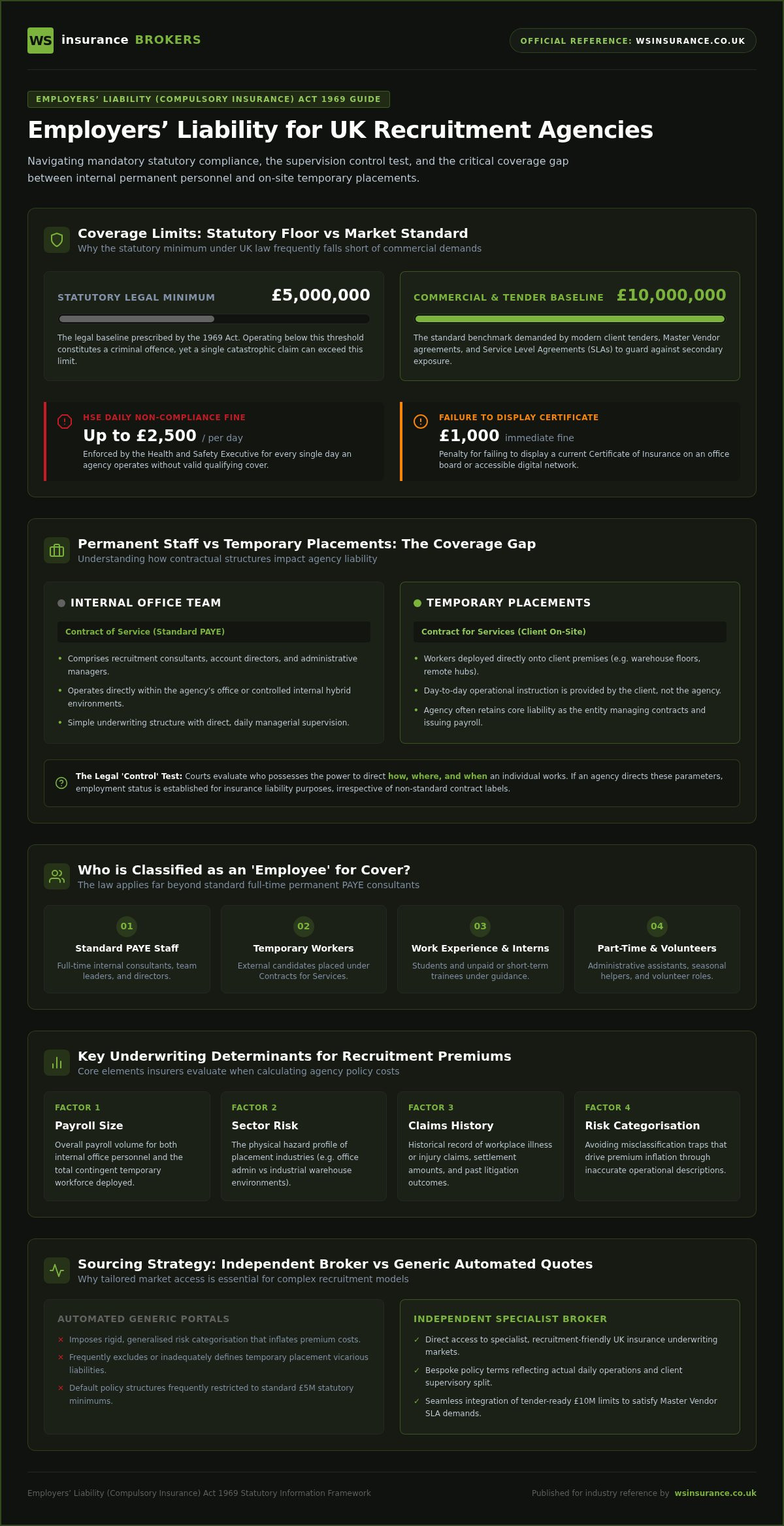
The Employers’ Liability (Compulsory Insurance) Act 1969 serves as the bedrock of workplace safety across the United Kingdom. For recruitment leaders, this legislation isn’t a mere administrative hurdle; it’s a mandatory safeguard that ensures your business can meet the cost of compensation for employee injuries or illnesses. Employers liability insurance for recruitment is a statutory protection for human capital. Operating without valid cover isn’t just a lapse in judgement, it’s a criminal offence. The Health and Safety Executive (HSE) enforces these rules strictly, with the power to issue fines of up to £2,500 for every single day you lack the required protection.
Whilst the law dictates a minimum cover limit of £5 million, this figure is rarely sufficient for a scaling agency. A single serious incident involving a temporary worker or a long-term illness claim from a permanent consultant can see legal fees and compensation awards spiral beyond this statutory floor. Most professional insurers and industry advisors now recommend a baseline of £10 million to provide a genuine safety net. Beyond the financial threat, the reputational damage of being named in an HSE enforcement action can be terminal for an agency’s growth prospects, making robust employers liability insurance for recruitment agencies UK a cornerstone of your risk management strategy.
Statutory Requirements vs. Client Contractual Demands
There’s often a disconnect between what the law requires and what your clients expect. Even if you are legally compliant with a £5 million policy, you’ll find that the majority of modern tender documents and Service Level Agreements (SLAs) demand a minimum of £10 million. Clients want the certainty that your agency won’t collapse under the weight of a claim, potentially leaving them exposed to secondary litigation. You are also legally required to display your current Certificate of Insurance. Whether you pin it to an office noticeboard or host it on a shared digital drive, it must be easily accessible to all staff. Failing to produce this certificate during an HSE inspection can result in an immediate £1,000 fine.
Defining the ‘Employee’ in a Recruitment Context
In the recruitment sector, the definition of an ’employee’ is broader than many directors realise. It isn’t limited to those on a standard PAYE contract. The law typically includes work experience students, volunteers, and part-time administrative staff within this bracket. The ‘control’ test is the primary tool used to determine liability; if your agency directs how, where, and when a person works, they are likely your employee for insurance purposes. This makes it vital to ensure your policy explicitly covers everyone under your guidance, removing any ambiguity that could lead to a declined claim during a dispute.
Permanent Staff vs. Temporary Placements: Navigating the Coverage Gap
Recruitment directors often face a dual challenge when structuring their protection. Your internal team of consultants and managers is straightforward to insure, as they operate under a standard Contract of Service. The real complexity lies with your temporary placements. These individuals often work under a Contract for Services, yet they remain your responsibility in the eyes of many insurers. Maintaining comprehensive employers liability insurance for recruitment agencies UK ensures that whether a staff member is at their desk in your office or on a warehouse floor twenty miles away, your agency is shielded from the financial fallout of a workplace injury.
The legal baseline is set by the Employers’ Liability (Compulsory Insurance) Act 1969, but the application of this law in recruitment is nuanced. Insurers look closely at the “control” test to determine where the duty of care sits. If a temp worker is injured, the courts will examine who had the power to tell them what to do. Even if your client provides the daily instructions, the agency often retains the core liability as the entity that pays the worker and manages the overarching contract. Securing the right employers liability insurance for recruitment agencies UK involves more than a tick-box exercise; it requires a deep dive into the specific risks of your chosen industries.
The Role of the ‘Hired-in’ Worker
Many agencies believe that workers placed through Umbrella companies are entirely the Umbrella’s problem. This is a dangerous assumption. Whilst the Umbrella provides the payroll and basic cover, your agency can still be pulled into a claim if the client or the worker alleges negligence in the placement process. A “hired-in” worker clause is a vital component of a recruitment-specific policy. It removes the uncertainty regarding who is the “employer” by extending your protection to cover staff you’ve placed with third parties, regardless of their specific tax status.
Sector-Specific Risk Profiles
Your premium is a direct reflection of the environments where your temps work. Placing office-based IT contractors is perceived as low risk, whereas placing manual labourers in the light industrial or construction sectors involves a higher probability of physical injury. Safety-critical roles in energy or rail require even more granular scrutiny. It’s essential to provide your broker with accurate trade descriptions; failing to disclose that a worker is operating at height or using heavy machinery can lead to a voided policy. Ensuring your recruitment agency insurance is tailored to your specific sectors will prevent these costly oversights.
Vicarious Liability: The Invisible Risk in Recruitment
For many recruitment directors, the concept of vicarious liability remains a secondary concern until a claim lands on their desk. This legal principle dictates that an employer is responsible for the negligent acts or omissions of their employees, provided those acts occur during the course of their employment. In a recruitment context, this creates a unique vulnerability; you are often held accountable for the behaviour of individuals you do not directly supervise. Vicarious liability acts as a legal ‘bridge’ between the temp’s action and the agency’s bank account. Without the right protection, a single mistake by a placement can lead to a direct financial drain on your business.
The challenge lies in the intersection of different covers. Whilst your permanent staff are typically covered for injury under standard employers liability insurance for recruitment agencies UK, the actions of your temporary placements often fall into a grey area. Professional Indemnity (PI) insurance usually covers financial loss resulting from professional errors, but it may not address physical injury or property damage caused by a temp’s negligence. Most UK firms are legally required to hold employers’ liability insurance, yet few realise that a basic policy often stops at the office door. This leaves the agency exposed if a placement causes a serious accident on a client’s premises.
Standard vs. Specialist Liability Wordings
Generic business insurance is built for companies where staff work under one roof and one set of safety protocols. Recruitment is different. A “standard” liability extension might only cover clerical errors, leaving you vulnerable if a placement causes physical harm to a third party or damages expensive equipment. You need bespoke employers liability insurance for recruitment agencies UK that explicitly includes vicarious liability for the physical actions of your placements. Identifying these non-standard risks early allows for precise underwriting, removing the uncertainty that comes with off-the-shelf policies.
Protecting Against ‘Drivers’ Negligence’
If your agency specialises in placing HGV or delivery drivers, the risks are significantly magnified. Standard employers’ liability won’t pay for the damage to a client’s vehicle if your driver misjudges a corner or fails to secure a load correctly. Drivers’ negligence cover is a specialist addition that fills the gap between the vehicle’s own motor insurance and the agency’s broader liability programme. It ensures that a minor lapse behind the wheel doesn’t escalate into a major contractual dispute or a crippling financial loss for your agency.
Calculating Costs and Managing Agency Risk in 2026
Calculating your premium involves a precise assessment of several variables. Insurers don’t just look at your agency’s name; they scrutinise your turnover, the size of your payroll, and the specific risk profile of the sectors you serve. A high-turnover agency placing medical professionals will face a different premium structure than a smaller firm focused on heavy engineering. Your claims history also plays a pivotal role. A clean record suggests a disciplined approach to safety, whilst a string of minor incidents can signal underlying systemic issues to an underwriter. Securing competitive employers liability insurance for recruitment agencies UK depends on how well you manage these perceptions. To gain a broader perspective on your total exposure, you can read our guide on How to Identify Business Risks to Insure Against in 2026: A UK Strategy Guide.
Your ‘Terms of Business’ are equally critical. By clearly outlining the safety responsibilities of your clients, you create a contractual barrier that protects your own loss ratio. This proactive approach to documentation removes the ambiguity that often leads to expensive litigation and helps maintain your agency’s reputation as a reliable partner.
The Importance of Accurate Payroll Forecasting
Underestimating your temporary payroll is a common pitfall that can lead to severe financial consequences. Many policies for employers liability insurance for recruitment agencies UK are declaration-based. This means you provide an estimate at the start of the year and adjust it based on actual figures at the end. If you significantly underestimate your payroll, insurers may apply ‘average’ clauses during a claim, potentially reducing the payout in proportion to the underinsurance. Maintaining transparency with your broker throughout the year allows for mid-term adjustments, preventing sudden premium shocks and ensuring your coverage remains valid at all times.
Risk Management Strategies for Recruiters
Managing risk effectively requires more than just buying a policy; it involves demonstrating due diligence to your insurer. Robust vetting procedures for candidates and clear, written contracts help define where ‘direction and control’ truly lie. These documents act as a shield, proving to underwriters that you have taken every reasonable step to mitigate potential hazards. An independent broker acts as your advocate here, helping you present a compelling ‘risk story’ to the market. By highlighting your internal safety protocols and contract clarity, we can often source more competitive rates from specialist UK insurers. To start refining your own policy, you can request a bespoke insurance review today.
Why an Independent Broker is Essential for Recruitment Protection
Automated quote engines offer speed, yet they frequently fail to capture the intricate realities of a modern recruitment firm. These digital platforms prioritise high-volume, low-complexity risks, which leaves agencies with diverse placement portfolios exposed to significant coverage gaps. When you seek employers liability insurance for recruitment agencies UK, you aren’t just buying a certificate; you’re investing in a protective outcome. WS Insurance Brokers provides access to a specialist panel of ‘recruitment-friendly’ insurers who understand that your risk doesn’t stop at your office door. For a deeper understanding of how this partnership functions, you can explore our resource on Insurance Brokers: The Complete 2026 Guide to Professional Risk Placement.
The value of a broker is most evident during a crisis. If a temporary worker causes a major incident on a client’s site, you need more than an automated email response. You require a dedicated claims advocate who understands the nuances of vicarious liability and can stand as a shield between your agency and the complexities of the legal system. This personal accessibility removes the uncertainty that plagues generic insurance products, providing a steady hand when you need it most.
Bespoke Policy Management vs. Off-the-Shelf Cover
Off-the-shelf policies often treat recruitment as a generic clerical business. This approach is dangerous because it ignores the need for vicarious liability extensions or fidelity bonding to protect against candidate dishonesty. We specialise in bespoke policy management, ensuring your cover is as unique as your candidate list. By bundling your employers’ liability with Professional Indemnity and Cyber cover, we create a unified wall of security that eliminates overlaps and reduces administrative friction. Because we are independent, our loyalty remains firmly with your agency rather than any single insurer.
Securing Long-Term Security in a Shifting Market
The insurance market is in a constant state of flux, with appetite for recruitment risks shifting between providers. We monitor these trends proactively to ensure your employers liability insurance for recruitment agencies UK remains both relevant and competitively priced. Our status as an FCA-regulated firm provides the transparency and integrity you require from a trusted advisor. We invite you to engage in a consultative review of your current agency insurance, allowing us to identify potential weaknesses and replace them with certainties. Securing your agency’s future starts with a conversation that prioritises your long-term security over a simple transaction.
Future-Proofing Your Agency Against Liability Risks
Operating a recruitment firm in 2026 requires a shift from viewing insurance as a commodity to seeing it as a strategic shield. You’ve seen how the legal minimums often fall short of modern client expectations and how the ‘control’ test can leave you exposed to vicarious liability claims. Securing the right employers liability insurance for recruitment agencies UK isn’t just about ticking a box for the HSE; it’s about protecting your reputation and your bottom line from the actions of staff you don’t directly supervise.
WS Insurance Brokers acts as your trusted advisor, removing the anxiety of the selection process through independent, FCA-regulated advice. We provide access to a panel of specialist UK recruitment insurers and offer dedicated claims advocacy to support you when it matters most. Rather than settling for an off-the-shelf policy that leaves gaps in your protection, take the next step toward total business security. Request a bespoke recruitment insurance consultation from WS Insurance Brokers today and ensure your agency is built on a foundation of certainty and professional reliability.
Frequently Asked Questions
Is employers’ liability insurance legally required for recruitment agencies in the UK?
Yes, holding this insurance is a legal mandate for any UK recruitment agency that employs staff. Under the Employers’ Liability (Compulsory Insurance) Act 1969, you must maintain a minimum of £5 million in cover. Most commercial contracts and specialist brokers recommend £10 million to ensure adequate protection. This requirement applies to permanent office staff and often extends to temporary workers, depending on the nature of their contract and the level of control your agency exerts.
Does my recruitment agency need EL insurance for contractors or freelancers?
Whether you need cover for contractors depends on their specific working relationship with your agency. If you exercise direction and control over how they perform their duties, insurers and the law will likely classify them as employees. This is particularly relevant for those on a PAYE basis or working through umbrella structures. To remove uncertainty, it’s safer to include these individuals under your employers liability insurance for recruitment agencies UK policy to prevent significant coverage gaps during a claim.
What is the difference between public liability and employers’ liability for recruiters?
Public liability insurance protects your agency against claims from third parties, such as clients or members of the public, for injury or property damage. In contrast, employers’ liability is specifically designed to cover your own staff and placements if they suffer an injury or illness whilst working for you. For a recruiter, the lines often blur when a temp causes damage at a client site; having both covers correctly aligned is essential for complete security.
How much does employers’ liability insurance cost for a UK recruitment agency?
The cost of your premium is determined by several factors, including your total payroll size, annual turnover, and the risk profile of the sectors you serve. Placing manual labourers in construction generally incurs higher costs than placing office-based clerical staff. Your claims history also influences the final figure. Because every agency has a unique risk profile, working with an independent broker allows you to source competitive rates from a panel of specialist insurers rather than relying on generic estimates.
Does EL insurance cover my temps if they are working from home?
Most modern policies extend cover to temporary workers even if they are operating from a home office. Your agency still maintains a duty of care regarding their health and safety in a remote environment. It’s vital to ensure your policy doesn’t contain restrictive “premises only” clauses that could void cover for remote placements. We recommend reviewing your specific policy wording with a specialist to ensure your hybrid and remote workers are fully protected against workplace-related injuries or illnesses.
What is vicarious liability, and do I need a specific extension for it?
Vicarious liability is the legal principle that makes your agency responsible for the negligent acts or errors committed by your placements. In the recruitment sector, this is a critical risk because you are often held liable for a temp’s mistake at a client’s premises. You should ensure your policy includes a specific extension for vicarious liability, as standard business insurance often excludes the physical actions of staff working under the supervision of a third party.
What happens if I don’t have the correct EL insurance for my temporary workers?
Failing to maintain the correct employers liability insurance for recruitment agencies UK can lead to severe penalties from the Health and Safety Executive. You can be fined up to £2,500 for every day you are without valid cover. Beyond the financial cost, your agency faces significant reputational damage and potential personal liability for directors. This lack of compliance can also lead to immediate contract terminations by clients who require proof of valid insurance as part of their SLAs.
Can I get a combined policy for Professional Indemnity and Employers’ Liability?
Yes, it is common and often more cost-effective to bundle Professional Indemnity, Public Liability, and Employers’ Liability into a single recruitment agency insurance package. This combined approach ensures there are no overlaps or gaps between different sections of your cover. It also simplifies your administration and claims process. An independent broker can help you structure these bespoke programmes, ensuring that every element of your agency’s risk is managed under one cohesive and transparent policy.