
Selecting the lowest monthly premium might be the most expensive mistake you ever make for your family’s long-term security. Choosing between life insurance vs critical illness cover UK often feels like a gamble against the fine print, where one misinterpreted medical definition could jeopardise a future claim. You want to protect those who matter most, yet the sheer volume of insurers and varying survival periods can leave even the most diligent person feeling overwhelmed. We understand that the fear of a policy failing to pay out creates unnecessary anxiety during an already difficult time.
This 2026 guide provides a methodical framework to cut through the jargon, ensuring your coverage is robust, transparent, and, above all, claim-ready when it’s needed most. We’ll examine the core functional differences between these protections, provide a definitive evaluation checklist for comparing providers, and explain why the survival period is the most critical metric you aren’t currently tracking. By the end, you’ll have the confidence to select a bespoke policy that acts as a genuine shield for your lifestyle and financial commitments.
Key Takeaways
- Distinguish between the legacy protection of life cover and the living benefits of critical illness protection to ensure your family’s lifestyle remains uninterrupted.
- Understand the mandatory survival periods, often between 14 and 30 days, which are essential for a successful claim under UK critical illness policies.
- Learn to evaluate life insurance vs critical illness cover UK by looking beyond the monthly premium to the specific medical definitions and exclusions that matter most.
- Identify the correct policy structure, such as choosing between accelerated or additional payouts, to align with your mortgage or personal debt obligations.
- Discover how an independent, whole-of-market approach identifies bespoke solutions that comparison sites and automated algorithms often overlook.
The Strategic Interplay Between Life Insurance and Critical Illness Cover
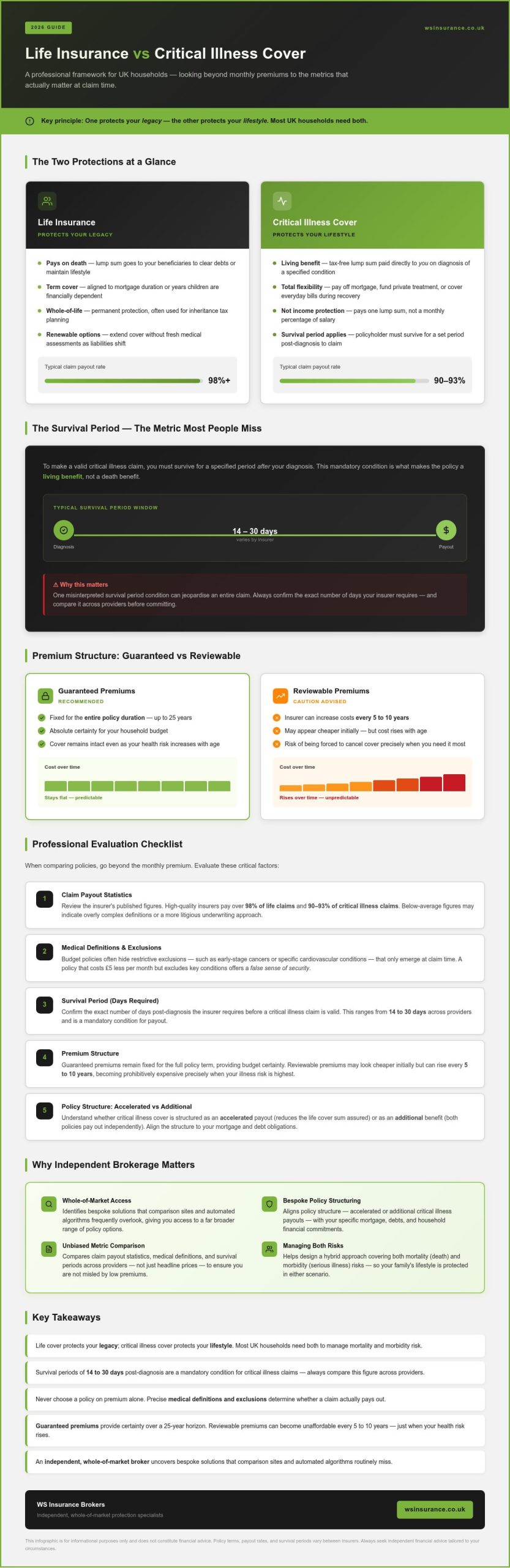
Understanding the distinction between life insurance and critical illness cover is the first step toward true financial resilience. Life insurance acts as a final safety net; it ensures that your beneficiaries receive a lump sum to clear debts or maintain their lifestyle after you’re gone. Conversely, critical illness cover serves as a living benefit. It provides a tax-free payment directly to you upon the diagnosis of a specified condition. When evaluating life insurance vs critical illness cover UK, you must recognise that one protects your legacy whilst the other protects your lifestyle.
Most UK households require a hybrid approach to manage both mortality and morbidity risks. Whilst we often plan for the “if I die” scenario, the psychological shift toward “if I am too ill to work” is where comprehensive protection begins. Surviving a major health event like a stroke or heart attack can be a financial catastrophe without a bridge to replace lost income. Integrating both policies removes the uncertainty of how your family would cope if you were suddenly removed from the workforce, either temporarily or permanently.
Life Insurance: Term vs Whole-of-Life
Critical Illness: A Financial Bridge
A critical illness insurance policy delivers a lump sum that replaces your income during lengthy recovery periods. This payment offers total flexibility; you might use it to pay off the mortgage, fund private medical treatment, or simply cover the bills whilst you focus on getting better. It differs fundamentally from income protection, which pays a monthly percentage of your salary rather than a single payout. A valid claim requires the policyholder to survive for a specific duration following diagnosis, typically ranging from 14 to 30 days depending on the insurer’s terms. This survival period is a mandatory condition that ensures the policy functions as a living benefit rather than a death benefit.
A Professional Framework: Comparing Policies Beyond Monthly Premiums
Price is a poor proxy for protection. Whilst comparison sites prioritise the lowest monthly premium, these budget options often hide restrictive medical exclusions that only come to light during a claim. When evaluating life insurance vs critical illness cover UK, the true value lies in the contract’s precision. A policy that costs £5 less per month but excludes early-stage cancers or specific cardiovascular conditions offers a false sense of security. Reliable protection requires a shift in focus from the cost of the premium to the certainty of the payout.
One of the most significant trust metrics you should examine is an insurer’s published claim payout statistics. These figures provide a transparent look at how often a provider actually delivers on its promises. High-quality insurers in 2026 typically pay out over 98% of life claims and roughly 90% to 93% of critical illness claims. If a provider’s statistics fall below industry averages, it often indicates overly complex medical definitions or a more litigious approach to underwriting. Choosing an independent broker to compare these metrics ensures you aren’t misled by headline prices alone.
Premium structure also dictates long-term affordability. Guaranteed premiums remain fixed for the entire 25-year duration of a policy, providing absolute certainty for your household budget. Reviewable premiums may appear attractive initially because they are cheaper, but they allow the insurer to increase costs every five to ten years. Over a long-term horizon, a reviewable policy can become prohibitively expensive just as your risk of illness increases, potentially forcing you to cancel the cover when you need it most.
Assessing Definition Breadth
Modern policies are moving toward severity-based payouts. This means that instead of an “all or nothing” approach, the insurer may pay out a percentage of the sum assured for less severe, but still life-altering, diagnoses. You should also distinguish between “Own Occupation” and “Any Occupation” for Total and Permanent Disability (TPD). Own Occupation is the gold standard; it ensures a payout if you cannot perform your specific job. Any Occupation is far more restrictive, as the insurer could deny a claim if they believe you are capable of performing any form of work, regardless of your professional background.
The Role of Added Value Services
Comprehensive policies now include services that provide immediate ROI whilst you are healthy. Many top UK providers offer 24/7 virtual GP access, mental health support, and second medical opinion services from global specialists. These aren’t just “extras”; they are integral tools for early intervention and rehabilitation. Accessing a world-class consultant to verify a diagnosis can remove immense pressure from a family. When you weigh up different providers, consider how these clinical support services enhance your overall security beyond the eventual financial payout.
Navigating the Complexity of Medical Definitions and Survival Periods
Medical definitions are the engine room of your policy. Whilst the Association of British Insurers (ABI) provides a baseline for coverage, top-tier providers often go much further to ensure claim-ability. When weighing up life insurance vs critical illness cover UK, you’ll find that the latter’s complexity lies in the “Big Three” conditions: cancer, heart attack, and stroke. These account for the vast majority of claims, yet the specific wording can vary significantly between a standard policy and a premium one. A high-quality contract removes the uncertainty of whether a diagnosis is “severe enough” to trigger a payout.
One of the most misunderstood elements is the survival period trap. Unlike life insurance, which triggers upon death, critical illness cover requires the policyholder to survive for a mandatory period following diagnosis. This is usually between 14 and 30 days. If the policyholder passes away within this window, the critical illness element won’t pay out, and the claim would instead fall under the life insurance portion of a combined plan. This distinction is vital for ensuring your family has a comprehensive safety net that covers all eventualities. Modern policies often include partial payments for lesser conditions, which provides immediate financial support whilst keeping the full policy in force for the future.
Cancer Definitions: “In Situ” vs Invasive
Medical advancements in 2026 mean we’re catching illnesses earlier than ever. This creates a challenge for policy wording. Many standard contracts only trigger a full payout for invasive cancers that have spread. Early-stage “in situ” conditions, which haven’t breached the surrounding tissue, might only result in a partial payment or no payout at all. Top-tier insurers handle non-invasive surgeries with more empathy, often offering specific “additional cover” for these early diagnoses. This ensures you receive a lump sum to aid recovery without reducing the main sum assured you’ve set aside for more severe events.
Cardiovascular Cover: Beyond the Standard Heart Attack
A heart attack isn’t a single medical event in the eyes of an underwriter. Insurers now use specific clinical metrics, such as ejection fraction levels, to dictate payout percentages. Ejection fraction measures how effectively your heart pumps blood; if your heart remains strong despite the event, a basic policy might not pay out in full. Similarly, stroke definitions have evolved. Whilst older policies required permanent neurological symptoms to last for weeks, modern, high-quality wording might trigger a claim based on clinical imaging alone. Comparing these nuances ensures your protection keeps pace with modern medicine rather than relying on outdated, restrictive definitions.
Strategic Policy Structuring for Diverse Client Needs
Structuring your protection requires more than just picking a provider; it involves aligning the payout mechanism with your specific UK liabilities. Level term insurance maintains a constant sum assured, making it the ideal choice for replacing a salary or covering interest-only mortgages. Conversely, decreasing term cover is designed to mirror the reducing balance of a repayment mortgage. When you compare life insurance vs critical illness cover UK, you must also decide between accelerated and additional payouts. An accelerated policy pays out on the first event, whether that’s death or illness, and then ends. An additional payout structure keeps the life insurance in force even after a critical illness claim is settled, providing a double layer of security.
Integrated vs Standalone Cover
Combining life and critical illness into a single integrated plan is often the most cost-effective route for young families. However, high-income earners often benefit from standalone policies. Standalone cover provides superior protection because a claim on the critical illness portion does not reduce or cancel the life insurance. Whilst multi-policy discounts are available amongst top insurers, the comprehensive security of having two independent pots of cover often outweighs the modest savings of an integrated plan. This separation ensures that a health scare earlier in life doesn’t leave you without death benefits in your later years.
The Vital Importance of Writing Policies in Trust
Placing your policy in trust is perhaps the most significant step in removing uncertainty for your beneficiaries. Without a trust, the payout becomes part of your estate and must go through probate, a process that can take six months or longer. A policy written in trust usually pays out within four weeks, providing immediate liquidity when it’s needed most. This structure also ensures the payout remains outside your estate for Inheritance Tax purposes, potentially saving your family thousands of pounds. This level of meticulous planning is equally important for entrepreneurs, as detailed in our guide to Business Insurance UK. To ensure your family receives their funds without unnecessary delays, you can speak with our expert advisors about setting up a trust today.
Why Independent Brokerage is Essential for Accurate Comparison
Algorithms excel at sorting by price; they fail at assessing the human nuance of a complex medical history. When comparing life insurance vs critical illness cover UK, a whole-of-market broker identifies the specific policy wordings that align with your health profile. This whole-of-market advantage ensures we look where algorithms cannot reach, accessing insurers that don’t appear on standard comparison sites. We act as a protective shield between you and the insurers, managing the medical evidence process to ensure your application is presented in the best possible light.
Pre-underwriting is a critical part of our proactive labour. If you have pre-existing conditions, we’ll speak to underwriters directly before you even apply. This removes the anxiety of a potential decline or a heavily loaded premium that makes the cover unaffordably expensive. Our role doesn’t end once the policy is in force. We provide ongoing management, reviewing your protection as your family grows or your financial commitments evolve, ensuring your safety net remains robust over the decades.
The Human Element in a Digital Market
A 20-page PDF comparison cannot replicate the clarity of a conversation with a specialist. Our Insurance Brokers leverage their industry tenure to negotiate bespoke terms that automated platforms overlook. We translate clinical jargon into plain English, allowing you to make decisions based on facts rather than fear. This consultative approach prioritises your long-term security over a quick transaction, ensuring the policy you select is actually claim-ready when it matters most.
Claims Advocacy: The Ultimate Test of Integrity
The true value of a broker is revealed at the point of a claim. If an insurer disputes a medical definition or queries the severity of a condition, we step in as your professional advocate. WS Insurance Brokers supports families during these difficult times, using our industry standing to challenge unfair decisions. When the time comes to claim on your life insurance vs critical illness cover UK, having a steady hand to manage the process removes immense pressure from your loved ones. This advocacy is the final expression of our loyalty to you, turning a financial product into a genuine promise of security. Our team remains available for a personal consultation to help you secure a future defined by clarity and confidence.
Securing Your Financial Resilience for 2026 and Beyond
Building a robust safety net requires a shift from viewing insurance as a commodity to seeing it as a precise protective outcome. We’ve explored how medical definitions and survival periods dictate the success of a claim; choosing the wrong policy based on price alone can leave your family vulnerable when they need support most. Understanding the nuances of life insurance vs critical illness cover UK ensures that whether you’re protecting a legacy or securing your current lifestyle, your coverage is fit for purpose. A hybrid approach, structured within a trust, remains the gold standard for comprehensive security.
As an independent, FCA-regulated brokerage, we provide unbiased advice with access to the entire UK insurance market. We act as your expert guide, removing the uncertainty of complex jargon and ensuring your policies are truly claim-ready. Don’t leave your family’s future to the limitations of an algorithm. You can request a bespoke protection review from WS Insurance Brokers today to ensure your peace of mind is built on a foundation of clinical precision and personal accessibility. Your long-term security is our priority.
Frequently Asked Questions
Is it better to have life insurance and critical illness cover together?
Combining these protections into an integrated policy is often the most cost-effective solution for UK families. However, a standalone approach provides superior security because a claim on one doesn’t reduce the sum assured of the other. When comparing life insurance vs critical illness cover UK, the decision depends on whether you prioritise a lower monthly premium or maximum coverage for multiple health events over a 25-year term.
What is the “Survival Period” in a UK critical illness policy?
The survival period is a mandatory timeframe, typically between 14 and 30 days, that a policyholder must survive following a diagnosis for a claim to be valid. This clause ensures the policy functions as a living benefit. If the individual passes away within this window, the critical illness portion won’t pay out; instead, a life insurance claim would be initiated. This distinction is vital for ensuring your family has a comprehensive safety net.
Can I get life insurance if I have a pre-existing medical condition?
You can certainly obtain coverage even with a pre-existing condition, though the terms depend on the severity and management of your health. Independent brokers use pre-underwriting to speak with insurers directly before you apply, which removes the uncertainty of a potential decline. By accessing the entire market, we identify providers who specialise in specific risks, ensuring you receive a bespoke solution rather than a generic refusal from an automated system.
Does critical illness cover pay out for mental health issues in 2026?
Many top-tier critical illness policies in 2026 now include coverage for specific, severe mental health conditions, provided they meet the insurer’s strict clinical definitions. Coverage often focuses on conditions that require significant medical intervention or hospitalisation. It’s essential to review the fine print, as standard budget policies may exclude mental health entirely. A specialist review helps you identify which insurers provide these modern, integrated support services as part of their core contract.
How much life insurance do I actually need for my family?
Your coverage should ideally clear all outstanding debts, including your mortgage, whilst providing a lump sum to replace your income for several years. A common rule of thumb is ten times your annual salary, but a bespoke review accounts for specific liabilities like school fees or inheritance tax. Calculating the right amount removes the risk of being underinsured, ensuring your beneficiaries can maintain their lifestyle without financial hardship in your absence.
What is the difference between “Level” and “Decreasing” term insurance?
Level term insurance provides a fixed sum assured that remains constant throughout the policy’s duration, making it ideal for family protection or interest-only mortgages. Decreasing term insurance features a sum assured that reduces over time, typically in line with the balance of a repayment mortgage. Whilst decreasing term is generally more affordable, level term offers greater long-term value for those wanting to leave a specific legacy for their dependents.
Why do some insurers pay out only 50% for certain conditions?
Severity-based payouts are common in modern UK policies to provide financial support for less critical conditions whilst keeping the main policy in force. For example, an early-stage cancer diagnosis might trigger a 50% partial payment, whereas an invasive diagnosis would result in a full 100% payout. This tiered approach ensures you receive assistance during recovery without exhausting your entire safety net, providing a more flexible and responsive form of protection.
How often should I review my protection policies with an independent broker?
We recommend reviewing your protection every two to three years or whenever a significant life event occurs, such as moving house, getting married, or having a child. As your career evolves and your liabilities change, your old policy may no longer be fit for purpose. Regular consultations ensure your coverage remains competitive and reflects the current medical definitions in the 2026 market, maintaining your family’s security at every stage.