
Did you know that over 40% of business interruption declarations are underinsured, often leaving firms with less than half the protection they actually need? When you are faced with a major disruption, the fear that insurance funds might run out before your customers return is a heavy burden to carry. We understand the pressure to keep premiums manageable whilst ensuring your livelihood remains secure. Having the business interruption indemnity period explained in plain English is the first step toward removing that uncertainty and protecting your future.
It is common to feel that once the doors are open, the crisis is over; however, true recovery often takes much longer than the physical repairs. This guide provides a clear, methodical framework for calculating a safe indemnity period that accounts for more than just bricks and mortar. You will discover why the physical rebuilding time is often the shortest part of the journey and how to select a period that supports your business until turnover fully recovers. By the end of this article, you will have the confidence to stress-test your recovery timeline and ensure your policy acts as a genuine shield for your long-term security.
Key Takeaways
- Distinguish between the time required for physical repairs and the often longer duration needed for your turnover to return to pre-loss levels.
- Having the business interruption indemnity period explained ensures you avoid the common 12-month trap that leaves many UK firms dangerously underinsured.
- Identify the external factors, such as planning permissions and forensic investigations, that frequently extend recovery timelines beyond initial expectations.
- Learn to select the correct basis of cover to ensure your financial support remains steady whilst you focus on reclaiming your market share.
- Secure your long-term stability by stress-testing your recovery plan against real-world scenarios rather than relying on generic, off-the-shelf policy limits.
What is a Business Interruption Indemnity Period?
A business interruption indemnity period is the specific duration during which your insurer provides financial support following a claimable event, such as a fire, flood, or major theft. It is the lifeline that bridges the gap between catastrophe and recovery. When a disaster strikes, your revenue stream is often severed instantly, but your fixed costs don’t stop. Staff wages, loan repayments, and standing charges remain due whilst your production line is silent. The indemnity period provides the essential liquidity needed to meet these obligations, acting as a shield between your business and insolvency. It’s the mechanism that keeps your key personnel on the payroll and ensures your suppliers remain confident in your future.
Understanding how this works is vital for your long-term security. Having the business interruption indemnity period explained in the context of your specific operations allows you to identify exactly how long you could survive without a steady income. It isn’t merely a “buffer” for a few weeks of closure; it’s a comprehensive financial recovery window that begins the moment the physical damage occurs. Without an adequate period, even the most successful firm can face total failure whilst waiting for repairs to finish.
Maximum vs. Actual Indemnity Periods
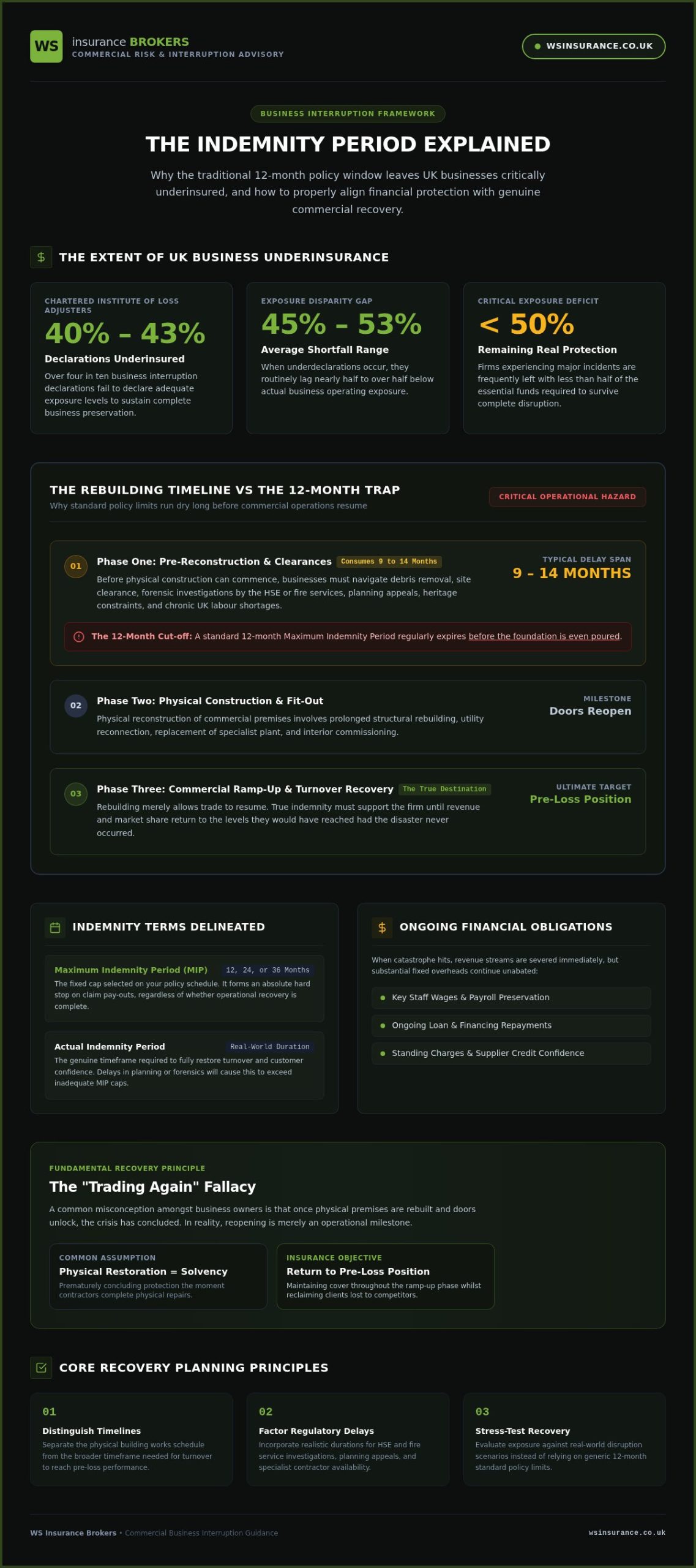
Your policy schedule will list a Maximum Indemnity Period, commonly referred to as the MIP. This is the ultimate time limit on your claim. It is a fixed cap, typically set at 12, 24, or 36 months depending on your choice at the start of the policy. In contrast, the Actual Indemnity Period is the real-world time it takes for your business to fully recover. If your recovery is swift, the actual period may be shorter than your MIP. However, if your recovery is delayed by external factors, the MIP acts as a hard stop. Choosing the right cap is a delicate balancing act. You want to keep premiums efficient whilst ensuring the safety net is wide enough to catch you if things go wrong. Most modern UK businesses find that a 12-month cap is far too short for current regulatory and construction realities.
The Goal of Indemnity: Returning to ‘Pre-Loss’ Position
The “trading again” fallacy is one of the biggest risks facing SMEs today. Just because you’ve rebuilt your premises and started serving customers doesn’t mean your bank balance has recovered. The fundamental goal of business interruption insurance is to return your firm to the financial position it would have enjoyed had the damage never occurred. This means the cover should continue until your turnover and market share are fully restored. Reopening is merely a milestone; full recovery is the destination. Your policy must account for the difficult “ramp-up” phase where you are winning back clients who moved to competitors during your absence. A robust business insurance strategy ensures that your financial position is protected even during the slow climb back to full profitability.
Calculating the Correct Length: Why 12 Months is Rarely Enough
Historically, a 12-month indemnity period was the default for many UK commercial packages. However, in 2026, this timeframe is often dangerously inadequate. Industry data from the Chartered Institute of Loss Adjusters indicates that between 40% and 43% of business interruption declarations are underinsured. When you consider that underdeclarations often run 45% to 53% below actual exposure, it’s clear that the ’12-month trap’ is a systemic risk to business survival. Choosing a period that is too short doesn’t just mean the money stops early; it means your business might never reopen at all.
The Rebuilding Timeline
The physical reconstruction of a commercial property involves far more than just laying bricks. Before a single contractor arrives, you must navigate debris removal, site clearance, and potentially lengthy forensic investigations by the HSE or fire services. In 2026, real-world rebuild approvals regularly consume 9 to 14 months before construction even begins. This delay is driven by appeals, heritage constraints, and chronic labour shortages within the UK construction sector. According to the National Association of Insurance Commissioners, these periods of restoration are critical for calculating lost income accurately. If you’ve only secured a 12-month window, your insurance support could expire before the foundation is even poured. Specialist equipment lead times add another layer of complexity. If your production relies on bespoke machinery with a 6-month shipping bottleneck, your indemnity period must account for this lag.
The Customer Retention Factor
A business doesn’t exist in a vacuum. Whilst your doors are closed, your loyal customers are forced to find alternatives. Winning them back requires significant marketing effort and time. It’s a common mistake to assume that the business interruption indemnity period explained in your policy only covers the time you are physically closed. In reality, you need protection that continues until your turnover returns to its pre-loss trajectory. This ramp-up phase is often the most volatile part of your recovery. You’ll need to fund promotional campaigns and potentially offer discounts to reclaim market share.
If you’re concerned about your current coverage, you can speak with an independent broker to stress-test your timeline against these realistic 2026 benchmarks. Relying on a generic 12-month limit is a gamble that few businesses can afford to lose. Your recovery depends on a period that reflects the true speed of the modern market, not just the speed of a builder.
The Hidden Hurdles: Planning, Regulatory Delays, and Market Share
When you have the business interruption indemnity period explained in full, it becomes clear that physical rebuilding is often the final stage of a much longer journey. The clock starts ticking the moment your property is damaged, but the actual work rarely begins immediately. There is a silent interval between the disaster and the first brick being laid; this is where many businesses find their indemnity periods are too short. Mandatory forensic investigations by the fire service or the Health and Safety Executive (HSE) can freeze your site for weeks, if not months, preventing any clearance or assessment. Early identification of these procedural bottlenecks is a cornerstone of identifying business risks that could otherwise derail your long-term survival.
Regulatory and Planning Obstacles
Navigating the UK planning system in 2026 remains a complex undertaking for commercial property owners. Whilst statutory determination periods for minor developments stand at 8 weeks, major developments often require 13 to 16 weeks for a decision. However, real-world data from loss adjusters confirms that rebuild approvals regularly consume between 9 and 14 months. This delay is often exacerbated by site clearance requirements, environmental constraints, or appeals. If your business operates from a listed building, the hurdles are even higher. Sourcing heritage materials and adhering to conservation officer demands can add significant time to your restoration. Building Control requirements may also have changed since your original construction, forcing a complete redesign to meet modern safety or carbon efficiency standards. These regulatory ‘stop’ periods happen whilst your revenue is at zero, making an adequate time ceiling essential.
The Market Displacement Risk
The damage to your business isn’t limited to the physical structure; it extends to your standing in the market. Seasonal firms face a particularly high risk; missing a single peak trading window can result in a ‘double hit’ to annual revenue that takes years to overcome. Even for non-seasonal firms, the difficulty of recruiting and retraining skilled staff amongst a competitive job market can slow your return to full capacity. According to the Insurance Information Institute’s guide to business interruption, the period of restoration must account for these real-world market frictions. This is why a 24 or 36-month indemnity period is increasingly becoming the UK industry standard for businesses seeking genuine stability. It provides the breathing space needed to reclaim your market share and ensure your customers don’t permanently migrate to your competitors whilst you are offline.
Revenue vs. Gross Profit: How Policy Basis Affects Your Period
The financial metric you choose to protect is just as critical as the length of time you select. If your financial definitions are flawed, even a 36-month window cannot prevent a shortfall. This relationship between the money and the time is why having the business interruption indemnity period explained alongside your “basis of cover” is so vital. Whilst some firms only need to cover the increased cost of working (ICOW) to relocate quickly, others require a full Gross Profit or Gross Revenue basis to survive. A professional insurance broker acts as your expert guide here, ensuring your policy definitions align perfectly with your real-world recovery needs.
Choosing the Right Financial Metric
- Gross Profit Basis: Best for manufacturing and retail where variable costs are high and easy to define.
- Gross Revenue Basis: Preferred by professional services and digital firms where material costs are negligible.
- Declaration-Linked Policies: These provide a vital safety net by incorporating an automatic 133.33% uplift cushion over your declared estimate. This protects you against unforeseen growth or inflation during the indemnity period.
Extended Period of Indemnity Clauses
Many business owners assume the claim ends when the building is handed back by the contractors. This is a dangerous misconception. Your financial recovery often lags months behind the physical rebuild. An “Extended Indemnity” clause is designed to bridge this gap. It ensures that the insurer continues to pay for the shortfall in your earnings until your turnover reaches the level it would have achieved had the loss never occurred.
For landlords, this often takes the form of “Loss of Rent” cover, which is distinct from standard business interruption. Whilst a tenant might move back in at month 18, you may have offered a rent-free period to secure the lease, or the property might remain vacant for longer than expected. Without an extended clause, your support stops the moment the property is “habitable,” regardless of whether you are actually receiving rent. To ensure your financial definitions are robust enough for 2026, you can request a bespoke review of your policy basis from our independent team.
Securing Your Future: Why Professional Advice is Essential
The WS Insurance Broker Advantage
As an independent brokerage, we aren’t tied to a restricted list of providers. We access the entire breadth of the UK market to identify insurers who offer the most flexible and robust indemnity terms. This autonomy allows us to act as your fierce advocate, prioritising your long-term security over the immediate transaction. Our dedicated claims support serves as a protective shield between you and the technical complexities of the insurer’s requirements. We handle the clinical precision of the paperwork whilst you focus on leading your team through the crisis. This partnership approach ensures that your claim is processed with transparency and integrity from day one.
Designing Your Bespoke Protection
We replace “guestimation” with a methodical, data-driven approach to risk assessment. Our team “stress-tests” your recovery plan, ensuring that the business interruption indemnity period explained in your schedule matches the practicalities of the 2026 market. Recent survey data from Aviva reveals that 19% of businesses admit to not having reviewed their maximum indemnity period in over two years. This is a dangerous oversight in a market where supply chain bottlenecks and regulatory shifts can change your risk profile overnight. We recommend a thorough audit at every annual renewal to ensure your cover remains relevant to your growth and the external economic environment.
Your business deserves more than a commodity; it requires a protective outcome that eliminates doubt. A professional risk audit is the only way to determine your ideal period with absolute certainty. Contact WS Insurance Brokers today for a bespoke risk assessment.
Protecting Your Business Beyond the Rebuild
Selecting the right duration for your cover is about more than just predicting a construction timeline. It’s about ensuring your financial support lasts until your market share and turnover are fully restored. We have seen how regulatory delays and the complex ramp-up phase can quickly exhaust a standard 12-month policy, leaving your livelihood at risk. Having the business interruption indemnity period explained in the context of your specific operations allows you to move forward with absolute certainty. You don’t have to navigate these technical complexities alone.
As an independent UK-wide brokerage that is FCA Authorised and Regulated, we bring specialist commercial property expertise to every consultation. We act as your expert guide, stress-testing your recovery plan to eliminate the danger of underinsurance. You can Request a Professional Risk Review from WS Insurance Brokers to secure a bespoke solution that prioritises your long-term stability. Let us help you build a robust shield around your business so you can focus on future growth with complete peace of mind.
Frequently Asked Questions
What is the standard business interruption indemnity period in the UK?
Having the business interruption indemnity period explained in the context of 2026 realities is vital. Whilst 12 months was once the commercial default, many modern insurers now offer 24, 36, and 48-month options as standard. This shift addresses the reality that complex construction projects and supply chain bottlenecks often exceed one year. It’s essential to review your specific sector needs and lead times for specialist equipment rather than accepting a generic policy limit that could leave you exposed.
Can I increase my indemnity period mid-term?
You can absolutely increase your indemnity period mid-term through a mid-term adjustment. If your business has grown or you realise your current timeline is too optimistic, you should contact your broker immediately to update your cover. This ensures your protection remains aligned with your actual risk profile. Whilst a pro-rata premium may apply for the remainder of the policy year, it’s a small price for the security of a guaranteed financial safety net that removes any lingering doubt.
Does the indemnity period cover the time spent waiting for planning permission?
Yes, the indemnity period covers all delays resulting from the insured event, including the time spent waiting for local authority planning permissions. The business interruption indemnity period explained in your policy schedule must account for the fact that major developments often face protracted statutory determination periods. If your site is frozen due to environmental constraints or heritage appeals, the clock continues to run. Ensuring your period is long enough to cover these “silent” months is critical for your survival.
What happens if my business recovers faster than the indemnity period?
Your claim naturally terminates once your business returns to the financial position it would have achieved had the damage not occurred. The indemnity period is a maximum cap, not a guaranteed payment duration. If you regain your pre-loss turnover and market share within six months, the insurer’s liability ends there. This highlights why the period is a safety ceiling; you only use the portion required to bridge the financial gap back to full operational profitability and market stability.
Is the cost of the premium significantly higher for a 36-month indemnity period?
Increasing your indemnity period from 12 to 36 months doesn’t typically triple your premium. Insurers recognise that the risk of a total loss lasting the full three years is lower than a short disruption. You must proportionately increase your sum insured to 300% of annual turnover for a 36-month period to avoid average penalties. However, the rate applied to that sum often decreases for longer durations. It’s a cost-effective way to secure your long-term future without excessive overheads.
Does the indemnity period include the ‘waiting period’ or ‘excess’?
The indemnity period technically begins on the date of the physical damage, but some policies include a “time excess” or waiting period. This is a short duration, such as 48 hours or seven days, where you must self-fund the interruption before the insurer’s liability kicks in. You should check your specific policy schedule to see if a time-based excess applies. Most standard commercial property policies trigger cover immediately, provided the underlying physical damage claim is also valid and accepted.
How do I know if my business needs a Gross Profit or Gross Revenue basis?
Your choice depends on whether you have significant variable costs that stop when you stop trading. Manufacturing and retail firms usually opt for a Gross Profit basis, deducting variable expenses like raw materials. Professional services or digital consultancies usually prefer Gross Revenue, as their costs are mostly fixed salaries. Choosing the wrong basis can lead to catastrophic underinsurance. We recommend a professional risk audit to ensure your financial definitions match your actual recovery needs and long-term business goals.
Can an indemnity period be extended after a loss has occurred?
No, you cannot extend your maximum indemnity period once a loss has already taken place. The limits set in your policy schedule at the time of the incident are the absolute maximum the insurer will pay. This is why stress-testing your recovery timeline at every annual renewal is so vital. Waiting until a fire or flood occurs to realise your 12-month window is too short is a mistake that many businesses unfortunately don’t survive. Proactive planning is your best defence.