
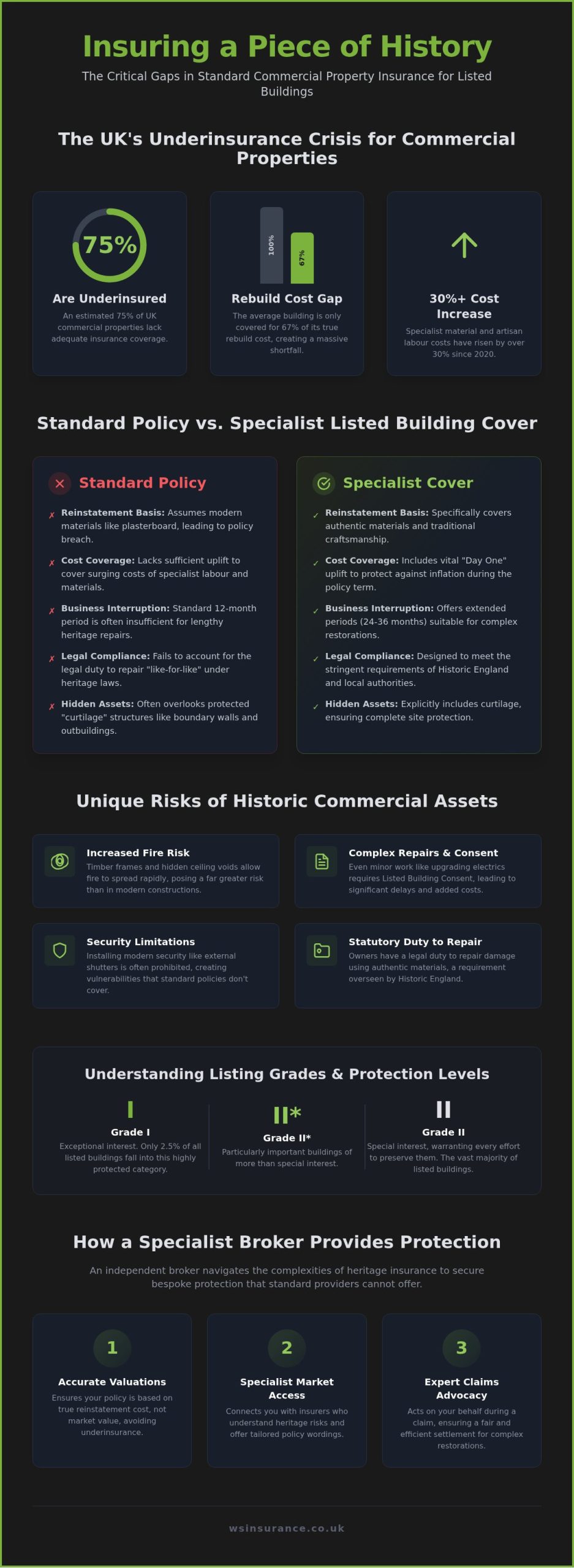
Did you know that an estimated 75% of UK commercial properties are currently underinsured, with the average building covered for only 67% of its true rebuild cost? When your asset is a heritage site, this gap isn’t just a financial risk; it’s a legal minefield. Securing the right commercial property insurance for listed buildings requires more than a standard policy. It demands a tailored strategy that treats your premises as a piece of history rather than a simple pile of bricks and mortar.
We understand the anxiety that comes with managing a Grade I or Grade II property, especially as specialist materials and artisan labour costs have risen by over 30% since 2020. You want the peace of mind that comes from knowing a claim will actually cover authentic restoration whilst you remain compliant with strict heritage laws. This guide provides the clarity you need to navigate the 2026 landscape, including the recent transfer of the Building Safety Regulator to the MHCLG. We will explore how to secure accurate reinstatement valuations, navigate the “Condition of Average” clause, and protect your business from the lengthy delays typical of heritage repairs.
Key Takeaways
- Identify why standard policies often fail to cover the unique craftsmanship and specialist materials required for heritage restoration.
- Understand your legal duty to repair Grade I and Grade II structures, ensuring every claim meets the strict “like-for-like” requirements.
- Learn how to calculate accurate reinstatement costs to avoid the common pitfalls of underinsurance when arranging commercial property insurance for listed buildings.
- Discover the critical difference between market value and reinstatement figures to ensure your policy acts as a dedicated restoration fund.
- See how partnering with an independent broker provides access to bespoke specialist markets and expert claims advocacy for complex heritage assets.
Why Listed Commercial Property Requires Specialist Insurance Protection
Owning a heritage asset is a mark of prestige, yet it transforms your risk profile from a simple commercial venture into a custodial one. Standard commercial property insurance usually operates on the assumption of modern reinstatement, where damaged walls are replaced with standard bricks and plasterboard. For a Listed building, this approach is legally impossible. You are mandated by law to restore the fabric of the building using authentic materials and traditional methods, which can be exponentially more expensive than modern alternatives.
Standard policies often fail listed owners because they lack the “Day One” uplift required to cover the surging costs of specialist labour and materials. Between 2020 and 2025, UK commercial rebuild costs rose by up to 35%. When you add the requirement for bespoke craftsmanship, the risk of underinsurance becomes a reality for 75% of UK commercial properties. Without a policy designed for heritage risks, you could be left with a significant financial shortfall that threatens the very existence of your business.
The Definition of a Listed Commercial Building
A property is added to the National Heritage List for England (NHLE) because of its special architectural or historic interest. Whether you operate out of a converted Victorian mill or a Georgian townhouse office, your obligations extend beyond the main structure. If you are looking to lease or manage such unique premises, you can learn more about Nikki Homes and their consultancy-led approach to characterful property. It’s vital to ensure your commercial property insurance for listed buildings covers “curtilage” structures. This includes boundary walls, outbuildings, and even pavings that were present before 1948. Overlooking these secondary assets can lead to significant out-of-pocket expenses during a claim, as they carry the same legal protection as the primary building.
Common Risks Unique to Historic Commercial Assets
Historic buildings weren’t designed with modern fire safety or data cabling in mind. Timber frames and hidden ceiling voids allow fire to spread rapidly, making the risk profile far higher than a purpose-built 2026 warehouse. Upgrading electrics or installing security systems often requires Listed Building Consent, as you cannot simply drill through 18th-century masonry without permission. These restrictions mean that even minor repairs take longer, which is why a standard 12-month business interruption period is rarely sufficient for a heritage site.
Security is another complex area. You can’t always install the latest external shutters or heavy-duty alarms without altering the building’s character. This creates a vulnerability that specialist insurers understand. They provide cover that respects the building’s integrity rather than penalising you for non-compliance with modern security standards that your building physically cannot meet. Specialist cover accounts for these extended timelines and physical limitations, providing the steady hand you need when restoration becomes a years-long project.
Understanding Listing Grades and the Legal Duty to Repair
The legal framework surrounding heritage assets in the UK is stringent. When you own a listed commercial property, you don’t just own a building; you own a piece of national history. This status carries a statutory duty to maintain and repair the structure in a way that preserves its historical character. For a clear breakdown of these categories, What Are Listed Buildings? provides the official government criteria used by Historic England. If your premises suffer damage, the “like-for-like” repair requirement means you cannot use modern, cheaper substitutes. You must source original materials, such as hand-knapped flint or specific types of lime mortar, which significantly inflates the cost of commercial property insurance for listed buildings.
Historic England plays a pivotal role during the restoration process, often requiring detailed surveys before work can even begin. This oversight ensures that the building’s historical integrity remains intact, but it also adds layers of complexity to any insurance claim. If you’re unsure how your listing grade affects your current policy, speaking with a specialist broker can help remove the uncertainty.
Grade I and II* Listings: The Highest Level of Protection
Grade I buildings comprise only about 2.5% of all listings, representing assets of exceptional interest. Grade II* accounts for around 5.8%. These structures present the highest risk for insurers because they often require highly specialised architects and master craftsmen who understand centuries-old construction techniques. The “Heritage Premium” is the additional financial outlay required to source authentic materials and specialist labour that standard modern policies simply do not account for. Because the pool of qualified contractors is small, repair times are long, often leading to higher business interruption claims that reflect the true time needed for restoration.
Grade II Listed Buildings: The Most Common Commercial Listing
Grade II buildings make up over 90% of the list. They are common in town centres where shops, offices, and pubs occupy historic shells. A frequent misconception is that Grade II status only applies to the exterior. In reality, the listing usually covers the entire structure, including internal floorboards, fireplaces, and even 20th-century partitions. Any alteration requires Listed Building Consent. Failing to obtain this is a criminal offence, and it can void your insurance if you haven’t secured bespoke property protection that acknowledges these legal constraints. Precision in your policy wording ensures that your commercial property insurance for listed buildings actually works when you need it most, shielding you from the financial impact of these strict regulations.
Standard Policy vs. Specialist Listed Building Cover: The Critical Gaps
Many business owners mistakenly believe that a standard policy from a comparison site provides sufficient security. It doesn’t. Standard commercial policies usually focus on indemnity, which pays out the value of the loss minus depreciation. In contrast, commercial property insurance for listed buildings must focus on reinstatement. Market value is a vanity metric in heritage insurance; it doesn’t matter if your building is worth £1 million on the open market if the cost to rebuild it using authentic 17th-century techniques is £2 million. Specialist policies bridge this gap by covering the actual cost of restoration, regardless of the property’s market price.
A critical gap in standard cover is the influence of the local Conservation Officer. These officials have the legal authority to dictate exactly how repairs are carried out. If they insist on hand-carved stone rather than cast moulds, a standard policy might refuse to pay the difference, citing “betterment.” Specialist cover accounts for these mandates, including the substantial professional fees for heritage architects, surveyors, and legal advisors required to navigate the planning process. Having a steady hand to manage these complexities ensures you aren’t left fighting a two-front battle against both the regulator and your insurer.
The Trap of Underinsurance in Heritage Buildings
Underinsurance is a silent threat that currently affects an estimated 70-75% of UK commercial properties. If you’re covered for only 67% of the true rebuild cost, the “Average Clause” allows insurers to reduce your claim payout by that same percentage, even for partial losses. Modern online rebuild calculators often fail to account for the complexity of 18th-century masonry or specialist lime renders. We recommend professional Rebuild Cost Assessments (RCAs) to ensure your valuation reflects the 30-35% inflation seen in the construction industry between 2020 and 2025. This precision removes the uncertainty that leads to devastating financial shortfalls during a claim.
Specialist Extensions for Commercial Listed Assets
Heritage repairs aren’t fast. Planning consents and sourcing rare materials can stall projects for years, which is why a standard 12-month Business Interruption period is inadequate. We typically advise an indemnity period of at least 36 months to ensure your revenue is protected whilst your asset is restored. Specialist commercial property insurance for listed buildings also provides for alternative accommodation for staff and robust Public Liability cover. This is essential if your historic site invites footfall from the general public, as older structures often present unique trip hazards or structural risks that standard policies might exclude. By accessing our panel of specialist insurers, we find the favourite rates for these extended protections, ensuring your business remains resilient throughout the restoration journey.
Calculating Accurate Reinstatement Costs for Heritage Assets
Precision is the only effective antidote to the anxiety of underinsurance. When arranging commercial property insurance for listed buildings, the sum insured must reflect the cost of a total rebuild using authentic materials and period-appropriate methods. A standard valuation often misses the “Heritage Premium” associated with sourcing hand-knapped flint, specialist lime mortar, or bespoke hand-made roof tiles. We strongly recommend commissioning a RICS-qualified surveyor who possesses specific experience in historic structures. Their expertise ensures that your policy acts as a dedicated restoration fund rather than a generic safety net.
Debris removal in a sensitive historic environment is another frequently overlooked expense. Unlike modern sites where rubble is simply cleared, a listed building claim often requires the careful extraction and storage of salvageable materials for reuse. This labour-intensive process, combined with the 2% annual increase in rebuild costs recorded in January 2026, means your valuation must be reviewed every twelve months. Relying on an outdated figure from three years ago is a significant risk; the 30-35% inflation in construction costs between 2020 and 2025 has left many owners with a dangerous shortfall.
A Checklist for Listed Building Valuations
To remove uncertainty from the valuation process, ensure your surveyor addresses these heritage-specific factors:
- VAT Obligations: Whilst new builds are often zero-rated, repairs and restorations to listed buildings usually attract the full 20% VAT rate.
- Professional Fees: Reinstating a heritage asset requires a team of specialists, including heritage architects and conservation consultants. These fees can add 10-15% to the total claim cost.
- Regulatory Compliance: Even when restoring like-for-like, you must often incorporate modern fire safety and energy efficiency measures within the old shell to meet current building regulations.
Securing commercial property insurance for listed buildings based on these granular details ensures that your legal duty to repair is fully funded, protecting both your capital and your reputation as a custodian of history.
Managing Business Risks to Insure Against
Your property strategy should be part of a broader approach to business risks to insure against. Proactive maintenance is your strongest defence against rising premiums. Insurers look favourably on owners who clear gutters, maintain leadwork, and conduct regular electrical thermal imaging. Documenting your building’s original features with high-resolution photography and detailed architectural records also simplifies the claims process. This evidence removes doubt during negotiations with loss adjusters, proving the exact standard of craftsmanship that must be reinstated. To ensure your heritage asset is protected by a valuation that reflects 2026 market realities, request a specialist consultation with our team today.
How an Independent Broker Secures Bespoke Listed Building Protection
Direct insurers often rely on automated systems that struggle with the nuances of Grade II* timber frames or 18th-century masonry. Choosing to work with specialist insurance brokers instead of buying direct provides a vital layer of protection between your asset and the complexities of the broader market. We act as your advocate, navigating the specialist markets where the most comprehensive commercial property insurance for listed buildings is found. These niche providers rarely appear on comparison sites, yet they offer the bespoke terms necessary for high-quality heritage restoration.
When a claim occurs, the value of an independent partner becomes clear. We provide dedicated claims advocacy, acting as the bridge between you, the insurer, and the loss adjuster. This proactive labour removes the anxiety of the restoration process, ensuring that the heritage requirements discussed in previous sections are fully funded. Our role is to be the steady hand that ensures your claim covers the authentic materials and specialist craftsmen your building legally requires, shielding you from the financial shortfalls that often plague standard policies.
The WS Insurance Brokers Consultation Process
Our approach begins with a methodical assessment of your unique risk profile. We don’t just look at the listing grade; we examine the building’s usage, its current condition, and its historical significance. This structured process allows us to source the favourite rates amongst a panel of specialist insurers who truly understand heritage risks. Once your policy is in place, we provide ongoing support for mid-term adjustments and policy renewals. This ensures your cover keeps pace with 2026 market realities and any physical alterations to your premises, removing the uncertainty that often surrounds long-term property management.
Why Independence Matters for Your Heritage Asset
We are fiercely loyal to our clients rather than the service providers. Because we aren’t restricted to a single provider or a limited panel, we can access the entire breadth of the market to find the most secure outcome for your property. This autonomy eliminates doubt regarding the suitability of your cover, as our advice is based purely on your long-term security. With experienced brokers based in Exeter, Bristol, and London, we offer a level of personal accessibility that large, automated corporations cannot match. You have a direct line to a professional who understands the local planning landscape and the unique pressures of managing commercial property insurance for listed buildings in a fluctuating economy.
Securing the Future of Your Heritage Asset
Managing a historic commercial property in 2026 requires a shift from viewing insurance as a commodity to seeing it as a vital restoration fund. We’ve explored how the legal duty to repair Grade I and Grade II structures necessitates a policy that prioritises reinstatement over market value. By securing accurate valuations and accounting for the “Heritage Premium” of specialist materials, you protect your business from the devastating impact of underinsurance. A standard policy simply won’t do.
Partnering with an expert guide removes the uncertainty from the risk placement process. As an independent brokerage, we provide access to the whole market, finding the favourite rates amongst major UK heritage insurers that don’t appear on comparison sites. We are FCA regulated and offer dedicated claims support to ensure your restorations are handled with the care they deserve whilst we advocate for your interests. Secure your heritage asset with a bespoke commercial property insurance quote from WS Insurance Brokers. Investing in the right commercial property insurance for listed buildings ensures your piece of history remains a resilient commercial asset for generations to come.
Frequently Asked Questions
What is the difference between Grade I and Grade II commercial property insurance?
Grade I status is reserved for buildings of exceptional interest, representing just 2.5% of listings, while Grade II is the most common category. From an insurance perspective, Grade I assets require significantly higher limits for specialist craftsmanship and rare materials. Insurers view these properties as a higher risk because the pool of qualified artisans is smaller. Grade II listings still require specialist cover, but the restoration requirements are often less complex than those for Grade I.
Does commercial property insurance for listed buildings cover internal alterations?
Yes, these policies cover internal alterations provided you have secured the necessary Listed Building Consent and informed your broker. Most listings protect the entire structure, including internal features like fireplaces, staircases, and floorboards. If you make changes without legal permission, your insurer may void the policy. Specialist cover ensures that your internal heritage features are protected against damage, provided the works have been approved by your local Conservation Officer.
How is the rebuild cost of a listed building calculated for insurance?
Rebuild costs are calculated through a professional Rebuild Cost Assessment that accounts for the unique craftsmanship of your property. This figure must include the “Heritage Premium” for authentic materials like lime mortar, along with professional fees and debris removal. Unlike modern units, you cannot use standard price-per-square-metre rates. This precision ensures your commercial property insurance for listed buildings reflects the actual cost of a like-for-like restoration in the current 2026 market.
Can I get standard commercial insurance for a Grade II listed office?
It’s technically possible to find standard insurance, but it’s rarely advisable for a heritage asset. Standard policies often exclude the additional costs required for statutory “like-for-like” repairs. If a claim occurs, a standard provider might only pay for modern materials, leaving you to fund the difference for authentic restoration. Bespoke cover removes this risk by including heritage-specific clauses that account for the unique craftsmanship required for a Grade II listed office.
Why are premiums higher for listed commercial buildings?
Premiums are higher because the cost of repairing a listed building is significantly greater than a modern equivalent. Insurers must account for specialist labour, authentic materials, and the increased risk of fire spread in older structures. The longer timelines required for heritage restoration also lead to higher business interruption risks. By paying a higher premium for specialist cover, you’re essentially funding a dedicated restoration fund that protects the building’s historical and commercial value.
What happens if I repair a listed building without the correct insurance or consent?
Carrying out repairs without consent is a criminal offence that can lead to heavy fines or an enforcement notice to undo the work. From an insurance standpoint, unauthorised repairs often void your policy, leaving you without any protection for the building. It can also make it difficult to secure cover in the future. Correct insurance provides access to heritage experts who ensure your repairs meet all legal requirements and preserve your building’s integrity.
Does listed building insurance cover the cost of a specialist heritage surveyor?
Yes, specialist policies usually include professional fees for heritage architects and surveyors as part of the total sum insured. These experts are essential for navigating the complex planning and consent stages of a heritage claim. We ensure your limits are high enough to cover these consultants, as their involvement is often a legal requirement. Having this cover in place for your commercial property insurance for listed buildings removes the financial burden of these essential professional services.
Is business interruption insurance different for listed buildings?
Business interruption cover for heritage assets is different because it typically requires a much longer indemnity period. While a standard business might recover in 12 months, listed buildings often face lengthy delays due to planning consents and the scarcity of specialist materials. We usually recommend a period of 36 months or more. This ensures your revenue is protected whilst you wait for the necessary approvals and artisan craftsmen to complete the restoration work.