
Could a single overlooked exclusion in your contractors all risk insurance uk policy be the difference between project success and total insolvency? In an industry where construction firms accounted for 17% of all UK business failures in early 2026, the margin for error has never been thinner. You likely feel that managing the intricate insurance clauses within a JCT 2024 or NEC contract is a significant burden, often leaving you more concerned about fine print than the actual build. It’s a common frustration to worry that despite paying rising premiums, a claim for plant theft or weather damage might still be rejected on a technicality whilst your project timeline remains under pressure.
This guide is designed to remove that uncertainty and provide you with a steady hand through the complexities of modern site protection. By mastering the nuances of CAR insurance, you’ll be able to satisfy the most stringent lender requirements and ensure your materials, temporary works, and machinery are fully shielded to minimise your financial exposure. We will examine the latest 2026 market trends, explain how to align your cover with the new JCT 2024 emphasis on collaboration, and show you how to secure your assets throughout the critical defects liability period.
Key Takeaways
- Understand the precise scope of “All Risk” coverage to distinguish between protected physical damage and specific policy exclusions, ensuring your site is never left vulnerable.
- Discover how to structure a comprehensive contractors all risk insurance uk policy that protects permanent contract works alongside both owned and hired-in plant and machinery.
- Identify the most efficient insurance framework for your business by comparing the flexibility of annual policies against the robust security of project-specific cover.
- Master the insurance requirements of JCT 2024 and NEC contracts, including the essential use of joint names policies to satisfy the demands of employers and lenders.
- Learn the advantages of partnering with an independent broker to access bespoke risk assessments and transparent, whole-of-market rates that remove financial uncertainty.
What is Contractors All Risk Insurance in the UK?
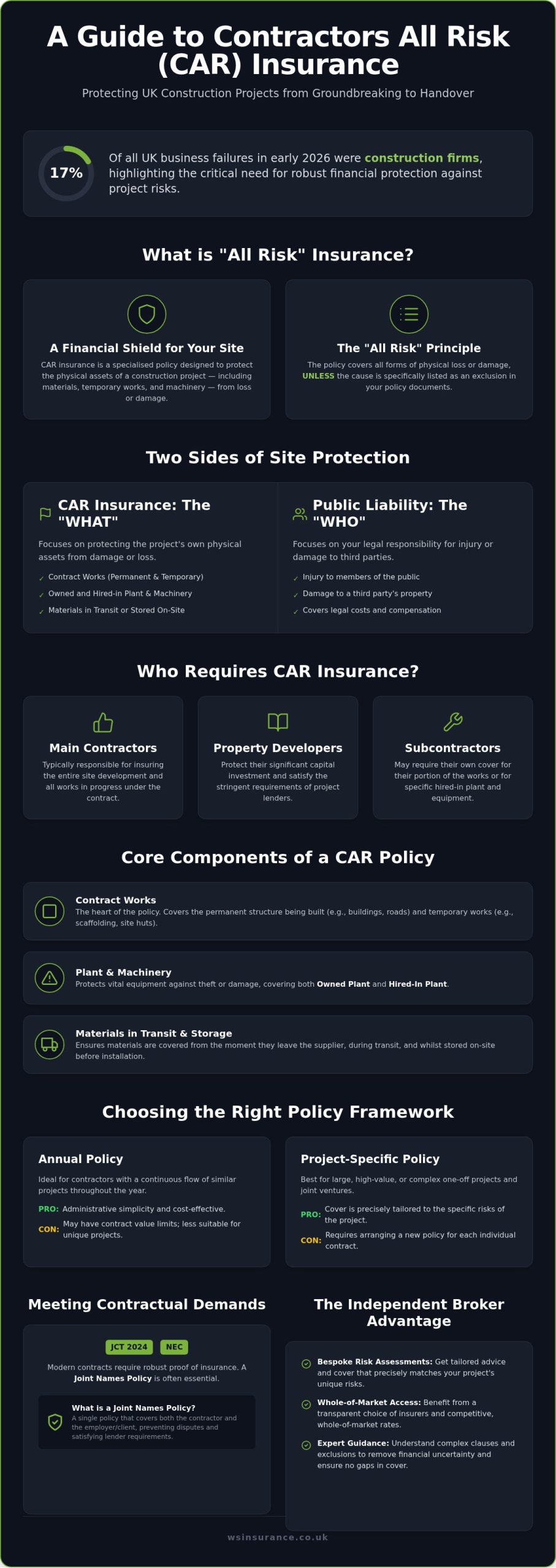
At its core, contractors all risk insurance uk is a specialised form of protection designed to shield the physical assets of a construction project from the moment ground is broken until the final handover. Often categorised internationally as Builder’s Risk Insurance, this policy serves as a financial safety net for the significant capital invested in materials, labour, and machinery. It acts as a primary shield against the unpredictable, ensuring that if a site is devastated by fire, flood, or theft, the project can resume without crippling the firm’s balance sheet.
The “All Risk” label is a specific insurance term that requires a professional’s eye to interpret correctly. It doesn’t imply that every conceivable scenario is covered; rather, it operates on a negative-exclusion basis. This means the policy covers all physical loss or damage to the works unless the cause is specifically listed as an exclusion in your schedule. Common exclusions typically include wear and tear, rust, or faulty design, but the broad nature of the cover provides a level of security that standard business policies simply cannot match.
Developers, main contractors, and subcontractors all find themselves beneath this protective umbrella. Because the construction sector accounted for 17% of all UK business failures in early 2026, having a steady hand to manage these risks is no longer optional. It’s a contractual necessity that satisfies lenders and employers whilst protecting the livelihoods of everyone on the site.
The Distinction Between CAR and General Liability
It’s a common misconception that a standard public liability policy provides enough protection for a project. Public liability is essentially about the “who”; it covers your legal responsibility if a third party is injured or their property is damaged. In contrast, contractors all risk insurance uk is about the “what”. It focuses on the contract works themselves, including the bricks, mortar, timber, and expensive plant equipment. These two policies work in tandem to provide 360-degree site protection, ensuring that both your legal liabilities and your physical assets are secure.
Who Typically Requires CAR Insurance?
The requirement for CAR insurance is usually dictated by the project’s contract, such as the JCT 2024 suite. Those who typically need to secure this cover include:
- Main Contractors: Usually responsible for the entire site development and the safety of all works in progress.
- Property Developers: Seeking to protect their investment and satisfy the stringent requirements of high-street or specialist lenders.
- Subcontractors: Whilst often covered under a main contractor’s policy, they may require their own cover if specific contractual obligations demand they protect their portion of the works or their own hired-in plant.
By identifying who holds the risk at each stage, we can eliminate doubt and ensure that no gaps are left in your protective shield.
Core Components of a Comprehensive CAR Policy
Building a robust shield around your construction project requires more than just a basic certificate. You must understand the Core Components of a Comprehensive CAR Policy to ensure every asset, from the foundation to the finishing touches, is secured. A standard contractors all risk insurance uk policy isn’t a single product but a modular framework that we tailor to your specific site risks and contractual duties.
Understanding Contract Works Coverage
The contract works section is the heartbeat of the policy. Contract Works are the physical assets being constructed on a specific site. As the project grows in value, the level of cover automatically scales to match the increasing investment. This doesn’t just apply to the bricks and mortar; it also includes temporary works such as site huts, hoarding, and scaffolding. Without this specific inclusion, a fire that destroys your site office could lead to significant unrecoverable costs that fall outside of a standard property policy.
Plant, Machinery, and Hired-in Equipment
Managing plant and machinery involves navigating complex financial risks, particularly regarding hired-in equipment. When you hire an excavator, you aren’t just responsible for the machine itself; you’re also liable for continuing hire charges whilst the equipment is being repaired or replaced following an incident. A comprehensive contractors all risk insurance uk policy covers these ongoing costs, which can otherwise spiral into thousands of pounds. To maintain this protection, insurers often mandate specific security standards, such as GPS tracking on heavy machinery or Thatcham-approved immobilisers. If you’re unsure which security protocols apply to your current fleet, a quick consultation with WS Insurance Brokers can help align your site practices with your policy requirements.
Common Exclusions to Monitor
The “All Risk” title can be misleading if you don’t scrutinise the exclusions. Most policies will not cover losses that are only discovered during a routine inventory check or “stock-take” rather than a specific, identifiable incident. You must also pay close attention to design and workmanship defects, often governed by the DE (Design Exclusion) or LEG (London Engineering Group) clause frameworks. These clauses determine whether the policy will pay for only the resulting damage or if it will also cover the cost of replacing the defective part itself. Other standard exclusions include gradual deterioration, such as rust or rot, and any damage caused by the wilful negligence of the policyholder.
Annual vs Project-Specific Insurance Frameworks
Choosing the right framework for your contractors all risk insurance uk is a pivotal business decision. It’s not just about the premium; it’s about aligning your protection with your project pipeline and turnover. As an expert guide in this complex market, we help you determine whether a continuous annual shield or a bespoke project-specific policy offers the most robust security for your assets. This choice eliminates doubt and ensures your coverage limits always match your actual site exposure.
When to Choose an Annual Policy
An annual policy acts as a continuous shield for established firms managing a high volume of smaller, similar projects throughout the year. It simplifies administration by covering all active sites under a single renewal date, which is a cornerstone of broader Business Insurance strategies. This model is highly efficient for contractors who don’t want the burden of arranging new cover every time they start a fresh job. However, you must monitor your “Maximum Contract Value” limits closely. If a new project’s value exceeds this pre-agreed threshold, your annual policy may be rendered invalid for that specific site, leaving you exposed to significant financial loss. We proactively review these limits with you to ensure your growth never outpaces your protection.
The Advantages of Project-Specific CAR
Project-specific cover is the logical choice for large-scale developments where the Gross Development Value (GDV) is high or the project involves unique risks. These policies are tailored to the exact requirements of a single contract, providing a level of precision that annual policies sometimes lack. As Contractors’ All Risk (CAR) Insurance explained by industry authorities suggests, these frameworks are often mandatory for satisfying lender or employer requirements, particularly when a “Joint Names” policy is required. This ensures the employer’s interest is protected alongside yours for the entire duration of the build. The coverage period aligns perfectly with the project timeline, usually extending to cover the critical 12 to 24-month defects liability period after completion. This bespoke approach ensures that even for the most complex contractors all risk insurance uk requirements, your business remains fully shielded from site accidents or weather damage until the final handover is complete.
Navigating JCT and NEC Contractual Requirements
Aligning your contractors all risk insurance uk with the specific demands of JCT or NEC frameworks is a task that requires clinical precision. JCT 2024 contracts, utilised by 59% of the UK industry, place a heavy emphasis on collaboration but maintain strict insurance obligations, primarily under Clause 6.7. This clause requires the works to be insured in “Joint Names,” a mechanism that ensures both the employer and the contractor are protected under a single policy. It effectively prevents an insurer from exercising subrogation rights, meaning they cannot pay one party and then sue the other to recover the funds following a site incident.
For firms operating under NEC4, the approach shifts to the “Insurance Table” found within the contract data. This requires you to define specific liability caps and ensure the cover matches the project’s unique risk profile. Whether you’re managing a major civil engineering project or a residential development, failing to match your policy to these tables can lead to a breach of contract. As your expert guide, we help you navigate these tables to ensure your contractors all risk insurance uk limits are perfectly calibrated to your legal obligations.
Joint Names and Non-Negligence Cover
The requirement for a Joint Names policy is often paired with a need for “Non-Negligence” cover, specifically the JCT 6.5.1 (formerly 21.2.1) indemnity. This provides a vital shield for damage caused to neighbouring property where no negligence can be proven against the contractor, such as subsidence or vibration damage during excavation. This protection is particularly relevant for projects in dense urban centres where the risk to adjacent structures is high. For developers, this level of site protection is as critical as their Commercial Property Insurance, as it removes the financial uncertainty surrounding complex third-party property claims.
The Maintenance Period: Post-Completion Protection
Your financial exposure doesn’t end the moment the keys are handed over. Most standard contracts mandate a maintenance or defects liability period, typically lasting 12 or 24 months after project completion. It’s essential to ensure your policy schedule explicitly extends to cover this window. This extension distinguishes between new damage occurring whilst your team is on-site rectifying a defect and the original damage caused by the defect itself. Without this specific post-completion protection, your policy might expire prematurely, leaving you to fund expensive repairs from your own cash reserves. If you’re currently reviewing a new contract and need to verify your compliance, you can speak with WS Insurance Brokers for a professional assessment of your contractual insurance requirements.
Securing Bespoke Protection with an Independent Broker
In a market where construction project starts fell by 18% in early 2026, the pressure to maintain profitability whilst managing risk is immense. Automated online quote engines often fail to grasp the nuances of site-specific hazards or the granular requirements of a complex build. Securing contractors all risk insurance uk through an independent broker provides you with a steady hand that looks beyond the algorithm. We act as your dedicated advocate, shielding you from the clinical complexity of policy wording and ensuring that if a claim arises, you have a seasoned professional standing between your business and the insurer’s claims department. This personal intervention removes the anxiety of the claims process and focuses on the swift restoration of your project’s timeline.
Why Independence Matters for Construction Risk
True independence ensures transparency in fees and a refreshing lack of bias towards specific providers. Whilst restricted panels often limit your options to a handful of insurers, our whole-of-market access allows us to scour the industry for the most competitive rates, even for high-risk trades or specialist developments. We specialise in customising policies to include vital extensions such as “Off-Site Storage,” which protects expensive materials before they even reach the site gates. This proactive labour on our part results in a bespoke protective shield that removes the uncertainty often found in off-the-shelf products. We don’t just sell a commodity; we build a narrative of partnership where our diligent risk assessment directly results in your ease and confidence.
Taking the Next Steps for Your Project
Preparing for a professional consultation is the first step towards securing your business assets. You’ll need to provide clear project values, details of your site security measures, and the specific contract types, such as JCT 2024, that you’re working under. As your project evolves, your contractors all risk insurance uk must keep pace. We manage the process of mid-term adjustments seamlessly, ensuring that if your project scope expands or your completion date shifts, your cover remains valid and robust. This methodical approach ensures your assets are always protected, allowing you to focus on the build with absolute confidence. Secure your next project with WS Insurance Brokers to experience the clarity and security that only an expert guide can provide.
Building with Absolute Confidence and Site Security
Mastering the complexities of contractors all risk insurance uk ensures that your projects remain resilient against unpredictable site accidents and weather damage. By aligning your cover with the specific demands of JCT 2024 or NEC frameworks, you satisfy both lender requirements and your own need for financial stability. We’ve explored how a tailored policy protects your contract works, plant, and materials from the first day on-site through to the final handover and the critical defects liability period.
As an independent UK brokerage, we act as your expert guide to remove uncertainty from the selection process. Being authorised and regulated by the Financial Conduct Authority, we provide transparent advice and leverage our full market access to secure competitive, bespoke rates that restricted panels cannot match. We handle the proactive labour of risk assessment so you can focus on delivering high-quality construction projects with total peace of mind.
Ready to eliminate doubt and protect your business assets? Request a Bespoke Contractors All Risk Quote from WS Insurance Brokers today. We are here to provide the steady hand and diligent advocacy your next development deserves.
Frequently Asked Questions
What is the difference between Contractors All Risk and Public Liability?
Public liability insurance protects your business against claims for third-party injury or property damage, whereas contractors all risk insurance uk focuses on the physical project itself. Whilst public liability is essential for legal protection against the public, it won’t pay to rebuild a wall collapsed by a storm or replace stolen timber. CAR insurance bridges this gap, ensuring that the permanent and temporary works, along with site materials, are financially secured against physical loss or damage.
Does Contractors All Risk insurance cover my own tools?
Standard CAR policies primarily focus on the contract works and plant, but you can typically add an extension to cover your own tools and employee effects. This isn’t always included by default, so it’s vital to specify the total value of the equipment you wish to protect. Most insurers require these tools to be stored in a secure, locked vehicle or a site container with specific security ratings to maintain valid cover during non-working hours.
Is a Joint Names policy mandatory for JCT contracts?
A Joint Names policy is a standard requirement for most JCT contracts, particularly under the Clause 6.7 framework. This arrangement ensures that both the employer and the contractor are named on the policy schedule, preventing the insurer from seeking recovery costs from either party after a claim. It creates a unified shield of protection that satisfies the contractual obligations of the employer whilst removing the financial risk of subrogation between the two primary stakeholders.
What are the common exclusions in a CAR insurance policy?
Common exclusions include damage caused by wear and tear, rust, or gradual atmospheric conditions. You’ll also find that losses discovered during a routine inventory check, rather than a specific incident, are generally excluded from cover. Most notably, design and workmanship defects are often limited by specific DE or LEG clauses, which may only cover the resulting damage rather than the cost of rectifying the original faulty part itself. Professional advice helps clarify these boundaries.
How much does contractors all risk insurance cost in the UK?
You can certainly secure CAR insurance for a single self-build project through a project-specific policy. This is often referred to as self-build insurance and is designed to protect your investment from the first day on-site until completion. It’s particularly useful for satisfying lender requirements if you’re using a mortgage to fund the build. This cover ensures that the structure, materials, and any hired-in plant are protected against fire, theft, and accidental damage throughout the construction phase.
What is the “Maintenance Period” in a construction insurance policy?
The maintenance period, often called the defects liability period, is a timeframe after the project’s completion where the contractor remains responsible for rectifying any faults. Standard periods typically last 12 or 24 months. A robust CAR policy should be extended to cover this window, ensuring that if you cause accidental damage whilst returning to the site to fix a defect, your business remains protected. It prevents a gap in cover during this critical handover phase.
Does CAR insurance cover damage caused by design defects?
Coverage for design defects depends entirely on the specific “Design Exclusion” (DE) or “London Engineering Group” (LEG) clauses within your policy. Whilst some basic policies exclude design defects entirely, more comprehensive versions may cover the damage resulting from a defect, even if they don’t pay for the faulty part itself. It’s a complex area where professional guidance is essential to ensure your policy matches the specific risk profile of your project’s architectural requirements.