
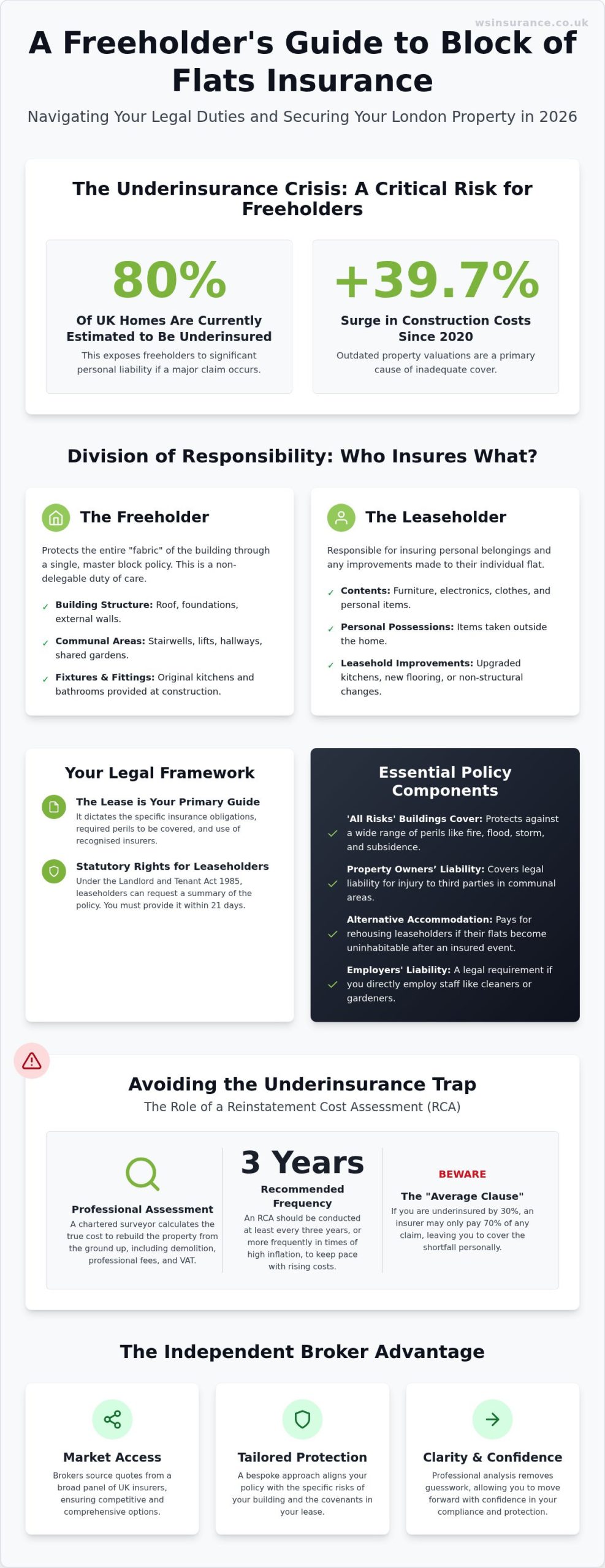
Did you know that an estimated 80% of UK homes are currently underinsured, with construction costs having surged 39.7% since 2020? For those managing property in the capital, understanding the specific block of flats insurance requirements for freeholders London is no longer just an administrative task; it’s a vital shield against personal liability. You likely feel the pressure of rising premiums in this 2026 market and the confusion caused by the Leasehold and Freehold Reform Act 2024. It’s a complex landscape where the line between statutory duty and leasehold obligation often feels blurred.
We believe that clarity is the foundation of security. This guide simplifies the current regulatory complexity, ensuring you master your legal obligations while securing the most robust protection for your building. Our professional analysis removes the guesswork from your policy selection, allowing you to move forward with confidence. We will provide a definitive checklist of required covers, explain how to avoid the trap of underinsurance, and show you how a bespoke approach can stabilise your costs in an unpredictable market.
Key Takeaways
- Understand that the Lease is your primary legal guide, dictating specific obligations for building fabric protection and the use of recognised insurers.
- Master the block of flats insurance requirements for freeholders London to ensure your property remains fully compliant with the latest 2026 statutory regulations.
- Learn why a professional Reinstatement Cost Assessment (RCA) is essential every three years to prevent the financial risk of “Average Clause” penalties.
- Identify the core components of a robust policy, including “all risks” buildings cover and property owners’ liability for shared spaces.
- Discover how independent brokers act as a shield against market complexity by sourcing tailored protection from a broad panel of UK insurers.
Understanding Block of Flats Insurance: The Freeholder’s Duty of Care
Block of flats insurance is a comprehensive policy designed to protect the physical structure, communal areas, and legal liabilities of a multi-unit building. As a freeholder, you aren’t just an owner; you’re the custodian of a complex asset. This role carries a significant fiduciary responsibility to safeguard the investments of all stakeholders, including leaseholders and their mortgage providers. You must ensure the building is protected against a wide range of perils, from fire and flood to structural failure. The freeholder’s insurance obligation is a non-delegable duty of care that cannot be passed off to a third party.
Meeting the block of flats insurance requirements for freeholders London involves more than just finding a cheap quote. In a dense urban environment, the risks are heightened, making a standard residential policy insufficient. You need a solution that addresses the specific needs of a multi-unit structure whilst remaining compliant with the Leasehold and Freehold Reform Act 2024. In the current 2026 market, where construction costs have risen by 39.7% since 2020, this duty is more critical than ever to prevent financial exposure.
Freeholder vs. Leaseholder: Who Insures What?
The division of responsibility is a cornerstone of UK leasehold law. The freeholder’s primary duty is to protect the “fabric” of the building. This includes the roof, external masonry, foundations, and all communal areas such as lift shafts, stairwells, and shared gardens. It’s a collective approach to risk. Leaseholders, by contrast, are typically only responsible for their own contents and personal belongings within their individual units.
A single, master block policy is far more efficient than individual leaseholder buildings policies. It ensures there are no “grey areas” where a claim might fall between two different providers. This unified approach provides a safety net for everyone in the building, ensuring that shared infrastructure is always covered and rebuilds are managed centrally.
The Consequences of Non-Compliance
Whilst buildings insurance isn’t mandated by criminal law, the contractual obligations within a lease make it a strict legal necessity. The lease serves as the constitutional document for your property, outlining the specific block of flats insurance requirements for freeholders London that you must uphold to remain compliant. Most modern leases contain explicit covenants requiring the freeholder to insure the building for its full reinstatement value with recognised insurers. These agreements often list specific perils that must be covered, ranging from standard fire and flood to more niche concerns like aircraft impact or subterranean subsidence.
Statutory rights provide leaseholders with a layer of protection and transparency. Under the Landlord and Tenant Act 1985, leaseholders have a legal right to request a summary of the insurance policy or inspect the policy documents. You’re required to provide this information within 21 days of a written request. Failing to do so isn’t just a lapse in communication; it’s a summary offence that can lead to fines. The Commonhold and Leasehold Reform Act 2002 further refines these relationships, providing a framework for managing insurance disputes and ensuring that any premiums passed on through service charges represent fair value. If you’re unsure if your current policy meets these rigorous standards, professional risk placement can help align your cover with your contractual duties.
Interpreting Insurance Covenants in the Lease
Identifying the specific perils in an older lease requires a meticulous eye. You might find outdated language that doesn’t reflect 2026 insurance standards, such as a requirement to insure only against “fire.” In these cases, a “Trusted Advisor” approach is essential to ensure you’re providing comprehensive “all risks” cover that satisfies modern mortgage lenders. It’s also vital to name leaseholders and their mortgagees as interested parties on the policy. This simple administrative step protects their financial interest and prevents delays during the conveyancing process when flats are sold.
Right to Manage (RTM) and Management Companies
When leaseholders exercise their Right to Manage, the responsibility for procuring insurance typically shifts from the freeholder to the RTM company. This transition doesn’t diminish the importance of the lease covenants; the RTM company must still adhere to the original requirements. Residents Management Companies (RMCs) often face complex risks beyond simple property damage. Directors of these companies should consider specialised business insurance to protect against personal liability whilst managing the block’s affairs. This ensures that those volunteering their time to manage the building aren’t left exposed to litigation or financial loss.
Core Cover Components: Essential Protection for Multi-Unit Buildings
Buildings insurance forms the bedrock of your protection strategy. A standard policy typically covers damage from fire, lightning, explosion, and aircraft impact. However, meeting the block of flats insurance requirements for freeholders London usually necessitates an “all risks” extension. This broader level of cover protects the property against any accidental damage unless it is specifically excluded in the policy wording. In a 2026 market where property insurance payouts reached a record high of £6.1 billion in the previous year, having this comprehensive safety net is vital for long-term security.
Directors and Officers (D&O) Liability
If you operate as a Residents Management Company (RMC) or act as an individual freeholder, Directors and Officers (D&O) Insurance is a vital safeguard. This policy protects board members against claims of “wrongful acts” in the management of the block. These claims often arise from disputes over service charge allocations, failure to appoint competent contractors, or administrative errors. D&O cover removes personal financial anxiety for board members by ensuring their private assets aren’t at risk during litigation. It allows you to manage the building with a steady hand, knowing your personal security is protected whilst you fulfil your duties.
Specialist Add-ons: Terrorism and Engineering Cover
High-density urban environments require specialised protection that standard policies might overlook. Terrorism cover is often a mandatory requirement in modern leases, protecting the building against damage from acts of political or ideological violence. Engineering Insurance is another essential addition for blocks with complex plant and machinery. It covers the sudden and unforeseen breakdown of communal lifts, central heating systems, and water pumps. Finally, Legal Expenses cover provides the financial means to recover unpaid service charges or handle complex tenant disputes. These additions ensure that the block of flats insurance requirements for freeholders London are met with precision, leaving no gaps in your building’s defensive shield.
Navigating the Reinstatement Cost Assessment (RCA) Process
Reinstatement cost represents the total expense required to rebuild your property from the ground up following a total loss. This figure is entirely distinct from market value, which reflects what the property might fetch on the open market. Confusing these two numbers is a dangerous gamble when meeting the block of flats insurance requirements for freeholders London. Whilst market values fluctuate based on demand and postcode, rebuild costs are driven by the hard reality of material prices and professional labour. With construction costs having surged by 39.7% between 2020 and 2026, relying on an outdated valuation is a recipe for financial disaster.
The primary danger of inaccurate valuation is the “Average Clause” penalty. If your building is insured for only 70% of its actual rebuild cost, the insurer can legally reduce any claim payout by 30%, even for a minor kitchen fire. This leaves a massive shortfall that the freeholder may have to fund. For a deeper analysis of how to protect your assets against such gaps, consult our commercial property insurance guide. Ensuring your “Sum Insured” is precise removes uncertainty and provides the steady hand needed to manage a multi-unit block effectively.
How to Conduct a Professional Valuation
Securing an accurate RCA requires a methodical approach. It’s not something you should estimate yourself or rely on a generic online calculator to provide. Follow these steps to ensure compliance:
- Appoint a RICS-qualified surveyor to perform a formal RCA. They use standard Building Cost Information Service (BCIS) data to calculate precise figures.
- Review the assessment every three years. This is the frequency recommended by RICS to account for inflation and material price hikes.
- Update your broker immediately after any major building works. Extensions or significant structural repairs will instantly change your block of flats insurance requirements for freeholders London.
Avoiding the Pitfalls of Underinsurance
Inflation-linking on a policy provides a helpful buffer, but it isn’t a substitute for a professional RCA. It often fails to account for specific structural complexities or the 10% to 15% typically required for professional fees like architects and surveyors. If a claim is partially rejected due to underinsurance, you face more than just a financial loss; you face potential litigation from leaseholders for failing in your duty of care. A robust valuation must include debris removal, site clearance, and VAT considerations to be truly comprehensive. Our experts act as a shield against these risks; speak with a specialist to secure a valuation that stands up to scrutiny.
Securing Bespoke Protection: The Independent Broker Advantage
An independent broker acts as a shield between the property owner and the complexities of the broader market. Instead of a mere transaction, you receive a consultative partnership that prioritises your long-term security. This is particularly vital when managing the block of flats insurance requirements for freeholders London, where high property values and dense urban risks demand a sophisticated approach. By acting as a Trusted Advisor, your broker ensures that your building isn’t just another number in an automated system but a protected asset backed by professional advocacy.
Accessing a broad panel of UK insurers is a hallmark of the independent model. It allows for a comparative analysis of coverage terms and pricing, ensuring you aren’t restricted to a single provider’s appetite for risk. In the 2026 market, where premiums have shown signs of rising after a period of stability, this market-wide access is a badge of honour that distinguishes specialist brokers from restricted competitors. You can learn more about how insurance brokers provide this professional risk placement in our comprehensive guide.
Tailoring Your Policy to Your Specific Block
Every building has a unique DNA. A generic policy often fails to account for specific architectural features like listed status or expansive flat roofs, which many insurers view with caution. We specialise in “risk presentation,” a proactive process where we highlight your building’s maintenance history and safety protocols to underwriters. This diligent labour often results in more favourable terms and lower excesses. Transparency remains at the heart of this process; we ensure all permitted insurance fees are itemised and clear, aligning with the transparency requirements of the Leasehold and Freehold Reform Act 2024.
The Consultation Process: Removing Uncertainty
Our approach is logical and structured. We begin by understanding your underlying management philosophy and the specific needs of your property portfolio. This moves into a granular assessment of risk, where we identify potential gaps in your current cover. This methodical rhythm mirrors a professional consultation, moving from high-level identity to specific service categories without losing sight of your security. We act as a steady hand, eliminating doubt at every stage of the placement process. Contact our expert team today for a comprehensive block insurance review and ensure your property is protected by a bespoke legal safeguard.
Securing Your Property’s Future with Professional Risk Placement
Managing a multi-unit building requires a diligent approach to risk that goes beyond simple price comparison. By mastering the block of flats insurance requirements for freeholders London, you protect not only the physical fabric of the building but also the financial interests of every leaseholder. Remember that an accurate Reinstatement Cost Assessment is your strongest defence against underinsurance in a market where rebuilding expenses continue to climb. Aligning your policy with both leasehold covenants and the latest statutory reforms ensures your block remains a compliant and secure asset.
As your Trusted Advisor, we provide the steady hand needed to navigate these complexities. Our independent status grants us whole-of-market access, whilst our FCA-regulated advice and dedicated claims advocacy remove the burden of uncertainty from your shoulders. We act as a protective shield, sourcing tailored terms that generic providers often overlook. Request a bespoke block of flats insurance review from our expert brokers today to confirm your building is fully protected. Your peace of mind is our priority, and we’re here to help you secure a resilient future for your property.
Frequently Asked Questions
Is block of flats insurance a legal requirement for freeholders?
Insurance isn’t a statutory legal requirement under UK criminal law, but it’s a strict contractual obligation within almost every lease. If you don’t maintain cover, you’re in breach of the lease covenants, which can lead to legal action from leaseholders. Meeting the block of flats insurance requirements for freeholders London is also essential for mortgage lenders, who won’t provide finance on individual units without a valid, comprehensive building policy in place.
What is the difference between buildings insurance and block insurance?
Standard buildings insurance is designed for single dwellings, whereas block insurance is a specialist commercial product for multi-unit properties. It covers the entire structure, including communal hallways, lifts, and shared roofs, under one master policy. This unified approach is much more efficient than individual policies. It ensures there are no gaps in protection and provides property owners’ liability cover for shared spaces, which a standard residential policy would typically exclude.
How is the premium for a block of flats calculated?
Insurers calculate premiums by assessing several risk factors, primarily the total reinstatement cost of the building. They also look at the property’s age, construction materials, and the presence of any flat roofs or specialist plant like lifts. Your claims history and the ratio of let units to owner-occupied flats also play a part. Using a specialist broker helps you present these risks accurately to a panel of insurers to secure the most competitive rates.
Can freeholders pass the insurance cost onto leaseholders?
Yes, most leases allow freeholders to recover the cost of the premium from leaseholders via service charges. However, you must ensure the costs are reasonably incurred and provide a summary of the cover if requested. Following recent legislative changes, you must be transparent about any fees. We help you maintain this transparency by providing itemised breakdowns, ensuring you meet the regulatory block of flats insurance requirements for freeholders London whilst providing fair value.
What happens if a block of flats is underinsured?
If your building is underinsured, insurers will apply the Average Clause to any claim you make. This means they’ll only pay a percentage of the loss proportional to the level of underinsurance. For example, if you’re only insured for 80% of the rebuild cost, you’ll only receive 80% of your claim value. As the freeholder, you could be held personally liable by leaseholders to fund the resulting financial shortfall and restore the building.
Does block of flats insurance cover unoccupied units?
Most policies provide full cover for individual units that are unoccupied for short periods, typically between 30 and 60 days. Once a unit exceeds this timeframe, insurers often restrict cover to basic perils or increase the policy excess. It’s vital to inform your broker if a flat becomes vacant for an extended period. We can then negotiate with underwriters to maintain the highest possible level of security for the building fabric during that vacancy.
How often should I carry out a Reinstatement Cost Assessment?
The Royal Institution of Chartered Surveyors recommends that a comprehensive Reinstatement Cost Assessment is carried out every three years. You should also commission a new assessment immediately after any major structural works or extensions. Relying on index-linking alone is risky in a volatile construction market. Regular professional valuations remove the uncertainty of underinsurance, ensuring your sum insured remains accurate and your building stays fully protected against rising material and labour costs.
Is Terrorism insurance compulsory for a block of flats?
Terrorism insurance isn’t a statutory requirement, but it is often a mandatory covenant within the lease agreement. Even if your lease is silent on the matter, we strongly recommend it for properties in high-density urban centres. Standard policies usually exclude damage caused by acts of terrorism, leaving a significant gap in your protection. Including this cover ensures that your building is shielded from all potential perils, providing total peace of mind for you and your leaseholders.