
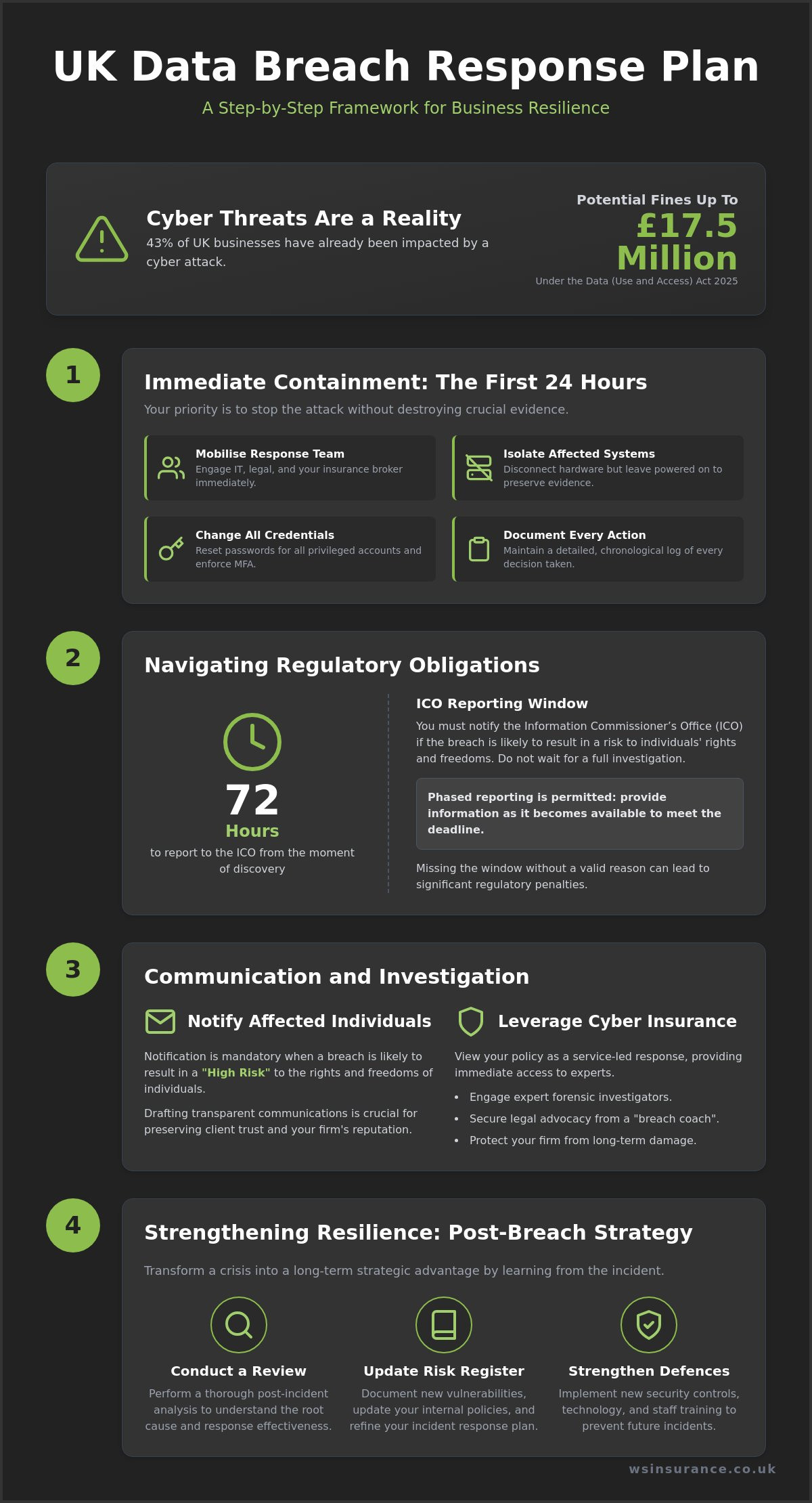
Did you know that cyber threats have already impacted 43% of UK businesses, leaving many to face the daunting reality of a compromised network? Discovering a security failure is an incredibly high-pressure moment, and knowing exactly what to do after a data breach UK business owners find themselves facing can be the difference between a managed recovery and a regulatory disaster. You’re likely worried about the strict 72-hour reporting window to the Information Commissioner’s Office (ICO) or the potential for fines that can now reach £17.5 million under the Data (Use and Access) Act 2025.
We promise to replace that anxiety with a clear, step-by-step framework designed to contain the threat and ensure full compliance with the July 2026 Model Action Plan. This guide explores how to meet new mandatory central reporting deadlines to the Department for Science, Innovation and Technology (DSIT), manage third-party supplier notifications, and utilise cyber insurance as a proactive service to protect your firm’s long-term reputation. By following this methodical approach, you can act as a shield for your clients’ data whilst ensuring your business remains resilient in a complex market.
Key Takeaways
- Mobilise your incident response team immediately to isolate systems and prevent further exfiltration whilst preserving vital evidence for forensic review.
- Master the 72-hour ICO reporting window by learning exactly what to do after a data breach UK business owners must prioritise to avoid significant regulatory penalties.
- Identify the “High Risk” threshold to determine when notification to individuals is mandatory and how to draft transparent communications that preserve client trust.
- Leverage specialist Cyber & Data Breach Insurance as a service-led response, providing your firm with immediate access to expert forensic investigators and legal advocacy.
- Transform a security crisis into a resilience strategy by conducting a thorough post-incident review to update your risk register and strengthen systemic defences.
Immediate Containment: The Critical First 24 Hours
The first 24 hours after discovering a security incident are the most volatile. Your priority is to stop the data exfiltration without destroying the tracks left by the intruder. Knowing what to do after a data breach UK business leaders find themselves managing requires a blend of technical swiftness and calm, strategic leadership to prevent the situation from spiralling. Acting quickly during this window is vital to meeting the strict reporting requirements of the Information Commissioner’s Office (ICO).
Assembling Your Response Team
Preserving Evidence for Forensic Analysis
Containment is about isolation, not deletion. Whilst your first instinct might be to “wipe and reinstall” to get back to business, doing so can permanently erase the digital fingerprints needed to understand the breach’s scope. Instead, isolate affected segments of the network and change administrative credentials across the board. Forensic preservation is the act of protecting digital evidence for legal and insurance scrutiny. This process ensures that you meet your obligations under the UK General Data Protection Regulation (UK GDPR) by providing a clear trail of what happened.
To ensure your response stands up to scrutiny and protects your long-term interests, follow these practical steps:
- Isolate affected systems: Disconnect compromised hardware from the internet but leave them powered on if possible to preserve volatile memory for the investigators.
- Change all credentials: Reset passwords for all privileged accounts and implement multi-factor authentication (MFA) immediately if it isn’t already active.
- Document every action: Maintain a chronological log of every discovery, decision, and action taken. Record the “who, what, and when” of every containment step for the ICO.
- Avoid file deletion: Disabling access is safer than deleting files, as deletion can alter metadata that forensic experts rely on to determine the entry point.
Acting as a steady hand during these initial hours protects your business from long-term reputational damage. By focusing on methodical containment rather than panicked recovery, you ensure that your firm remains a resilient entity in the eyes of both regulators and clients. Understanding what to do after a data breach UK business teams must manage involves this balance of technical precision and transparent documentation.
Navigating UK Regulatory Obligations and the ICO
Once the initial fire of a breach is contained, the regulatory clock is already ticking. Understanding what to do after a data breach UK business leaders find themselves managing requires an immediate shift towards transparency and legal compliance. The Information Commissioner’s Office (ICO) expects a clinical, methodical approach to reporting. With the full implementation of the Data (Use and Access) Act 2025, the standards for accountability have never been higher. You aren’t just protecting data; you’re defending your firm’s right to operate in a strictly regulated market.
The 72-Hour Reporting Window
The 72-hour deadline begins the moment you have a reasonable degree of certainty that a security incident has affected personal data. It’s a common mistake to wait until an investigation is complete before contacting the regulator. You don’t need every answer to start the process. If your internal review is ongoing, the ICO allows for a “phased” report where you provide information as it becomes available. If you miss this window, you must provide a reasoned justification for the delay. Documenting your discovery timeline is essential to demonstrate that you’ve acted with due diligence and integrity.
Assessing Risk to Rights and Freedoms
Not every incident requires a report to the ICO. You only notify the regulator if the breach is likely to result in a risk to the rights and freedoms of individuals. This assessment involves categorising the data involved. Is it basic contact information, or does it include “Special Category” data like health records or biometric identifiers? You must evaluate the potential for identity theft, financial loss, or reputational damage to the victims. Utilising a robust risk assessment framework allows you to document your decision-making process clearly, providing a shield if your choice is later scrutinised.
As of April 2026, the reporting landscape has become more integrated. Personal data breaches must now also be reported to the Government Security Group and the Department for Science, Innovation and Technology (DSIT) under a new, single cross-government framework. This alignment ensures a coordinated response to significant threats. Following the UK Government’s Model Action Plan is no longer just for public bodies; it’s the gold standard for any business aiming to minimise the fallout of a breach.
Penalties for non-compliance are severe, with maximum fines reaching £17.5 million or 4% of annual turnover, but a proactive response can often mitigate these costs. By seeking expert insurance advocacy, you gain a partner who helps navigate these complex filings, removing the uncertainty that often leads to costly reporting errors.
Communicating with Affected Individuals and Stakeholders
While the ICO focuses on regulatory compliance, your clients and partners care about their personal security. Deciding what to do after a data breach UK business leaders must navigate involves a delicate balance of legal duty and brand protection. Under current regulations, you’re only legally required to notify individuals if the incident poses a “high risk” to their rights and freedoms. This usually means situations involving potential identity theft, financial loss, or significant social disadvantage. Acting as a steady hand during this phase is vital to maintaining your firm’s integrity.
The Anatomy of a Breach Notification
A notification shouldn’t be a wall of legalese. It needs to be clear, concise, and helpful. Start by explaining what happened in plain English. Avoid technical jargon that confuses rather than clarifies. Your communication should include:
- A clear description: Explain the nature of the breach without hiding behind complex terminology.
- Actionable advice: Provide specific steps individuals can take, such as changing passwords or alerting their banks.
- DPO contact details: Ensure your Data Protection Officer’s information is prominent for further enquiries.
- Support services: Mention any credit monitoring or identity protection you’re providing to mitigate harm.
This level of transparency removes uncertainty and helps to rebuild the trust that a security failure inevitably shakes. It shows that you’re taking the welfare of your clients seriously and acting as a protective shield between them and the criminals who stole their data.
Reputation Management and PR Strategy
Silence is rarely your friend in a crisis. Transparency is often the best defence against long-term brand damage. Brief your customer-facing teams thoroughly; they need to handle enquiries with empathy and accuracy to prevent misinformation from spreading. This is where your business insurance provider becomes an invaluable partner. Many specialist policies cover the costs of crisis management and public relations experts who can help you manage the media narrative whilst you focus on technical recovery.
Beyond just words, action speaks volumes. Offering support services like credit monitoring can significantly mitigate harm and demonstrate your commitment to client welfare. This proactive stance aligns with the UK Government Cyber Attack Response Guidance, which emphasises that a well-managed communication strategy can reduce the overall impact of an attack. By taking these steps, you protect your business from the secondary crisis of a reputational collapse.
The Role of Forensic Investigation and Insurance Claims
Managing the aftermath of a security failure requires more than just technical fixes; it demands a forensic level of scrutiny to satisfy both regulators and insurers. Determining what to do after a data breach UK business owners find themselves navigating often depends on the speed at which expert help arrives. Specialist Cyber & Data Breach Insurance is not merely a financial safety net. It’s a service-led response that provides immediate access to forensic investigators who can deconstruct the attack whilst you focus on maintaining operations. This clinical approach is essential for removing uncertainty and proving to stakeholders that the situation is under control.
Why Forensic Investigation is Non-Negotiable
A professional investigation is the only way to identify “Patient Zero”, which is the specific entry point the attacker used to infiltrate your network. Without this clarity, you risk a “re-infection” where the intruder returns through the same unpatched vulnerability. Investigators search for persistent threats, which are hidden backdoors left behind to ensure long-term access. This process provides the factual basis for your final report to the ICO, ensuring that your documentation is based on clinical evidence rather than speculation. It replaces doubt with certainty, allowing you to prove that the threat has been fully eradicated from your systems.
Navigating the Cyber Insurance Claim
Your insurance broker acts as a steady hand during the claims process, serving as an advocate amongst insurers and legal teams. Notifying your broker immediately is essential to trigger “first-party” response covers, which pay for the initial costs of forensics, legal advice, and crisis communication. You must also understand the role of “third-party” cover. This provides protection if clients or partners bring legal action against you for the loss of their data. This dual-layered protection is vital for your firm’s long-term survival in a complex market.
Loss of revenue is another critical factor to manage. If your systems are offline or your operations are severely curtailed, business interruption cover can help bridge the financial gap. This ensures that the immediate cost of the breach doesn’t lead to a secondary financial crisis for your business. By acting as a shield between you and the broader insurance market, a specialist broker ensures that your claim is handled with the diligence and transparency required for a successful outcome. To ensure your firm has this level of expert advocacy, consider reviewing your options for Cyber & Data Breach Insurance today.
Strengthening Resilience: Post-Breach Strategy for 2026
Survival is only the first stage of recovery. Once the immediate threat is neutralised and the regulators are satisfied, the focus must shift to ensuring a similar event never happens again. Understanding what to do after a data breach UK business owners have endured means conducting a rigorous Post-Incident Review. This isn’t a finger-pointing exercise; it’s a clinical assessment of your systemic vulnerabilities. By updating your Risk Register and Incident Response Plan with real-world data from the breach, you replace theoretical assumptions with hard-won operational intelligence. This methodical approach ensures your team is better prepared for the evolving tactics of 2026 cybercriminals.
Learning from the Incident
Closing the technical gaps is paramount. If the breach occurred because of a lack of multi-factor authentication (MFA) or unencrypted data, these must be addressed immediately through network segmentation and robust encryption protocols. You should also review your third-party supplier contracts to ensure they mandate notification of suspected breaches within 12 to 24 hours, as required by modern best practices. Demonstrating a proactive improvement in your risk posture through a post-breach audit can lead to lower insurance premiums by providing underwriters with tangible evidence of your improved risk management. This transparency builds trust with your insurers and secures more favourable terms for your future coverage.
The Future of Cyber Protection
Finally, you must review your Cyber Insurance limits to ensure they reflect the current threat landscape and the increased fines under the Data (Use and Access) Act 2025. To ensure your coverage limits reflect these evolving risks, contact WS Insurance Brokers for a comprehensive review of your professional risk placement. We act as your expert guide, removing the uncertainty from your security strategy and helping you build a business that isn’t just recovered, but truly resilient. Our role is to act as a shield, ensuring your business has the professional advocacy it needs to thrive in a complex market.
Navigating Your Path to Digital Resilience
Managing a security incident is about more than just technical fixes; it’s about a coordinated legal and insurance-led response that prioritises your firm’s integrity. By focusing on immediate containment, clinical documentation, and transparent communication, you can successfully navigate the complexities of modern regulation. Knowing exactly what to do after a data breach UK business leaders face ensures that you remain compliant with the latest 2026 mandates whilst protecting your firm’s reputation from long-term damage. Turning a crisis into a manageable recovery requires a steady hand and expert advocacy at every stage.
Don’t leave your firm’s survival to chance in an increasingly volatile market. You can secure your business with specialist Cyber Insurance from WS Insurance Brokers to gain access to 24/7 emergency cyber response teams and dedicated claims advocacy. As an FCA-regulated independent broker, we act as your protective shield, removing uncertainty and providing the expert guidance needed to safeguard your future. We’re here to ensure you’re never alone in a crisis, helping you build a stronger, more resilient business today.
Frequently Asked Questions
Do I always have to report a data breach to the ICO within 72 hours?
No, you only need to report a breach if it is likely to result in a risk to the rights and freedoms of individuals. If your assessment determines there is no risk, you don’t need to notify the ICO, but you must still document the incident and your reasoning internally. Knowing what to do after a data breach UK business owners encounter involves making this risk-based decision quickly and accurately to ensure compliance.
What happens if I miss the 72-hour reporting deadline?
If you miss the 72-hour window, you must submit your report as soon as possible along with a reasoned justification for the delay. The ICO understands that complex investigations take time, but failing to provide a valid reason for lateness can result in increased regulatory scrutiny or higher penalties. Proactive communication, even if incomplete, is always better than silence when managing a security incident.
Can my business be fined if a data breach was caused by a human error?
Yes, the ICO can issue fines for breaches caused by accidental human error just as they do for malicious cyber attacks. Regulators look at whether you had adequate technical measures and staff training in place to prevent such mistakes. Under the Data (Use and Access) Act 2025, the financial consequences for negligence are significant, making robust internal policies and regular employee awareness training essential for every firm.
Will my standard Public Liability insurance cover a data breach?
Standard Public Liability insurance is designed to cover physical injury or third-party property damage, not digital data loss or cyber crime. To protect your business from the costs of forensic investigations, legal fees, and regulatory fines, you require specialist Cyber & Data Breach Insurance. This specific cover acts as a shield, providing the professional advocacy and financial support that general commercial policies typically exclude.
Do I need to tell my customers if their data has been stolen?
You are only legally required to notify affected individuals if the breach is likely to result in a high risk to their rights and freedoms. This “high risk” threshold usually applies if the stolen data could lead to identity theft, fraud, or physical harm. When this occurs, you must inform them without undue delay so they can take necessary steps, such as changing passwords or alerting their banks.
What is the Data (Use and Access) Act 2025 and how does it affect me?
The Data (Use and Access) Act 2025 refined the UK’s data protection framework by aligning penalties for all privacy breaches with UK GDPR levels. This means the maximum fine for non-compliance is now £17.5 million or 4% of annual worldwide turnover. For any UK firm, this act emphasises the need for clinical precision in data handling and a methodical approach to reporting security incidents to avoid devastating financial hits.
How much does Cyber Insurance cost for a UK small business?
The cost of coverage depends on several factors, including your industry sector, annual turnover, and the volume of sensitive data you process. Because every business has a unique risk profile, there is no one-size-fits-all price for protection. To ensure you receive a fair value proposition, you should consult an independent broker who can access the entire breadth of the market to find a policy tailored to your specific needs.
What should I do if a hacker is demanding a ransom for our data?
You should immediately contact your emergency cyber response team or insurance broker and avoid engaging with the attacker directly. Paying a ransom does not guarantee the safe return of your data and can often mark your business as a soft target for future attacks. Professional negotiators and forensic experts are required to manage these high-pressure situations, removing the uncertainty and helping you recover your systems through secure, legal channels.