
What if the cover you expect to protect your future home doesn’t address the risks of building it? A self-build brings changing exposures, from the site and building work to materials and the people involved. That’s why construction insurance for self-build projects needs a closer look than a standard home policy alone.
It’s understandable to feel unsure about which cover applies at each stage, especially when plans, costs or responsibilities change. Review the risks as the build progresses rather than assuming one policy will fit from groundwork to completion.
This guide explains the main types of cover to consider, how site, materials, works and liability may feature, and what information to prepare before arranging insurance. You’ll also learn what to review when project details change and as the property moves from construction towards completion. A broker-led assessment can help relate your project details to suitable policy options and wording, giving you a clearer basis for decisions.
Key Takeaways
- Assess construction insurance for self-build projects against the risks and responsibilities specific to your build, rather than relying on the policy label alone.
- Compare what each option says about insured property, work in progress, materials and liability, alongside excesses, exclusions and conditions.
- Prepare a clear project summary, including its value, expected duration and key details, to support an informed review.
- Revisit the policy when plans or timings change, so relevant adjustments can be considered as the project progresses.
- A broker-led review can connect project details with policy options and wording, with support available through policy administration and claims.
Why construction insurance for self-build projects needs a project-stage view
Before work starts, get a clear picture of what the insurance is intended to protect and how that may change as your self-build progresses. Discovering after damage, theft or a delay that the policy terms don’t match the project can add uncertainty at an already difficult time.
Construction insurance for self-build projects is considered against the particular risks of a build and the wording of the relevant policy. It isn’t one universal package: the policy sets out what property or work is insured, which events apply and what exclusions or conditions may affect cover. Builder’s risk insurance offers a broad introduction to the wider category, sometimes called course of construction insurance. The terms of an individual policy are what matter for your project.
An unfinished home differs from a completed, lived-in property. Parts of the structure may be exposed, work may be under way and the building may be empty for periods. Consider the project’s circumstances, as declared to the insurer, alongside the policy terms.
How project risks change from site preparation to completion
The risk picture develops as the site is prepared, construction begins, materials arrive and the building becomes enclosed. These are related but distinct considerations: the site itself, the structure and work in progress, materials held on site, and liability to other people. Cover for one area doesn’t automatically mean the others are addressed by the same policy wording.
Insurers may need clear information about occupancy, site security and the contractors involved. For instance, an unattended site presents different circumstances from one where people are working regularly. As the project moves between stages, keep the declared details up to date so the review reflects how the site is actually being used.
Why ordinary home insurance may not fit every self-build
A standard home policy may have exclusions, limits or conditions relating to building work or periods when the property is unoccupied. That doesn’t mean ordinary home cover can never apply, but its wording needs careful attention before work begins and as circumstances change. Don’t assume cover for a completed home automatically extends to construction activity, materials or contractor-related risks.
Completed-home cover is designed around a finished property; project-specific construction cover is considered against the changing circumstances of the build. Reviewing the declared project details alongside the policy’s exclusions and conditions can help clarify where cover applies and where it may not.
What construction insurance for a self-build may need to address
Once you’ve mapped how the project changes over time, identify the risks that need consideration. Construction insurance for self-build projects can involve several distinct areas, but a policy label alone won’t tell you what is insured. The wording sets out the property and events covered, applicable limits, exclusions and conditions. Treat each category below as a prompt for review, not as a guarantee that every policy includes it.
Separate physical damage to the build from claims alleging injury or damage to someone else’s property. These are different risks and may be addressed under different sections or policies. The complete guide to self-build insurance from Homebuilding & Renovating provides further context for self-builders, but your policy terms determine the protection in place.
Works, existing structures and materials on site
Contract works is a term you may encounter for work being carried out, but its exact scope depends on the policy. Check how the wording treats new work alongside any existing building, particularly for an extension or substantial alteration. Materials also need specific attention: check how the policy addresses items in transit, stored away from the site or waiting to be installed. Don’t assume they’re treated like materials kept on site.
For example, a delivery of windows may be at the property, in transit or held elsewhere before installation. Those circumstances can affect which policy provisions apply. A clear record of where materials are kept and when they’ll be used makes the review more precise.
Public liability and responsibilities around the site
Public liability insurance relates to claims that you’re legally responsible for injury to another person or damage to their property. It is distinct from cover for damage to the works themselves. A visitor, neighbour or passer-by could be affected by activity at or around a site, but whether a particular claim is covered depends on the policy wording, exclusions and circumstances.
If you directly employ workers, including temporary or labour-only workers, employers’ liability insurance and the applicable legal requirements may also be relevant. Employment arrangements matter, so describe who is carrying out the work and how they’re engaged when the project’s risks are reviewed.
Cover depends on the project facts declared to the insurer and the policy’s terms, exclusions and conditions. WS Insurance Brokers arranges construction and trades insurance and can help relate your project details to suitable options. Explore construction and trades insurance for support with assessing project risks and policy wording.
How to compare self-build insurance options without overlooking exclusions
Compare the detail, not just the policy name or headline limit. A familiar home insurance label doesn’t establish that building work, materials or an unoccupied property fit the policy terms. For construction insurance for self-build projects, assess each option against the same project facts, then look closely at what it includes, restricts or excludes.
Which policy details deserve close attention?
Check how the policy defines the insured property and when cover starts and ends. Review limits and excesses alongside security requirements, notification duties and conditions that apply if the property is unoccupied. An exclusion can be significant: for example, if wording restricts cover for theft unless specified security measures are in place, a loss could be affected if those measures weren’t followed. This is an illustrative example, not a coverage ruling; the actual wording and circumstances determine the outcome.
| Comparison point | What to review |
|---|---|
| Insured property | Which parts of the property are included, and when does cover begin or end? |
| Works | How does the wording define work in progress, and what limits or restrictions apply? |
| Materials | How are materials treated on site, in transit or stored elsewhere? |
| Liability | What liability sections apply, and what exclusions or conditions affect them? |
| Excesses | What amount would you need to contribute towards a claim? |
| Exclusions | Which events or circumstances are excluded, restricted or subject to conditions? |
How to compare project-specific cover fairly
Give the same project details for every option under consideration. Include the expected duration, construction method, security arrangements and occupancy plans. These circumstances can shape how an insurer assesses the risk, so comparisons are less useful if one is based on an occupied site and another on an empty one, or if the build details differ.
Consider the premium alongside limits, excesses, restrictions, exclusions and service arrangements. Don’t treat the lowest price or largest headline limit as the best fit on its own. Homebuilding & Renovating’s guide to self-build insurance offers additional context. For a separate perspective on completed-property considerations, see our commercial property insurance guide.
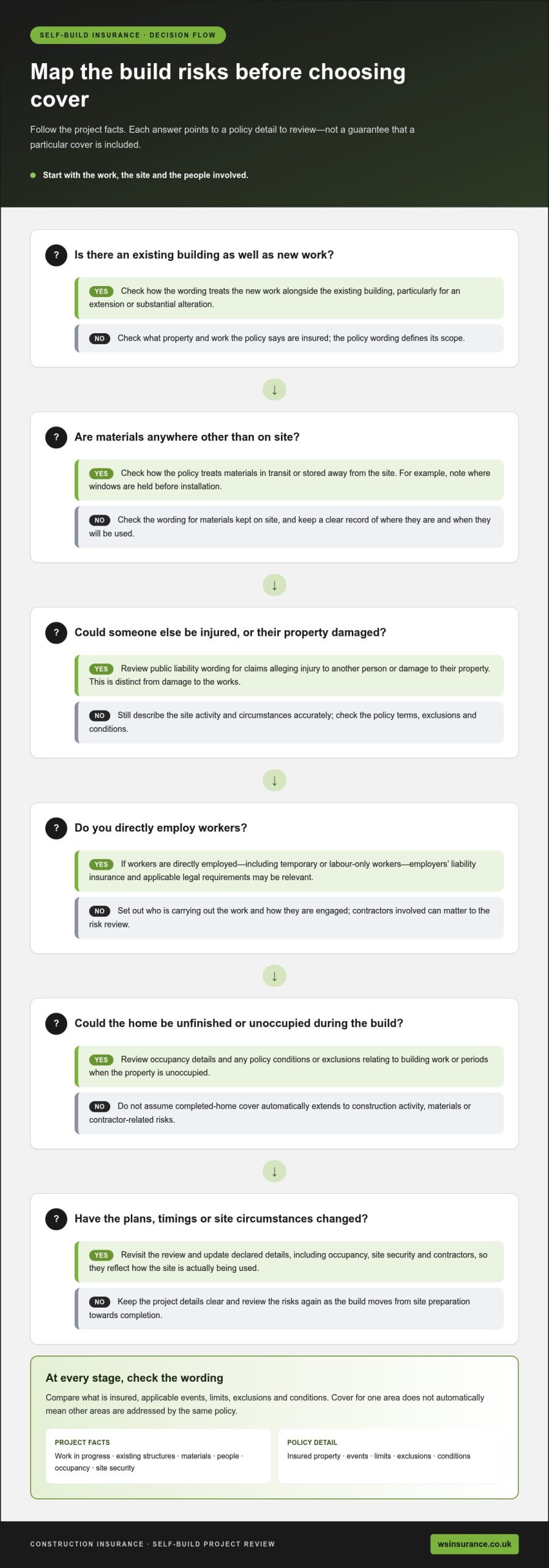
What to prepare before arranging construction insurance for a self-build
A clear project summary makes it easier to discuss risks and compare options on a consistent basis. Before arranging construction insurance for self-build projects, gather the details that describe the build as planned, including its value and expected duration. Accurate project disclosures give insurers a clearer basis for assessing the risk.
Project facts and documents to gather
Use this checklist to organise the information you’ll need. If a detail is still provisional, note that rather than presenting it as fixed.
- Outline the project: gather available plans and describe the scope of work, construction method and expected start and completion dates.
- Record project value and duration: prepare the figures and expected timescale you’ll use when discussing the build.
- Describe the site: note access arrangements, security measures and whether the property or site will be occupied during the work.
- List the people doing the work: record the contractors and trades involved, along with relevant employment arrangements if you’ll engage workers directly.
- Identify property and materials: note any existing structures, where materials will be stored and whether items will be kept off site or transported before installation.
Having the same information to hand keeps discussions clear. It also makes it easier to explain which details are confirmed and which may change.
When to review cover as the build progresses
Arranging cover is a starting point, not the only time to review the project information. Schedule review prompts around key milestones: before work starts, when a major stage is completed and before anyone begins occupying the home. These points can bring changes to the site, structure or how the property is used.
Revisit the policy information if the scope, timing, occupancy plans or contractors change. For example, a delay may extend the expected build period, while a change in who carries out the work may alter the details previously declared. Follow the policy’s notification conditions and report material changes in line with its terms. Keep records of updates and relevant correspondence so you can track what has been communicated.
A broker-led review can relate updated project details to policy options and wording. Ongoing policy management can also support consideration of relevant adjustments. Discuss your self-build insurance requirements with WS Insurance Brokers.
Arrange self-build insurance with a clear route from review to support
Once you’ve gathered your project information and identified the areas that need attention, a broker-led review can bring the decisions into a clear sequence. For construction insurance for self-build projects, that means understanding the build, assessing its risks, sourcing relevant options and carefully reviewing the policy terms before cover is arranged.
How a broker-led insurance review can help
A risk assessment connects details such as the construction method, project timeline, site security and occupancy plans with the questions insurers may need answered. As an independent broker, WS Insurance Brokers uses access to a panel of UK insurers to source options for consideration and help you compare their terms against your project circumstances. WS Insurance Brokers is authorised and regulated by the Financial Conduct Authority. Read our guide to insurance brokers to learn more about the role a broker can play.
What to do when project details change or a claim occurs
Insurance arrangements should keep pace with the build. If the scope, schedule, occupancy plans or contractors change, review the policy conditions and notify the relevant parties in line with their requirements. Policy administration can help keep track of updates, while claims support can assist you through the claims process. Neither support nor a policy description guarantees that a claim will be accepted or paid; the insurer’s decision depends on the policy terms and circumstances.
If an incident occurs, follow the insurer’s instructions and keep a clear record of relevant information. This may include:
- the date and a brief account of what happened;
- photographs of damage or the affected area, where appropriate;
- related correspondence, reports or other records requested during the claims process.
Keep copies of communications and note when changes were reported. Clear records can make it easier to explain what happened and respond to requests for information, though they don’t determine the outcome of a claim.
WS Insurance Brokers can review your project details, assess relevant risks and source options from its panel of UK insurers. Discuss your self-build insurance requirements and the next steps for your project.
Take the next step with confidence
Self-build insurance is most useful when it reflects the project as it develops. A thorough review considers changing site risks, the work and materials involved, and liability. It also checks exclusions, conditions and limits rather than relying on a familiar policy label.
Before arranging cover, prepare clear details about your project, including its value, duration, construction plans, security, occupancy and contractors. Revisit those details as the build progresses, and report relevant changes in line with your policy conditions. This gives you a stronger basis for understanding how construction insurance for self-build projects relates to your plans.
WS Insurance Brokers is an independent brokerage with access to a panel of UK insurers and is authorised and regulated by the Financial Conduct Authority. Its support includes policy management and assistance through the claims process, helping you address questions as circumstances change without promising a particular claims outcome.
For a considered review of your project and the available policy options, discuss your self-build insurance requirements with WS Insurance Brokers. Start with a clear review of your project details and the risks to consider at each stage.
Frequently Asked Questions
What insurance do I need for a self-build project in the UK?
For a UK self-build, consider cover for the work in progress, existing structures, materials and liability to others. Construction insurance for self-build projects isn’t one standard package, so the policy wording determines what is insured, along with limits, exclusions and conditions. Public liability and, if you directly employ workers, employers’ liability may also be relevant. A structural warranty is separate from construction-period insurance and may be a lender requirement.
Does standard home insurance cover a self-build?
It may not cover every aspect of a self-build. Standard home insurance can have restrictions relating to building work or periods when the property is unoccupied, but the answer depends on the policy wording and your circumstances. Read the exclusions and conditions, and disclose the planned work and occupancy arrangements. Don’t assume cover intended for a completed home automatically extends to construction activity or materials on site.
Is public liability insurance included in self-build insurance?
Public liability isn’t automatically included in every self-build policy. It relates to claims alleging that you’re responsible for injury to another person or damage to their property, such as an incident involving a neighbour or visitor. This is different from damage to the building work itself. Check the policy schedule and wording for the liability section, its limits, exclusions and conditions, and consider how your arrangements with contractors affect responsibilities.
How do I insure building materials for a self-build?
Check how the policy treats materials at each point: on site, in transit, stored off site or awaiting installation. These circumstances may be subject to different limits, exclusions or security conditions, so don’t assume materials are insured wherever they’re kept. Prepare a record of what you’ve bought, where it’s stored and when it’s due to be used. Then compare those details with the policy wording and any relevant conditions.
When should I arrange construction insurance for a self-build?
Arrange cover before work starts, allowing time to explain the project and review when the policy takes effect. Give accurate information about the expected duration, construction plans, site security, occupancy and contractors. As the build progresses, report material changes in line with the policy conditions. A revised schedule or change in who is doing the work can affect the information used to assess the risk, so keep the details under review.
Does self-build insurance cover theft or damage to tools?
Not necessarily. Tools may be treated differently from building materials or the work itself, and cover can depend on who owns them, where they’re kept and the policy’s security conditions. Tools belonging to a contractor may not be treated in the same way as your own. Check the wording for tools, theft, storage requirements, limits and exclusions rather than assuming site insurance automatically protects every item on the project.
What happens to self-build insurance when the house is complete?
Completion is a point to review the policy, not assume the construction cover continues unchanged. Tell your broker when the build is complete and discuss the transition to appropriate cover for the finished home, including when occupation begins. Check the construction policy’s end date and any relevant conditions to avoid gaps or unintended overlap. A structural warranty is separate from home insurance, so consider it as a distinct part of the completion arrangements.