
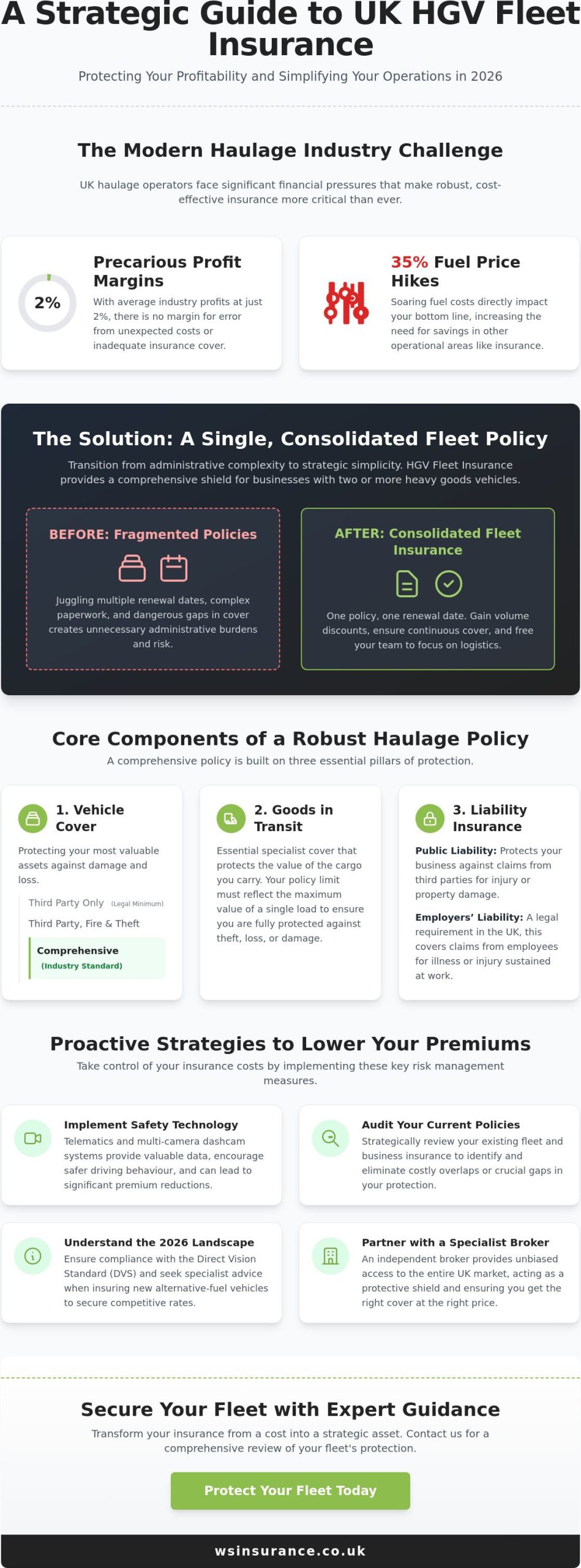
With average profit margins in the UK haulage industry sitting at a precarious 2 per cent, can your business afford to let rising premiums and hidden policy exclusions quietly erode your bottom line? It’s a question many operators are asking as they face the dual pressure of 35 per cent fuel price hikes and the ongoing complexity of securing reliable HGV fleet insurance UK. You likely feel that the current market is increasingly difficult; individual renewal dates and opaque terms often create more administrative work for your team instead of providing the security your fleet requires.
We understand that you need a steady hand to help you navigate these financial hurdles. This guide reveals how to transform your insurance from a mere regulatory cost into a strategic asset, ensuring you obtain cost-effective coverage that actually fits your specific cargo and routes. We will walk you through the process of consolidating your renewals into a single manageable date, accessing specialist UK underwriters, and identifying the precise protections required to thrive in the 2026 haulage environment. By the end of this guide, you’ll have the clarity needed to protect your fleet with confidence.
Key Takeaways
- Simplify your administrative burden by consolidating multiple vehicle policies into a single, manageable HGV fleet insurance UK agreement with one renewal date.
- Identify the essential coverage levels and specialist Goods in Transit protections required to safeguard your cargo against modern operational risks.
- Discover how implementing proactive safety measures, including telematics and multi-camera dashcam systems, can actively lower your premiums and improve driver behaviour.
- Master a strategic approach to sourcing cover by auditing your current fleet and reviewing existing business insurance to eliminate costly overlaps.
- Understand the benefits of partnering with an independent broker who provides unbiased access to the entire UK market and acts as a protective shield for your haulage operations.
Understanding HGV Fleet Insurance in the UK Market
For any haulage operator, the transition from managing individual vehicle policies to a consolidated agreement is a significant milestone in business maturity. HGV fleet insurance UK provides a comprehensive protective shield for businesses operating two or more heavy goods vehicles. Rather than juggling a fragmented collection of start dates and terms, operators can unify their entire fleet under a single, cohesive agreement. This strategic move eliminates the administrative burden of tracking multiple renewals and ensures that no vehicle inadvertently operates without cover.
Who Needs a Specialist Fleet Policy?
Haulage contractors, own-goods distributors, and construction firms all require the specific protections that only a specialist policy can offer. Standard commercial vehicle insurance UK often falls short when applied to heavy goods vehicles, as it may not account for the immense liability risks or the specific requirements of an Operator’s Licence (O-licence). For O-licence holders, insurance verification is a legal pillar of their professional standing. A foundational grasp of Understanding Vehicle Insurance principles confirms that liability and property protection must be precisely calibrated to the vehicle’s weight and the nature of the cargo being transported. Without this precision, a business remains exposed to hidden exclusions that could prove catastrophic during a claim.
The 2026 Regulatory Landscape
The regulatory environment in 2026 has introduced new layers of complexity for fleet operators. Compliance with the Direct Vision Standard (DVS) in London is no longer optional for those seeking competitive premiums; vehicles with poor visibility ratings are increasingly difficult to insure at standard rates. Furthermore, the industry is navigating a transition towards alternative fuels. With the 12-month VED holiday for HGVs running from 1 July 2026 to 30 June 2027, many operators are taking the opportunity to integrate electric or hydrogen-powered trucks into their fleets. Insuring these zero-emission vehicles requires specialist knowledge of battery salvage costs and unique repair requirements, making the choice of a knowledgeable broker more critical than ever.
Core Components of a Robust Haulage Policy
Securing a policy that stands up to scrutiny requires more than just ticking boxes. You have three primary choices for your vehicle cover: Comprehensive, Third Party Fire and Theft (TPF&T), and Third Party Only (TPO). While TPO is the legal minimum, most operators find it leaves them dangerously exposed. Comprehensive cover remains the industry standard for HGV fleet insurance UK because it protects your most valuable assets against accidental damage, even when your own driver is at fault. In an era where a single repair can cost thousands, this level of security is fundamental to business continuity.
Beyond the vehicles, you must protect the cargo. Specialist Goods in Transit (GiT) cover is essential, especially given that haulage industry profits are currently squeezed at just 2 per cent. Whether you carry general haulage or high-value electronics, your policy needs to reflect the maximum value of a single load. This isn’t just about financial protection; it’s about regulatory compliance. The Official Operator Licensing Guide outlines the strict standards for maintaining professional competence and operational safety, which includes having adequate insurance for the goods being moved.
Liability insurance forms the third pillar of a robust policy. Public Liability protects you against claims from third parties for injury or property damage, while Employers’ Liability is a legal requirement if you have staff. These aren’t just administrative hurdles; they are your safety net against litigation that could otherwise end your business. If you aren’t sure how these components should mesh together, a quick review of your current commercial fleet insurance can highlight any dangerous gaps in your protection.
Heavy-duty breakdown and recovery shouldn’t be an afterthought. Standard roadside assistance won’t suffice for a 44-tonne artic. You need a policy that guarantees specialist recovery to get your vehicle back to a depot or a qualified repairer, minimising the impact of a breakdown on your delivery schedule.
Driver Flexibility: Any Driver vs Named Driver
Choosing between “Any Driver” and “Named Driver” policies involves a careful cost-benefit analysis. Any Driver policies offer maximum operational flexibility, which is vital for fleets facing the current driver shortage. However, they typically carry higher premiums. A common middle ground is “Any Driver over 25”, which provides flexibility while reassuring underwriters that your vehicles are in experienced hands. This approach allows you to recruit new talent without the delay of individual policy referrals; it creates a smoother onboarding process for your team.
Specialist Extensions for Heavy Goods
Generic policies often exclude high-risk activities. If you transport chemicals or fuel, ADR (Hazardous Goods) cover is mandatory. Similarly, refrigerated transport requires “deterioration of stock” extensions to protect against cooling unit failures. For those hauling heavy machinery, ensure your policy accounts for the specific risks involved in heavy lifting and plant transport. These tailored extensions remove the anxiety of hidden exclusions, ensuring that your specific niche in the haulage market is fully protected.
Proactive Risk Management: Lowering Your Fleet Premiums
Securing competitive rates for HGV fleet insurance UK is no longer just about shopping around at renewal time. In the current market, underwriters are increasingly looking for evidence of active risk mitigation before they’ll commit to their best pricing. This shift means that your operational habits directly dictate your financial outcomes. By demonstrating a commitment to safety through data and technology, you transform your business from a statistical risk into a preferred client. It’s about taking the steering wheel of your insurance costs rather than being a passenger to market fluctuations.
Telematics systems have become the cornerstone of this proactive approach. These units provide real-time insights into driver behaviour, tracking everything from harsh braking to excessive idling. When you share this data with insurers, you’re providing a transparent view of your fleet’s safety culture. Similarly, multi-camera dashcam systems are now frequently an underwriter requirement rather than an optional extra. These devices provide the “silent witness” needed to exonerate your drivers in non-fault incidents, which prevents your claims history from being unfairly tarnished by third-party errors. Citing resources like the Road Haulage Association can help you stay abreast of the latest industry benchmarks for these safety standards.
Physical security at your depot also plays a vital role in premium calculation. Insurers favour operators who invest in secure, well-lit overnight parking and robust perimeter fencing. Combined with a rigorous driver training programme that goes beyond the mandatory 35 hours of periodic CPC training, these measures signal to the market that you’re a low-risk operator. This diligent approach acts as a protective shield for your profit margins, which is especially critical given the tight 2 per cent margins currently seen across the sector.
Technology as an Insurance Asset
AI-driven fatigue monitoring is the latest frontier in fleet safety. These systems can detect early signs of driver tiredness and alert the cab, preventing accidents before they occur. GPS tracking also remains a fundamental tool for reducing theft risk; it allows for rapid vehicle recovery and lowers the likelihood of a total loss claim. Providing insurers with clear, unfiltered access to your fleet’s performance data eliminates the guesswork that often leads to inflated premiums. This transparency builds a narrative of reliability that restricted, automated brokers simply can’t match.
Claims Management and Excess Strategy
Your approach to claims is just as important as your accident prevention. Implementing a strict “First Notification of Loss” (FNOL) policy ensures that your insurer is informed of any incident within hours, not days. This speed allows them to control third-party costs and prevent expensive credit hire charges from spiralling. You might also consider a higher voluntary excess to lower your annual costs, provided your cash flow can support the increased initial outlay during a claim. Ultimately, a clean, well-documented claims history is your strongest negotiation tool when we approach the market on your behalf.
A Strategic Buying Guide: How to Source the Best Cover
Sourcing the ideal HGV fleet insurance UK requires a methodical approach that begins long before you receive a formal quote. In a market where underwriters are increasingly selective, your preparation serves as the foundation for your eventual premium. Start by conducting a thorough internal audit of your operational footprint. You need a granular view of your vehicle specifications, driver profiles, and typical haulage routes. This level of detail allows an underwriter to see the reality of your risk rather than a generic industry average, which often leads to more favourable terms.
Simultaneously, review your existing business insurance to identify any potential overlaps in public liability or property cover. Many operators find they’re paying twice for similar protections across different policies. Gathering at least three years of verified Confirmed Claims Experience (CCE) is also non-negotiable. This document functions as your business’s financial CV; it proves your reliability to potential insurers and serves as your strongest lever during price negotiations. Once your data is organised, consult an independent professional to finalise your terms and ensure all O-licence requirements are met with absolute precision.
Broker vs Direct: Why Independence Matters
The limitations of online comparison sites become painfully clear when dealing with complex HGV risks. These automated platforms are designed for high-volume, low-complexity products and often fail to account for the nuances of a 50-vehicle fleet or specialist cargo requirements. By choosing to work with independent insurance brokers, you gain a dedicated advocate who prioritises your security over a quick transaction. We provide access to “unseen” London markets, including specialist mutuals and Lloyd’s of London syndicates that don’t deal directly with the public. This autonomy ensures that your policy is placed based on its merits rather than being restricted to a handful of high-street providers.
Avoiding Common Pitfalls
Underinsurance remains a silent threat to many hauliers, particularly regarding inaccurate vehicle valuations. If your fleet is undervalued, you risk falling foul of the “Average Clause” during a claim. This clause allows insurers to reduce your payout proportionally to the level of underinsurance, which can lead to a significant financial shortfall when you least expect it. You must also remain diligent about disclosing mid-term adjustments. Adding or removing vehicles without prompt notification can create gaps in your protection that only come to light after an incident. Clear, consistent communication with your broker removes this uncertainty and protects your professional standing.
If you are looking to eliminate the complexity of your current renewal process, contact our specialist fleet team for a transparent assessment of your insurance requirements.
Why Partner with WS Insurance Brokers for Your Fleet Protection?
Choosing the right partner for your HGV fleet insurance UK is a decision that directly impacts your business’s resilience and long-term viability. As an independent broker, WS Insurance Brokers doesn’t answer to any single insurance company. Instead, we answer to you. This autonomy allows us to scan the entire breadth of the UK market, including specialist underwriters that restricted competitors simply cannot access. We act as a shield between your operation and the volatility of the insurance industry, ensuring your cover is robust and your premiums remain pragmatic. Our role is to provide the steady hand you need in an increasingly complex environment.
Our “Trusted Advisor” philosophy means we prioritise your security over a quick transaction. We don’t just sell policies; we design protective frameworks tailored to your specific haulage niche. Whether you’re managing a fleet of refrigerated artics or specialised ADR tankers, the team at WS Insurance Brokers provides the clinical precision required to eliminate gaps in your cover. When incidents occur, our dedicated claims support team takes over the heavy lifting. We advocate fiercely for your interests, managing the complexities of the claims process so you can keep your focus on your delivery schedules and driver management.
A Steady Hand in a Complex Market
We remove the anxiety from the renewal process through proactive market reviews that begin months before your current policy expires. This diligent approach ensures you aren’t forced into last-minute decisions under pressure. Our commitment to transparency and integrity is absolute; you’ll always receive a clear explanation of our recommendations and the logic behind them. By providing a single point of contact for all your commercial covers, WS Insurance Brokers creates a narrative of partnership that simplifies your administrative life. You gain a seasoned professional who understands your business history and your future goals.
Next Steps for Your Fleet
Initiating a professional risk review with our team is the first step toward securing your business’s future. Preparing for your next renewal whilst the market is favourable allows us to position your fleet in the best possible light to underwriters. We invite you to experience the clarity and confidence that comes with expert guidance. Don’t leave your fleet’s protection to chance or automated algorithms that fail to see the human effort behind your haulage operation. Our team is ready to provide the thorough, safety-oriented outcomes your business deserves.
Request a bespoke HGV fleet insurance review from WS Insurance Brokers
Securing Your Haulage Future
Navigating the 2026 haulage market requires a blend of operational diligence and strategic foresight. Securing robust HGV fleet insurance UK is no longer a passive annual task; it is a proactive pillar of your risk management strategy. By consolidating your renewal dates and embracing safety technology like telematics, you actively influence your insurability and protect your profit margins. You now have the clarity needed to avoid common pitfalls like underinsurance and fragmented policies that create unnecessary administrative burdens.
WS Insurance Brokers acts as your expert guide through these market complexities. Our team is authorised and regulated by the Financial Conduct Authority. We provide access to specialist London and regional insurance markets that remain hidden from automated comparison sites. We offer independent advice with no bias towards specific insurers; this ensures that every recommendation we make is focused solely on your business’s long-term security. Take the first step toward removing uncertainty and establishing a partnership built on transparency and integrity.
Secure your fleet with a tailored HGV insurance quote from WS Insurance Brokers
We look forward to helping your business move forward with confidence.
Frequently Asked Questions
What is the minimum number of vehicles for HGV fleet insurance?
Most insurers define a fleet as a minimum of two vehicles, although some specialist providers may require three or more to trigger fleet-rated terms. This entry-level threshold allows smaller haulage operators to benefit from the administrative ease of a single policy from the outset. Starting your HGV fleet insurance UK journey with just two vehicles provides a scalable foundation that grows alongside your business.
Can I include vans and cars on my HGV fleet policy?
You can certainly include vans and company cars on a mixed fleet policy alongside your heavy goods vehicles. This consolidation ensures that all company-owned assets are managed under a unified renewal date and a single set of terms. It removes the complexity of managing separate private motor or commercial vehicle policies, providing a holistic and transparent view of your business’s total road risk.
Does HGV fleet insurance cover my drivers whilst they are in Europe?
Standard policies typically provide the minimum legal cover required for EU travel, but comprehensive protection usually requires a specific territorial extension. If your drivers frequently cross into Europe, you must ensure your policy includes full foreign use cover to maintain the same level of security enjoyed in the UK. This extension accounts for the unique recovery and liability risks associated with international haulage operations.
How does telematics affect my HGV fleet insurance premium?
Telematics systems act as a transparent record of your fleet’s safety culture, allowing underwriters to offer discounts based on actual driver behaviour rather than generic risk profiles. By providing real-time data on speed, braking, and cornering, you demonstrate a commitment to proactive risk management. This evidence-based approach often results in more favourable terms and lower renewal rates for diligent, safety-conscious operators.
Is Goods in Transit insurance included as standard in fleet policies?
Goods in Transit insurance is frequently treated as a separate, essential component rather than being automatically included in the base vehicle policy. Because cargo values and types vary significantly between hauliers, this cover must be tailored to your specific contracts. We ensure that your transit limits align with your conditions of carriage to prevent any dangerous financial shortfalls during a claim.
What happens if I need to add a new vehicle to my fleet mid-term?
Adding a new vehicle mid-term is a straightforward process that typically results in a pro-rata premium adjustment for the remainder of the policy year. You simply notify your broker of the vehicle details to ensure immediate cover is in place. This flexibility allows your fleet to remain agile, responding to new contracts or vehicle upgrades without the need to negotiate a completely new insurance agreement.
Are there specific age restrictions for drivers on an HGV fleet policy?
Most underwriters prefer drivers to be over the age of 25 due to the increased risk associated with heavy goods vehicles. While it’s possible to include younger drivers, they often attract higher excesses and may require individual referral to the insurer for approval. We work with you to find a balance between operational flexibility and premium costs, often securing “Any Driver over 25” terms.
How can I lower my HGV fleet insurance costs in 2026?
Lowering costs in 2026 requires a combination of leveraging government relief, such as the 12-month VED holiday, and investing in advanced safety technology. Implementing multi-camera systems and robust driver training programmes reduces the frequency of fault accidents, which remains the most effective way to secure lower premiums. Maintaining a clean claims history functions as your strongest negotiation tool when accessing the breadth of the UK insurance market.