
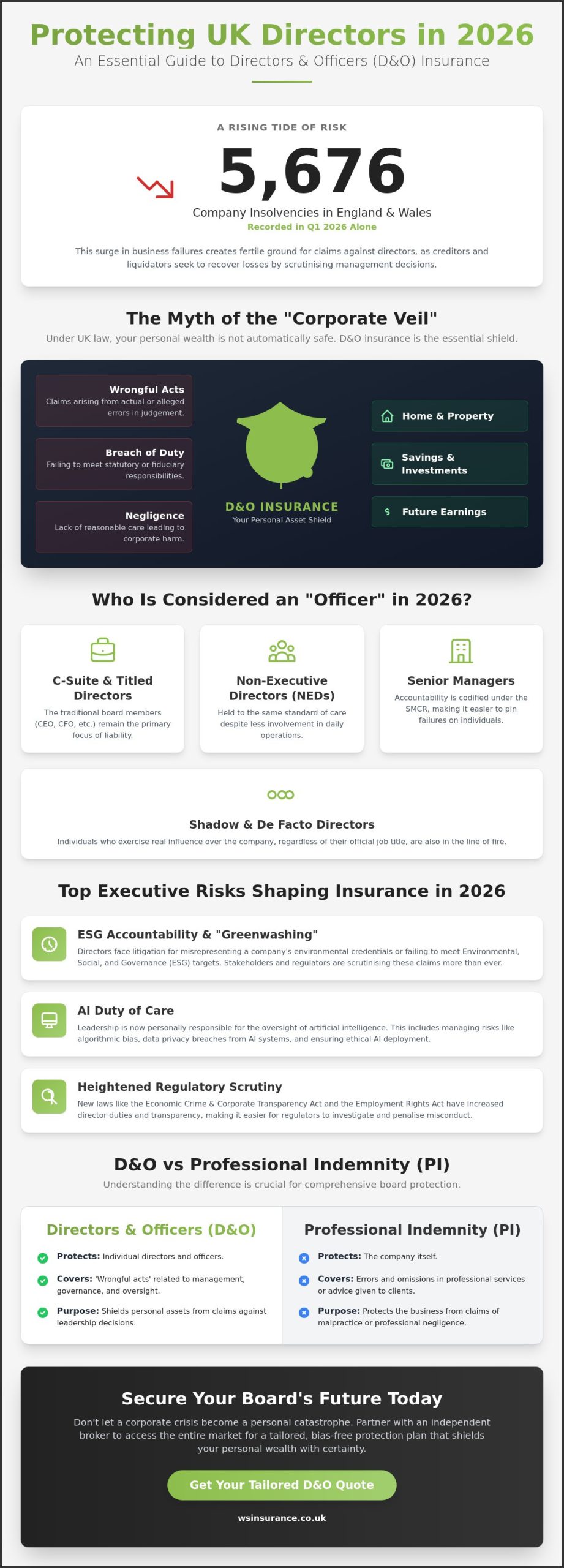
With 5,676 company insolvencies recorded in England and Wales during the first quarter of 2026 alone, the shield between corporate failure and your personal bank account has never felt thinner. You likely recognise that leadership requires courage, but the fear that a regulatory shift or a litigation claim could lead to personal bankruptcy is a burden that shouldn’t rest on your shoulders. Securing robust directors and officers insurance UK is no longer a standard corporate tick-box exercise; it’s a vital strategy for protecting everything you’ve worked to build.
We understand the anxiety caused by the recent rollout of the Employment Rights Act and the heightened scrutiny of the Economic Crime and Corporate Transparency Act. This guide removes the confusion surrounding management liability, providing the clarity you need to distinguish your coverage from Professional Indemnity. You’ll learn to master these complexities and protect your personal assets against modern executive risks with absolute certainty.
Our team has analysed the current 2026 climate to help you establish clear coverage boundaries and select appropriate indemnity limits. We explore how to defend your board against emerging threats like AI litigation and greenwashing claims, ensuring your leadership remains focused on growth rather than legal defence. You’ll move forward with the confidence that your personal wealth is shielded by a steady, professional hand.
Key Takeaways
- Understand the reality of unlimited personal liability under UK law and why a dedicated policy acts as a necessary shield for your private wealth.
- Discover how directors and officers insurance UK has evolved to address 2026 risks, including “Greenwashing” litigation and the emerging “AI Duty of Care”.
- Learn to distinguish between Professional Indemnity and management liability to ensure your board is protected against governance failures rather than just service errors.
- Identify the critical factors for setting indemnity limits that account for both legal defence costs and potential settlements, including the necessity of run-off cover.
- Recognise the strategic advantage of partnering with an independent broker to access the entire market for a tailored, bias-free protection plan.
The Evolution of Management Liability: Why UK Directors Face Greater Risks in 2026
Leadership in the UK has become a high-stakes environment where the lines between corporate responsibility and personal liability are increasingly blurred. Whilst the concept of a limited company suggests a layer of protection, the reality for individuals in the boardroom is often quite different. Directors and Officers (D&O) liability insurance acts as a personal shield, protecting your private wealth when the company’s own assets cannot or will not cover you. It’s a critical component of directors and officers insurance UK strategies, especially as regulatory scrutiny intensifies across every sector.
Many directors mistakenly believe the “corporate veil” provides absolute protection. In truth, UK law allows for unlimited personal liability in cases of wrongful acts, negligence, or breach of duty. If a claimant successfully “pierces the veil,” your personal home, savings, and investments are directly at risk. The modern director is more exposed than ever. Increased transparency requirements, such as those mandated by the Economic Crime and Corporate Transparency Act, mean your decisions are now subject to intense public and regulatory scrutiny. This transparency ensures that mistakes are spotted faster and punished more severely than in previous years.
Who is Classified as an “Officer” in 2026?
The definition of an “officer” has expanded significantly. It no longer applies solely to those with a C-suite title on their business card. In 2026, shadow directors, senior managers, and “de facto” directors who exercise real influence over the company are all within the line of fire. Non-executive directors (NEDs) face unique risks. They’re often held to the same standard of care as full-time directors despite having less visibility into daily operations. The Senior Managers and Certification Regime (SMCR) has codified this accountability, making it easier for regulators to pin specific failures on individual leaders regardless of their exact job title.
The Personal Cost of a Corporate Claim
The financial impact of a claim often begins long before a verdict is reached. Legal defence costs in the UK are substantial. These expenses can exhaust your personal savings whilst a claim is still pending. Beyond the immediate monetary drain, there’s the looming threat of director disqualification, which can end a career overnight. Robust insurance provides the necessary resources to fight disqualification orders and clear your reputation. Learning how to identify business risks to insure against is a foundational part of your 2026 strategy. This proactive labour ensures that a corporate crisis doesn’t result in a personal catastrophe.
Key Trends Shaping Executive Insurance: From ESG Accountability to AI Oversight
The landscape of executive risk in 2026 has shifted from traditional financial oversight to a broader, more complex definition of governance. Directors now face a multi-front challenge where digital ethics and environmental stewardship are as scrutinised as the balance sheet. This evolution is reflected in how UK directors’ and officers’ liability insurance is structured, moving beyond simple indemnity to provide a comprehensive defence against modern litigation. Understanding these trends is essential for any board seeking to maintain a steady hand in a volatile market.
In the first quarter of 2026, 5,676 company insolvencies were recorded in England and Wales. This surge in business failure creates a fertile ground for directors and officers insurance UK claims, as liquidators and creditors look for any sign of mismanagement to recover losses. We’re also seeing a significant rise in the “AI Duty of Care.” Directors are now expected to oversee algorithmic bias and data ethics personally. If an automated system produces discriminatory outcomes or violates data privacy, the board can no longer claim technical ignorance as a defence. Regulators now view AI governance as a fundamental management responsibility.
To address these expanding risks, many organisations are shifting towards “Entity Cover” within their management liability suites. This extension protects the company itself when it’s named as a co-defendant alongside individual directors. It prevents the dilution of personal limits and ensures that the entire leadership structure remains shielded. If you’re unsure how these trends impact your specific sector, a quick consultation with the experts at WS Insurance Brokers can provide the necessary clarity.
ESG and the Boardroom: A New Litigation Frontier
Climate-related disclosures have become a primary trigger for D&O claims. The Financial Conduct Authority (FCA) is actively policing sustainability claims, making “Greenwashing” a high-risk area for directors who sign off on misleading environmental statements. It’s vital to ensure your policy specifically includes “Pollution Defence Costs.” Whilst many standard policies exclude environmental damage, directors need protection for the legal costs associated with defending allegations of ESG-related wrongful acts.
Cyber Oversight as a Management Responsibility
It’s important to distinguish between Cyber Insurance and D&O coverage. Whilst a cyber policy handles the immediate fallout of a breach, D&O insurance protects you when shareholders claim the board failed to implement adequate supervision. A major data breach often triggers a secondary claim against leadership for “failure to supervise” digital assets. Working with experienced commercial insurance brokers ensures these covers are integrated, eliminating gaps that could leave your personal assets exposed during a crisis.
Comparing Executive Insurance Solutions: D&O, PI, and Management Liability
Many business leaders find themselves confused by the overlapping terminology of corporate protection. It’s vital to clear the air. A common misconception is that Public Liability covers executive decisions; it doesn’t. Public Liability protects against physical injury or property damage to third parties. It won’t help you if a shareholder alleges you’ve breached your fiduciary duty or failed to exercise due diligence during a merger.
Management Liability is often sold as an umbrella suite. This efficient structure bundles D&O with other essential protections like Employment Practices Liability and Corporate Legal Liability. By combining these, you ensure there are no cracks in your defence. This narrative of partnership ensures that the broker’s proactive labour results in your absolute confidence. You’re not just buying a policy; you’re securing a steady hand to guide you through the complexities of the broader market.
D&O vs Professional Indemnity: The Critical Difference
D&O insurance protects the individual person from claims arising from their management decisions, whilst PI insurance protects the business against errors in the professional services provided to clients. These policies must work in tandem to eliminate gaps that could leave you vulnerable. You can find more detail in our directors and officers insurance UK guide. Without both, a single claim could be rejected by one insurer on the basis that it belongs under the other’s remit.
Employment Practices Liability (EPL)
EPL has become a cornerstone of the modern management liability package. In the UK’s current regulatory environment, claims involving wrongful dismissal, harassment, or discrimination are increasingly common. EPL doesn’t just protect the company; it shields the individual manager named in the suit. Whether it’s a dispute over a redundancy process or an allegation of a hostile work environment, having this cover in place removes the financial anxiety of a protracted legal battle. It acts as a shield between the manager and the costs of litigation.
Structuring Your Policy: Determining Adequate Limits and Coverage Extensions
Designing a robust defence requires more than simply selecting a high number on a policy schedule. A well-structured directors and officers insurance UK policy must be segmented into three distinct layers of protection, commonly known as Side A, B, and C. Side A provides direct protection for your personal assets when the company is legally or financially unable to indemnify you. Side B serves as a reimbursement mechanism for the firm when it has already paid for your defence, whilst Side C covers the entity itself during securities litigation. This layered approach ensures that your private wealth remains the final, untouched line of defence.
Your limit of indemnity must account for the dual pressure of legal fees and potential settlements. In the UK, high-profile litigation can see legal costs escalate long before a case reaches court. If your limit is too low, these costs can erode the available funds, leaving you personally liable for the final settlement. We also recommend including “Crisis Management” extensions. These provisions provide immediate access to public relations experts to protect your reputation, ensuring that a legal challenge doesn’t result in lasting professional damage. For those planning to step down, “Run-off Cover” is indispensable. It protects you for a specified period, often up to six years, against claims arising from decisions made whilst you were still on the board.
Calculating the Right Limit for Your Sector
Determining the correct limit requires a methodical assessment of your company turnover, employee count, and the regulatory intensity of your industry. A small tech start-up faces different litigation triggers than a large financial institution. We often warn against the “minimum limit” trap. Whilst a £1 million limit might seem sufficient for an SME, it can be quickly exhausted if multiple directors are named in the same suit. In such cases, the “aggregate limit” is shared amongst all defendants, potentially leaving individuals with inadequate protection during a complex, multi-party dispute.
The Importance of Retroactive Dates
D&O policies operate on a “claims-made” basis. This means the policy in force at the time the claim is notified is the one that must respond, regardless of when the alleged “wrongful act” occurred. You must ensure your retroactive date covers all past board decisions to avoid a gap in your timeline. Our team of business insurance brokers can audit these dates to ensure your protection is seamless and comprehensive. If you’re ready to remove the uncertainty from your executive protection programme, contact our expert team today for a tailored consultation that puts your security first.
Securing Your Board’s Future with WS Insurance Brokers
WS Insurance Brokers acts as the steady hand required to manage the complexities of modern management liability. We position ourselves as an independent partner, focused on removing every trace of uncertainty from your executive risk profile. Our autonomy is our greatest strength; by maintaining “whole of market” access, we ensure you aren’t restricted to a handful of providers with limited appetites. Instead, our proactive labour results in a selection of competitive rates and robust terms that a direct insurer simply cannot match. This independence allows us to act with fierce loyalty to your interests, rather than those of the insurance companies.
We take a bespoke approach to every placement, ensuring that your directors and officers insurance UK strategy integrates seamlessly with your existing Professional Indemnity cover. As discussed in previous sections, the gaps between these policies can be catastrophic for your personal wealth. We audit your entire insurance suite to ensure that management failures and professional service errors are clearly defined and appropriately protected. This narrative of partnership continues into the claims process, where we act as a dedicated shield between you and the stressors of corporate litigation. We provide the calm reliability you need when your reputation and assets are on the line.
Why an Independent Broker Beats a Direct Insurer
Choosing an independent broker ensures that your favourite outcome is prioritised over insurer profit. We act as a Trusted Advisor, translating the dense regulatory jargon of 2026 into a clear, actionable security plan. Direct insurers often use automated systems that lack the human nuance required for high-stakes executive protection. We provide transparent, unbiased advice that prioritises your long-term security. A proactive risk review with our team ensures that your current policy doesn’t just exist but actively reflects the emerging trends of 2026, from AI oversight to ESG accountability.
Take the Next Step in Executive Security
Protecting your board’s future shouldn’t be an arduous task. We invite you to organise a confidential consultation to audit your current protection and identify any hidden exposures. Our process is methodical and structured, designed to provide maximum clarity with minimal disruption to your schedule. Working with a seasoned professional allows you to delegate the complexity whilst retaining absolute confidence in the result. Enquire about bespoke Directors and Officers insurance today to secure your legacy with a partner who values integrity and precision above all else.
Future-Proofing Your Board for the 2026 Landscape
Navigating the heightened risks of the modern UK economy requires more than just a standard policy; it demands a strategic shield for your personal wealth. We’ve explored how the shift toward ESG accountability and the emerging “AI Duty of Care” have fundamentally changed the director’s risk profile. By distinguishing between management liability and professional indemnity, and structuring your policy with the correct Side A, B, and C layers, you ensure that your private life remains separate from corporate crises. Securing robust directors and officers insurance UK is the final, essential step in a comprehensive governance strategy.
As an independent partner authorised and regulated by the Financial Conduct Authority, we provide the transparent, unbiased guidance you need to make informed decisions. Our team offers whole-of-market access to major UK insurers, ensuring you benefit from competitive premiums without sacrificing the depth of your protection. We don’t just place your cover; we act as a dedicated advocate throughout the claims process, providing a steady hand during stressful litigation. Secure your board with bespoke D&O insurance from WS Insurance Brokers. You can lead with absolute confidence, knowing your future is in safe hands.
Frequently Asked Questions
Is Directors and Officers insurance a legal requirement in the UK?
No, directors and officers insurance UK is not a legal requirement under current legislation, unlike Employers’ Liability insurance. However, whilst the law doesn’t mandate it, many company articles of association or investor agreements will insist upon it as a condition of your appointment. Without this protection, you are personally liable for management errors, making it a vital component of a responsible governance framework for any UK board.
Does D&O insurance cover criminal acts or fraud committed by a director?
D&O insurance does not cover proven criminal acts, deliberate fraud, or personal profit gained through illegal means. It’s designed to protect you against “wrongful acts” committed in good faith. Most policies will provide an advance for legal defence costs during an investigation; however, if a court finds you guilty of a criminal act, the insurer will typically seek to recover those costs from you immediately.
Can a small private limited company function without D&O insurance?
A small private limited company can technically function without it, but the risks are often underestimated by SME owners. Small businesses aren’t immune to regulatory investigations or employee disputes that target individual managers. Because your personal assets aren’t shielded by the company’s limited status in cases of negligence, even a minor legal challenge could lead to personal financial ruin without a robust policy in place.
What is the difference between D&O and Management Liability insurance?
Management Liability is a comprehensive insurance suite that typically bundles three distinct covers: D&O, Employment Practices Liability (EPL), and Corporate Legal Liability. Whilst D&O specifically protects the individual personal assets of the directors, Management Liability provides a broader shield that includes protection for the company entity itself. This bundled approach removes uncertainty by ensuring that both the individuals and the organisation are defended against diverse governance risks.
Who typically pays the premium for Directors and Officers insurance?
The company almost always pays the premium for the policy as part of its executive benefits and risk management strategy. This is standard practice in the UK and is not usually considered a “benefit in kind” for tax purposes, provided the policy only covers the director’s liability to the company or third parties. Paying the premium centrally ensures that all board members are consistently protected under a single, unified structure.
What happens to my D&O cover if I resign from the board?
Your protection doesn’t automatically end when you resign, provided the company maintains the policy or secures specific run-off cover. Since D&O insurance is “claims-made”, you are only protected if a policy is active at the time the claim is notified, even if the act happened years ago. We recommend ensuring your exit agreement includes a provision for six years of run-off cover to shield your retirement from past board decisions.
Does D&O insurance protect my personal home and assets?
Can shareholders sue directors, and does D&O cover this?
Shareholders can certainly sue directors for reasons such as breach of fiduciary duty or misleading financial statements, and D&O insurance is designed to cover this. These are often referred to as “derivative actions” brought on behalf of the company. Your policy provides the resources to defend against such allegations, ensuring that shareholder disputes don’t result in a direct drain on your personal financial resources.