
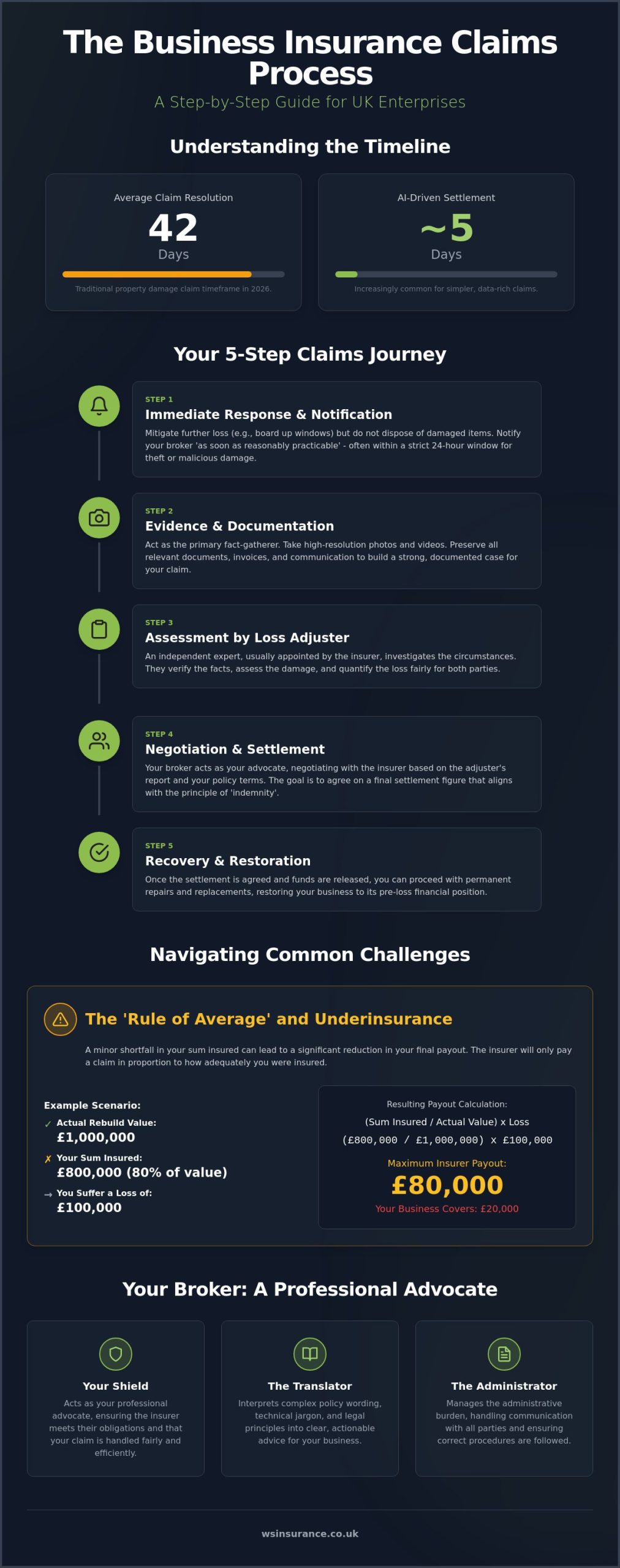
Did you know that while AI-driven systems have slashed some settlement times to under five days, the average property damage claim in 2026 still takes roughly 42 days to reach a final resolution? For a UK business owner, those six weeks can feel like an eternity, especially whilst you’re wrestling with technical jargon like ‘indemnity’ or the dreaded ‘average clause’. It’s completely natural to feel anxious about claim rejection or the impact of prolonged downtime on your enterprise. Having the business insurance claims process explained simply and transparently allows you to move from a position of worry to one of absolute control.
We believe that clarity is the best antidote to uncertainty. This guide provides a definitive roadmap for the current landscape. You’ll learn how to organise your documentation effectively and understand the vital role your broker plays as a loyal advocate between you and the insurer. Our goal is to replace confusion with confidence; we provide a steady hand to guide you through every stage of the journey. By the end of this breakdown, you will have the tools to protect your enterprise with total certainty.
Key Takeaways
- Understand why notifying your insurer ‘as soon as reasonably practicable’ is a critical contractual obligation to avoid potential claim rejection.
- Discover how the ‘Rule of Average’ works and why a minor shortfall in your sum insured can lead to a significant reduction in your final payout.
- Gain confidence by having the business insurance claims process explained, allowing you to mitigate further losses and secure your premises without delay.
- Learn how an independent broker acts as your professional advocate, translating complex policy wording into clear, actionable advice whilst managing the administrative burden.
- Build a ‘Claims First’ culture within your management team through regular policy reviews and updated property valuations tailored to the 2026 economic environment.
What is the Business Insurance Claims Process?
At its core, the Insurance claim process is the formal mechanism through which a business notifies its insurer of a loss to seek financial recovery. It’s the activation of the promise you purchased when you first paid your premium. Having the business insurance claims process explained clearly is vital; it moves the experience from a chaotic reaction to a managed recovery. This structured procedure is essential for maintaining business continuity. When stakeholders see a methodical response to a crisis, it preserves confidence in your leadership whilst protecting your enterprise’s long term reputation.
You’ll typically encounter two distinct categories of claims. First-party claims involve damage to your own assets, such as your premises or equipment covered under Commercial Property Insurance. Third-party claims occur when another person or entity holds your business liable for injury or damage. These often fall under Public Liability or Professional Indemnity Insurance. Regardless of the type, the foundation of every claim is the ‘Contract of Indemnity’. This legal principle ensures your business is returned to the exact financial position it occupied immediately before the loss occurred. It’s a system designed for restoration, not for profit.
The Legal Framework of a Commercial Claim
UK law dictates how you must interact with your insurer. The ‘Duty of Fair Presentation of Risk’ is a cornerstone of this relationship; it requires you to disclose every material circumstance that could influence an underwriter’s decision. If this isn’t handled with precision from the start, it can jeopardise the validity of your claim later. Similarly, the principle of ‘Utmost Good Faith’ demands total transparency from both parties. In 2026, updated FCA regulatory requirements have further strengthened these standards. These rules ensure fairer outcomes by mandating that insurers provide greater clarity and transparency throughout the entire claims journey.
Key Stakeholders in Your Claims Journey
- The Insurer: This is the entity providing the financial indemnity. They’re responsible for assessing the claim against your policy terms and releasing the funds.
- The Loss Adjuster: These are independent experts usually appointed by the insurer. Their role is to investigate the circumstances of the loss, verify the facts, and ensure the claim is quantified fairly for both sides.
- The Broker: This is where your protection is most visible. An independent broker acts as your shield and professional advocate. They don’t just facilitate communication; they interpret complex policy wording to ensure the insurer meets their obligations to you.
By understanding these roles, you can remove the anxiety often associated with the business insurance claims process explained in technical manuals. You aren’t navigating this complex market alone; you have a team of professionals designed to ensure your business remains secure.
The Step-by-Step Mechanics of a Commercial Insurance Claim
A successful recovery depends on precision during the first few hours following an incident. Having the business insurance claims process explained step-by-step ensures you don’t miss critical contractual deadlines or overlook vital evidence. It’s about moving from the initial shock of the event to a position of organised, documented strength. By following a methodical path, you eliminate the guesswork that often leads to anxiety and delayed payouts.
Step 1: Immediate Response and Notification
Your primary duty is to mitigate further loss. This might involve boarding up a broken window or isolating a breached server to prevent further data exfiltration. However, you must distinguish between emergency repairs and permanent restoration. Don’t dispose of damaged items or commit to major repairs until an adjuster has inspected the site. Notification is equally urgent. Most policies require you to report a loss ‘as soon as reasonably practicable’. For specific incidents like theft or malicious damage, this often means a strict 24-hour window. Logging the claim through your broker ensures the right details are captured correctly the first time, preventing administrative hurdles later.
Step 2: The Investigation and Evidence Phase
The transition from incident to documented proof requires a diligent approach. You should act as the primary gatherer of facts to support your case. Capture high-resolution photographs from multiple angles, secure CCTV footage, and obtain written statements from witnesses whilst the details are fresh in their minds. In cyber-liability or data breach claims, digital evidence is paramount. Ensure your IT team preserves server logs and forensic data without altering the digital trail. Cooperating with the Loss Adjuster is essential; however, remember that your broker acts as your shield, ensuring your interests remain protected during every interview and site visit.
Step 3: Calculating Business Interruption
Physical damage is often just the tip of the iceberg. The real threat to your enterprise is the resulting downtime. This is where business insurance truly proves its value. You must determine the ‘Indemnity Period’, which is the length of time the insurer will support your revenue recovery. This often spans 12 to 36 months, depending on your policy. Additionally, identify any ‘Increased Cost of Working’ (ICOW). These are the extra expenses you incur to keep the business operational, such as renting temporary office space or hiring emergency equipment. Finalising the payout requires a careful review of the insurer’s offer to ensure every penny of lost revenue and additional expenditure is accounted for. If you’re unsure about your current coverage levels, a personal consultation can help clarify your position and remove any lingering uncertainty.
Navigating Challenges: Underinsurance and Documentation Pitfalls
Even with the business insurance claims process explained in detail, many UK enterprises stumble at the final hurdle due to technical oversights. The most common pitfall is underinsurance, a risk that has intensified in the fluctuating economy of 2026. As building material costs and labour rates shift, outdated valuations become a significant liability. If your cover hasn’t kept pace with these market changes, you risk a repudiated claim or a payout that fails to cover your actual losses. We act as a steady hand to help you identify these gaps before they compromise your security.
Avoiding the Underinsurance Trap
When arranging commercial property insurance, you must focus on the reinstatement cost rather than the market value. Reinstatement represents the total cost to rebuild your premises from scratch, including debris removal and professional fees. Failing to reach this figure triggers the ‘Rule of Average’. Under the Average Clause, if you insure a building for £400,000 when its true reinstatement value is £500,000, a £100,000 claim would be reduced by 20%, leaving you to fund a £20,000 shortfall yourself. Seasonal stock fluctuations also require transparent declaration; an undeclared surge in inventory during peak periods can lead to similar penalties. Non-disclosure of material facts, such as changes in business activity or previous CCJs, remains a silent threat that can haunt a claim years after policy inception.
Best Practices for Record Keeping
Documentation errors are the primary cause of avoidable delays during the business insurance claims process explained in your policy wording. To protect your enterprise, you should maintain an off-site digital asset register that includes serial numbers, purchase dates, and digital receipts for all business equipment. This ensures that even if your physical office is inaccessible, your proof of ownership remains secure and verifiable. For liability claims, contemporary risk assessments and employee training logs are your strongest defence; they provide the clinical precision needed to prove you’ve met your legal duty of care. Organising your financial records, including VAT returns and profit and loss statements, allows for a much smoother calculation of Business Interruption losses. This proactive preparation removes uncertainty and allows your broker to act as a more effective shield between you and the insurer’s investigation team.
Proactive Risk Management: Building a Claims-Ready Business
Preparation is the most effective shield against business disruption. Whilst we have had the business insurance claims process explained from a procedural standpoint, the most successful claims are those where the business was ready before the incident occurred. Building a ‘Claims First’ culture means your management team views insurance as a dynamic safety net rather than a static expense. When every leader understands their role in documentation and mitigation, the entire organisation becomes more resilient. In 2026, many firms are utilising IoT sensors and automated risk logging to provide a clinical record of events in real time. This technology removes the ambiguity from incident reporting and ensures that your insurance brokers have the best possible data to advocate on your behalf.
The Role of Annual Risk Strategy Reviews
Identifying business risks is a continuous process that must adapt to your growth. It isn’t enough to review your cover once a year; you must align your insurance limits with your current business trajectory and turnover. If you’ve recently expanded your fleet or invested in new technology, your old policy might leave you exposed. We help you evaluate emerging threats like supply chain volatility and sophisticated cyber-attacks that could impact your continuity. This proactive alignment eliminates the doubt that often arises during the settlement phase and ensures your protective outcome is never in question.
Creating a Response Team
Designating a specific ‘Claims Coordinator’ within your organisation provides a single point of contact for both staff and insurers. This individual ensures that all incidents are logged immediately, adhering to the strict notification windows we highlighted previously. Everyone in your team should know the protocol for reporting a loss, from a minor property theft to a major data breach. Mock claim exercises are an invaluable tool for testing your internal response speed. These drills reveal gaps in your documentation or communication channels before a real crisis occurs. If you want to ensure your business is fully prepared for any eventuality, you can book a professional risk assessment with our expert team to secure your long-term future.
Why an Independent Broker is Your Best Advocate During a Claim
Having the business insurance claims process explained in a manual rarely prepares you for the emotional and administrative pressure of a real world loss. When a crisis occurs, your primary focus must remain on your staff, your customers, and your core operations. An independent broker acts as a professional shield, removing the heavy administrative burden from your desk and allowing you to lead your business through the disruption. We don’t just facilitate communication; we provide the expert interpretation needed to translate clinical policy wording into actionable advice. This ensuring you never feel lost amongst the technicalities of your cover.
Our role is one of fierce loyalty to your enterprise. Because we operate independently from the insurers, our only priority is your financial and operational recovery. We act as a steady hand during negotiations, ensuring that the ‘Contract of Indemnity’ we discussed earlier is honoured to the letter. This advocacy is vital when challenging complex adjuster decisions or settlement offers that may not fully reflect the true scale of your loss. We strive for a safety-oriented outcome where your business is truly protected, not just nominally covered.
The Difference Between Direct and Broker-Led Claims
When you deal with a direct insurer, you’re often speaking to a centralised call centre where your specific industry nuances might be overlooked. This can lead to significant missed opportunities, particularly regarding ‘Increased Cost of Working’ revenue recovery. A direct insurer may settle for the obvious physical damage whilst ignoring the subtle expenses required to maintain your market position. WS Insurance Brokers provides a steady hand in this complex market. We understand the specific risks associated with specialised sectors like technology or recruitment, ensuring every facet of your claim is presented with precision. Having a broker manage the business insurance claims process explained through a lens of industry expertise often results in more comprehensive settlements and faster resolution times.
Securing Your Long-Term Commercial Future
A claim shouldn’t be viewed as an isolated event but as a critical data point for your future resilience. Once the immediate crisis has passed and the payout is secured, we work with you to analyse why the loss occurred and how your risk strategy can be improved. This transparent advice helps build a more resilient enterprise, turning a moment of vulnerability into a foundation for future security. We believe that professional advocacy is the difference between a business that merely survives a claim and one that emerges stronger. To ensure your enterprise has the dedicated support it deserves, contact WS Insurance Brokers for a consultation on your commercial protection and secure the expert guidance your business needs.
Secure Your Enterprise with Professional Advocacy
Having the business insurance claims process explained is only the first step towards securing your commercial future. Success lies in the clinical precision of your documentation and the strength of the shield you place between your enterprise and the complexities of the market. We’ve explored how avoiding the underinsurance trap through accurate reinstatement valuations and building a ‘Claims First’ culture can significantly reduce business downtime. These proactive measures ensure that when a crisis occurs, you aren’t just reacting; you’re following a managed roadmap to recovery.
As an FCA Authorised and Regulated firm, we provide independent advocacy for complex commercial claims. We leverage our unbiased access to the entire UK insurance market to ensure your settlement is fair and comprehensive. You don’t have to navigate these challenges alone. Secure your business with expert claims advocacy from WS Insurance Brokers and move forward with absolute certainty. Your long-term resilience is our priority, and we’re here to provide the steady hand your business deserves.
Frequently Asked Questions
How long does a business insurance claim usually take in the UK?
In 2026, the average property damage claim takes approximately 42 days from lodgement to settlement, whilst public liability claims typically reach a median resolution in 72 days. Most general commercial lines fall within a 45 to 90 day window. These timelines can vary based on the complexity of the incident and the quality of your documentation. Having the business insurance claims process explained by your broker helps manage expectations during this period.
What happens if my business insurance claim is rejected?
If your claim is rejected, you’ll receive a formal repudiation letter outlining the specific policy conditions or exclusions the insurer has applied. You have the right to challenge this through the insurer’s internal complaints process. If a satisfactory resolution isn’t reached, you can escalate the matter to the Financial Ombudsman Service (FOS). Your broker acts as a vital advocate here, reviewing the technical reasons for rejection and presenting counter-arguments on your behalf.
Can I start repairs before the insurance company inspects the damage?
You should only carry out emergency repairs necessary to prevent further damage, such as boarding up windows or securing a site. You must not begin permanent restoration or dispose of damaged assets until a loss adjuster has conducted their inspection. Doing so can make it impossible for the insurer to verify the extent of the loss. Always take detailed photographs and keep receipts for any emergency work undertaken during the initial phase.
What is an insurance excess and when do I have to pay it?
An insurance excess is the fixed amount you’ve agreed to contribute towards each claim, acting as a form of self-insurance. You don’t usually pay this as a separate bill; instead, the insurer deducts the excess amount from your final settlement check. For example, if you have a £500 excess on a £5,000 claim, you’ll receive £4,500. Understanding your excess levels is a key part of having the business insurance claims process explained during your annual review.
Do I need a loss assessor if I already have an insurance broker?
You generally don’t need a loss assessor if you’re already working with a proactive, independent broker. Whilst loss assessors are independent experts you can hire, they often charge a percentage of your final settlement as their fee. In contrast, your broker provides dedicated claims advocacy as part of their ongoing service. We act as your shield and primary point of contact, ensuring the insurer meets their obligations without you incurring additional professional fees.
What documents will I need to provide for a business interruption claim?
You’ll need to provide comprehensive financial records to verify your lost revenue and additional expenses. This typically includes at least two years of audited accounts, recent VAT returns, and detailed profit and loss statements. You should also keep a clinical record of any ‘Increased Cost of Working’, such as receipts for temporary equipment hire or relocated premises. These documents allow the loss adjuster to calculate the indemnity required to return your business to its pre-loss position.
Will my insurance premiums go up after I make a claim?
Making a claim can lead to a premium increase at your next renewal because it changes your risk profile in the eyes of underwriters. However, this isn’t always a certainty. If the claim was a ‘one-off’ event and you’ve implemented new risk management protocols since the incident, your broker can negotiate with the market to keep costs stable. We use our access to the entire breadth of the market to ensure your pricing remains competitive.
Can I claim for a loss that happened before I took out the policy?
No, you cannot claim for any loss or damage that occurred before your policy inception date. Insurance is designed to protect against fortuitous, unforeseen events that happen during the period of cover. Attempting to claim for pre-existing damage is considered a breach of the principle of ‘Utmost Good Faith’ and can lead to your entire policy being voided. It’s essential to disclose all known risks and previous incidents when you first arrange your protection.